- Renewing a contract in Vietnam requires a formal written amendment or a new agreement to satisfy the Civil Code 2015 and Commercial Law 2005 requirements for validity.
- Price adjustment clauses must be linked to objective indices ( such as the General Statistics Office of Vietnam's CPI) to remain enforceable during periods of high inflation.
- Arbitration through the Vietnam International Arbitration Centre (VIAC) is generally preferred over local courts for foreign investors due to confidentiality and specialized expertise.
- Termination for convenience is legally permissible but requires explicit language and a defined notice period to avoid claims of "wrongful termination" under Vietnamese law.
- Intellectual Property (IP) ownership must be explicitly defined in OEM contracts, as Vietnamese law may default ownership of "improvements" to the manufacturer if not otherwise stated.
Checklist for Renewing Commercial Contracts in Vietnam
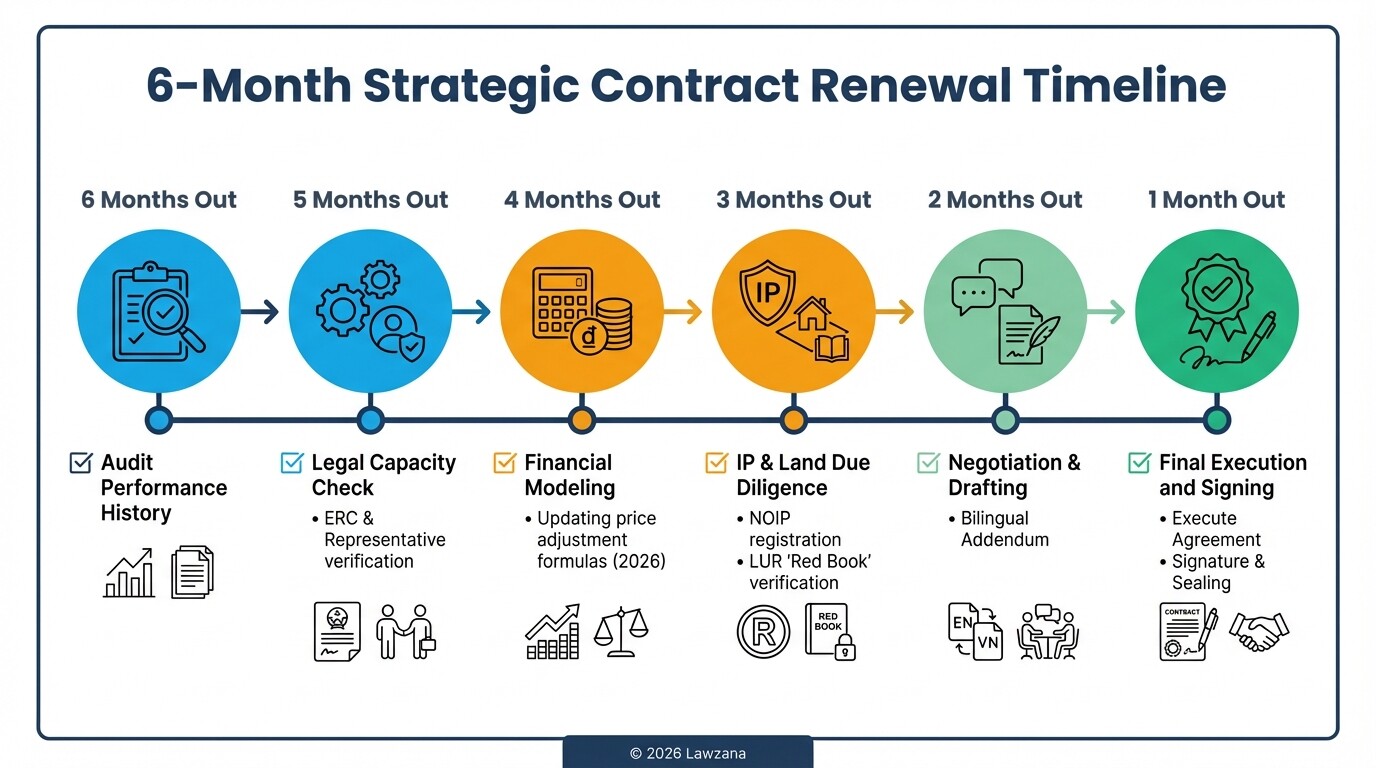
To ensure a smooth transition and mitigate risks when renewing long-term manufacturing or supply agreements, use the following checklist. This process should begin at least six months before the current contract expiration date.
| Step | Action Item | Legal Reference |
|---|---|---|
| 1 | Audit Performance History | Review the counterparty's compliance with quality standards and delivery timelines. |
| 2 | Verify Legal Representative | Confirm the person signing has the authority per the Enterprise Registration Certificate (ERC). |
| 3 | Update Price Indexes | Replace static pricing with formulas linked to the 2026 inflation forecasts. |
| 4 | Renew IP Licenses | Ensure all trademark and patent authorizations are extended in line with the contract term. |
| 5 | Review Land-Use Rights | If the factory is leased, verify the sub-lessor's land-use rights are valid for the new term. |
| 6 | Execute Formal Amendment | Sign a "Contract Renewal Agreement" or an "Addendum" in both English and Vietnamese. |
Sample Contract Renewal Clause
"This Agreement shall expire on [Date]. The Parties may renew this Agreement for an additional term of [Number] years by providing written notice of intent to renew at least ninety (90) days prior to the expiration date. All terms and conditions shall remain in effect unless modified in writing and signed by the authorized representatives of both Parties."
Selecting the Right Forum: VIAC Arbitration vs. Local Courts
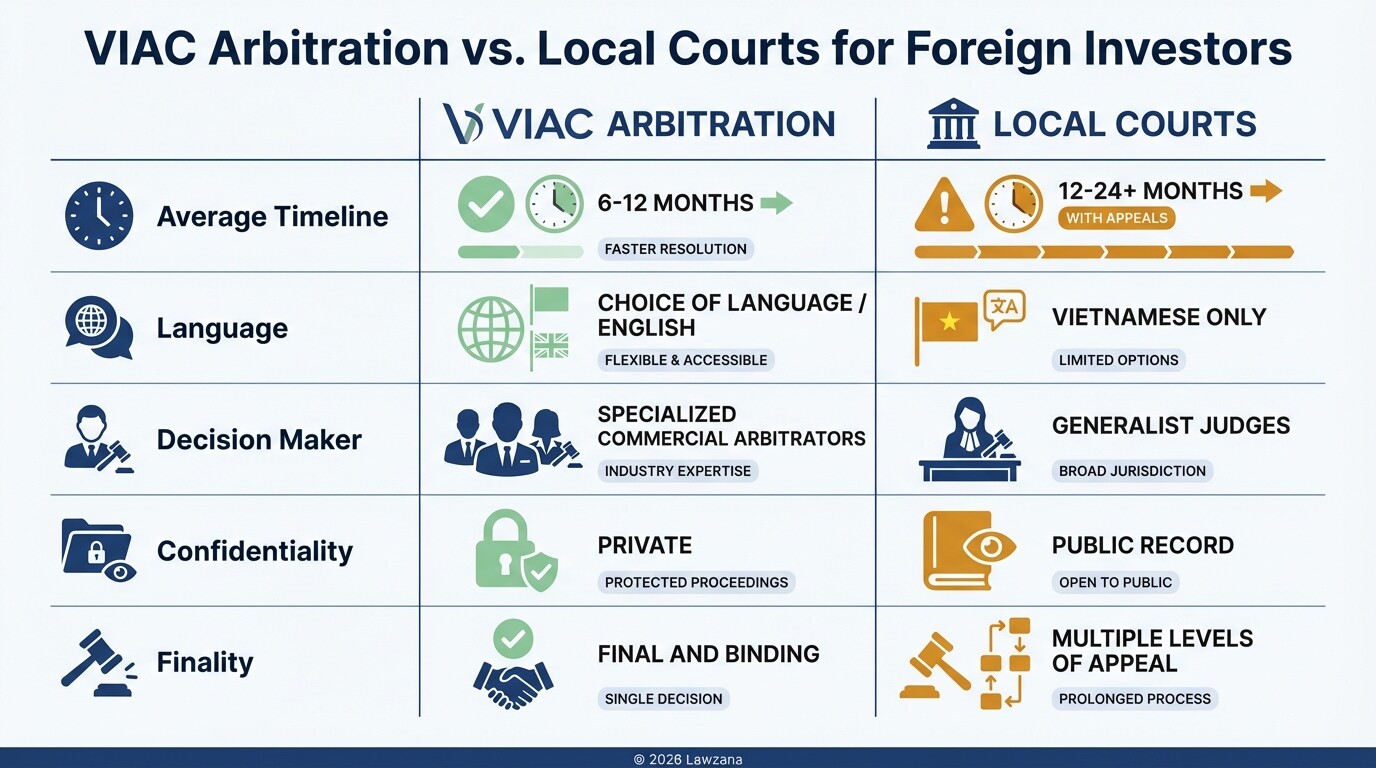
Choosing the correct dispute resolution forum determines how quickly and fairly a commercial conflict is resolved. In Vietnam, foreign entities typically choose between the Vietnam International Arbitration Centre (VIAC) and the local People's Courts.
For B2B manufacturing and supply contracts, VIAC arbitration is the gold standard. It offers a faster timeline (often 6 to 12 months) compared to the court system, which can involve lengthy appeals and a lack of specialized commercial knowledge. Furthermore, VIAC awards are final and binding, whereas court judgments are subject to multiple levels of review.
Local Courts are generally more cost-effective for small-scale debt collection but present challenges for foreign investors. Proceedings are conducted exclusively in Vietnamese, and judges may lack experience with complex international commercial concepts like "consequential damages" or "liquidated damages" as understood in Western jurisdictions.
Enforceability of 2026 Price Adjustment Clauses
Price adjustment clauses allow parties to modify contract values based on shifts in the economic environment, such as inflation or raw material cost spikes. Under the Civil Code 2015, Article 420 regarding "performance of contracts upon fundamental change of circumstances" provides a legal basis for renegotiation, but it is notoriously difficult to trigger in practice.
To ensure enforceability for the 2026-2030 period, your renewal should include an automatic price adjustment formula rather than a "right to renegotiate." The formula should reference a verifiable data source, such as the General Statistics Office of Vietnam.
Recommended Price Adjustment Elements:
- Base Date: The specific date the initial price was set.
- Trigger Point: A percentage change in the Consumer Price Index (e.g., +/- 3%) that activates the adjustment.
- Weighting: Different weights for labor, raw materials, and energy costs.
Protecting Intellectual Property in OEM Manufacturing Contracts
Intellectual Property (IP) theft remains a significant concern for foreign brands renewing Original Equipment Manufacturer (OEM) agreements in Vietnam. Without specific "Work-for-Hire" or "Assignment of Rights" language, a local manufacturer might claim ownership of any process improvements or design tweaks made during the production cycle.
Under the Law on Intellectual Property, registration is territorial. Even if you have registered your trademark in the US or EU, it is not protected in Vietnam unless you have filed with the National Office of Intellectual Property (NOIP). Your renewal contract should explicitly state that the foreign investor retains ownership of all "Background IP" and "Foreground IP" (new developments created during the contract).
Termination for Convenience vs. Termination for Cause
Vietnamese law distinguishes between "unilateral termination" (without a breach) and "rescission" (due to a breach). Many foreign investors mistakenly assume they can terminate a contract at any time if they provide notice, but without a specific "Termination for Convenience" clause, this can be treated as a breach of contract.
- Termination for Cause: Triggered by specific events such as bankruptcy, non-payment, or repeated quality failures. This usually requires a "cure period" where the defaulting party is given 15 to 30 days to fix the issue.
- Termination for Convenience: Allows a party to exit the contract for strategic reasons. For this to be enforceable in Vietnam, the contract must clearly state the notice period (typically 60 to 180 days) and may include a "termination fee" to compensate the manufacturer for lost production capacity.
Land-Use Right Complexities in Factory Lease Renewals
In Vietnam, land is technically owned by the state, and users hold "Land-Use Rights" (LUR). Foreign-invested enterprises (FIEs) often lease land or factories within Industrial Zones (IZs). When renewing a commercial contract that involves a physical facility, you must verify the underlying LUR of the landlord.
The 2024 Land Law (effective 2025) introduces new nuances regarding how land rent is paid-either via an annual payment or a one-time lump sum. If your landlord pays annually, they have fewer rights to sublease or mortgage the property, which could jeopardize your factory's stability. Always request the "Red Book" (Land Use Right Certificate) and verify that the remaining term of the landlord's lease exceeds your proposed contract renewal term.
Common Misconceptions
"A handshake or email is enough to renew a contract."
While Vietnamese law recognizes some verbal agreements, commercial contracts involving foreign elements or significant value must be in writing. An email thread may be used as evidence of intent, but a formal signed addendum is required to avoid disputes over terms and conditions.
"Foreign law can always govern a contract signed in Vietnam."
While parties can choose foreign law (like Singaporean or English law) for international contracts, if the contract is entirely performed in Vietnam and involves land or local assets, Vietnamese mandatory rules (jus cogens) will often override the chosen foreign law.
FAQ
Is it better to sign an addendum or a brand-new contract?
An addendum is faster and preserves the history of the relationship, which is useful for regulatory compliance. However, if the changes are extensive (e.g., changing the payment structure, IP terms, and the forum selection), a brand-new "Amended and Restated Agreement" is cleaner and reduces the risk of conflicting terms.
How much does it cost to resolve a dispute at VIAC?
VIAC fees are based on the value of the dispute. For a claim of 2.3 billion VND (approx. $100,000 USD), the arbitration fee is roughly 150 million to 200 million VND. This excludes lawyer fees and expert witness costs.
Can I terminate a contract if my supplier raises prices?
Only if your contract includes a specific termination right related to price escalations. Without such a clause, a price hike is considered a request for negotiation, and you are generally expected to continue performing under the original terms unless both parties agree to the change.
What is the legal interest rate for late payments in Vietnam?
Under the Commercial Law 2005, the maximum interest rate for late payments is the average overdue debt interest rate on the market, unless otherwise agreed. However, the Civil Code limits interest to 20% per year. It is best to specify a rate (e.g., 1% per month) in the contract to avoid ambiguity.
When to Hire a Lawyer
Navigating the Vietnamese legal landscape requires local expertise, especially as regulations regarding land and IP are currently in transition. You should consult a lawyer if:
- You are transitioning from a local court jurisdiction to VIAC arbitration.
- Your manufacturer is requesting to use your designs for "other clients" (white-labeling).
- You are renewing a lease for a factory located in an Industrial Zone with complex land-use history.
- The contract value exceeds 5 billion VND (approx. $200,000 USD).
Next Steps
- Review Expiry Dates: Audit your current contract portfolio to identify agreements expiring in 2026.
- Conduct Due Diligence: Use the National Business Registration Portal to verify that your partner's legal status is still "Active."
- Draft the Amendment: Prepare a draft including the 2026 price adjustment formulas and updated IP protections.
- Negotiate Early: Begin the conversation with your partner early to avoid the pressure of an expiring agreement, which often leads to unfavorable terms.