- Greek courts generally have jurisdiction if Greece is the "habitual residence" of both spouses, regardless of their nationality.
- Consensual divorce is the fastest route, finalized before a notary public in as little as 10 to 12 days once an agreement is reached.
- Since 2021, joint custody is the legal default in Greece, ensuring both parents remain active in the child's upbringing.
- Property acquired during the marriage is not automatically split 50/50; instead, a spouse may claim a share of the increase in the other's wealth.
- Greek divorce decrees are widely recognized in the EU, USA, and UK, though specific administrative steps like apostilles are required for non-EU countries.
Does Greece Have Jurisdiction Over Your Divorce?
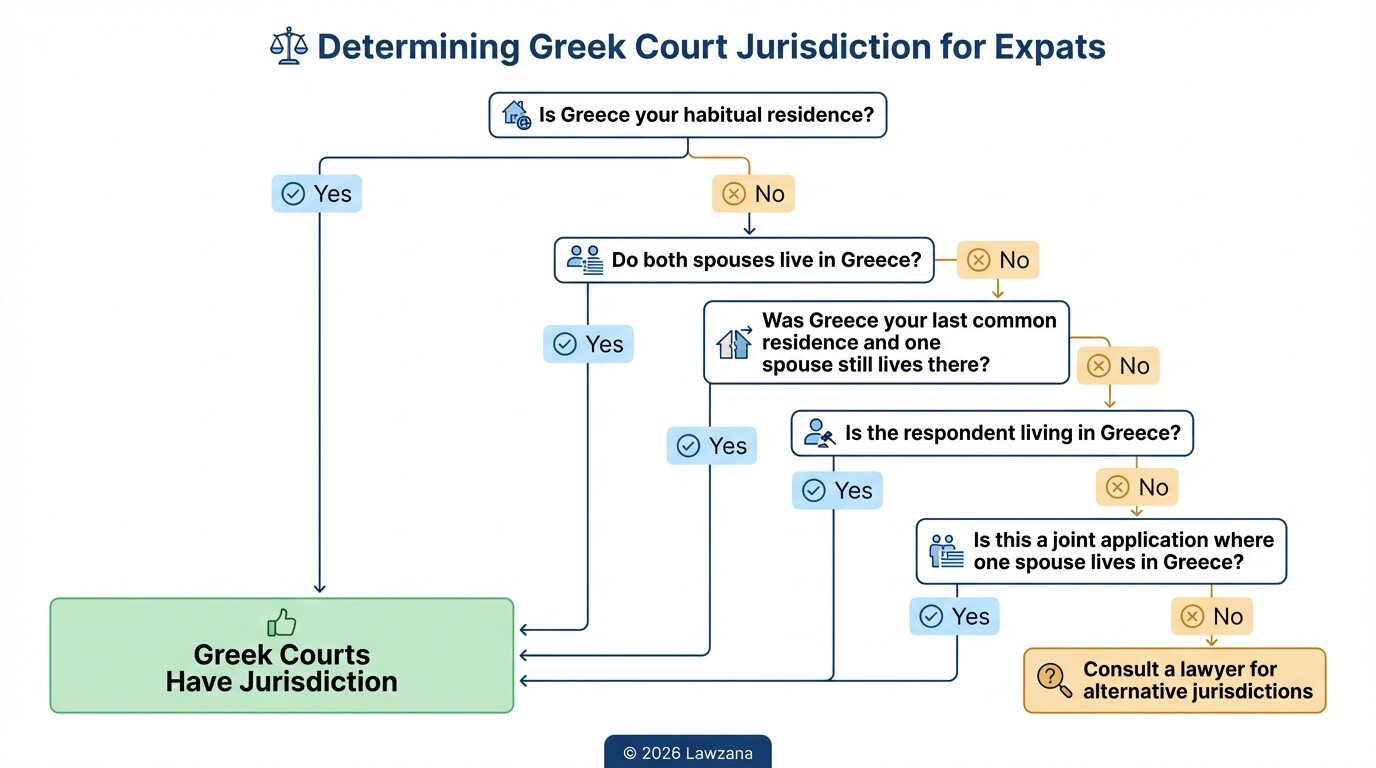
Greek courts have the authority to handle a divorce if the couple's last common habitual residence was in Greece or if the defendant resides there. For expats, this means you do not need to be a Greek citizen to file for divorce in the country, provided you have established your life and primary home on Greek soil.
Under EU Regulation 2019/1111, jurisdiction is primarily determined by:
- The habitual residence of both spouses.
- The last habitual residence of the spouses, if one of them still resides there.
- The habitual residence of the respondent.
- In the case of a joint application, the habitual residence of either spouse.
If you are a non-EU citizen, Greek domestic law (Code of Civil Procedure) applies similar standards. If both parties are living in Greece, the local courts are almost always competent to hear the case.
The 2021 Reform: Joint Custody as the Default Standard
Under Law 4800/2021, Greece shifted its legal framework to make joint parental responsibility the mandatory starting point following a divorce. This reform aims to protect the child's right to be raised by both parents, moving away from the old system where sole custody was typically granted to the mother.
Key features of the joint custody law include:
- Equal Responsibility: Both parents must decide together on major issues such as education, health, and religious upbringing.
- Communication Time: The law establishes a rebuttable presumption that the child should spend at least one-third of their time with the parent they do not reside with.
- Child's Best Interest: Courts use this as the primary metric when a dispute arises, often involving social workers or child psychologists.
- Mediation: Parents are now encouraged (and sometimes required) to attend an initial mediation session to attempt to resolve custody disputes outside of court.
How the Consensual Divorce Procedure Works
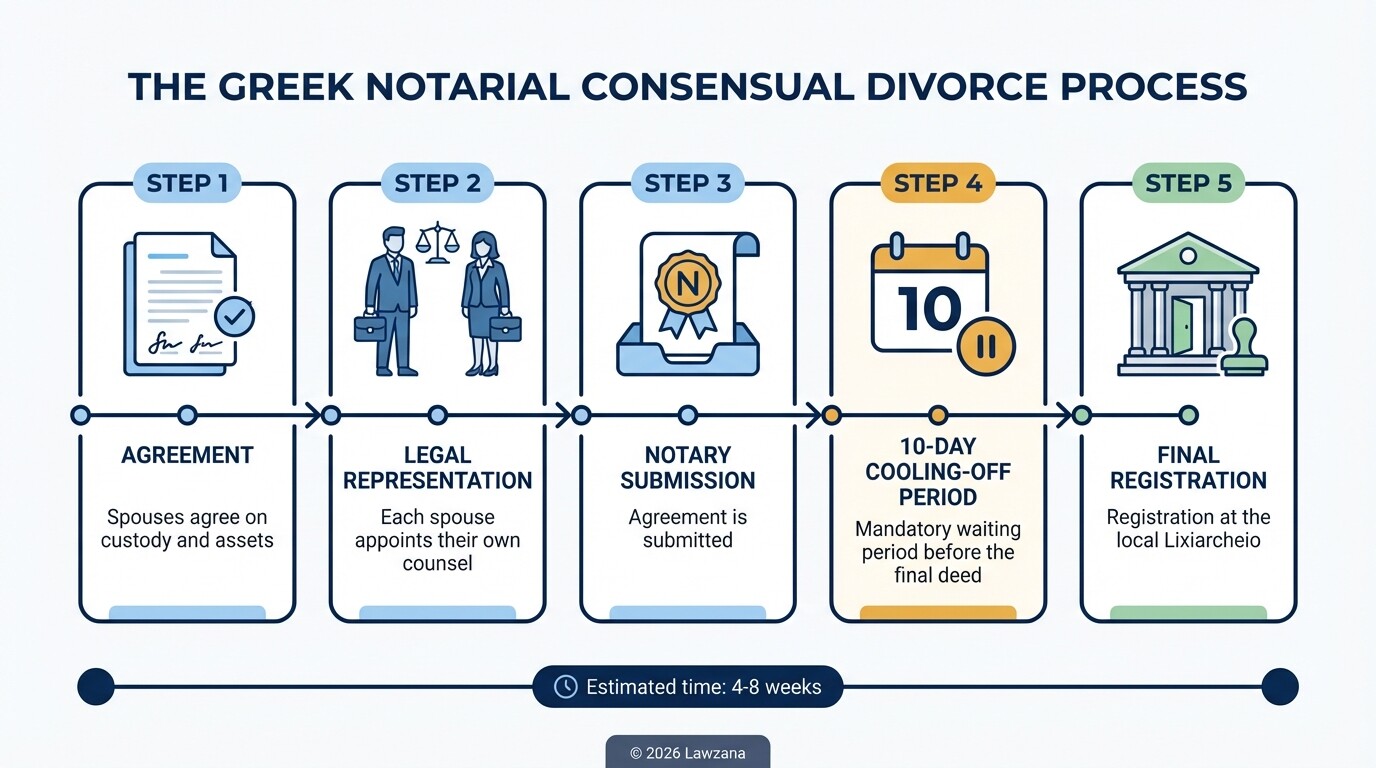
A consensual divorce in Greece is an administrative process performed before a notary public rather than a judge. This "notarial divorce" is available to couples who agree on all aspects of their separation, including the division of assets and child arrangements.
The process follows these steps:
- The Agreement: Spouses draft and sign a written agreement covering the dissolution of marriage and, if applicable, child custody, communication, and alimony.
- Legal Representation: Each spouse must be represented by their own lawyer, who signs the agreement alongside them.
- The Notary Appointment: The agreement is submitted to a notary public.
- The 10-Day Waiting Period: At least 10 days must pass from the signing of the initial agreement before the final notarial deed can be executed.
- Final Registration: The notary deed is filed at the local Registry (Lixiarcheio) where the marriage was originally recorded or registered.
This method is highly preferred for expats because it avoids the emotional and financial drain of a public court battle.
Division of Marital Property and Assets
Greece follows a "separation of assets" regime, meaning that getting married does not automatically merge your property with your spouse's. However, Law 1329/1983 provides a mechanism for a spouse to claim a share of the wealth accumulated by the other during the marriage.
When a marriage ends, a spouse who contributed to the increase of the other's property is entitled to claim the part of the increase that resulted from their contribution.
- The 1/3 Presumption: The law presumes that your contribution to the other spouse's wealth increase is one-third (1/3), unless proven otherwise.
- Proving Contribution: This contribution can be financial (direct investment) or non-financial (managing the household or raising children, which allowed the other spouse to earn).
- Time Limits: A claim for the distribution of assets must be filed within two years after the divorce becomes final.
| Asset Type | General Treatment in Greece |
|---|---|
| Pre-marital Property | Remains the sole property of the original owner. |
| Inheritances & Gifts | Generally excluded from the "increase of wealth" calculation. |
| Real Estate in Greece | Subject to the "participation in acquisitions" claim if value increased. |
| Joint Bank Accounts | Typically split 50/50 unless a different ownership structure is proven. |
Recognition of Greek Divorce Decrees Abroad
A Greek divorce decree is generally valid worldwide, but the method of recognition varies depending on the destination country. Because Greece is an EU member, the process within Europe is streamlined, while recognition in the USA or UK requires more formal documentation.
Recognition in the EU
Under the Brussels IIb Regulation, a divorce granted in Greece is recognized in other EU member states without any special procedure. You simply request a standard certificate from the Greek authority that issued the divorce.
Recognition in the USA and UK
For the United States and the United Kingdom, recognition is based on "comity" or specific domestic laws.
- The UK: Following Brexit, the UK recognizes Greek divorces if they were effective in Greece and at least one spouse was habitually resident or a national of Greece at the time.
- The USA: US states generally recognize foreign divorces as long as both parties received notice and had the opportunity to be heard.
- Apostille: You must obtain an "Apostille" stamp (under the Hague Convention) on your Greek divorce certificate to make it a legal document in the US or UK.
Common Misconceptions About Greek Divorce
Myth 1: You must stay in Greece for the entire process. While your lawyers need to be present, expats can often manage a consensual divorce via a Power of Attorney (PoA) signed at a Greek Consulate in their home country. You do not always need to fly back to Athens or Thessaloniki to sign the final papers.
Myth 2: The mother always gets full custody. This was common practice in the past, but the 2021 reform has changed the landscape. Courts now start with the assumption of joint custody. Fathers have significantly stronger legal standing to demand equal participation in their children's lives than they did five years ago.
Myth 3: You can't divorce in Greece if you were married in another country. As long as you are habitually resident in Greece, the courts can dissolve your marriage regardless of where the wedding ceremony took place. You will simply need a legalized and translated copy of your foreign marriage certificate.
Frequently Asked Questions
How much does a divorce cost in Greece?
For a consensual divorce, costs typically range from €1,500 to €3,000, covering notary fees and legal fees for both spouses. Contested divorces are significantly more expensive, often exceeding €5,000 per spouse depending on the complexity of property and custody disputes.
How long does the divorce process take?
A consensual divorce is usually finalized within 4 to 8 weeks. A contested divorce, however, can take anywhere from 18 months to several years if there are multiple appeals regarding assets or child custody.
Can I claim alimony from my ex-spouse in Greece?
Yes, alimony (spousal support) may be awarded if one spouse cannot support themselves from their own income or property. This is common if one spouse stayed home to raise children, but it is typically granted for a specific duration rather than for life.
What happens if we cannot agree on who stays in the family home?
If you cannot agree, a judge can grant "temporary use" of the family home to one spouse based on who has a greater need (usually the parent with primary physical care of the children), regardless of whose name is on the lease or title deed.
When to Hire a Lawyer
Navigating a divorce as an expat requires more than just domestic legal knowledge; it requires an understanding of international private law. You should hire a lawyer immediately if:
- There are children involved and you cannot agree on a relocation plan.
- You or your spouse own significant assets in multiple countries.
- There is a risk that your spouse will move assets or leave the country with children.
- You were served with divorce papers from a Greek court and have a strict deadline to respond.
Next Steps
- Gather Documents: Secure your marriage certificate, children's birth certificates, and documentation of all assets acquired during the marriage.
- Consult an Expert: Speak with a lawyer specializing in Greek family law and cross-border disputes to verify if Greece is the most advantageous jurisdiction for your case.
- Attempt Mediation: Before filing for a contested divorce, consider a formal mediation session to see if a consensual notarial divorce is possible.
- Update Your Residency: Ensure your Greek residence permit or registration is current, as this serves as vital evidence of your "habitual residence."