Greece Golden Visa Property Purchases: Dispute Prevention Guide
- The Greek Golden Visa investment thresholds recently increased, requiring an €800,000 minimum in premium areas like Athens and Thessaloniki, and €400,000 in the rest of the country.
- Thorough due diligence on the Hellenic Cadastre (Ktimatologio) is mandatory, as Greece finalizes its national land registry integration by 2026.
- Purchasing property directly as an individual is the most straightforward path for a Golden Visa, though 100% self-owned corporate entities are permitted under specific conditions.
- Expect to pay an additional 7% to 10% of the property purchase price in transfer taxes, notary fees, and legal due diligence costs.
- Serving a formal extrajudicial notice (exodiko) is the critical first step to resolving developer disputes before entering costly litigation.
Navigating the Updated Regulatory Investment Thresholds
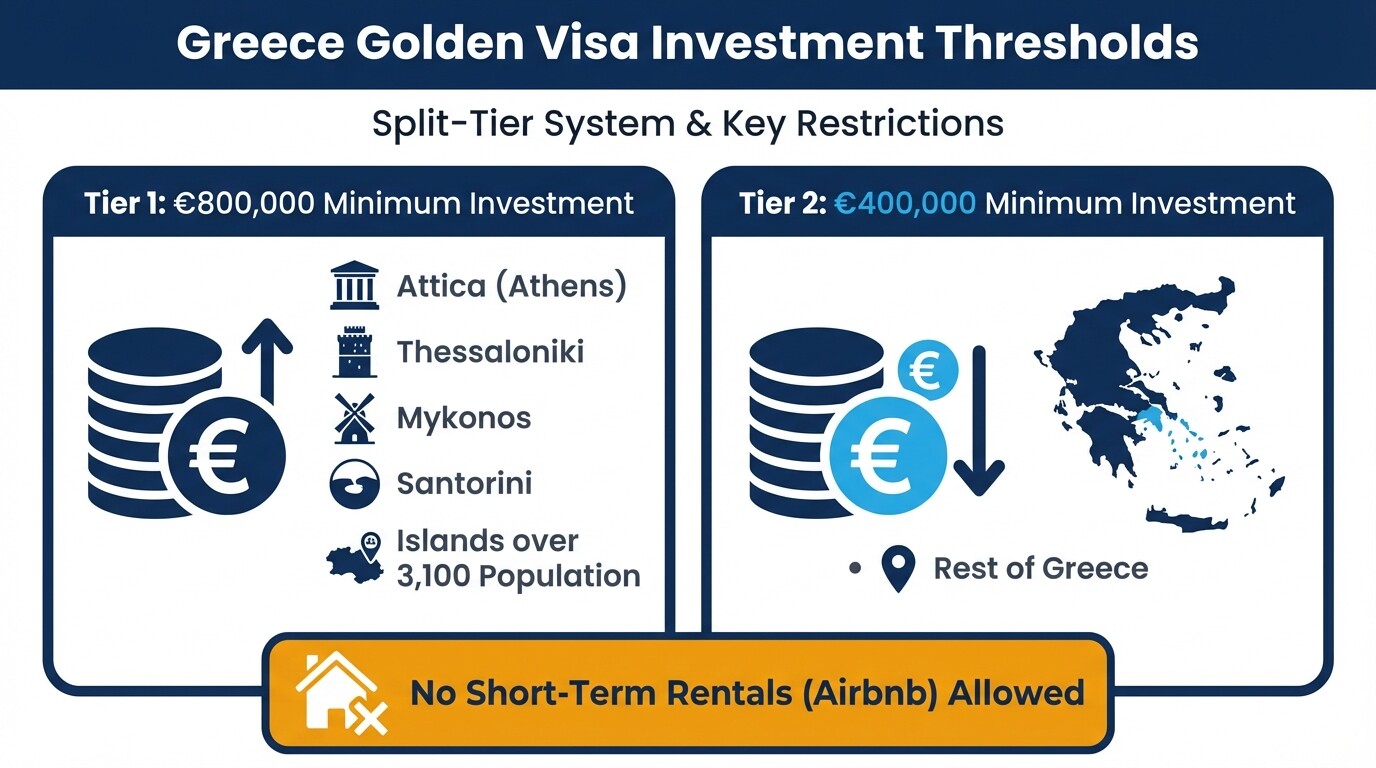
Greece's Golden Visa program features a two-tiered investment system based on geographic location and property demand. You must meet specific financial minimums to qualify for residency, and recent regulatory updates have strictly limited how these properties can be used.
Under the latest rules, the minimum property investment in Tier 1 locations-which include the entire Attica region (Athens), Thessaloniki, Mykonos, Santorini, and islands with a population over 3,100-is €800,000. For the rest of Greece, the minimum investment is €400,000. Additionally, properties purchased under these new thresholds cannot be rented out as short-term tourist accommodations (such as Airbnb). You can verify the most current application procedures directly through the Hellenic Ministry of Migration and Asylum.
Property Dispute Prevention Checklist
Preventing real estate disputes in Greece requires proactive contract management before any funds change hands. Using a standardized checklist ensures you do not overlook hidden liabilities that could jeopardize both your investment and your visa application.
- Conduct a strict title search: Verify continuous, undisputed ownership for at least the past 20 years at the local land registry or cadastre.
- Demand an Engineer's Certificate: Ensure a licensed civil engineer provides a certificate stating the property has no illegal extensions (afthaireta) or that any past zoning violations have been legally regularized and fined paid.
- Use an escrow arrangement for deposits: Never transfer initial reservation fees directly to a seller's personal account. Use a dedicated escrow account managed by your legal representative or notary.
- Include a Golden Visa contingency clause: Draft a contract provision that allows for the refund of your deposit if your initial Golden Visa eligibility check fails due to unforeseen regulatory shifts.
- Define explicit delivery penalties: For off-plan properties, write specific daily or weekly financial penalty clauses for construction delays.
Comparing Direct Ownership vs. Corporate Entity Purchases
Buying property directly in your own name is the most common approach for Golden Visa applicants, while corporate purchases offer distinct liability barriers but stricter visa requirements. The right choice depends on your long-term tax strategy and whether you intend to generate rental income.
If you purchase through a foreign or domestic corporate entity, Greek law dictates you must own 100% of the company's shares to qualify for the Golden Visa.
| Feature | Direct Personal Ownership | Corporate Entity Ownership (100% shares) | | : | : | : | | Visa Eligibility | Straightforward; standard processing. | Complex; requires extensive corporate documentation. | | Rental Income Tax | Progressive scale: 15% to 45% based on income volume. | Flat corporate tax rate (currently 22%), plus potential dividend taxes. | | Legal Protection | Personal liability for property-related claims. | Corporate veil protects personal assets from property liabilities. | | Setup & Maintenance | Minimal; requires only a Greek Tax Number (AFM). | High; requires corporate accounting, annual filings, and legal upkeep. |
Common Legal Mistakes in Greek Property Purchases
International buyers frequently encounter disputes by neglecting local zoning laws and underestimating the complexity of Greece's property registration transition. Failing to verify building legality and registry status can completely stall a property transfer.
The most critical mistake leading into 2026 is ignoring the Ktimatologio (Hellenic Cadastre) transition. Greece is aggressively moving from a localized system of mortgage registries to a centralized digital land registry. Buyers who rely on outdated local records may purchase land with overlapping boundaries or unrecorded state claims. Furthermore, buying a property with unregularized illegal extensions-like enclosed balconies or converted basements-means the notary cannot legally transfer the deed, leaving your capital trapped.
Estimated Costs for Golden Visa Property Transactions
Closing costs and application fees in Greece are substantial and must be factored into your total investment capital. Buyers should budget an additional 7% to 10% above the property's purchase price to cover all mandatory transaction fees.
- Property Transfer Tax (FMA): 3.09% of the property's objective value or the purchase price, whichever is higher.
- Notary Fees: Typically 1% to 1.5% of the property value, plus 24% VAT. The notary drafts the official deed and calculates state taxes.
- Land Registry Fees: Approximately 0.5% to 0.7% of the property value to register the new deed in the buyer's name.
- Legal Due Diligence: Lawyers generally charge 1% to 2% of the transaction value to review titles, draft contracts, and oversee the transfer.
- Golden Visa Application Fees: The state fee is €2,000 for the main applicant, plus €150 for each dependent family member, alongside a €16 fee for printing the biometric residence card.
Pre-Litigation Steps to Resolve Breach of Contract
If a Greek property developer or seller fails to meet their contractual obligations, taking immediate formal action outside of court is the fastest way to force compliance. Greek courts suffer from extensive backlogs, making out-of-court settlements highly preferable.
- Serve an Extrajudicial Notice (Exodiko): Your lawyer will draft a formal legal warning demanding compliance (e.g., finishing construction, returning a deposit). This must be officially served to the breaching party by a court bailiff to establish a legal timeline and proof of receipt.
- Initiate Formal Mediation: Before pursuing a full civil lawsuit, Greek law strongly encourages, and sometimes mandates, mediation. An independent, state-certified mediator will attempt to negotiate a binding settlement between you and the seller.
- Execute Penalty Clauses: If the preliminary agreement (symphonitiko) includes specific penalty clauses for breaches-such as a developer paying double the deposit back if they cancel the sale-your lawyer will demand these funds during mediation based on the evidence collected.
Common Misconceptions About Greek Real Estate
Many foreign investors mistakenly believe that the notary public acts as their personal legal advocate. In Greece, the notary is a neutral state official responsible for ensuring the transaction complies with tax laws and public policy, not for protecting the buyer from bad investments or hidden structural defects.
Another frequent myth is that any property purchase grants immediate residency rights. Merely signing a preliminary contract or paying a deposit does not secure a Golden Visa. You must execute the final public deed, pay the full purchase price in a traceable manner as defined by the state, and submit your formal application before any residency rights take effect.
Frequently Asked Questions
Can I buy multiple properties to reach the Golden Visa threshold?
Under the new rules, the investment must be made in a single property with a minimum surface area of 120 square meters to qualify for the Golden Visa. You can no longer bundle several cheap properties to reach the €400,000 or €800,000 minimums.
Are off-plan property purchases safe for the Golden Visa?
Off-plan purchases are eligible for the Golden Visa, but they carry higher dispute risks. To protect yourself, ensure the contract ties payment installments strictly to verifiable construction milestones rather than calendar dates.
Can I pay the property purchase price in cash?
No. To qualify for the Golden Visa, the entire purchase amount must be paid via a crossed bank cheque or a direct bank transfer from the buyer's account to the seller's account. Cash transactions explicitly invalidate the visa application.
When to Hire a Contract Lawyer in Greece & Next Steps
Navigating Greek property law requires localized expertise, especially when coordinating significant investments for immigration purposes. You should hire a lawyer before signing any reservation agreement or paying a deposit, as early intervention prevents you from committing to a property with unresolved title issues or zoning violations.
To take the next step, gather your financial documentation and identify your target investment region. Then, connect with vetted contract lawyers in Greece who specialize in Golden Visa transactions to begin your due diligence process securely.