- Filing a commercial claim in Hong Kong requires navigating a common law system, with most high-value disputes handled in the Court of First Instance.
- The standard litigation timeline ranges from 12 to 24 months, with costs strictly adhering to a "loser pays" principle.
- Foreign firms can secure assets before a trial begins by applying for a Mareva injunction to freeze a defendant's bank accounts.
- The Hong Kong International Arbitration Centre provides a globally recognized, confidential alternative to public court proceedings.
- Hong Kong judgments are highly enforceable worldwide, particularly in Mainland China due to reciprocal enforcement arrangements.
How the Legal Process Works for Breach of Contract Claims
Filing a breach of contract lawsuit in Hong Kong requires issuing a Writ of Summons and a Statement of Claim in either the District Court or the Court of First Instance. The plaintiff must then serve these legal documents to the defendant, who generally has 14 days to formally acknowledge the service.
The specific court you file in depends entirely on the financial value of your claim. The District Court handles claims up to HKD 3 million. Claims exceeding this amount, or those seeking complex equitable remedies, must be filed in the Court of First Instance at the High Court.
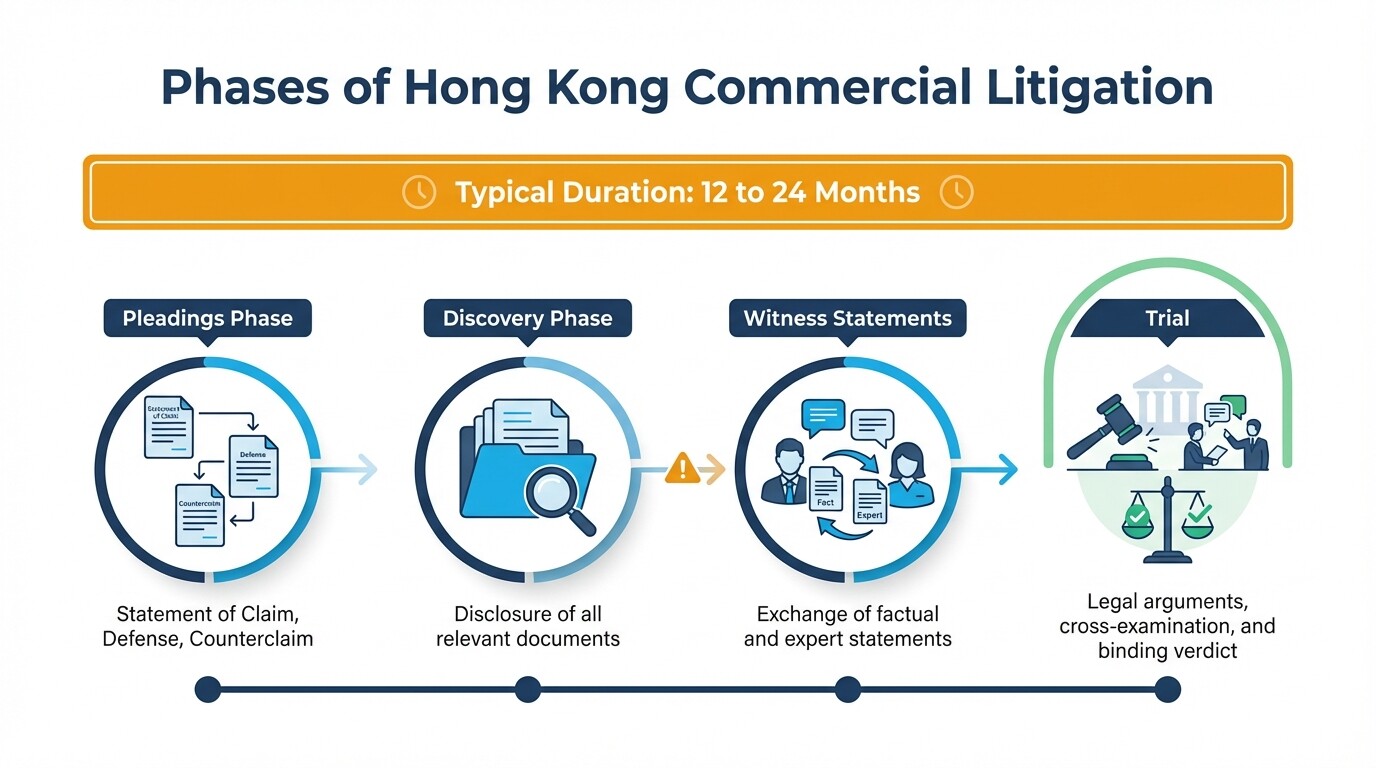
The standard procedure follows these distinct phases:
- Pleadings Phase: The plaintiff files the Statement of Claim. The defendant responds with a Defense, and potentially a Counterclaim. The plaintiff may then file a Reply.
- Discovery Phase: Both parties must disclose all documents relevant to the dispute, even those that harm their own case.
- Witness Statements: Parties exchange written statements from witnesses of fact and expert witnesses.
- Trial: Legal representatives present arguments, cross-examine witnesses, and the judge delivers a binding verdict.
For detailed procedural rules regarding civil actions, foreign entities can consult the official guidelines published by the Hong Kong Judiciary.
Litigation Costs and Timelines in Hong Kong
Commercial litigation in Hong Kong typically takes 12 to 24 months from filing to trial, with legal costs ranging from HKD 500,000 to over HKD 2 million depending on the complexity of the dispute. Hong Kong follows a strict "loser pays" principle, meaning the unsuccessful party usually covers 60 to 75 percent of the winning party's legal fees.
Because foreign plaintiffs are located outside the jurisdiction, Hong Kong courts frequently require them to pay "security for costs." This means your firm may need to deposit funds into the court to guarantee you can cover the defendant's legal fees if your lawsuit is unsuccessful.
| Litigation Stage | Estimated Timeline | Typical Cost Range (HKD) |
|---|---|---|
| Pre-action & Pleadings | 2 to 4 months | 100,000 to 300,000 |
| Discovery & Evidence | 4 to 8 months | 200,000 to 800,000 |
| Trial Preparation & Trial | 6 to 12 months | 300,000 to 1,000,000+ |
Alternatives to Litigation: Utilizing the HKIAC
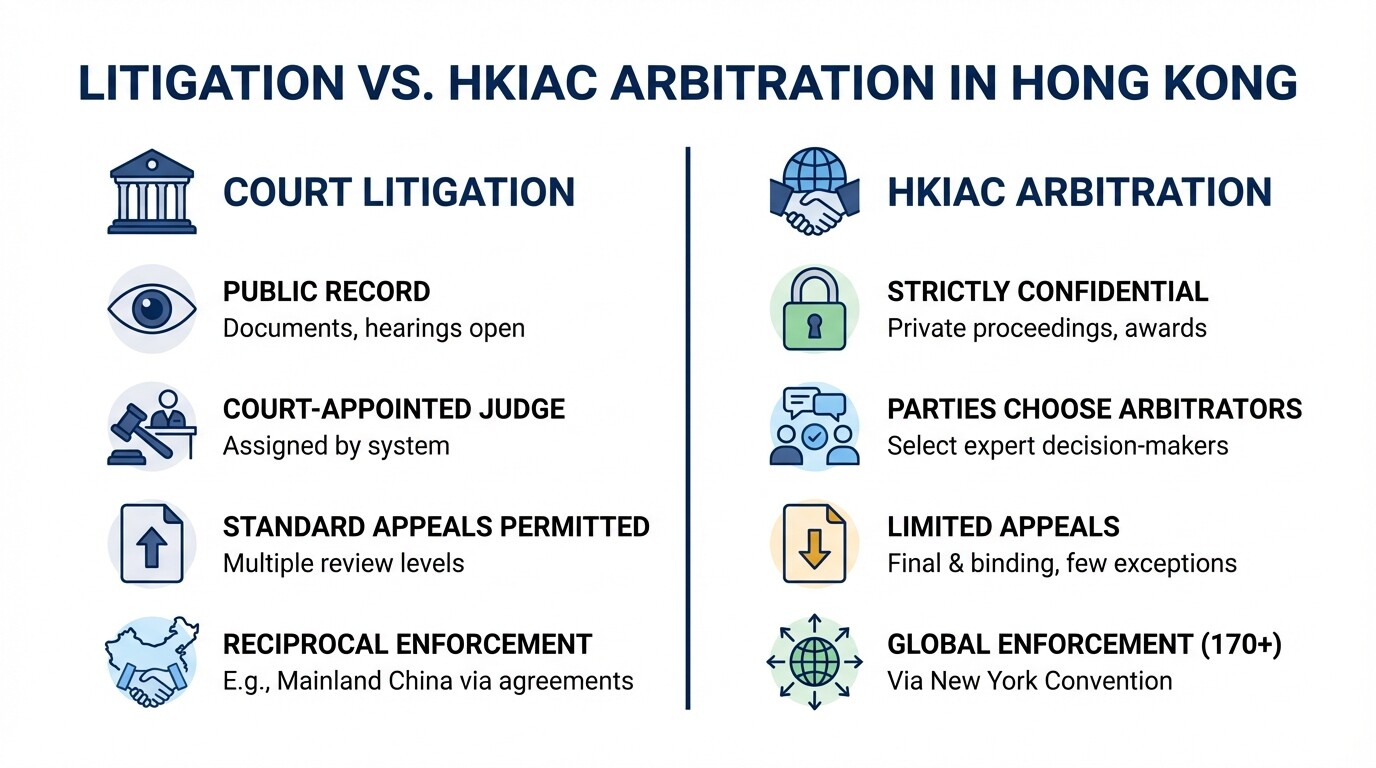
Foreign firms often use the Hong Kong International Arbitration Centre to resolve disputes as a faster, private alternative to court litigation. Arbitration awards from the HKIAC are enforceable in over 170 countries under the New York Convention, making it highly effective for cross-border commercial agreements.
Arbitration allows parties to choose their arbitrators, ensuring the decision-maker possesses specific industry expertise. Furthermore, HKIAC proceedings are strictly confidential, protecting trade secrets and preventing public relations damage. To utilize this avenue, foreign firms must include a valid arbitration clause in their commercial contracts before a dispute arises.
Standard HKIAC Arbitration Clause If you are drafting a contract with a Hong Kong entity, you can use the official model clause provided by the Hong Kong International Arbitration Centre to ensure jurisdiction:
"Any dispute, controversy, difference or claim arising out of or relating to this contract, including the existence, validity, interpretation, performance, breach or termination thereof or any dispute regarding non-contractual obligations arising out of or relating to it shall be referred to and finally resolved by arbitration administered by the Hong Kong International Arbitration Centre under the HKIAC Administered Arbitration Rules in force when the Notice of Arbitration is submitted. The law of this arbitration clause shall be Hong Kong law. The seat of arbitration shall be Hong Kong. The number of arbitrators shall be [one or three]. The arbitration proceedings shall be conducted in [English]."
Enforcing Hong Kong Judgments Across Borders
Hong Kong judgments can be enforced internationally through statutory reciprocal agreements or through common law principles in foreign courts. The most significant advantage of litigating in Hong Kong is its unique mutual recognition arrangement with Mainland China, which allows seamless enforcement of judgments across the border.
Under the Mainland Judgments in Civil and Commercial Matters (Reciprocal Enforcement) Ordinance, a judgment secured in Hong Kong can be directly registered and enforced against a defendant's assets in Mainland China. This is a critical mechanism for foreign firms dealing with Chinese manufacturers or partners who use Hong Kong as a corporate base.
For enforcement in countries without a reciprocal treaty, such as the United States, a Hong Kong judgment is typically enforced by initiating a fresh lawsuit in the foreign jurisdiction. The foreign court will usually grant a summary judgment based on the Hong Kong decision, provided the original judgment was final, conclusive, and for a definite sum of money.
Common Misconceptions About Hong Kong Litigation
Many foreign businesses misunderstand Hong Kong's legal system, falsely assuming it operates under Chinese civil law rather than common law. Addressing these myths prevents costly strategic errors during contract enforcement.
- Assuming Hong Kong courts favor local businesses: Hong Kong maintains a fiercely independent judiciary operating under English common law principles. Foreign plaintiffs face no systemic bias and frequently win judgments against local entities.
- Believing you must have a local office to sue: Foreign individuals and corporations can freely initiate legal proceedings in Hong Kong without maintaining a registered office, subsidiary, or physical presence in the territory.
- Thinking litigation is the only way to recover debt: Many straightforward breach of contract claims involving unpaid debts can be resolved through statutory demands and winding-up petitions, which are often faster and cheaper than a full trial.
Frequently Asked Questions
How can I prevent a defendant from moving assets out of Hong Kong before trial?
You can apply for a Mareva injunction, which is a powerful court order that freezes the defendant's assets, such as bank accounts and real estate, up to the value of your claim. This prevents the defendant from dissipating funds while the lawsuit is ongoing, ensuring there is actually money to recover when you win.
Do foreign plaintiffs need to pay a security deposit for court costs?
Yes, defendants in Hong Kong frequently apply for "security for costs" when the plaintiff is based overseas. If the court grants this application, the foreign firm must pay a specified sum into the court registry to proceed with the lawsuit.
Can I claim interest on the money owed in a breach of contract case?
Yes, the Hong Kong courts have the statutory power to award pre-judgment and post-judgment interest on debt and damages. The specific interest rate is determined by the court and is designed to compensate the plaintiff for the time they were deprived of their funds.
What happens if the defendant ignores the lawsuit entirely?
If the defendant fails to acknowledge service or fails to file a defense within the statutory time limits, the plaintiff can apply for a default judgment. This allows the foreign firm to win the case automatically without going through a full trial.
When to Hire a Commercial Litigation Lawyer
You should hire a commercial litigation lawyer the moment you anticipate a dispute, well before formally terminating a contract or issuing a threat of legal action. Early legal counsel allows you to secure asset-freezing injunctions, preserve critical evidence, and evaluate whether litigation or arbitration is your most cost-effective path.
Attempting to navigate Hong Kong court protocols without local representation often results in missed deadlines, flawed pleadings, and heavy cost penalties. If you are a foreign firm facing a breach of contract, consulting with experienced Hong Kong commercial litigation lawyers is essential for protecting your commercial interests and mapping out a viable recovery strategy.
Next Steps for Foreign Firms
Your immediate next step is to gather all executed contracts, email communications, invoices, and evidence of the financial loss caused by the breach. Organize these documents chronologically to provide a clear picture of the dispute.
From there, instruct a Hong Kong legal team to review the contract's dispute resolution clause. They will draft and serve a formal demand letter to the opposing party, which often prompts a settlement before formal court filings become necessary.