- New York law can be applied to international contracts exceeding $250,000 even if the parties and the transaction have no physical connection to the state.
- Under General Obligations Law § 5-1402, New York courts generally cannot dismiss a case for being an "inconvenient forum" if the contract is worth at least $1 million and includes a New York forum selection clause.
- Service of process on foreign defendants must strictly adhere to the Hague Service Convention to ensure a New York judgment is enforceable abroad.
- The New York Supreme Court's Commercial Division offers specialized judges and expedited procedures designed specifically for complex business disputes.
- International arbitration through the ICDR is often preferred over litigation for increased privacy and easier cross-border enforcement under the New York Convention.
Sample International Choice of Law and Forum Selection Clauses
New York courts strictly interpret contract language, so precision is vital when drafting clauses to ensure they are "exclusive" rather than "permissive." An exclusive clause mandates that disputes must be heard in New York, while a permissive clause merely allows it.
Standard Enforceable New York Choice of Law Clause
"This Agreement shall be governed by, and construed in accordance with, the laws of the State of New York, without regard to its conflict of laws principles. The parties agree that the provisions of New York General Obligations Law Section 5-1401 apply to this Agreement."
Exclusive Forum Selection Clause for New York Courts
"Any legal suit, action, or proceeding arising out of or related to this Agreement shall be instituted exclusively in the courts of the State of New York located in the County of New York or the United States District Court for the Southern District of New York. Each party irrevocably submits to the exclusive jurisdiction of such courts and waives any objection based on improper venue or forum non conveniens."
Combined Multi-Step Dispute Resolution Clause (Mediation to Arbitration)
"In the event of a dispute, the parties shall first attempt to resolve the matter through mediation administered by the International Centre for Dispute Resolution (ICDR) in accordance with its International Mediation Rules. If unresolved after 60 days, the dispute shall be finally settled by arbitration administered by the ICDR under its International Arbitration Rules by one or more arbitrators appointed in accordance with said Rules. The seat of arbitration shall be New York, New York, and the language of the arbitration shall be English."
Requirements for General Obligations Law Section 5-1401 for Large Contracts
New York General Obligations Law (GOL) Section 5-1401 allows parties to a contract to choose New York law to govern their agreement regardless of whether the transaction has a reasonable relation to the state. This statute is a cornerstone of global finance, providing a predictable legal framework for multinational entities.
For GOL § 5-1401 to apply, the contract must meet the following criteria:
- Minimum Value: The transaction must involve a consideration of at least $250,000 in the aggregate.
- Exclusions: This provision does not apply to contracts for personal, family, or household services, nor does it typically apply to certain labor or employment contracts.
- Explicit Choice: The parties must clearly state in the contract that New York law governs the agreement.
By meeting these requirements, international parties can avoid the "conflict of laws" analysis that often leads to unpredictable results in other jurisdictions. This means a Japanese company and a German company can trade in South America and still rely on the stability of New York commercial law.
How New York Courts Handle Inconvenient Forum Motions
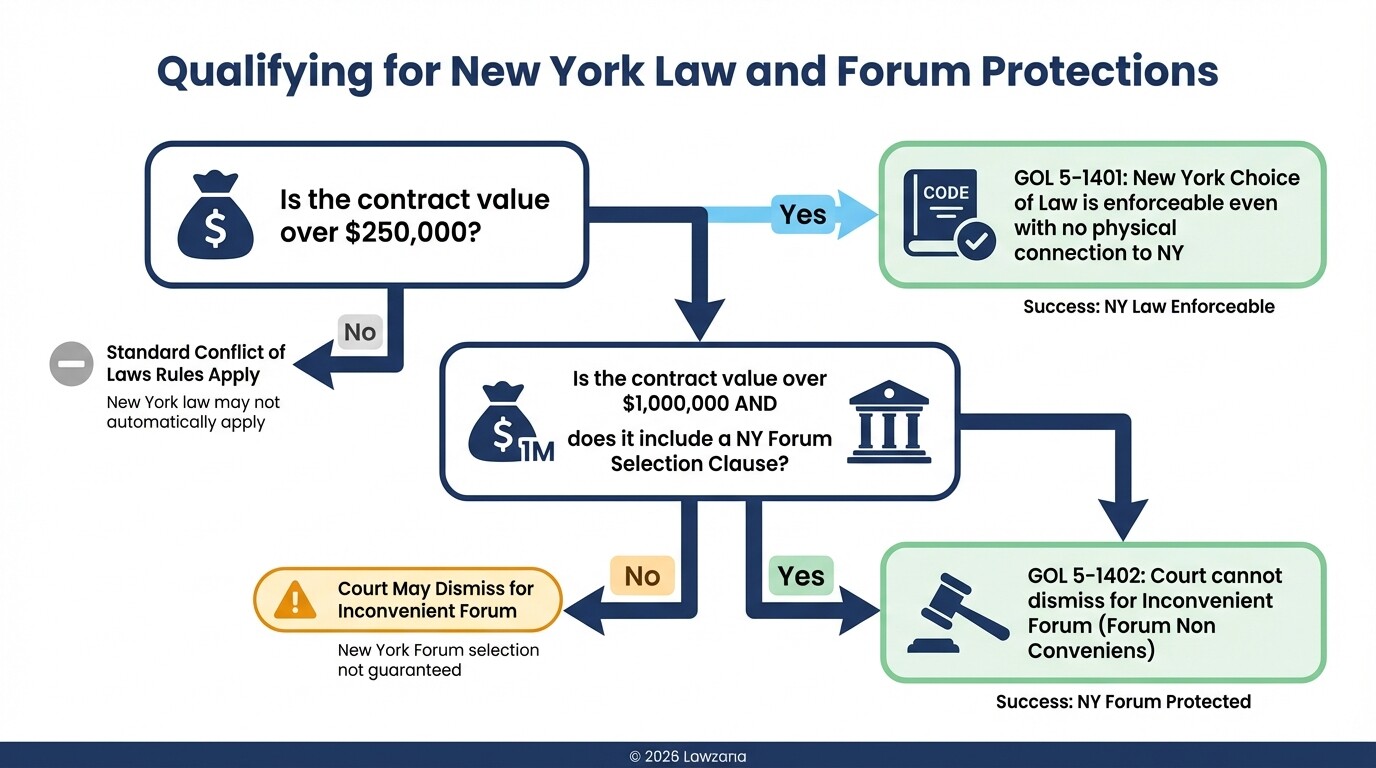
Foreign defendants often attempt to move litigation out of New York by filing a motion for "forum non conveniens," arguing that the court is an inconvenient location for the dispute. However, New York General Obligations Law Section 5-1402 creates a powerful shield against such motions for high-value contracts.
If a contract meets the following three conditions, a New York court is prohibited from dismissing the case on the grounds of inconvenient forum:
- The contract contains a New York choice of law clause pursuant to GOL § 5-1401.
- The contract contains a clause where the foreign party submits to the jurisdiction of New York courts.
- The transaction involves at least $1 million.
For disputes that do not meet the $1 million threshold, courts use a multi-factor test to decide whether to keep the case. They consider the residency of the parties, the location of witnesses and evidence, the burden on New York courts, and the availability of an alternative forum. Because New York values its status as a global commercial hub, its courts are generally reluctant to dismiss cases where the parties have intentionally sought out New York's legal expertise.
Procedures for Serving Process under the Hague Convention
When a New York lawsuit is filed against a foreign entity, the plaintiff must "serve process" (formally deliver the legal papers) in a way that is recognized by both New York law and international treaties. The Hague Service Convention is the primary treaty governing this process between the United States and over 70 other countries.
The standard procedure for service under the Hague Convention includes:
- Central Authority: The plaintiff sends a request and the legal documents to the "Central Authority" of the defendant's home country.
- Translation: Most member countries require the documents to be translated into their official language, which can be a significant expense.
- Certificate of Service: Once the Central Authority delivers the documents according to their local laws, they provide a formal Certificate of Service to the New York court.
It is important to note that while some countries allow service by registered mail or process server (Article 10), many have formally "objected" to these methods. If service is performed incorrectly, any judgment obtained in New York may be unenforceable in the defendant's home country, and the case could be dismissed by the New York judge for lack of personal jurisdiction.
Litigation Timelines and Attorney Fees in Commercial Divisions
Litigation in New York is thorough and can be expensive, particularly in the Commercial Division, which handles complex business disputes. These courts are designed to move more efficiently than general civil parts, but they still require significant time and resources.
| Phase of Litigation | Estimated Timeline | Typical Activities |
|---|---|---|
| Pleadings & Motions | 3 to 6 months | Filing the complaint, filing an answer, and motions to dismiss. |
| Discovery | 9 to 18 months | Exchange of documents (e-discovery), depositions of key witnesses, and expert reports. |
| Pre-Trial Motions | 4 to 6 months | Motions for summary judgment to resolve the case without a full trial. |
| Trial & Judgment | 2 to 5 days (actual trial) | Presentation of evidence and witness testimony before a judge or jury. |
Attorney Fees and Costs: Litigation costs in New York vary based on the complexity of the case. For international commercial disputes, hourly rates for partners at established New York firms typically range from $600 to $1,200 per hour. A full-scale litigation through trial can easily exceed $250,000 to $1,000,000 in legal fees. However, many commercial contracts include "prevailing party" clauses, which allow the winner to recover their attorney fees from the loser.
Arbitration Alternatives: AAA/ICDR vs. New York State Court
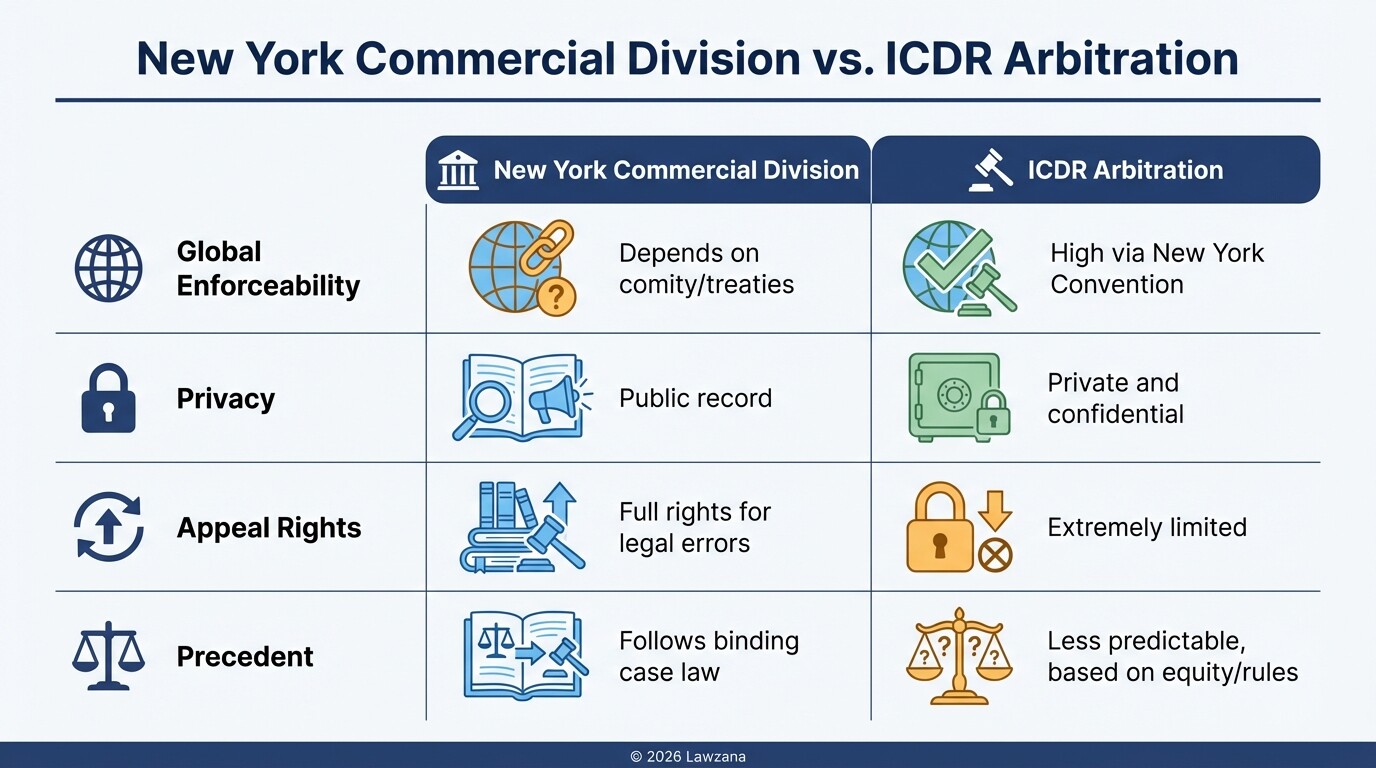
While New York courts are highly respected, many international firms choose arbitration through the International Centre for Dispute Resolution (ICDR), the international arm of the American Arbitration Association (AAA).
Advantages of ICDR Arbitration:
- Enforceability: Under the "New York Convention" treaty, arbitration awards are often easier to enforce in foreign countries than court judgments.
- Privacy: Arbitration proceedings and awards are generally private, whereas court filings in New York are public records.
- Expertise: Parties can select arbitrators with specific industry expertise (e.g., oil and gas, fintech, or international shipping).
Advantages of New York State Court Litigation:
- Precedent: Courts must follow legal precedent, making outcomes more predictable than arbitration, where "equity" may play a larger role.
- Appeal Rights: Court judgments can be appealed for legal errors; arbitration awards are almost impossible to overturn except in cases of fraud or extreme partiality.
- Cost: For smaller disputes, the filing fees and administrative costs of the AAA/ICDR can actually be higher than the filing fees for the New York Supreme Court.
Common Misconceptions
"Any contract choosing New York law must be heard in New York."
Choosing the "governing law" of a contract is not the same as choosing the "forum." You can have a contract governed by New York law that is litigated in London or Singapore. If you want the case to be heard in a New York court, you must include a specific "Forum Selection Clause."
"We don't need to follow the Hague Convention if the defendant has a New York office."
Even if a foreign company has a branch or subsidiary in New York, service on that office may not be sufficient to gain jurisdiction over the foreign parent company. Unless the subsidiary is a designated "agent for service of process," you likely still need to follow international service treaties to avoid a future motion to vacate the judgment.
"New York courts will always apply New York law if the contract says so."
While GOL § 5-1401 is very broad, New York courts may still refuse to apply New York law if it violates a "fundamental public policy" of a jurisdiction that has a significantly greater interest in the dispute. This is rare in commercial contexts but common in employment or consumer cases.
FAQ
Can I use New York law for a contract between two non-US companies?
Yes. Under GOL § 5-1401, as long as the contract value exceeds $250,000, two foreign companies can choose New York law even if neither company has a presence in the United States.
How much does it cost to file a lawsuit in the New York Commercial Division?
The initial filing fee (the "Index Number") is relatively low, currently $210. However, the true costs come from legal fees, expert witnesses, and the mandatory e-filing system requirements.
Can a New York judgment be enforced in a foreign country?
Yes, but it depends on the "comity" of the foreign country or specific bilateral treaties. Unlike arbitration awards, there is no single global treaty for court judgments. This is why many international contracts prefer arbitration.
Does a New York choice of law clause cover "torts" like fraud?
Not necessarily. Unless the clause is drafted broadly (e.g., "all claims arising out of or relating to this agreement"), a court might apply the law of the place where the fraud occurred rather than New York law.
When to Hire a Lawyer
Navigating the New York legal system as an international entity requires local expertise. You should consult a New York commercial litigator if:
- You are drafting a high-value contract ($250,000+) and want to ensure the choice of law clause is airtight.
- You have been served with a summons from a New York court and need to challenge jurisdiction or service.
- You need to enforce a New York judgment against assets located in another country.
- Your contract dispute involves complex financial instruments or multi-jurisdictional parties.
Next Steps
- Review Your Contracts: Check your current agreements for "permissive" vs. "exclusive" forum selection clauses.
- Assess the Value: Determine if your contracts meet the $250,000 (choice of law) or $1,000,000 (forum) thresholds under the General Obligations Law.
- Consult Local Counsel: If a dispute is brewing, engage a New York attorney early to ensure service of process is handled correctly under the Hague Convention.
- Consider Arbitration: Evaluate whether the ICDR or another arbitration body better serves your needs for privacy and global enforceability.