- Hong Kong operates as a free port, meaning general tariffs are not applied, but strict duties are levied on liquors, tobacco, hydrocarbon oil, and methyl alcohol.
- Importers dealing with dual-use goods or strategic commodities must secure specific licenses from the Trade and Industry Department (TID) prior to shipment.
- Statutory record-keeping laws require businesses to retain import and export declarations for at least two years, though tax and corporate laws demand seven years.
- Transshipment and transit cargo are not inherently exempt from regulatory oversight; strategic commodities require licensing even if they never officially enter the local market.
- Shifting global supply chain regulations slated for 2026 will require Hong Kong operators to implement stricter end-user tracking and ESG compliance documentation.
Hong Kong Import Compliance Checklist
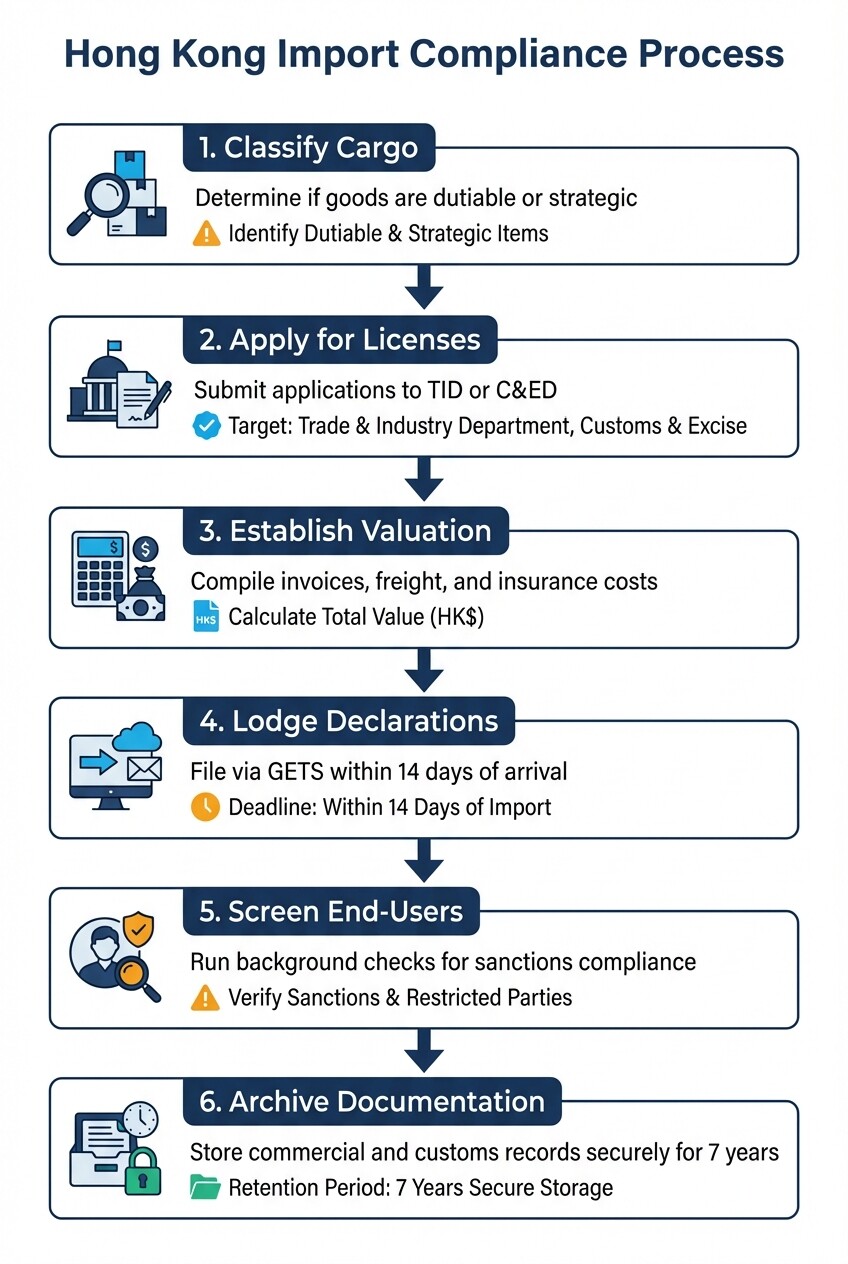
Managing international trade in a free port still requires rigorous operational protocols to avoid shipment seizures and financial penalties. Importers and logistics providers must proactively secure licenses, accurately classify goods, and maintain audit-ready documentation before cargo arrives at the border.
Use this step-by-step compliance checklist for your import operations:
- Classify Your Cargo: Determine if your goods fall under the four dutiable categories (liquors, tobacco, hydrocarbon oil, methyl alcohol) or the strategic commodities list.
- Apply for Necessary Licenses: Submit applications to the Trade and Industry Department (TID) for strategic goods or the Customs and Excise Department (C&ED) for dutiable goods.
- Establish Customs Valuation: For dutiable goods, compile commercial invoices, freight charges, and insurance costs to prove the exact transaction value.
- Lodge Import Declarations: File the mandatory import declaration via the Government Electronic Trading Services (GETS) system within 14 days of the cargo's arrival.
- Screen End-Users: Run background checks on buyers and transshipment partners to ensure compliance with international sanctions and export controls.
- Archive Documentation: Store all commercial invoices, packing lists, bills of lading, and customs declarations in a secure, easily retrievable digital format for a minimum of seven years.
Understanding Hong Kong's Current Customs Valuation Laws
Hong Kong operates as a free port with no general tariff on imported goods, meaning customs valuation primarily applies to four specific categories of dutiable commodities. For these regulated goods, valuation is strictly assessed based on the actual transaction value to calculate precise excise duties.
Under the Dutiable Commodities Ordinance (Cap. 109), the Customs and Excise Department requires importers to prove the normal price of the goods. This valuation process includes:
- Transaction Value Assessment: The primary basis for valuation is the price actually paid or payable for the goods when sold for export to Hong Kong.
- Inclusion of Incidental Costs: Valuation must include all costs incurred up to the point of importation, including freight, shipping insurance, and handling charges.
- Related-Party Transactions: If the buyer and seller are corporate affiliates, customs authorities will heavily scrutinize the valuation to ensure the declared price has not been artificially lowered to evade duties.
- Documentary Proof: Importers must provide original commercial invoices, contracts, bank remittance records, and freight documents to substantiate their declared value.
Compliance Requirements for Dual-Use Goods and Strategic Commodities
Importing, exporting, or transshipping dual-use goods-items with both commercial and military applications-requires strict adherence to Hong Kong's licensing regime to prevent illegal proliferation. Businesses must secure explicit pre-approval from the Trade and Industry Department (TID) before these goods enter or leave Hong Kong territory.
Regulated under the Import and Export Ordinance (Cap. 60), strategic commodities cover a vast range of high-tech and industrial products. Compliance requires businesses to navigate several critical mandates:
- Commodity Classification: Importers must evaluate their products against the detailed Control List, which covers electronics, computers, telecommunications equipment, and specialized materials.
- Pre-Shipment Licensing: An import or export license must be approved and physically or digitally issued before the carrier arrives in Hong Kong.
- End-User Statements: Authorities frequently require signed declarations from the ultimate end-user detailing exactly how the technology or equipment will be utilized.
- Transit Restrictions: Cargo passing through Hong Kong without changing vessels (transit) or moving between vessels (transshipment) still falls under strategic commodity controls and often requires specific transit licenses.
How to Handle Customs Disputes and Clearance Delays Effectively
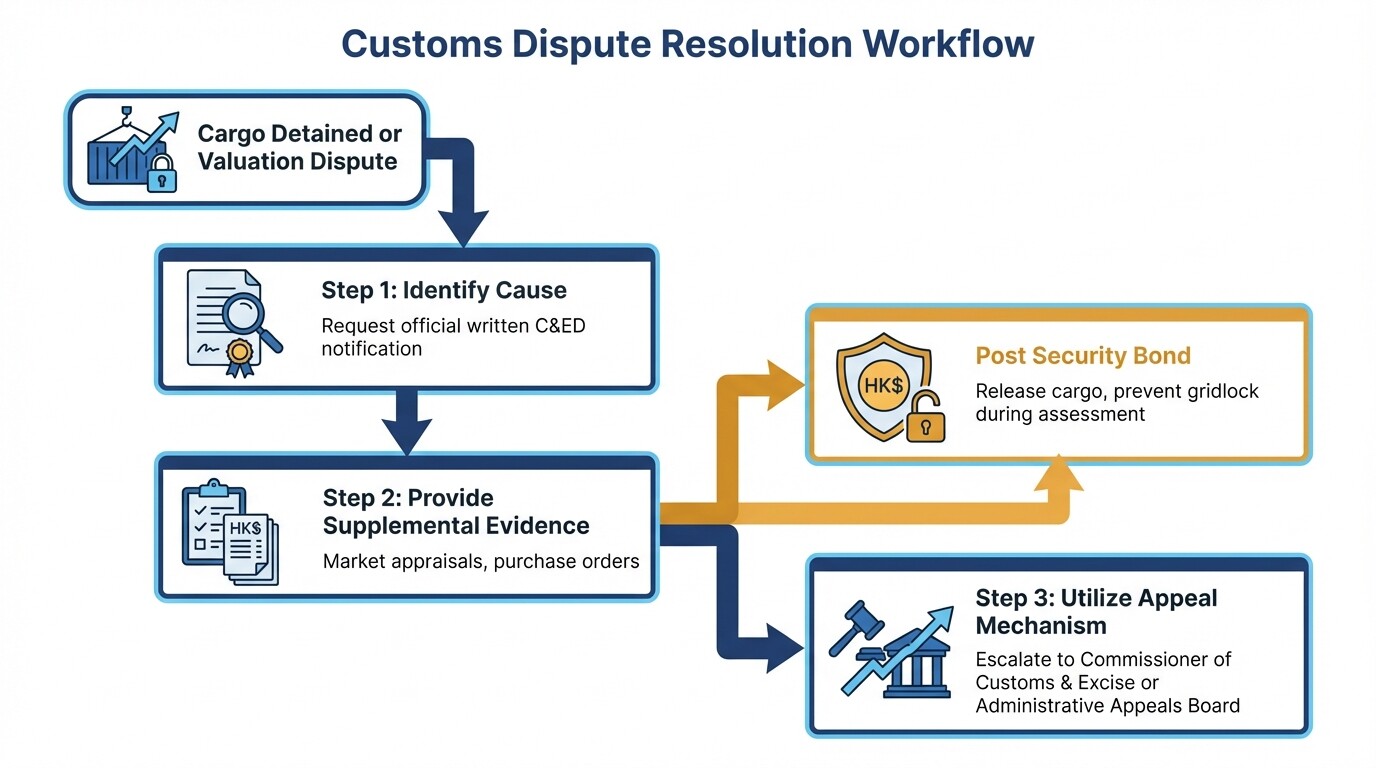
Customs disputes in Hong Kong typically arise from valuation disagreements, suspected misclassification, or missing strategic commodity licenses. Resolving these delays requires immediate engagement with customs officials, backed by comprehensive commercial documentation and legal clarity.
When facing cargo detainment or valuation disputes, businesses should take immediate structural steps:
- Identify the Cause of Delay: Request official written notification from the C&ED detailing whether the delay is an administrative hold, a valuation audit, or a licensing investigation.
- Provide Supplemental Evidence: If the dispute involves valuation, immediately supply secondary evidence such as independent market appraisals, purchase orders, and proof of identical goods pricing.
- Utilize the Appeal Mechanism: Disagreements over dutiable value can be formally appealed to the Commissioner of Customs and Excise. Further appeals can be escalated to the Administrative Appeals Board.
- Post Security Bonds: In certain valuation disputes, importers can negotiate to pay a deposit or post a bank guarantee to release the cargo while the final duty assessment is ongoing, preventing supply chain gridlock.
Record-Keeping Mandates for International Trade Operations
Statutory record-keeping is non-negotiable for importers, as customs authorities routinely conduct post-clearance audits to verify declarations. Failure to maintain these records can result in severe financial penalties and immediate suspension of trading privileges.
To remain compliant, businesses operating in Hong Kong must adhere to specific retention timelines:
- Trade Declarations (2 Years): The Import and Export (Registration) Regulations mandate that all documents related to import and export declarations be retained for a minimum of two years from the date of filing.
- General Business and Tax Records (7 Years): Under the Inland Revenue Ordinance, all business records-including commercial invoices, bank records, and ledgers-must be kept for seven years. It is best practice to retain all trade documents for this longer period.
- Format Requirements: Records can be maintained electronically, but they must be readily accessible, legible, and easily reproducible in hard copy if demanded during a customs audit.
Impact of Global Supply Chain Regulations on Hong Kong Imports in 2026
By 2026, shifting global trade policies, heightened international sanctions, and new environmental compliance laws will dramatically alter how Hong Kong importers manage supply chain risk. Importers must upgrade their compliance frameworks to account for external regulations that directly affect cargo moving through Hong Kong.
Key regulatory shifts operators must prepare for include:
- Enhanced Export Controls: Increased friction in US-China trade relations means Hong Kong importers of advanced technology (such as semiconductors) will face stricter end-use tracking and deeper audits from foreign jurisdictions.
- Digital Product Passports: The European Union's push for sustainability will require transshipped and imported goods to carry digital traceability records, detailing material origins and carbon footprints.
- Forced Labor Legislation: Global mandates prohibiting goods produced with forced labor will require Hong Kong logistics firms to thoroughly map and document upstream supply chains to avoid shipment seizures in destination markets.
Common Misconceptions About Hong Kong Import Rules
Misconception 1: "Because Hong Kong is a free port, there is no customs paperwork." While general tariffs are absent, mandatory import declarations must be filed within 14 days of arrival for nearly all goods. Failure to file these declarations on time incurs automatic late penalties.
Misconception 2: "Goods only transshipping through Hong Kong do not require licenses." Many businesses mistakenly believe that cargo remaining at the port or airport is exempt from local laws. In reality, strategic commodities and dual-use goods strictly require transshipment or transit licenses, and un-licensed transit cargo is frequently seized.
Frequently Asked Questions
What happens if I misdeclare the value of dutiable goods in Hong Kong?
Misdeclaring the value of dutiable commodities to evade taxes is a criminal offense under the Dutiable Commodities Ordinance. Penalties can include cargo seizure, massive fines up to HK$1 million, and up to two years of imprisonment for company directors.
How long does it take to get a strategic commodities license?
Standard applications for strategic commodities licenses submitted to the Trade and Industry Department generally take 2 to 3 working days to process. However, applications involving highly sensitive dual-use technology can take several weeks as they require inter-departmental review.
Do I need a customs broker to import goods into Hong Kong?
While not legally mandated, most international businesses use licensed customs brokers or freight forwarders to handle GETS declarations and secure necessary TID licenses. Given the technical complexity of strategic commodity classifications, professional logistics support is highly recommended.
When to Hire an International Trade Lawyer
Handling routine import declarations rarely requires legal counsel, but complex regulatory issues demand specialized intervention. You should engage an international trade attorney when facing formal customs investigations, cargo seizures, or allegations of sanction violations. Legal counsel is also essential when structuring new, high-volume supply chains involving dual-use technologies, ensuring your contracts correctly allocate compliance liabilities between buyers, sellers, and logistics providers.
Next Steps
If you are expanding your import operations or transshipping sensitive goods through Hong Kong, conduct an immediate internal audit of your classification and licensing protocols. Ensure your logistics team understands the specific TID requirements for your product categories and that your record-keeping systems automatically archive commercial documents for the required seven years. For complex disputes or strategic compliance planning, consult international trade lawyers in Hong Kong to safeguard your supply chain and protect your business from regulatory penalties.