- Direct execution is available for judgments from reciprocating territories like the United Kingdom, Singapore, and the United Arab Emirates.
- Judgments from non-reciprocating territories require the creditor to file a new civil suit in India based on the foreign decree.
- The enforcement process typically takes 18 to 24 months, heavily influenced by the jurisdiction of origin and local court efficiency.
- Indian courts will refuse to enforce any judgment that violates Indian public policy, lacks due process, or was obtained by fraud.
- Court fees vary significantly by Indian state, with some states capping the fee and others charging a sliding percentage of the total claim value.
Reciprocating vs. Non-Reciprocating Territories
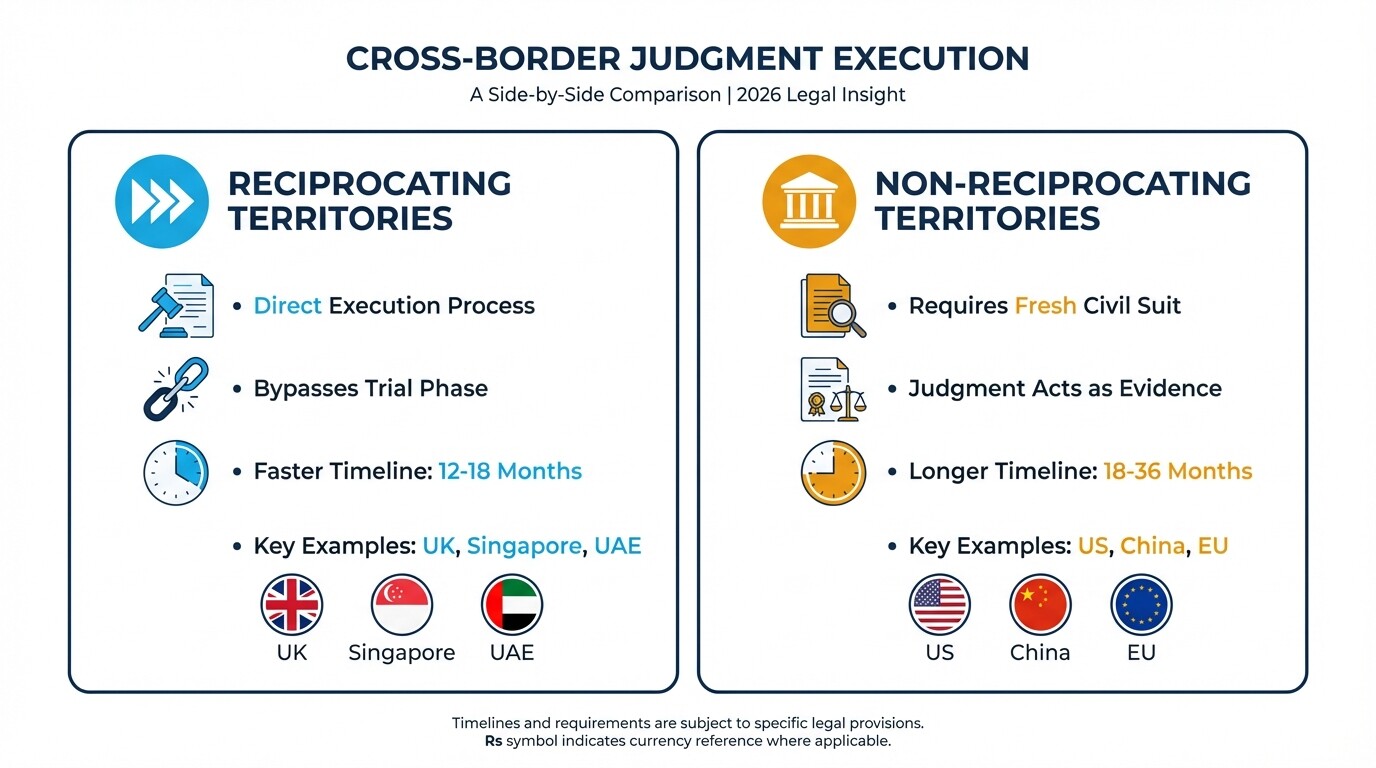
India classifies foreign jurisdictions into reciprocating and non-reciprocating territories, which dictates the legal method required for enforcement. Judgments from reciprocating territories enjoy a streamlined direct execution process, while those from non-reciprocating jurisdictions require initiating a fresh lawsuit.
The Government of India officially notifies reciprocating territories under the Code of Civil Procedure, 1908. Key reciprocating territories include the United Kingdom, Singapore, Hong Kong, and the United Arab Emirates. Creditors with decrees from these jurisdictions bypass the trial phase and proceed directly to execution.
Conversely, non-reciprocating territories include major economic partners like the United States, China, and most European Union member states. A judgment from these countries does not automatically hold the status of an Indian court decree. Instead, the foreign judgment serves as the evidentiary basis for a new civil claim, meaning the creditor must formally sue the debtor in an Indian court to secure a domestic decree before asset recovery can begin.
Step-by-Step Guide to Enforcing a Foreign Judgment in India
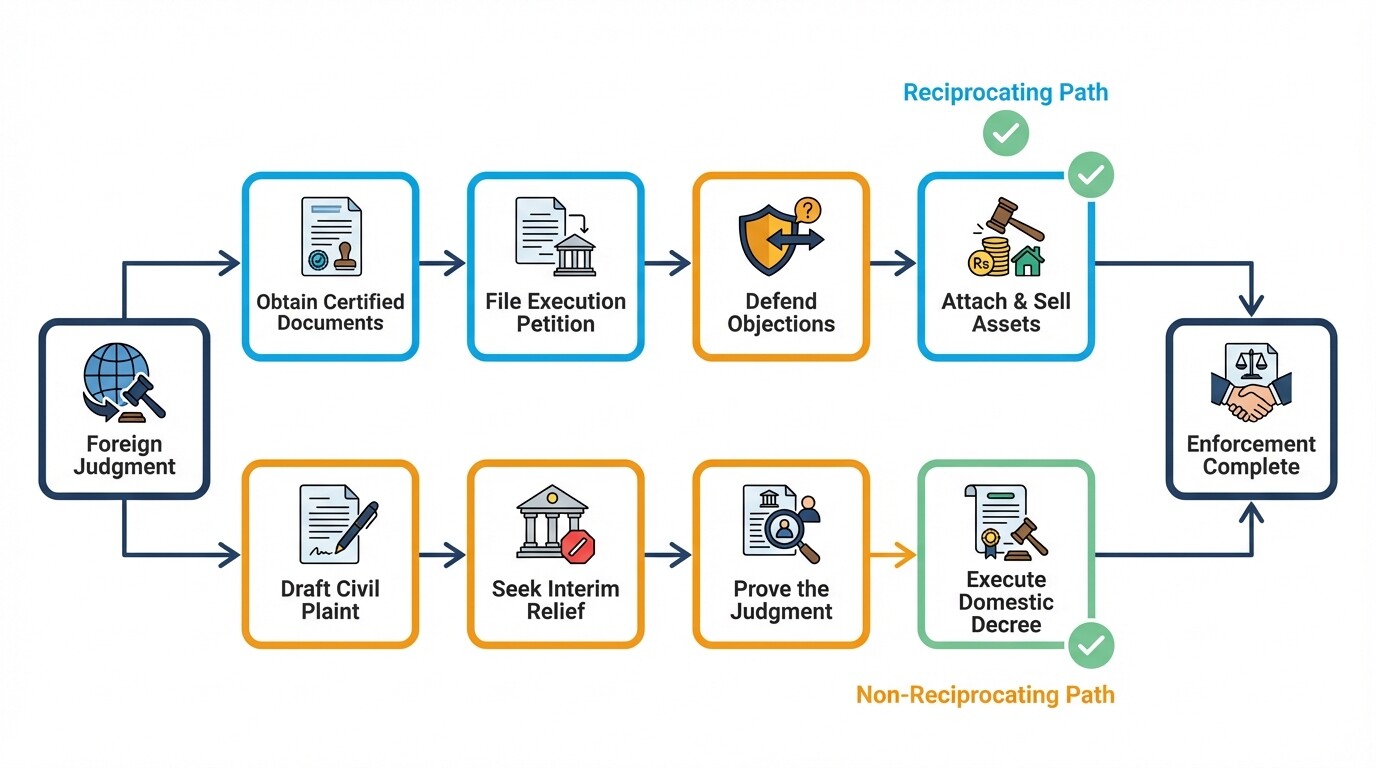
The legal procedure depends entirely on whether the judgment originates from a reciprocating or non-reciprocating territory. International businesses must follow these specific steps to recover assets within the Indian legal system.
Phase 1: Direct Execution for Reciprocating Territories
If you hold a judgment from a reciprocating territory like the UK or Singapore, you will utilize the direct execution petition process.
- Obtain Certified Documents: Secure a certified copy of the judgment and a non-satisfaction certificate from the originating foreign court. This certificate confirms the exact amount that remains unpaid.
- File an Execution Petition: Submit the petition under Section 44A of the Civil Procedure Code to the competent Indian court where the debtor resides or holds assets.
- Defend Against Objections: The Indian court will issue a notice to the debtor. The debtor may file objections, which the court will evaluate strictly on statutory grounds rather than reopening the facts of the case.
- Attach and Sell Assets: Once objections are dismissed, the court will issue orders to freeze bank accounts, attach property, or garnish commercial revenues to satisfy the debt.
Phase 2: Filing a Civil Suit for Non-Reciprocating Territories
If your judgment comes from a non-reciprocating territory like the United States, you must undergo a formal suit process.
- Draft the Civil Plaint: Prepare a civil suit relying on the foreign judgment as your primary cause of action. Ensure this is filed within the three-year limitation period.
- Seek Interim Relief: File an application for an injunction or attachment before judgment. This prevents the debtor from moving or hiding assets while the Indian suit is pending.
- Prove the Judgment: Present the certified foreign decree. Under Indian law, courts presume the foreign judgment is conclusive unless the debtor proves it violates a statutory exception.
- Execute the Indian Decree: Once the Indian court rules in your favor and issues a domestic decree, proceed with the standard asset attachment and sale process.
Expected Timelines for Enforcement
Enforcing a foreign judgment in India generally takes between 18 and 24 months. The exact timeline fluctuates based on court backlogs, the origin of the judgment, and whether the debtor actively contests the enforcement.
For direct execution petitions involving reciprocating territories, the process is considerably faster and often resolves within 12 to 18 months. Because the court only hears procedural objections rather than conducting a full trial, creditors reach the asset attachment phase much quicker.
For non-reciprocating territories, filing a civil suit extends the timeline. However, the introduction of the Commercial Courts Act has significantly accelerated these proceedings. Commercial disputes above a certain financial threshold are now subject to strict case management hearings and summary judgments. Consequently, an international creditor filing a civil suit can expect to secure and execute the domestic decree within 18 to 36 months, averaging around 24 months in major business hubs like Mumbai and Delhi.
Estimated Legal Costs and Court Fees
Creditors must budget for both statutory court fees and professional legal charges, which scale based on the claim's value and the enforcement method. Court fees vary significantly across different Indian states and represent the largest upfront expense.
When filing a direct execution petition, court fees are generally nominal. However, filing a fresh civil suit for a non-reciprocating judgment attracts substantial ad valorem court fees. For example, in Maharashtra, the court fee is capped at a maximum of INR 300,000 regardless of the claim size. In contrast, jurisdictions like Delhi apply a sliding percentage scale with no upper limit, which can significantly increase the initial cost of litigation.
Legal fees for commercial litigation in India typically follow a phased or milestone structure rather than hourly billing. Senior advocates handling complex cross-border enforcements charge between INR 100,000 and INR 500,000 per hearing. Comprehensive enforcement matters from start to finish generally incur legal costs ranging from USD 15,000 to USD 50,000, heavily dependent on the debtor's resistance and the complexity of tracing hidden assets.
Common Grounds for Refusal
Under Section 13 of the Civil Procedure Code, Indian courts recognize foreign judgments as conclusive unless they fail specific statutory tests. Courts will proactively refuse enforcement if the judgment violates fundamental due process or Indian public policy.
A debtor can successfully block enforcement by proving the foreign judgment falls into one of these categories:
- Lack of Jurisdiction: The foreign court that pronounced the judgment did not have competent jurisdiction over the defendant or the subject matter.
- Not Decided on Merits: The judgment was issued purely on technical grounds rather than an examination of the actual evidence.
- Violation of International Law: The proceedings appear on their face to be founded on an incorrect view of international law or a refusal to recognize applicable Indian law.
- Violation of Natural Justice: The debtor was not given proper notice of the proceedings or a fair opportunity to present their defense.
- Obtained by Fraud: The foreign court was misled, or the judgment was procured through deceitful practices.
- Breach of Indian Law: The underlying claim sustains a breach of any law currently in force in India.
Common Misconceptions About Foreign Judgments in India
Many international creditors misunderstand the scope of Indian judicial review during the enforcement process. Clarifying these legal realities helps businesses set accurate expectations for asset recovery.
A major misconception is that Indian courts will retry the entire case. Whether you are executing a reciprocating judgment or filing a suit on a non-reciprocating judgment, the Indian court does not act as an appellate body. The judge will not review the evidence or the merits of the original dispute. Their sole mandate is to ensure the judgment does not violate the statutory exceptions under Section 13 of the Civil Procedure Code.
Another frequent myth is that judgments from non-reciprocating territories hold no value in India. While they require filing a new lawsuit, the foreign judgment carries immense evidentiary weight. The Indian court presumes the judgment is valid, effectively shifting the burden of proof entirely onto the debtor to prove why it should not be enforced.
Frequently Asked Questions
What is the limitation period for enforcing a foreign judgment in India?
The limitation period to enforce a foreign judgment in India is three years. This timeline strictly begins from the date the foreign court issues the final judgment or decree.
Can ex-parte foreign judgments be enforced in India?
Yes, ex-parte judgments can be enforced, provided they were decided on the merits of the case. The creditor must prove the defendant was properly served with legal notice and intentionally chose not to participate.
Can I seek interim relief while enforcing a foreign judgment?
Creditors can apply for interim injunctions or attachment of assets before judgment. This prevents the debtor from liquidating, hiding, or transferring Indian assets while the enforcement proceedings are ongoing.
Does the foreign judgment need to be in English?
If the original judgment is in a language other than English, it must be accompanied by a certified, authenticated English translation when submitted to the Indian courts.
When to Hire a Commercial Litigation Lawyer
You should retain an Indian commercial litigation attorney immediately after securing a foreign judgment, especially before the debtor attempts to dissipate local assets. Early legal intervention is critical for securing emergency interim injunctions to freeze bank accounts and attach property.
Navigating the jurisdictional nuances of the Civil Procedure Code requires specialized local expertise. An experienced attorney will accurately calculate limitation periods, determine the correct state court for filing, and anticipate the debtor's statutory objections. To find vetted legal representation for cross-border recovery, explore commercial litigation lawyers in India who have proven track records in asset tracing and direct execution petitions.
Next Steps for International Creditors
Your immediate priority is to gather certified documentation from the foreign court and identify the debtor's assessable assets in India. Thorough preparation directly controls the speed and success rate of the enforcement process.
First, request a certified copy of the judgment and a formal non-satisfaction certificate from the court that issued the original ruling. Next, conduct an independent asset search in India to locate bank accounts, real estate, or corporate holdings belonging to the debtor. Finally, consult with an Indian commercial litigation specialist to map out your filing strategy and calculate the exact court fees required in the target jurisdiction.