Managing Employee Terminations in India - Legal Timelines
- India does not recognize "at-will" employment. Foreign subsidiaries must justify terminations with documented cause or follow strict retrenchment rules.
- Mutual Separation Agreements (MSAs) are the preferred exit strategy for multinational companies. They limit litigation risks and bypass statutory procedures.
- Employers must complete statutory full and final (F&F) settlements within two to 45 days, depending on the specific wage and gratuity components.
- Labor laws vary by state. Tech subsidiaries must align termination practices with local Shops and Establishments Acts in commercial hubs like Bengaluru and Mumbai.
- Wrongful termination disputes in Indian labor courts take three to seven years to resolve. This makes preemptive mediation and severance negotiations highly cost-effective.
Employee Termination vs. Mutual Separation Agreements (MSAs)
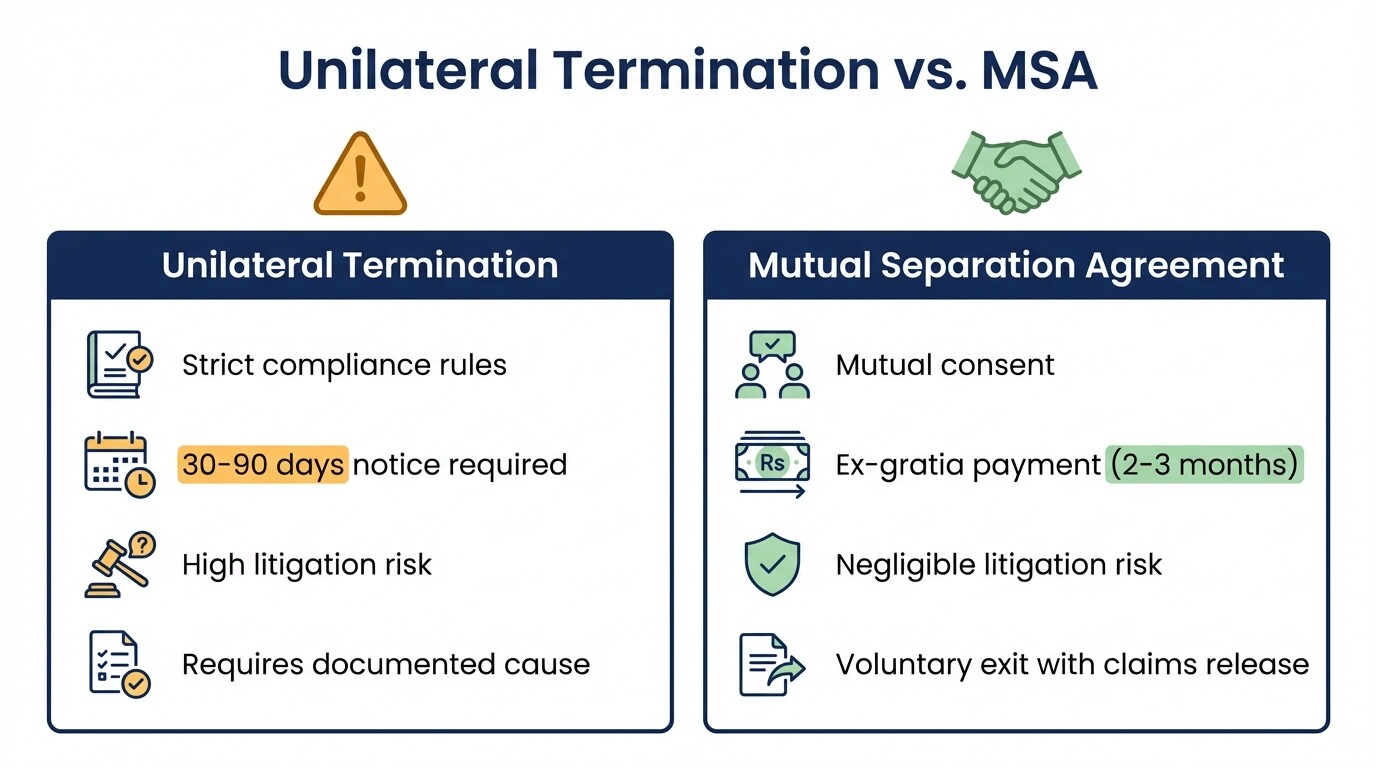
Unilateral termination in India requires strict compliance with statutory notice periods and "last in, first out" rules. Mutual Separation Agreements (MSAs) offer a negotiated alternative. Foreign subsidiaries prefer MSAs because they remove litigation risk and bypass the rigid termination procedures mandated by Indian labor tribunals.
Unilateral termination presents high compliance hurdles. For non-managerial staff classified as "workmen" under the Industrial Disputes Act, employers must prove disciplinary cause or follow strict retrenchment guidelines. These guidelines require 30 to 90 days of notice and statutory severance payouts. Manufacturing plants with 100 or more workmen even need prior government permission to execute layoffs. Unilateral dismissals leave the company vulnerable to wrongful termination lawsuits and demands for reinstatement.
An MSA relies on mutual consent. The employer offers an ex-gratia payment, usually two to three months of base salary, in exchange for the employee's voluntary resignation and a comprehensive release of claims. Because the employee leaves voluntarily under a signed contract, MSAs rarely trigger scrutiny from labor authorities. They are legally binding and prevent the employee from successfully pursuing wrongful termination litigation.
Timeline for Statutory Severance and Final Settlements
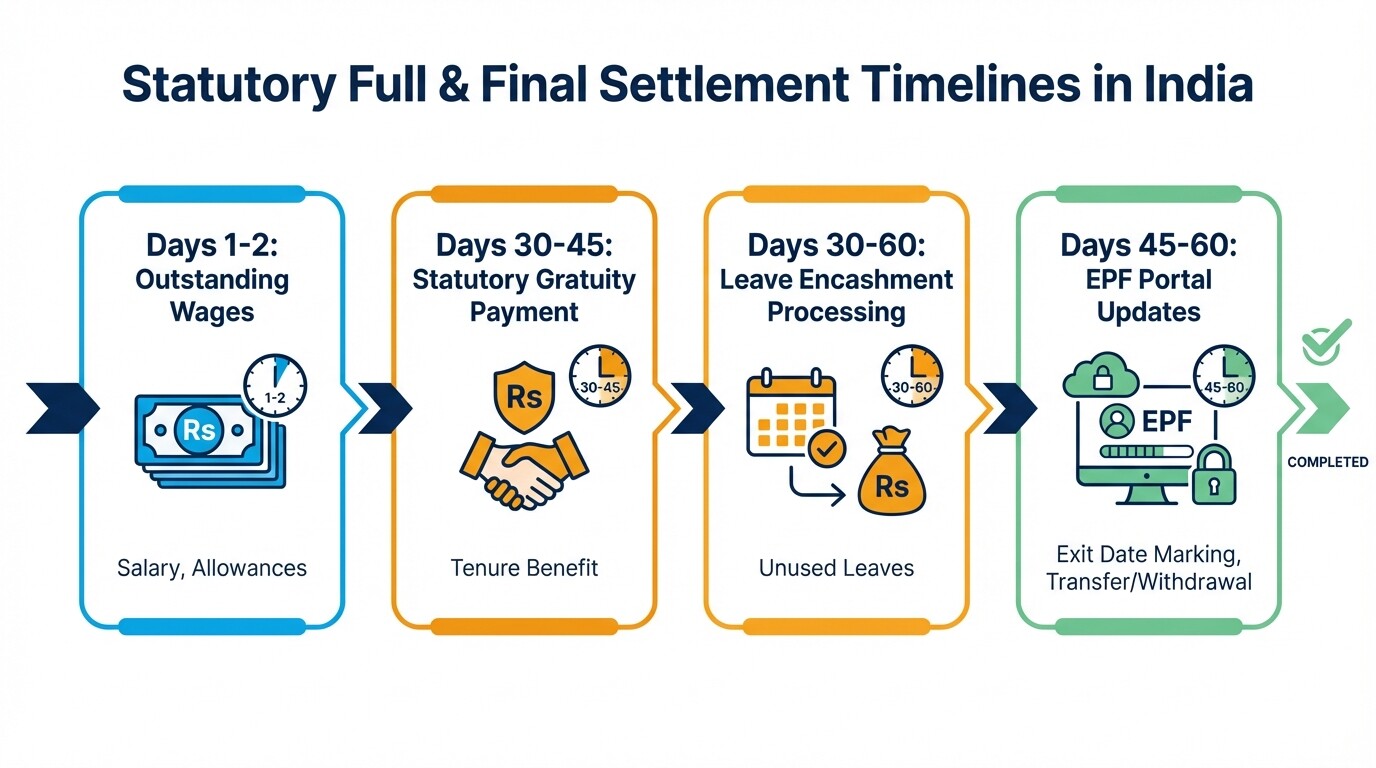
Indian labor law requires employers to complete full and final (F&F) settlements within specific timelines. Failure to meet these deadlines triggers penal interest and potential labor tribunal disputes.
Foreign subsidiaries must process the following exit payments according to this legal timeline:
- Days 1 to 2: Payout of outstanding wages for days worked in the final month. The Payment of Wages Act requires this immediately upon termination.
- Days 30 to 45: Payment of statutory gratuity. Under the Payment of Gratuity Act, employees with five continuous years of service are entitled to 15 days of wages for every completed year of service. Employers must pay this within 30 days of the last working day.
- Days 30 to 60: Leave encashment processing. You must pay out unused earned or privilege leave based on the employee's basic salary. This is usually processed alongside the regular 30-day payroll cycle.
- Days 45 to 60: Employees' Provident Fund (EPF) updates. The employer must update the employee's exit date on the official Employees' Provident Fund Organisation (EPFO) portal. This allows the employee to claim or transfer their retirement funds.
State-Specific Shops and Establishments Act Comparison
Foreign companies operating in India must comply with state-level Shops and Establishments Acts. These laws dictate local notice periods and leave encashment rules. Because labor regulations are shared between the central and state governments, termination requirements vary between commercial hubs.
Understanding local jurisdiction is necessary before issuing a termination letter. Below is a comparison of termination requirements across three major jurisdictions in India:
| State Jurisdiction | Key Tech Hub | Standard Notice Period | Termination Requirements |
|---|---|---|---|
| Karnataka | Bengaluru | 30 days | Requires 30 days written notice or pay in lieu. Termination must be for reasonable cause or misconduct. |
| Maharashtra | Mumbai / Pune | 30 days | Requires 30 days notice for employees with over one year of service. Immediate termination requires proven misconduct. |
| Haryana | Gurugram | 30 days | Requires 30 days notice or salary in lieu. Strict documentation required for performance-based dismissals. |
Pre-Litigation Mediation for Executives
Foreign subsidiaries prevent executive disputes by adding pre-litigation mediation and arbitration clauses to employment contracts. Executive departures often involve sensitive intellectual property, restrictive covenants, and substantial stock options. Preemptive mediation controls confidentiality and limits public tribunal exposure.
When a senior leader departs under contentious circumstances, employers should initiate pre-litigation mediation rather than issuing a unilateral termination notice. This process places the executive on "garden leave" while outside counsel facilitates a negotiated exit.
Mediation allows both parties to discuss equity vesting, severance payouts, and public relations messaging in a confidential environment. Indian courts support arbitration and mediation clauses for managerial staff. This makes mediation the safest mechanism to resolve C-suite exits privately.
Timelines for Wrongful Termination Claims in Labor Tribunals
Wrongful termination claims in Indian labor tribunals take three to seven years to resolve. Labor courts heavily favor the employee. Employers must account for these timelines when assessing the cost of litigation versus offering a higher severance settlement.
If an employee challenges their termination, the dispute moves through a structured administrative and judicial pipeline:
- Conciliation Phase (3 to 6 months): The employee files a complaint with the local labor commissioner. A conciliation officer attempts to mediate a settlement between the company and the employee.
- Labor Court Phase (2 to 5 years): If conciliation fails, the dispute goes to a Labor Court or Industrial Tribunal. Both sides present evidence, and the court assesses whether the termination violated Ministry of Labour and Employment regulations.
- Appellate Phase (2 to 4 years): The losing party often appeals to the State High Court and eventually the Supreme Court of India. This adds years of legal fees and administrative burden.
Common Misconceptions About Terminating Employees in India
Multinational employers often apply their home-country HR policies to India. This causes severe compliance failures. Navigating Indian labor laws requires adapting to a highly regulated workforce environment.
A primary misconception is that "at-will" employment exists in India. Employers cannot fire staff simply because they no longer need them. Unilateral termination requires documented disciplinary action or a formal retrenchment process involving government notifications and severance pay. Additionally, employers cannot immediately fire an employee for poor performance. You must implement a documented Performance Improvement Plan (PIP) giving the employee a reasonable opportunity to improve.
Another mistake is assuming that post-employment non-compete clauses are strictly enforceable. Under Section 27 of the Indian Contract Act, covenants that prevent an employee from joining a competitor after they leave the company are generally void and unenforceable. Employers must rely on non-disclosure agreements and confidentiality clauses to protect their intellectual property.
When to Hire an Employment Lawyer
Engaging local legal counsel early helps foreign subsidiaries structure terminations without triggering state labor disputes. Consult a lawyer before initiating mass layoffs, terminating senior executives, or drafting severance agreements to ensure compliance with overlapping central and state labor statutes.
A local specialist will draft legally compliant Mutual Separation Agreements and audit your internal disciplinary documentation. To connect with vetted legal professionals, browse dispute prevention and pre-litigation lawyers in India who specialize in corporate employment law.
Immediate Next Steps
- Audit existing employment contracts to ensure notice periods and arbitration clauses align with the specific Shops and Establishments Act of your operating state.
- Standardize your Performance Improvement Plan (PIP) documentation to establish clear legal cause for performance-based terminations.
- Draft a master template for Mutual Separation Agreements. Ensure it includes a release of future claims and confidentiality clauses.
- Centralize your exit checklist to guarantee that provident fund transfers and statutory gratuity payments happen within the strict 30 to 45-day legal window.