


How to Respond to a Legal Notice for Breach of Contract in India
Receiving a legal notice for a breach of contract can be a stressful moment for any entrepreneur or business owner in India. However, this formal document is not a lawsuit itself but a final warning to resolve a dispute before it reaches the courtroom. Responding correctly and within the stipulated timeframe is essential to protecting your business reputation and financial health.
What is a legal notice under Indian law and why is it important?
A legal notice is a formal communication sent by an advocate on behalf of their client to inform the recipient of an intended legal action. In India, it serves as a final opportunity for the parties to settle the dispute amicably without involving the judiciary. It outlines the grievances of the sender, the specific terms of the breach, and the relief sought, such as monetary compensation or specific performance.
While a legal notice is not mandatory for all private contract disputes, it is a customary practice that demonstrates a party's willingness to resolve the matter. If you ignore the notice, the court may view your silence as an admission of the facts stated therein or as a lack of "bona fide" intent to resolve the conflict. This could lead to the sender filing a summary suit or a regular civil suit under the Code of Civil Procedure, 1908.
Is a legal notice the same as a summons? Does every breach of contract require a notice? What happens if I refuse to accept the physical delivery of the notice?
How should you review your contract and records before replying?
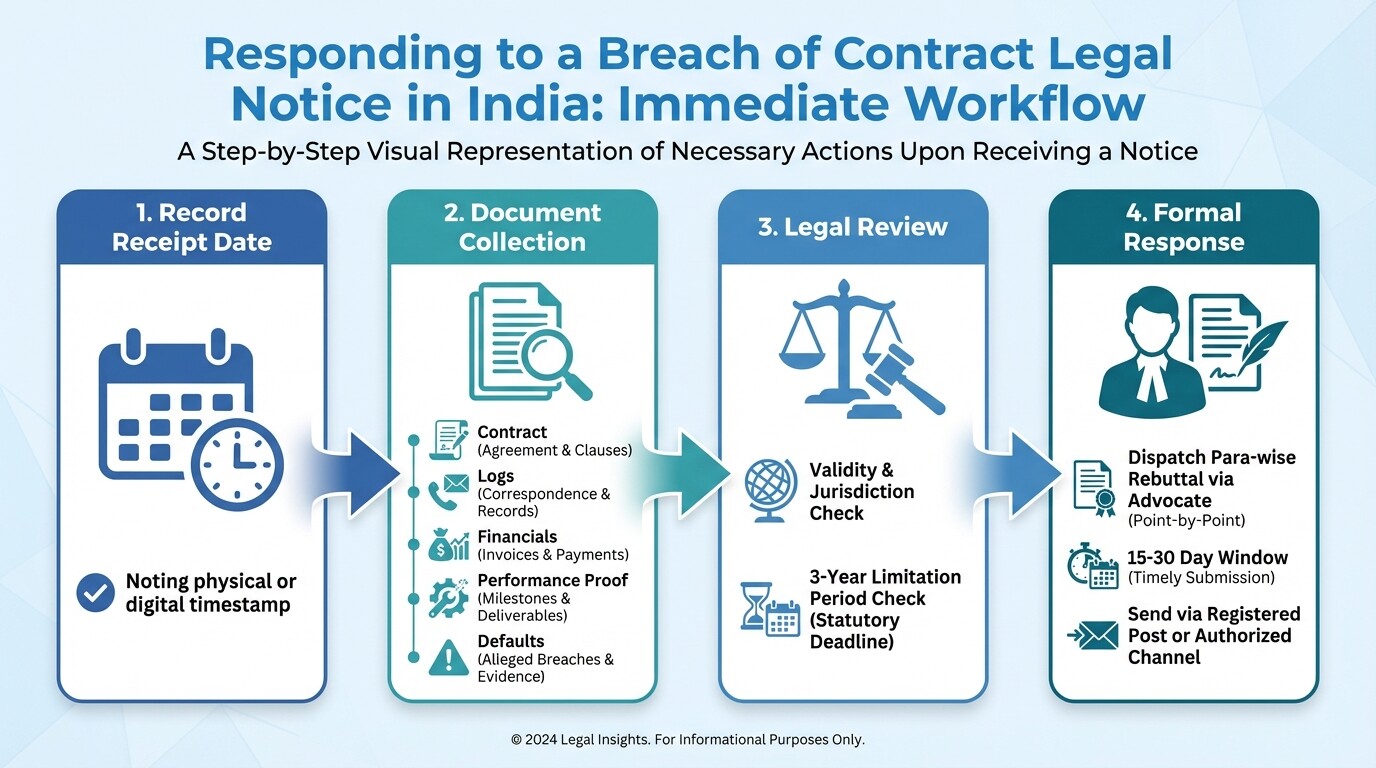
Before drafting a response, you must conduct a thorough internal audit of the transaction in question to identify any loopholes or valid defenses. This involves comparing the allegations in the notice against the signed clauses of your agreement and your actual performance of duties. You should look for "Force Majeure" clauses, dispute resolution provisions, and any amendments made to the original contract through mutual consent.
Organize your records in chronological order to build a clear timeline of events. The following checklist will help you gather the necessary documentation:
- The Primary Agreement: The signed contract, including all annexures and schedules.
- Communication Logs: Emails, WhatsApp chats, and letters exchanged regarding the performance of the contract.
- Financial Records: Invoices, bank statements, and payment receipts proving transaction history.
- Proof of Performance: Delivery challans, completion certificates, or status reports.
- Previous Defaults: Any notices you previously sent to the other party regarding their own failures to perform.
What if the contract was oral and not written? How do I handle "Force Majeure" in an Indian context? Can WhatsApp messages be used as evidence in Indian courts?
What are the key timelines and common mistakes to avoid?
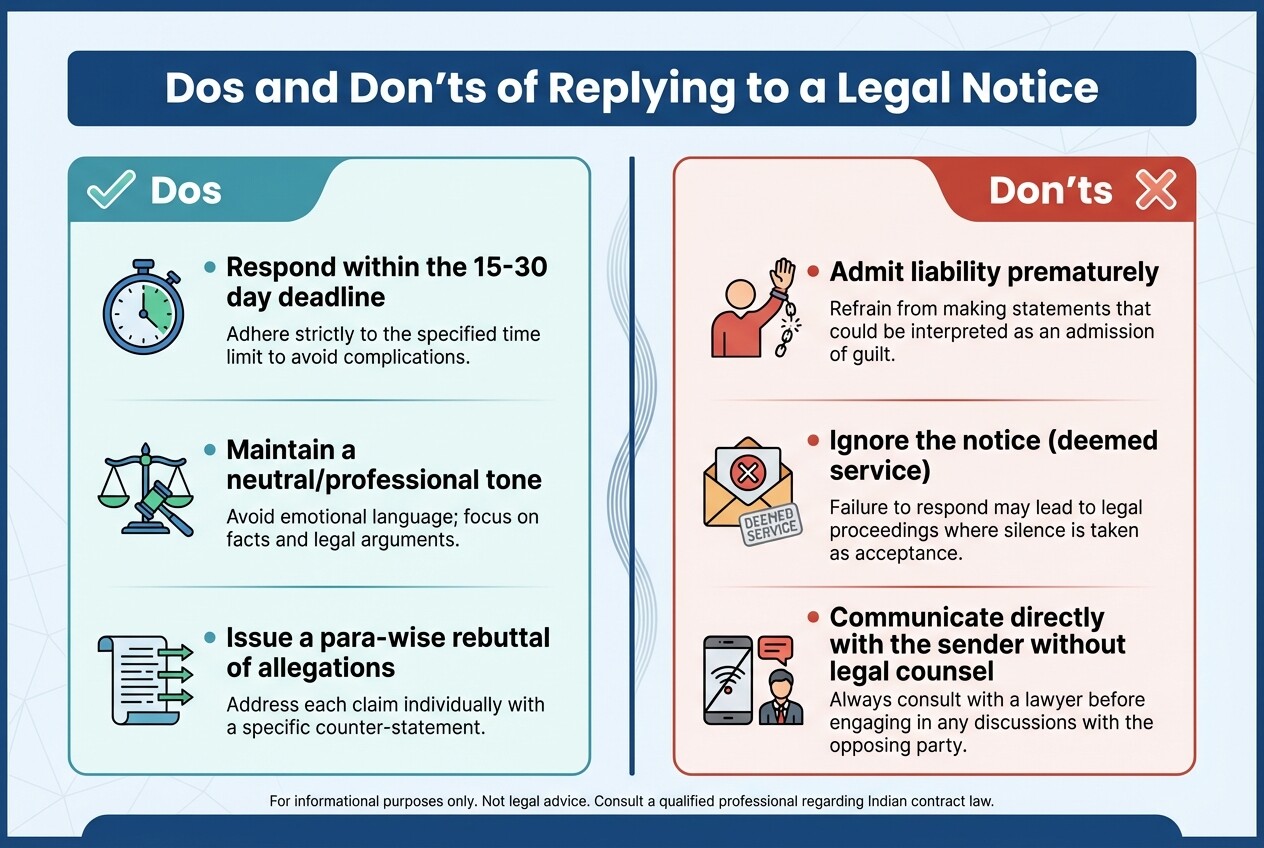
In India, a legal notice for breach of contract typically provides a window of 15 to 30 days for a response. If the notice is sent by a government body, a 60-day notice period is often mandatory under Section 80 of the Code of Civil Procedure. Missing these deadlines can trigger immediate litigation, which is both time-consuming and expensive.
Common mistakes made by Indian SMEs include:
- Admitting Liability: Avoid using language that suggests you are at fault unless you have a clear settlement strategy.
- Aggressive Tone: Using inflammatory language can escalate the situation and make future mediation difficult.
- Direct Communication: Responding personally without legal counsel can lead to accidental disclosures that may be used against you in court.
- Inconsistent Facts: Providing details in your reply that contradict your earlier emails or invoices.
How is the 15-day period calculated? Can I request an extension to respond to a legal notice? What if the notice was sent to the wrong address?
What are the options: negotiation, mediation, or litigation?
A response to a legal notice does not always have to be a denial; it can be an invitation to negotiate or mediate. Under the Commercial Courts Act, 2015, parties are often required to undergo "Pre-Institution Mediation" before the court will entertain a commercial suit. This is a cost-effective way to reach a settlement that benefits both businesses without the public exposure of a trial.
| Option | Pros | Cons |
|---|---|---|
| Negotiation | Quick, low cost, preserves relationship | No legal binding unless a settlement deed is signed |
| Mediation | Neutral third party, confidential, mandatory for many commercial disputes | Requires both parties to be willing to compromise |
| Litigation | Finality of judgment, enforceable by law | Expensive, can take years in Indian courts, public record |
How does Pre-Institution Mediation work in India? What is the cost of filing a commercial suit? Can I counter-sue the sender for harassment?
Why should you engage an Indian contract lawyer early?
Engaging a lawyer at the notice stage allows you to frame a "Reply Notice" that strategically protects your interests while keeping the door open for settlement. A lawyer will identify if the notice is legally valid, whether the claims are barred by the Limitation Act (usually 3 years for contract disputes), and if the court mentioned has the jurisdiction to hear the case.
In India, the cost of drafting a reply to a legal notice can range from ₹5,000 to ₹25,000, depending on the complexity and the lawyer's experience. This is a small investment compared to the potential loss of a lawsuit or the high court fees required for defending a case in a District or High Court.
How do I find a specialized contract lawyer in my city? Will a lawyer help me settle out of court? What information should I provide to my lawyer during the first consultation?
Common Misconceptions
"If I don't sign for the courier, I haven't officially received the notice."
In India, if a notice is sent to your registered business address via Registered Post AD or Speed Post and is returned as "refused" or "unclaimed," the law deems it as "served." Courts will proceed as if you are aware of the contents.
"A legal notice is the same as a police complaint."
A breach of contract is primarily a civil matter. While some parties try to add a criminal twist by alleging "cheating" under Section 420 of the Indian Penal Code, a standard breach of contract notice does not involve the police or jail time.
Frequently Asked Questions
Can a legal notice be sent via email or WhatsApp in India?
Yes, the Supreme Court of India and various High Courts have recognized service of legal notices through digital means, including email and WhatsApp, provided there is proof of delivery or the "blue tick" read receipt.
What should be the format of a reply to a legal notice?
The reply should be on the letterhead of a practicing advocate. It must include a point-by-point rebuttal (para-wise reply) of the allegations, a statement of your own facts, and a demand to withdraw the notice within a specific timeframe.
What is the Limitation Period for a breach of contract in India?
Under the Limitation Act, 1963, a party generally has 3 years from the date the breach occurred to file a lawsuit. If the notice is sent after this period, you can argue that the claim is "time-barred."
When to Hire a Lawyer
You should consult a lawyer immediately if:
- The notice involves a high monetary value (e.g., above ₹5 Lakhs).
- The sender threatens to halt your business operations or invoke an injunction.
- You have a strong counter-claim against the sender for unpaid dues or damages.
- The contract involves complex intellectual property or international trade clauses.
Next Steps
- Verify the sender: Check if the advocate who sent the notice is a legitimate member of the Bar Council.
- Scan and save: Create a digital copy of the notice and the envelope it arrived in (to prove the date of receipt).
- Draft a timeline: Write down exactly what happened from the day the contract was signed to the day you received the notice.
- Consult an expert: Reach out to a contract dispute lawyer to draft a formal reply within the deadline.