- Choosing a foreign "Seat" for arbitration allows global SaaS vendors to apply non-Indian procedural laws, though Indian courts can still grant interim relief unless specifically excluded.
- Institutional arbitration (e.g., SIAC or MCIA) is highly recommended over ad hoc arbitration for SaaS disputes to ensure predictable timelines and professional administration.
- India is a signatory to the New York Convention, making foreign arbitral awards enforceable in Indian courts provided they are from a "reciprocating territory."
- The distinction between "Seat" and "Venue" is a critical drafting point; the Seat determines the legal jurisdiction, while the Venue is merely the physical location of hearings.
- Recent amendments to the Arbitration and Conciliation Act have introduced mandatory timelines for domestic cases, though international commercial arbitrations enjoy more flexibility.
Should you choose institutional or ad hoc arbitration for SaaS contracts in India?
Institutional arbitration is the preferred choice for international SaaS contracts because it provides a structured framework, pre-established rules, and administrative oversight. Unlike ad hoc arbitration, where parties must self-manage the process, institutions offer a list of qualified arbitrators and fixed fee schedules that prevent costs from spiraling.
In the context of the Indian tech sector, the choice usually falls between:
- Institutional Arbitration: Organizations like the Mumbai Centre for International Arbitration (MCIA) or the Singapore International Arbitration Centre (SIAC) manage the process. They provide "emergency arbitrator" provisions, which are vital for SaaS companies needing to protect intellectual property or data on short notice.
- Ad Hoc Arbitration: Parties agree to conduct arbitration independently without an administrative body. While it appears cheaper initially, it often leads to delays in Indian courts when parties cannot agree on the appointment of an arbitrator.
| Feature | Institutional Arbitration | Ad Hoc Arbitration |
|---|---|---|
| Rules | Pre-defined and tested | Must be drafted by parties |
| Arbitrator Appointment | Handled by the institution | Requires mutual agreement or court intervention |
| Costs | Transparent, administrative fees apply | Unpredictable, often higher per-session fees |
| Efficiency | High (fixed timelines) | Low (prone to procedural delays) |
How enforceable are foreign arbitration awards in Indian courts?
Foreign arbitral awards are generally enforceable in India under the New York Convention, provided the award was issued in a country notified by India as a reciprocating territory. The Indian judiciary has shifted toward a "pro-enforcement" stance, meaning courts rarely interfere with foreign awards unless they violate the fundamental policy of Indian law.
To ensure your SaaS contract's foreign award is enforceable, consider these legal requirements:
- Reciprocating Territory: Ensure the seat of arbitration is in a country like Singapore, the UK, or the USA, which India recognizes for reciprocal enforcement.
- Commercial Relationship: The dispute must arise from a relationship considered "commercial" under Indian law (software licensing and SaaS agreements clearly fit this definition).
- Section 48 Grounds: An Indian court can only refuse enforcement on limited grounds, such as incapacity of parties, lack of proper notice, or if the award deals with a dispute not falling within the terms of the submission to arbitration.
What is the legal difference between Seat and Venue in IT contracts?
The "Seat" of arbitration is the most critical choice in a SaaS contract because it determines the "lex arbitri" or the law governing the arbitration procedure. The "Venue" is simply the geographical location where meetings or hearings take place for convenience and does not carry legal weight regarding court supervision.
In international SaaS agreements involving Indian clients, drafting errors often conflate these terms. For example:
- The Seat: If the Seat is Singapore, the Singapore International Arbitration Act applies, and Singaporean courts have exclusive jurisdiction over the arbitration's conduct.
- The Venue: If the Seat is Singapore but the Venue is Bangalore, the hearings happen in India for convenience, but the legal framework remains Singaporean.
Drafting Tip: Always use the phrase "The seat of arbitration shall be [City/Country]" to avoid ambiguity. If you only mention a "place" or "venue," Indian courts may interpret that location as the Seat, which could unintentionally subject the arbitration to Indian court intervention.
What interim relief measures are available under the Arbitration Act?
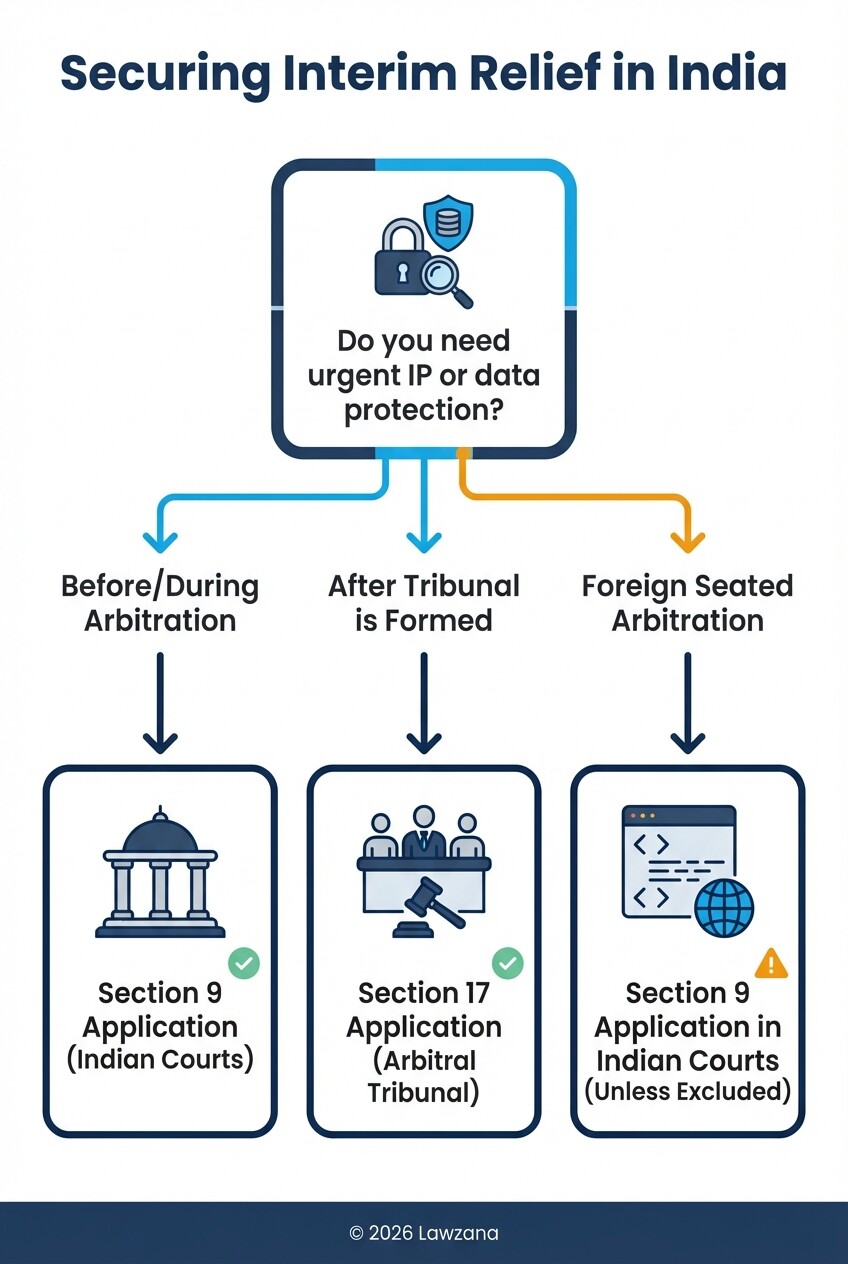
SaaS vendors can seek interim measures such as injunctions or freezing orders to prevent Indian clients from infringing on intellectual property or unauthorized use of software during a dispute. Under the Arbitration and Conciliation Act, 1996, parties can approach Indian courts for these urgent remedies even if the arbitration is seated outside India.
The two primary routes for interim relief are:
- Section 9 (Court-Ordered): A party can apply to an Indian court for interim measures before, during, or after the arbitral proceedings. This is crucial if the assets or data servers are physically located in India.
- Section 17 (Tribunal-Ordered): Once the arbitral tribunal is constituted, it has the same powers as a court to grant interim relief.
For international contracts, you must ensure that you do not accidentally exclude the application of Section 9 if you believe you may need the assistance of Indian courts to freeze assets or protect code located within Indian borders.
How can you manage costs and timelines for SaaS disputes in India?
Managing costs in Indian arbitration requires leveraging the Commercial Courts Act and choosing institutional rules that mandate expedited procedures. While domestic Indian arbitrations are legally required to be completed within 12 to 18 months, international commercial arbitrations are not bound by these strict timelines, making the choice of institutional rules even more important for efficiency.
To control expenses and time:
- Opt for Expedited Procedure: Most institutions (like SIAC or MCIA) allow for an expedited track if the amount in dispute is below a certain threshold (e.g., $6 million USD), resulting in a final award within six months.
- Limit the Number of Arbitrators: A sole arbitrator is significantly more cost-effective for SaaS disputes than a three-member tribunal.
- Pre-agreed Cost Capping: Include a clause that limits the recoverable legal costs to a reasonable percentage of the claim value.
- Virtual Hearings: Explicitly allow for virtual hearings in the contract to eliminate travel and venue booking expenses.
Common Misconceptions
Myth 1: Indian courts always interfere in international arbitration. While this was a concern in the past, the 2015 and 2019 amendments to the Arbitration Act have severely limited the scope of court intervention. Indian courts now prioritize the finality of the arbitral award, especially in "International Commercial Arbitrations."
Myth 2: You must use Indian law as the governing law if the client is in India. You are free to choose a foreign law (like New York or English law) to govern the substance of the SaaS contract. However, ensure the "Seat" is also outside India if you wish to completely avoid Part I of the Indian Arbitration Act.
Myth 3: Arbitration is always faster than litigation in India. Ad hoc arbitration can be just as slow as the court system. Only "Institutional Arbitration" with strictly enforced timelines offers a genuine speed advantage for tech companies.
FAQ
Can I enforce an "Emergency Arbitrator" award in India?
Yes, while the Act does not explicitly define "emergency arbitrator," the Supreme Court of India has held (in the Amazon v. Future Retail case) that emergency awards issued under institutional rules are enforceable in India for domestic seats. For foreign seats, they are often enforced via a Section 9 interim relief application.
What happens if my contract doesn't specify a "Seat"?
If the contract is silent, the arbitral tribunal will determine the Seat based on the circumstances of the case. This often leads to "satellite litigation" where parties fight over the jurisdiction before the actual dispute is even heard.
Is mediation mandatory before arbitration in India?
The Mediation Act, 2023 encourages pre-litigation mediation, but for international commercial arbitration, it is not currently mandatory unless your specific contract includes a "multi-tier" dispute resolution clause requiring mediation first.
Are digital signatures on SaaS contracts valid for arbitration clauses?
Yes, under the Information Technology Act, 2000, electronic contracts and digital signatures are legally recognized in India, making arbitration clauses within click-wrap or browse-wrap SaaS agreements enforceable.
When to Hire a Lawyer
You should consult a legal expert specializing in Indian arbitration and SaaS contracts if:
- You are drafting an enterprise-level agreement with a high-value Indian client (exceeding $100,000 USD).
- You need to choose between a foreign seat (e.g., Singapore) and an Indian seat based on your tax and operational structure.
- You are facing an immediate threat of IP theft or non-payment and need to move for interim relief in an Indian High Court.
- You have received a notice of arbitration from an Indian entity and need to appoint a qualified arbitrator.
Next Steps
- Review existing templates: Audit your current SaaS master service agreements (MSAs) to ensure the "Seat" is clearly defined and separated from the "Venue."
- Select an Institution: Decide on a preferred arbitration institution (like SIAC, HKIAC, or MCIA) and incorporate their standard model clause.
- Check Reciprocity: If choosing a foreign seat, confirm it is on India's list of reciprocating territories to guarantee future enforcement.
- Define Governing Law: Explicitly state the governing law for both the contract and the arbitration agreement itself.