- The Seat of arbitration is the legal jurisdiction that governs the proceedings, while the Venue is simply the physical location where hearings occur.
- Section 34 of the Arbitration and Conciliation Act, 1996, limits court intervention; awards can only be set aside for specific procedural irregularities or violations of public policy.
- India has moved toward a "pro-arbitration" regime, with the Supreme Court strictly enforcing timelines and limiting the grounds for challenging awards.
- Institutional arbitration through bodies like the MCIA or DIAC is increasingly preferred over ad-hoc methods to ensure administrative efficiency and cost predictability.
- Interim relief is available under Section 9 (from courts) and Section 17 (from the tribunal) to protect assets while the dispute is pending.
What is the legal difference between Seat and Venue in Indian law?
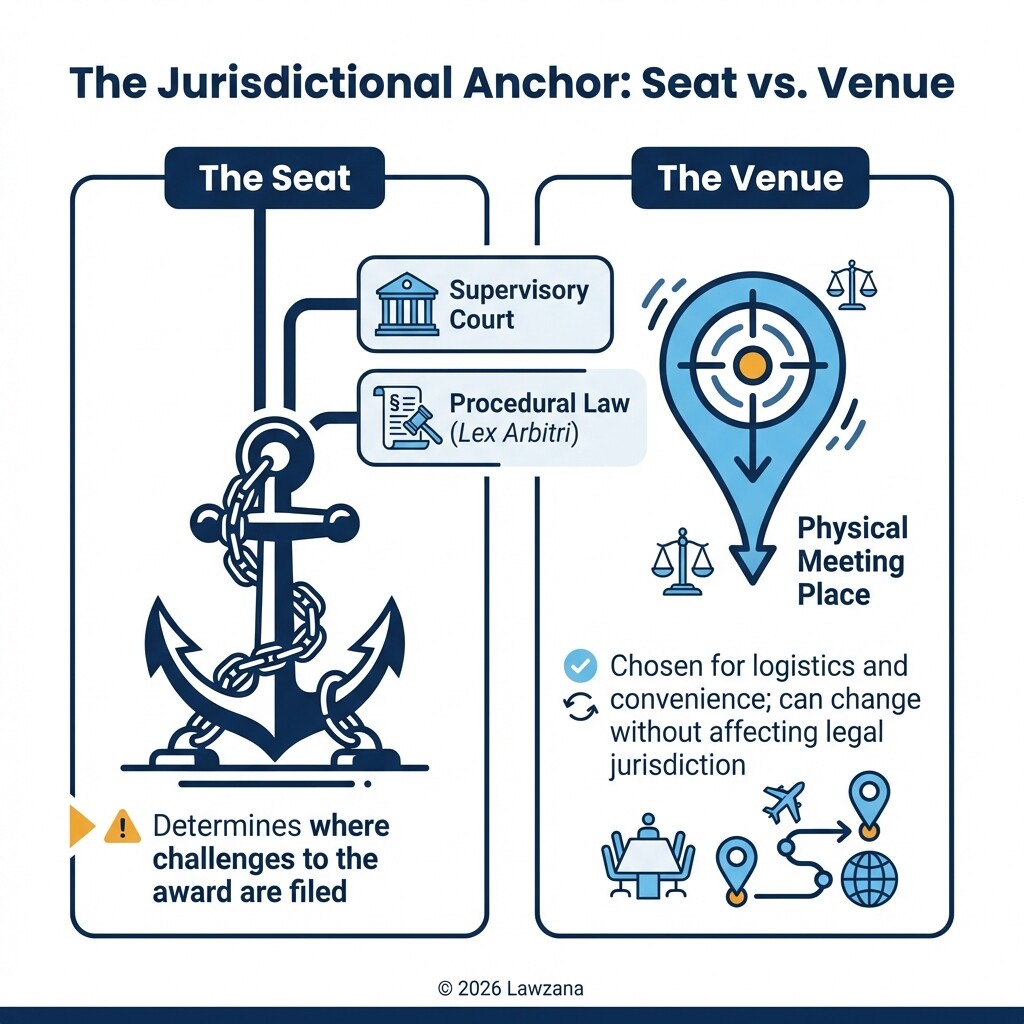
The "Seat" is the legal "home" of the arbitration, determining which court has supervisory jurisdiction and which procedural law (lex arbitri) applies. In contrast, the "Venue" is merely the geographical location where the parties, lawyers, and arbitrators meet for convenience.
In India, if the arbitration agreement designates a "Seat," the courts of that specific location have exclusive jurisdiction over the proceedings, including any challenges to the award. If only a "Venue" is mentioned without a designated "Seat," Indian courts often look at the "test of circumstances" to determine if the parties intended the Venue to function as the Seat.
| Feature | Seat (Legal Place) | Venue (Physical Location) |
|---|---|---|
| Jurisdiction | Determines which High Court supervises the case. | No impact on court jurisdiction. |
| Governing Law | Determines the procedural law of the arbitration. | No impact on the law. |
| Changing Location | Changing the Seat requires a formal contract amendment. | Can be changed easily for the convenience of witnesses. |
| Award Status | Determines the "nationality" of the award for enforcement. | Irrelevant to the award's legal status. |
What are the grounds for challenging an arbitral award under Section 34?
Under Section 34 of the Arbitration and Conciliation Act, 1996, an arbitral award can only be set aside if the petitioner proves specific, narrow grounds of unfairness or illegality. Indian courts are legally prohibited from reviewing the merits of the dispute or re-evaluating the evidence presented to the arbitrator.
The primary grounds for challenge include:
- Incapacity or Invalidity: A party was under some incapacity, or the arbitration agreement is not valid under Indian law.
- Lack of Notice: The party was not given proper notice of the appointment of an arbitrator or the proceedings.
- Beyond Scope: The award deals with a dispute not contemplated by or not falling within the terms of the submission to arbitration.
- Composition of Tribunal: The tribunal's composition or procedure was not in accordance with the agreement of the parties.
- Public Policy: The award is in conflict with the public policy of India, which includes cases of fraud, corruption, or fundamental policy of Indian law.
- Patent Illegality: For domestic arbitrations, an award can be set aside if it is "patently illegal" appearing on the face of the award (though this does not apply to international commercial arbitrations).
How does the Supreme Court of India view multi-tier arbitration clauses?
The Supreme Court of India generally enforces multi-tier arbitration clauses, which require parties to undergo preliminary steps like negotiation, mediation, or conciliation before initiating formal arbitration. These clauses are viewed as binding contractual conditions precedent that must be satisfied to trigger the arbitration process.
If a party bypasses a mandatory "friendly negotiation" period specified in the contract, the other party can challenge the commencement of arbitration as being premature. However, the Court has also clarified that if the pre-arbitral steps are worded as "discretionary" (using terms like "may") rather than "mandatory" (using "shall"), the failure to complete them will not bar the arbitration. Recent rulings emphasize that the primary goal is to respect the parties' intent while ensuring that these tiers do not become "endless loops" used as stall tactics.
Why is institutional arbitration preferred over ad-hoc arbitration in India?
Institutional arbitration is conducted under the rules of an established organization (like the MCIA or DIAC), which provides a structured framework for the dispute. Ad-hoc arbitration is managed entirely by the parties and the arbitrators themselves, which often leads to procedural delays and disputes over arbitrator fees.
The advantages of choosing an institution in India include:
- Administrative Support: The institution handles scheduling, communication, and the physical requirements of the hearings.
- Fixed Fee Schedules: Organizations like the Mumbai Centre for International Arbitration (MCIA) provide transparent, predetermined fee structures based on the claim amount, preventing unexpected costs.
- Scrutiny of Awards: Some institutions review the draft award before it is finalized to ensure it meets formal requirements, reducing the risk of it being set aside by a court.
- Appointment Efficiency: If the parties cannot agree on an arbitrator, the institution makes the appointment swiftly, avoiding the need for a time-consuming application to the High Court under Section 11.
What interim relief measures are available from Indian courts?
Interim relief consists of temporary orders meant to protect the interests of the parties and preserve the subject matter of the dispute until a final award is issued. In India, these measures are governed by Section 9 (pre-tribunal) and Section 17 (post-tribunal formation) of the Act.
Commonly granted interim measures include:
- Preservation of Goods: Orders to secure or sell perishable goods that are the subject of the dispute.
- Asset Freezing: Injunctions to prevent a party from disposing of assets or transferring funds to frustrate a potential award.
- Security for Costs: Requiring a party to deposit a specific sum into the court or a bank guarantee.
- Appointment of Receivers: Placing disputed property under the management of a court-appointed official.
Once a tribunal is constituted, the court will generally not entertain Section 9 petitions unless the party can prove that the remedy available from the tribunal under Section 17 is "inefficacious."
Common Misconceptions about Indian Arbitration
"Indian courts will re-try the entire case if I challenge the award."
This is false. The "merits-based" review is strictly prohibited. Even if the court believes the arbitrator made an error in interpreting the facts or the law, they cannot set aside the award unless that error constitutes a violation of public policy or patent illegality.
"Ad-hoc arbitration is cheaper because you don't pay institutional fees."
In reality, ad-hoc arbitration in India often becomes more expensive. Without a fixed fee schedule, arbitrators may charge per hearing, and the lack of a structured timeline can lead to years of litigation, significantly increasing legal fees.
"An arbitration award in India is just a piece of paper and cannot be enforced like a court decree."
Under Section 36 of the Act, an arbitral award is enforceable in the same manner as a decree of a civil court. Once the time for filing a challenge has expired, the winning party can initiate execution proceedings immediately to seize assets or garnish bank accounts.
Step-by-Step: Initiating Arbitration in India
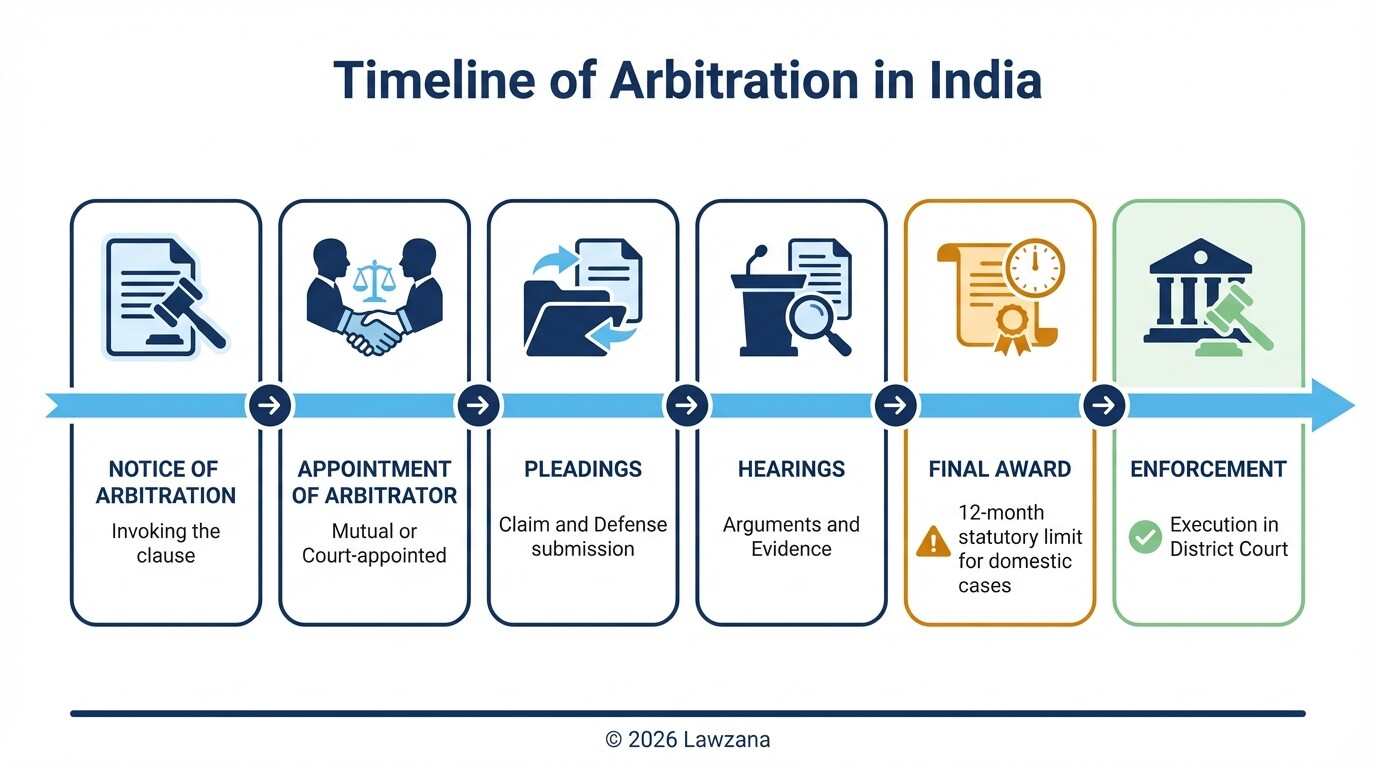
- Notice of Arbitration: Send a formal notice to the opposing party invoking the arbitration clause and suggesting an arbitrator (or following the institutional rules).
- Appointment of Arbitrator: If parties agree, the tribunal is formed. If not, an application is filed under Section 11 in the relevant High Court (or Supreme Court for international cases).
- Statement of Claim and Defense: Parties submit their written arguments and evidence.
- Hearings: Oral arguments and witness cross-examinations take place.
- Final Award: The tribunal issues a reasoned written decision. Under Section 29A, this must typically be completed within 12 months for domestic cases.
- Enforcement: After a 90-day waiting period (for challenges), the award is filed for execution in the district court where the debtor's assets are located.
Frequently Asked Questions
What is the time limit for completing an arbitration in India?
For domestic arbitrations, the award must be made within 12 months from the completion of pleadings. This can be extended by an additional 6 months by mutual consent. For international commercial arbitrations, these timelines are recommended but not mandatory.
Can an Indian court grant an injunction against an arbitration happening outside India?
Generally, no. Following the principle of "kompetenz-kompetenz," Indian courts are extremely hesitant to issue "anti-arbitration injunctions" if the parties have agreed to a foreign seat, provided the agreement is valid.
Are arbitration proceedings in India confidential?
Yes, Section 42A of the Act mandates that the arbitrator, the parties, and the arbitral institution must keep all proceedings confidential, except where disclosure is necessary for the implementation or enforcement of the award.
When to Hire a Lawyer
You should consult a specialized arbitration lawyer if:
- You are drafting a high-value commercial contract and need to ensure the "Seat" and "Venue" clauses are bulletproof.
- You have received a Notice of Arbitration and need to respond within the statutory timelines.
- You need to seek urgent interim relief to prevent the dissipation of assets.
- You are looking to enforce a foreign arbitral award against assets located in India.
- You wish to challenge a domestic award under the limited grounds of Section 34.
Next Steps
- Review your contracts: Identify if your current dispute resolution clauses specify a "Seat" or just a "Venue."
- Assess the Dispute: Determine if the claim meets the threshold for institutional arbitration to ensure a faster resolution.
- Gather Evidence: Compile all contractual correspondence and proof of breach before serving the Notice of Arbitration.
- Consult Experts: Contact a legal professional experienced in the Arbitration and Conciliation Act, 1996 to map out your litigation strategy.