FEMA Compliance Checklist for Foreign Direct Investment in India
- Determine your route: Verify immediately whether your industry falls under the automatic route or requires prior government approval before remitting funds.
- Watch the clock on allotments: Indian entities must allot shares to foreign investors within 60 days of receiving funds, or legally refund the capital within 15 days.
- File FC-GPR promptly: The Form FC-GPR must be submitted through the Reserve Bank of India's FIRMS portal within 30 days of share allotment.
- Observe pricing guidelines: Foreign investors cannot structure guaranteed exits above Fair Market Value (FMV); all equity instruments must carry inherent investment risk.
- Prepare for 2026 reporting: Modernize your compliance tracking, as the Reserve Bank of India (RBI) is rapidly transitioning to automated cross-border transaction monitoring and stricter Late Submission Fee (LSF) enforcement.
Complete FEMA Compliance Checklist for Foreign Investors
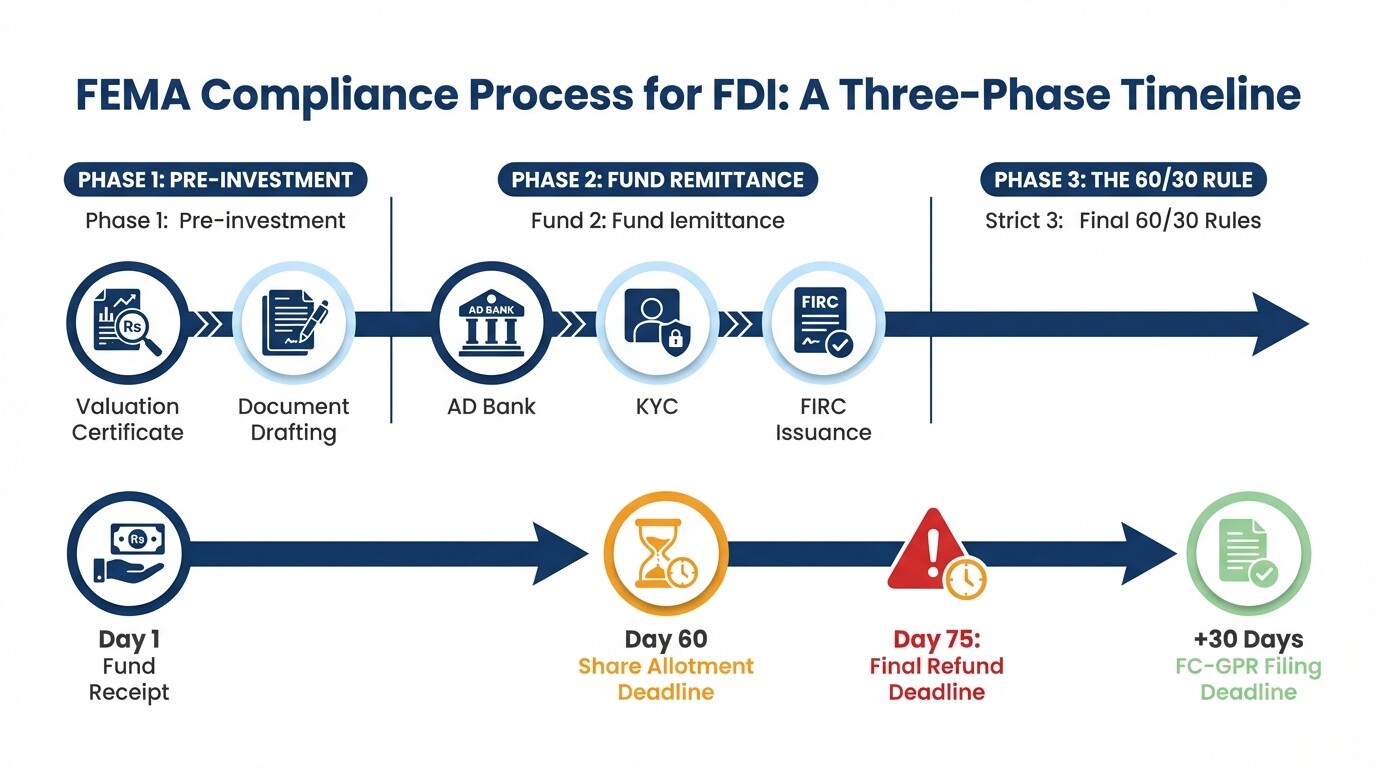
Use this comprehensive pre- and post-investment checklist to navigate India's Foreign Exchange Management Act (FEMA) framework. Managing these steps systematically prevents compliance bottlenecks, regulatory penalties, and issues during capital repatriation.
Phase 1: Pre-Investment Preparation
- Verify the FDI Route: Confirm if the target sector falls under the 100% Automatic Route, Government Route, or is a prohibited sector.
- Check Bordering Nation Rules: Ensure that if the beneficial owner is from a country sharing a land border with India (e.g., China), prior government approval is secured regardless of the sector.
- Obtain Valuation Certificate: Secure a Fair Market Value (FMV) certificate from a SEBI-registered Merchant Banker or Chartered Accountant before structuring the deal.
- Draft Compliant Agreements: Ensure the Term Sheet and Share Subscription/Shareholder Agreements explicitly prohibit guaranteed return mechanisms.
Phase 2: Fund Remittance and Banking
- Notify the AD Bank: Route the inward remittance strictly through an Authorized Dealer (AD) Category-I Bank in India.
- Collect KYC Documents: Provide your home-country banking KYC to the Indian entity's bank to clear the funds.
- Secure the FIRC: Ensure the Indian bank issues a Foreign Inward Remittance Certificate (FIRC) detailing the purpose of the funds.
Phase 3: Allotment and Reporting (The 60/30 Rule)
- Allot Shares (60 Days): The Indian company's Board must pass a resolution and allot shares within exactly 60 days of the fund receipt date.
- Register on FIRMS: Ensure the Indian entity's representative registers as a Business User on the RBI's Single Master Form (SMF) FIRMS portal.
- File Form FC-GPR (30 Days): Submit the Form FC-GPR on the FIRMS portal within 30 days of the share allotment date, attaching the FIRC, Valuation Certificate, and Company Secretary certificate.
Identifying the Automatic vs. Government Approval Route

Most foreign direct investment into India falls under the automatic route, requiring no prior regulatory approval. However, sensitive sectors or specific investor profiles require explicit government clearance before any capital can legally enter the country.
Under the automatic route, investors simply remit funds, allot shares, and report to the RBI post-investment. You do not need explicit permission to invest. Conversely, the government route requires formal prior approval through the Department for Promotion of Industry and Internal Trade (DPIIT). You must apply via the Foreign Investment Facilitation Portal (FIFP).
Government approval is mandatory if:
- Your investment is in restricted sectors like defense, broadcasting, or multi-brand retail.
- You are acquiring an existing Indian business in specific regulated sectors.
- The investor or beneficial owner is located in, or is a citizen of, a country that shares a land border with India (a rule introduced via Press Note 3 of 2020).
Avoiding Penalties: The 60-Day Share Allotment Window
Indian companies must allot equity shares to foreign investors within 60 days of receiving the inward remittance. Failing to meet this strict FEMA deadline requires the company to refund the capital within the next 15 days to avoid severe financial penalties.
Delays in share allotment are one of the most common triggers for FEMA violations. Once the capital hits the Indian entity's bank account, the clock starts. The board of directors must convene, pass the allotment resolution, and issue the shares within the 60-day window.
If the company cannot allot the shares due to regulatory or corporate issues, the funds must be repatriated immediately after the 60 days expire. If the company fails to refund the money by day 75, it constitutes a severe FEMA contravention, forcing the company to undergo a complex compounding process with the RBI to pay fines and regularize the default.
Ensuring Timely Filing of the FC-GPR Form
The Foreign Currency-Gross Provisional Return (FC-GPR) form must be filed within 30 days of the share allotment date. This mandatory filing is completed entirely online through the Reserve Bank of India's Foreign Investment Reporting and Management System (FIRMS).
With RBI's increasing shift toward automated compliance tracking heading into 2026, failing to file the FC-GPR on time triggers immediate Late Submission Fees (LSF). The LSF acts as a penalty, scaling up based on the size of the investment and the length of the delay.
To file the FC-GPR successfully, the Indian company must upload:
- The Foreign Inward Remittance Certificate (FIRC) and Know Your Customer (KYC) report from the AD Bank.
- A Valuation Certificate proving the shares were priced at or above Fair Market Value.
- A certificate from a practicing Company Secretary confirming compliance with India's Companies Act.
Complying with Sectoral Caps and Downstream Investment Rules
Foreign investors must strictly adhere to maximum foreign ownership limits designated for specific Indian industries. Furthermore, if an Indian company with foreign investment invests in another Indian entity, it triggers specific downstream investment reporting rules.
Many sectors in India permit 100% FDI, such as technology, manufacturing, and e-commerce marketplace models. However, sectors like insurance (74%), telecom (varies by sub-sector), and private security agencies (74%) have strict foreign equity caps. Structuring an investment that breaches these caps is illegal.
Downstream investment-often called indirect foreign investment-occurs when an Indian entity that is majority-owned or controlled by foreign investors uses its domestic funds to acquire shares in another Indian company. This triggers a requirement to file Form DI (Downstream Investment) on the FIRMS portal within 30 days of share allotment by the second company, ensuring the ultimate foreign beneficial ownership does not bypass sectoral caps.
Structuring Shareholder Agreements and Exit Strategies
Shareholder agreements must align with FEMA pricing guidelines, which dictate that foreign investors cannot exit an Indian company at a valuation higher than the fair market value. Drafting compliant exit clauses prevents regulatory friction during capital repatriation.
India does not permit foreign equity investments to operate like debt. Therefore, Shareholder Agreements (SHAs) cannot contain clauses that guarantee an assured rate of return upon exit. When drafting put options, call options, or buyback clauses, the language must explicitly state that the exit price will be determined by recognized valuation methodologies at the time of the exit.
- Entry Pricing: The foreign investor must purchase shares at a price equal to or higher than the calculated FMV.
- Exit Pricing: The foreign investor must sell their shares at a price equal to or lower than the calculated FMV at the time of exit.
Common Misconceptions About FEMA Compliance
Many foreign investors misunderstand the flexibility and administrative burdens of Indian foreign exchange laws. Clearing up these myths prevents costly delays and compliance breaches during cross-border transactions.
- Myth: Reporting is purely the foreign investor's responsibility. Fact: Under FEMA, the compliance and reporting burden (like filing the FC-GPR) falls squarely on the Indian investee company, though the foreign investor must provide timely KYC documentation.
- Myth: You can structure equity investments to guarantee fixed returns. Fact: FEMA prohibits guaranteed returns on equity investments. Foreign capital entering as equity must bear entrepreneurial risk, and any predetermined exit price violating FMV guidelines is void.
- Myth: Late filings can be ignored if the tax is paid. Fact: FEMA compliance is separate from tax liability. Missing RBI filing deadlines results in compounding proceedings or substantial Late Submission Fees, which can block future capital raises or exits until resolved.
Frequently Asked Questions About FDI in India
What is the FIRMS portal?
The Foreign Investment Reporting and Management System (FIRMS) is the Reserve Bank of India's official online portal used to submit the Single Master Form (SMF), which consolidates various FDI reporting forms like FC-GPR, FC-TRS, and Form DI.
Can foreign investors hold convertible notes in India?
Yes, foreign investors can invest in Indian startups through Convertible Notes. However, the Indian entity must be officially registered as a startup with DPIIT, the minimum investment must be INR 2.5 million in a single tranche, and the note must convert to equity or be repaid within ten years.
What is a Foreign Inward Remittance Certificate (FIRC)?
A FIRC is an official document issued by an Authorized Dealer (AD) Bank in India serving as legal proof that foreign funds have been received from outside the country. It is a mandatory attachment for FDI reporting.
What happens if I want to transfer my shares to another non-resident?
Transferring shares between two non-residents generally falls under the automatic route and does not require complex pricing guidelines or RBI approval, though it may trigger tax implications in India. The transfer must be reported using Form FC-TRS.
When to Hire a Corporate Lawyer in India
Navigating FEMA regulations requires specialized legal and financial expertise, particularly during cross-border M&A, structural reorganizations, or when setting up a new subsidiary in India. Retaining legal counsel is strongly advised when:
- You are investing in a heavily regulated sector with strict FDI caps.
- Your investment structure involves complex instruments like compulsorily convertible preference shares (CCPS) or convertible debentures.
- You need to draft or negotiate Shareholder Agreements to ensure exit clauses comply with FEMA pricing guidelines.
- You have missed a 60-day allotment or 30-day reporting deadline and need to navigate the RBI's compounding process.
To ensure your investment is structured compliantly from day one, consider consulting corporate and commercial lawyers in India who specialize in cross-border transactions and FEMA regulations.
Next Steps for Foreign Investors
- Engage a Local Advisor: Partner with an Indian Chartered Accountant or corporate law firm to review your proposed investment structure against current FEMA and DPIIT guidelines.
- Conduct Pre-Deal Valuation: Instruct an Indian valuer to establish the Fair Market Value of the target company before executing term sheets.
- Align Banking Channels: Open communications between your home bank and the Indian entity's AD Bank early to ensure seamless issuance of KYC and FIRC documents.