How can Italian exporters perform due diligence for high-risk jurisdictions?
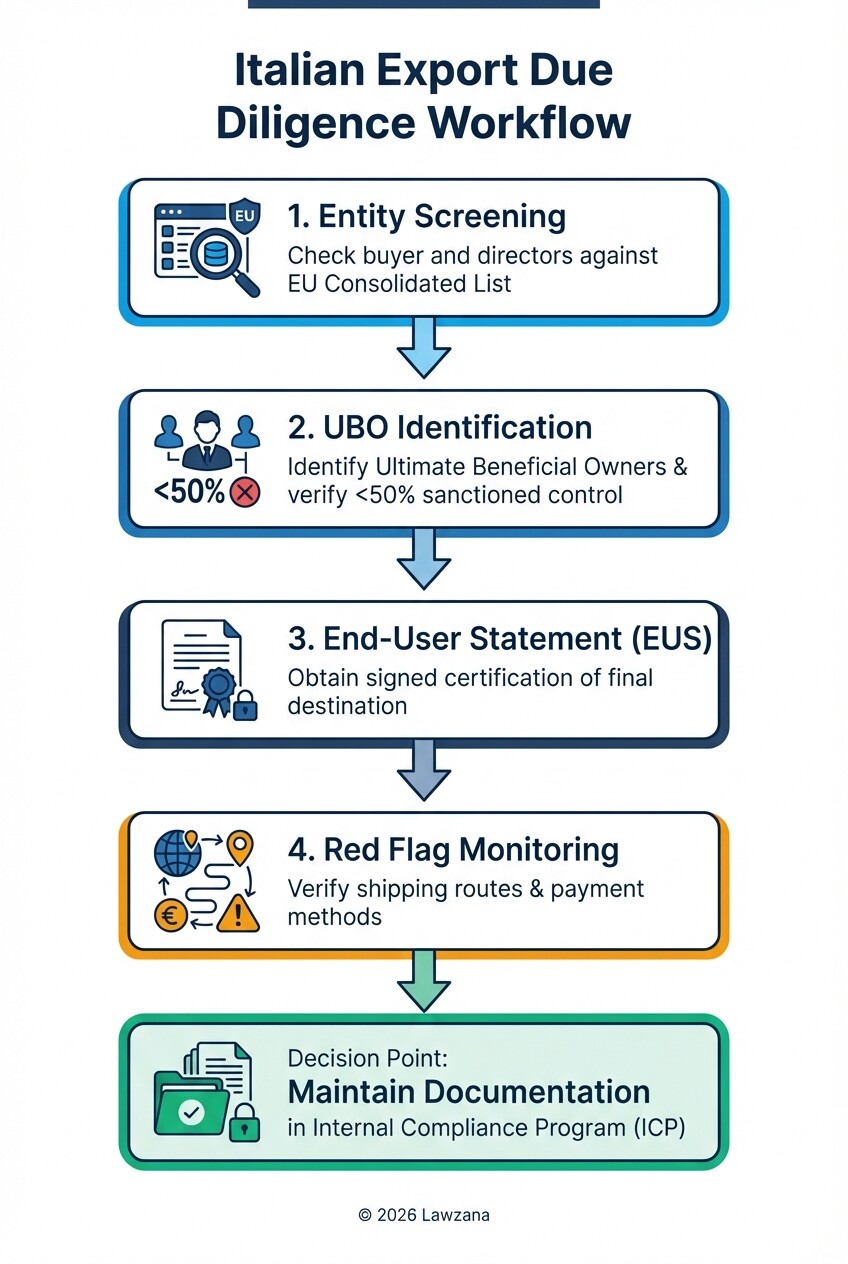
Italian exporters must implement a "Know Your Customer" (KYC) protocol that identifies the ultimate beneficial owner of the buying entity and the intended end-use of the product. This process involves cross-referencing all parties against the European Union's Sanctions Map and other international restrictive lists to ensure no funds or goods are inadvertently provided to sanctioned individuals or entities.
Effective due diligence in the luxury sector requires a multi-layered approach because high-value items are often targets for money laundering or diversion to restricted markets. Companies should follow these steps:
- Entity Screening: Check the buyer, their parent company, and their directors against the EU Consolidated List of Sanctions.
- End-User Statements (EUS): Require a formal document signed by the buyer certifying that the goods will not be re-exported to restricted regions or used for prohibited activities.
- UBO Identification: Verify the Ultimate Beneficial Owner (UBO) of the purchasing company. If a sanctioned person owns or controls more than 50 percent of the entity, the transaction is generally prohibited.
- Red Flag Monitoring: Be wary of buyers who are reluctant to provide end-use information, offer cash payments for large orders, or request shipping routes that are circuitous or illogical.
Is a simple Google search enough for due diligence?
While helpful, a manual search is insufficient for legal compliance. Italian authorities expect companies to use professional screening software and maintain a "Compliance Program" (Programma di Conformità Interna) that documents the steps taken for every transaction.
What luxury items are classified as dual-use goods under Italian law?
In Italy, dual-use goods are items, software, or technologies that are primarily designed for civilian purposes but could also be used for military applications or the production of weapons. Within the luxury sector, this often includes high-specification materials like carbon fiber, specialized sensors used in high-end watches, or advanced encryption software used in luxury telecommunications devices.
The classification of these goods is governed by EU Regulation 2021/821. If a luxury item meets the technical specifications listed in this regulation, the exporter must obtain an export license from the Unità per le autorizzazioni dei materiali di armamento (UAMA), which is part of the Italian Ministry of Foreign Affairs and International Cooperation.
Common luxury-related items that may require dual-use scrutiny include:
- High-Performance Materials: Specific alloys or composite materials used in luxury automotive or aerospace components.
- Encryption Technology: High-end secure communication devices or software integrated into luxury lifestyle products.
- Advanced Manufacturing Equipment: Specialized machinery used to create precision components for jewelry or high-fashion accessories.
- Chemicals and Toxins: Certain high-grade chemicals used in the production of luxury fragrances or cosmetics that are also precursors for restricted substances.
How do I confirm if my product is dual-use?
Exporters should consult the "Annex I" list of the EU Dual-Use Regulation. If the technical parameters of your product match any entry on that list, you must apply for an authorization through the UAMA portal.
How do you protect Made in Italy trademarks in international markets?
Protecting "Made in Italy" intellectual property involves a combination of international trademark registrations through the Madrid System and rigorous customs recordation. By registering trademarks in every jurisdiction where the brand operates, manufacturers can empower local customs authorities to seize counterfeit goods before they enter the market.
The "Made in Italy" brand is one of the most valuable assets for Italian manufacturers, but it is also highly vulnerable to "Italian Sounding" products and outright counterfeiting. To defend this IP, companies should:
- Register with WIPO: Use the World Intellectual Property Organization (WIPO) to file for international protection in multiple countries simultaneously using a single application.
- Customs Recordation: File applications for action with the Italian Customs and Monopolies Agency (ADM) and relevant foreign customs bureaus. This allows officers to proactively identify and stop shipments that infringe on your trademark.
- Blockchain and Traceability: Implement digital certificates of authenticity or NFC tags in luxury items. This provides a digital "paper trail" that proves the origin of the product to both consumers and regulators.
- Monitor Online Marketplaces: Regularly scan global e-commerce platforms for unauthorized use of your brand name or design patents.
What happens if my trademark is infringed upon abroad?
If an infringement is detected, the first step is usually a "cease and desist" letter sent by local legal counsel. If the infringement continues, you may need to pursue litigation in the local courts or seek administrative action through the country's IP office.
What contractual safeguards are necessary for international distribution?
International distribution agreements for Italian luxury goods must include robust compliance clauses that allow for immediate termination if the buyer violates trade sanctions or export controls. These contracts should clearly define the responsibilities of the distributor regarding end-user verification and prohibit the re-sale of goods into restricted territories.
Because global trade regulations change rapidly, a static contract is often insufficient. To mitigate risk, Italian manufacturers should include:
- Compliance with Laws Clause: A mandatory provision requiring the distributor to comply with all EU and local Italian export control laws.
- Right to Audit: The manufacturer should have the right to audit the distributor's books and records to verify the final destination of the luxury goods.
- Sanctions Out-Clause: A specific "Force Majeure" or termination clause that triggers if new sanctions make the fulfillment of the contract illegal.
- Indemnification: The distributor should agree to indemnify the Italian manufacturer for any fines or legal costs resulting from the distributor's breach of export laws.
Can I be held liable for my distributor's actions?
Yes. Under the principle of "vicarious liability," Italian companies can be held responsible if they knew, or should have known, that their distributor was diverting luxury products to sanctioned markets.
How do recent EU sanctions specifically impact Italian luxury exports?
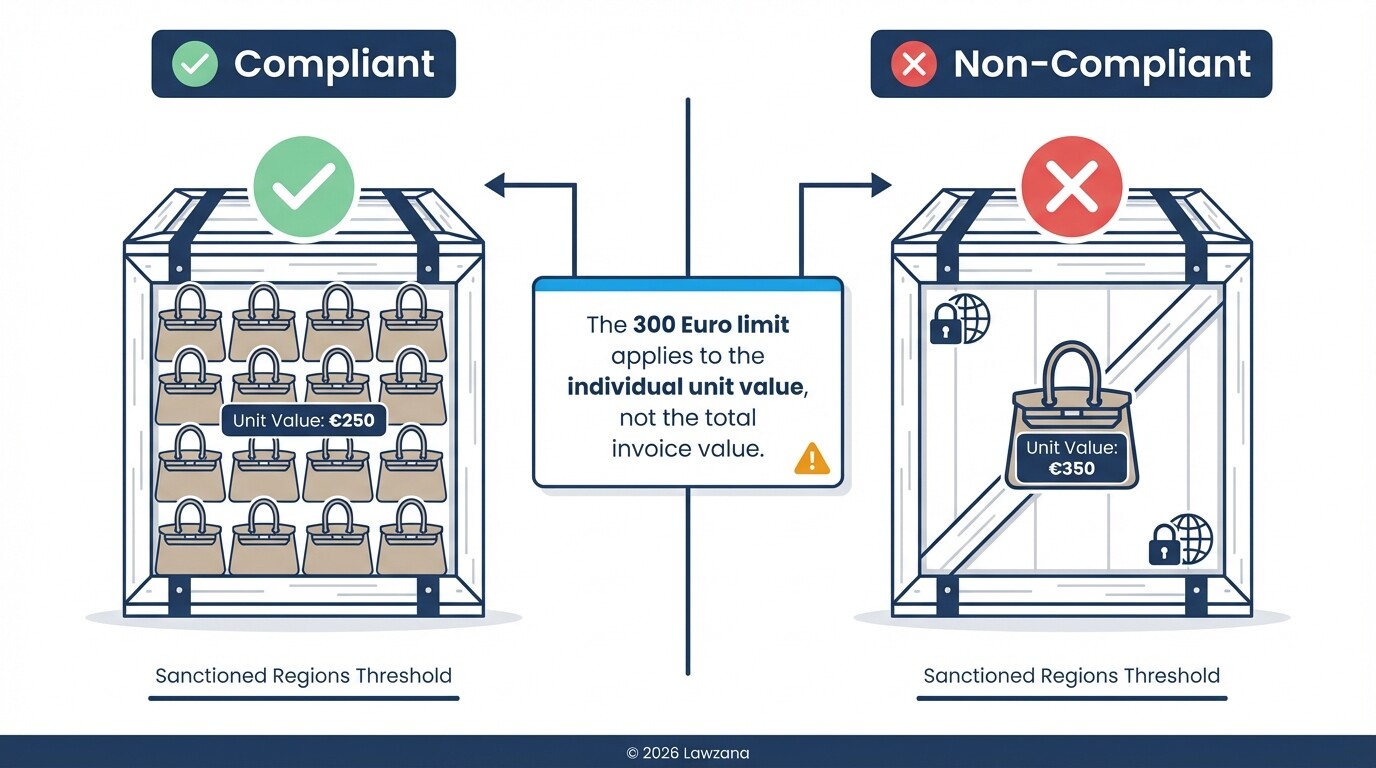
Recent EU sanctions packages, particularly those targeting Russia, have introduced a specific ban on the export of luxury goods valued at more than 300 Euros per item. This threshold applies to a wide range of categories, including high-end fashion, leather goods, jewelry, and luxury vehicles, effectively halting most traditional luxury trade with sanctioned regions.
The Italian government enforces these EU-wide regulations through the Comitato di Sicurezza Finanziaria (CSF) and the Customs Agency. Exporters must be aware that:
- Price Thresholds: The 300 Euro limit is per item, not per shipment. If a single handbag costs 350 Euros, it cannot be exported to Russia, even for personal use.
- Expanded Lists: The list of restricted luxury items is constantly updated and includes everything from perfumes and cosmetics to porcelain and electronic devices for domestic use.
- Circumvention Risks: Exporting to "middleman" countries (like certain Central Asian republics) with the intent that the goods will end up in Russia is a criminal offense known as "circumvention."
Where can I find the most updated list of sanctioned goods?
The European Commission's official website provides detailed lists of all restricted goods and the specific regulations (such as Regulation 833/2014) that govern them.
Common Misconceptions About Italian Export Controls
"My products are for fashion, so trade sanctions don't apply to me." This is a dangerous myth. Luxury goods are frequently the first items targeted by economic sanctions because they are seen as non-essential items consumed by the political elite of sanctioned nations.
"If I sell to a distributor in Dubai or Turkey, I am not responsible for where the goods go next." Italian law requires "due diligence" throughout the supply chain. If you are aware that your distributor is funneling products into a sanctioned region, you can face the same penalties as if you had shipped them there directly.
"The 300 Euro limit applies to the total invoice amount." The limit applies to the "unit value" of the item. An invoice for 10,000 Euros is acceptable if it consists of 100 items worth 100 Euros each, but a single item worth 301 Euros would be prohibited for export to sanctioned zones.
FAQ
What are the penalties for violating export controls in Italy? Violations can result in administrative fines reaching millions of Euros and criminal penalties for company executives, including imprisonment for up to 10 years. Additionally, the company may be barred from receiving government contracts or future export licenses.
Do I need a license to export "Made in Italy" goods to the USA? Generally, no license is required for standard luxury goods sent to the United States. However, you must still ensure that the specific US buyer is not on any "Denied Persons" or "Specially Designated Nationals" lists maintained by the US Treasury (OFAC).
How long does it take to get an export license from UAMA? The processing time for a dual-use license in Italy typically ranges from 30 to 90 days, depending on the complexity of the product and the destination country. It is essential to apply well in advance of the shipping date.
When to Hire a Lawyer
Navigating the intersection of Italian trade law and global sanctions requires specialized expertise. You should consult a legal professional if:
- You are entering a new market that is subject to international scrutiny or high levels of corruption.
- Your products involve advanced materials or technologies that might fall under "dual-use" categories.
- You have discovered a potential breach of compliance within your distribution network.
- You need to draft complex international distribution agreements with specific "sanction-proof" language.
- You are facing an audit or investigation by the Italian Customs Agency or UAMA.
Next Steps
- Audit Your Portfolio: Identify which of your products exceed the 300 Euro threshold or contain dual-use technology.
- Screen Your Partners: Run your current client list through the EU Sanctions Map to ensure no immediate risks.
- Update Contracts: Review your existing distribution agreements to ensure they include "right to terminate" clauses for sanctions violations.
- Consult an Expert: Engage a trade lawyer in Italy to develop a formal Internal Compliance Program (ICP) to protect your company from liability.