- Italy's "Golden Power" framework allows the government to veto or impose conditions on foreign investments in strategic sectors.
- Non-EU acquirers must notify the Italian government before closing deals that hit specific ownership thresholds.
- The standard regulatory review takes 45 days. A mandatory standstill period prevents the transaction from closing during this time.
- Failing to notify authorities triggers fines up to twice the transaction value and forced divestiture.
- Buyers should structure Golden Power clearance as a Condition Precedent (CP) in their Share Purchase Agreements to avoid legally binding themselves to a blocked deal.
Understanding the Golden Power Framework
Italy's Golden Power rules are Foreign Direct Investment (FDI) regulations that give the Italian government authority to review, condition, or block transactions involving strategic national assets. Non-EU corporate acquirers must comply with these rules before executing an M&A transaction in Italy.
Administered directly by the Italian Presidency of the Council of Ministers, the regime imposes a strict mandatory notification system. A transaction cannot legally close until the government issues a clearance decision. While non-EU companies face the strictest thresholds, EU-based acquirers are not fully exempt and must also notify the government when acquiring controlling stakes in Italian strategic assets.
Strategic Sectors Triggering Review
The government applies Golden Power rules to acquisitions in sectors critical to national security and economic stability. Non-EU buyers acquiring controlling stakes, or minority shares starting at 10% in certain industries, face mandatory government scrutiny if the investment exceeds €1 million.
The definition of a strategic sector has expanded significantly. Mandatory notification is highly likely if the target company operates in:
- Defense and security: Military equipment, dual-use technologies, and classified defense contractors.
- Critical infrastructure: Energy, transport networks, water supply, telecommunications, and healthcare facilities.
- Technology: Artificial intelligence, semiconductors, cybersecurity, aerospace, and quantum technology.
- Financial data: Banking, insurance, credit institutions, and large-scale data processing centers.
- Supply chains: Agri-food, healthcare supplies, and critical raw materials.
Notification Checklist: Required Documentation
Filing a Golden Power notification requires submitting a detailed digital dossier to the Department for the Coordination of Administrative Policies (DICA). There is no official government filing fee, but acquirers must compile extensive corporate and financial disclosures to prove the transaction does not threaten Italian interests.
Acquirers must prepare the following documentation:
- Corporate profile: Certified articles of incorporation, bylaws, and recent audited financial statements for the non-EU purchasing entity.
- Ultimate Beneficial Ownership: An organizational chart tracing ownership to the ultimate individual beneficiaries. This must disclose any state-owned influence or sovereign wealth fund backing.
- Target information: A description of the Italian target's operations, market share, and specific strategic assets or licenses.
- Transaction documents: Copies of the Share Purchase Agreement (SPA), Letters of Intent, or binding offers.
- Post-closing plan: A strategic memorandum outlining the acquirer's intentions for workforce retention, R&D continuity, and data security.
- Financing structure: Documentation showing the source of funds for the acquisition, including debt instruments or third-party financing.
The Clearance Process and Timeline
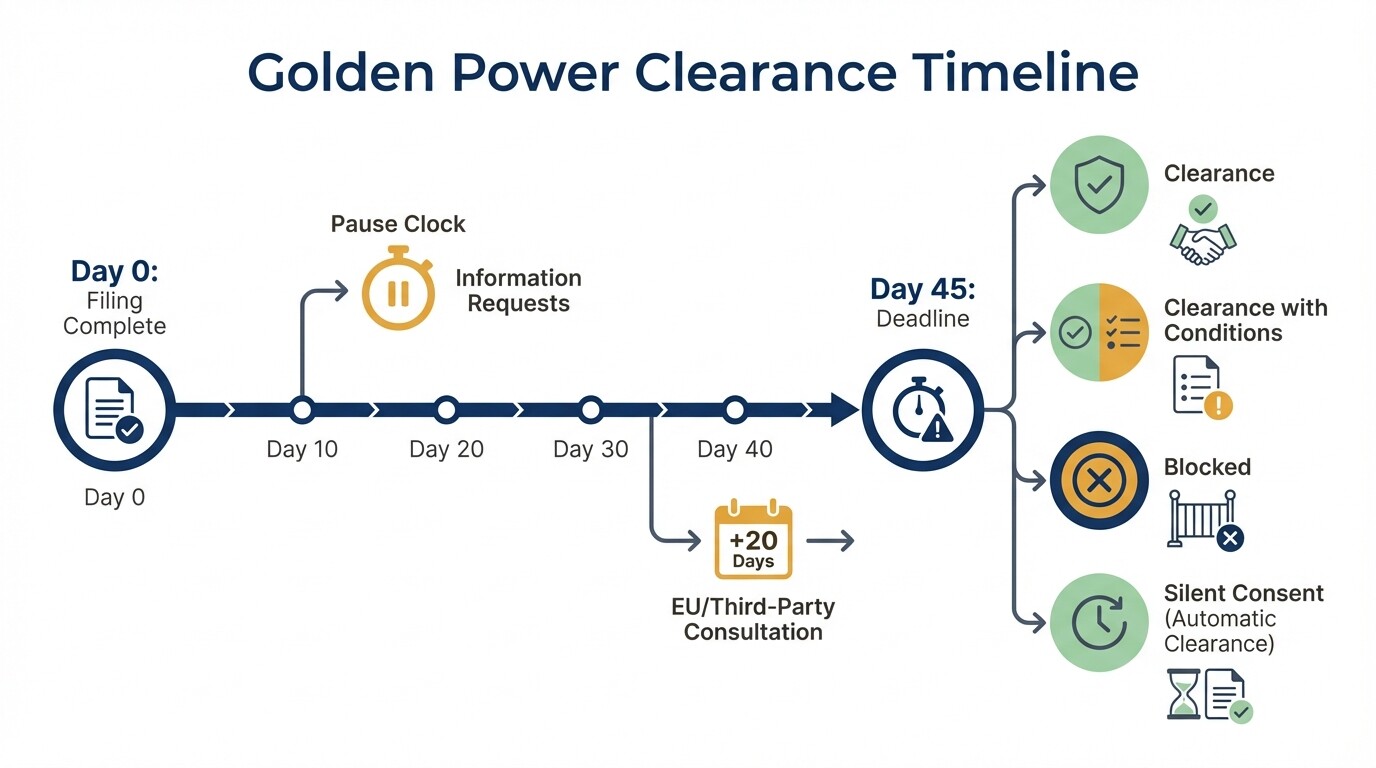
The standard review period for Golden Power clearance is 45 days from the date the government receives a complete notification. A "standstill obligation" remains in effect throughout this period. The parties cannot execute the transaction, transfer shares, or alter the target's corporate structure.
The timeline generally proceeds as follows:
- Filing (Day 0): The 45-day clock begins once the submission is officially deemed complete.
- Information requests: The government may pause the clock once to request additional data from the acquirer or target. The countdown resumes only when the parties provide the requested information.
- Third-party inquiries: Authorities can extend the deadline by 20 days to consult with other European Union member states or the European Commission.
- Final decision: The government issues a decree to clear the deal unconditionally, clear it with binding conditions, or block it.
- Silent consent: If the 45-day statutory timeline expires without a formal decree from the Presidency of the Council of Ministers, the "silence means consent" rule applies, and the transaction is automatically cleared.
Structuring Alternatives if Blocked
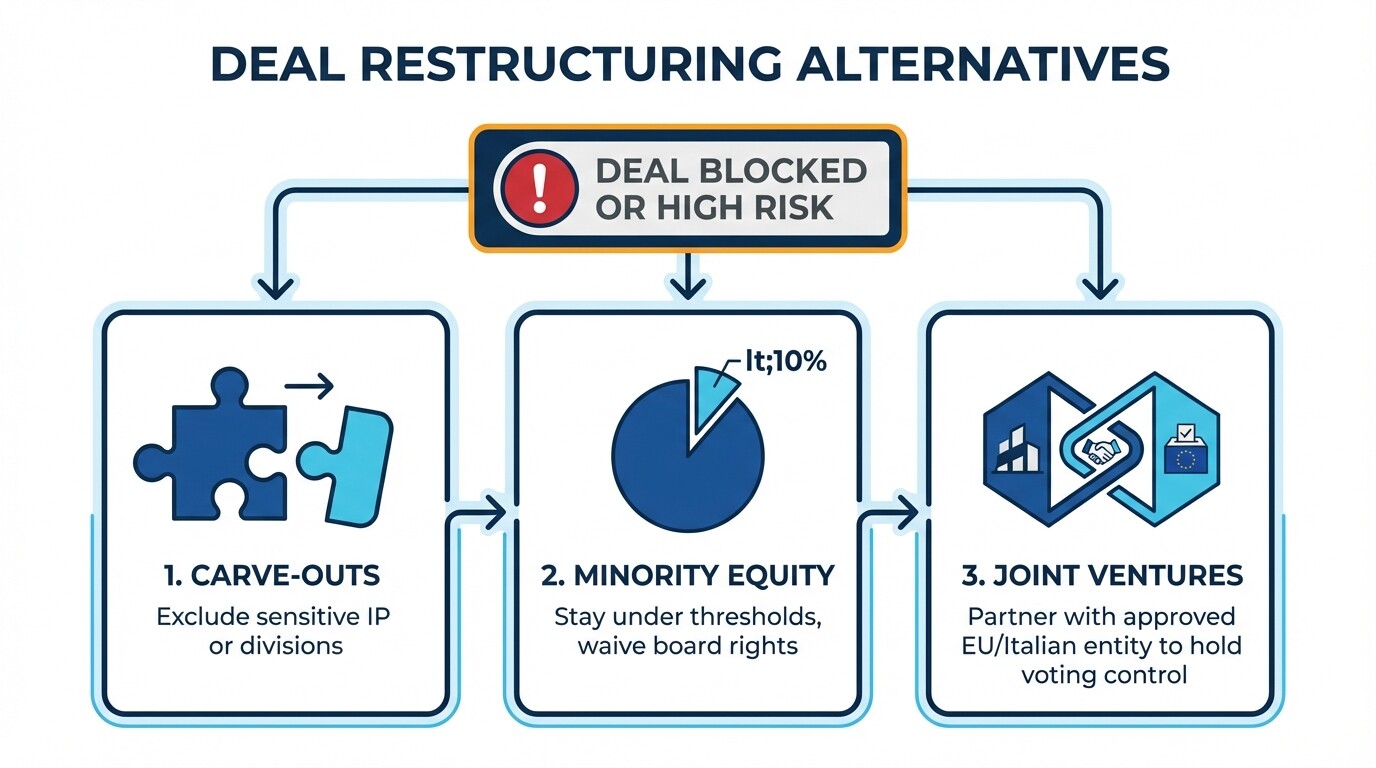
If the Italian government blocks an acquisition or imposes prohibitive conditions, parties can often restructure the deal. Anticipating regulatory pushback allows foreign acquirers to draft alternative transaction frameworks into early term sheets.
Common restructuring models include:
- Carve-outs: Excluding specific sensitive intellectual property or strategic divisions from the transaction, allowing the non-EU buyer to acquire the remaining commercial business.
- Minority equity: Reducing the purchase below the relevant Golden Power threshold (e.g., staying under 10% in restricted tech sectors) and waiving board appointment rights.
- Joint ventures: Partnering with an approved Italian or EU entity to form a joint venture where the EU partner retains voting control over the sensitive assets.
Penalties for Non-Compliance
Closing a transaction without Golden Power clearance is a direct violation of the standstill obligation. Italian authorities actively monitor corporate registries and press releases for undisclosed M&A activity.
The consequences for failing to notify the government or bypassing the clearance process include:
- Financial fines: Penalties range from 1% to 3% of the acquirer's global turnover, or up to twice the value of the transaction, whichever is higher.
- Nullification: Any corporate resolutions, voting rights exercises, or share transfers executed without clearance are legally null and void.
- Forced unwinding: The government can order the unwinding of the transaction at the acquirer's expense. This often forces a fire sale of the acquired assets to restore the pre-transaction status quo.
When to Hire an M&A Lawyer in Italy
Engaging local legal counsel during the due diligence phase prevents compliance failures. An Italian M&A attorney will assess whether your specific transaction triggers mandatory FDI filings, draft the notification dossier, and structure Condition Precedent clauses to protect your earnest money.
Non-EU entities planning an acquisition, joint venture, or asset purchase should secure representation before signing binding term sheets. To find experienced corporate counsel to navigate the Golden Power process, browse top M&A lawyers in Italy.