- Malaysian law imposes identical fiduciary duties and personal liabilities on both local and foreign directors under the Companies Act 2016.
- Every Malaysian private company must maintain at least one resident director whose principal place of residence is in Malaysia.
- Annual returns and audited financial statements must be filed on strict timelines with the Companies Commission of Malaysia (SSM) to avoid severe penalties.
- Navigating cross-border conflicts of interest requires formal declarations and recusal, especially when representing a foreign parent company.
- Securing localized Director and Officer (D&O) liability insurance is critical for mitigating personal exposure to regulatory defense costs.
Foreign Director Compliance Checklist
Staying compliant as a foreign director in Malaysia requires adhering to strict timelines and statutory filings. Use this checklist to ensure you meet all foundational corporate governance obligations upon appointment and throughout the fiscal year.
- Verify Resident Director Status: Confirm the company has at least one director whose principal residence is in Malaysia.
- Sign the Consent to Act: Execute Form 45 (Consent to Act as Director and Declaration) prior to your formal appointment.
- Declare Shareholdings and Interests: Disclose your shares, debentures, and any conflicts of interest in the company or its related corporations within 14 days of appointment.
- Review D&O Insurance: Obtain a copy of the company's Director and Officer liability policy and ensure it covers cross-border and local regulatory defense costs.
- Establish a Board Meeting Schedule: Ensure the board meets frequently enough to properly oversee the subsidiary, even if you attend via video conferencing.
- Monitor Filing Deadlines: Calendar the anniversary date of incorporation for Annual Returns and the financial year-end for audited financial statements.
Statutory Duties Under the Malaysian Companies Act
Foreign directors owe the exact same fiduciary duties as local directors under the Malaysian Companies Act 2016. You must act in good faith, exercise reasonable care, skill, and diligence, and always prioritize the Malaysian subsidiary's best interests over the interests of the foreign parent company that appointed you.
The law establishes two primary categories of duties for all directors:
- Fiduciary Duties: You must act honestly and in the best interest of the company. You cannot use your position, corporate property, or corporate information to gain an unfair advantage for yourself or others.
- Duties of Care, Skill, and Diligence: You must exercise the level of care and diligence expected of a reasonable director in your position. While you can delegate certain tasks to management, you cannot delegate your ultimate oversight responsibility. Ignorance of local operations is not a valid legal defense in Malaysia.
Required Documentation for Annual Returns and Financial Statements
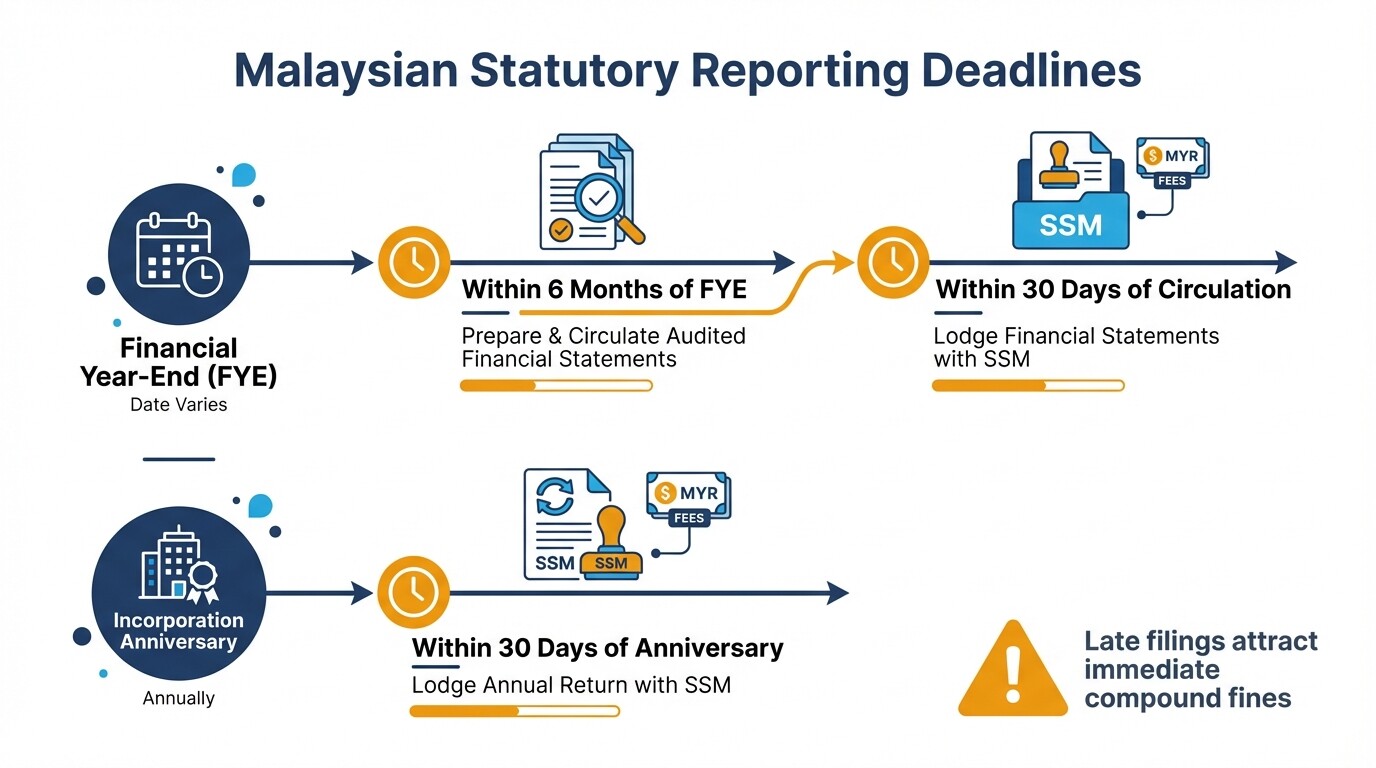
Malaysian subsidiaries must lodge their Annual Return within 30 days of their incorporation anniversary and file audited financial statements within 30 days of circulation to members. Foreign directors must ensure these documents accurately reflect the company's financial health and are submitted to the Companies Commission of Malaysia (SSM) on time.
The statutory reporting process involves specific milestones:
- Preparation of Financial Statements: The board must ensure financial statements are prepared within six months of the financial year-end.
- Statutory Audit: Unlike some jurisdictions, most Malaysian private companies require their financial statements to be audited by an approved local auditor.
- Circulation to Members: Audited statements must be circulated to all shareholders within six months of the financial year-end.
- Lodgment with SSM: The finalized financial statements and the Annual Return (detailing current shareholding, directorships, and registered office addresses) must be officially lodged with SSM. Late filings attract immediate compound fines.
Consequences of Failing the Resident Director Requirement
A Malaysian private company must maintain at least one director who ordinarily resides in Malaysia. Failing to meet this resident director requirement is a statutory offense that can result in hefty fines, company deregistration, and personal liability for the remaining foreign directors.
The "principal place of residence" rule means the resident director must spend the majority of their time in Malaysia. Using a temporary visitor or someone who merely holds a Malaysian address does not satisfy the law. If the sole resident director resigns, passes away, or relocates, the company has up to six months to appoint a replacement. Operating without a resident director beyond this grace period exposes the company and its existing foreign directors to fines of up to RM 50,000. Furthermore, the SSM may initiate proceedings to strike the company off the register.
Comparing Director and Officer (D&O) Liability Insurance Options
D&O insurance protects foreign directors from personal financial loss resulting from alleged wrongful acts in their management capacity. Choosing the right coverage depends on whether the policy needs to cover parent company risks, local subsidiary risks, or specific Malaysian regulatory defense costs.
| Insurance Structure | Coverage Scope | Best For | Potential Drawbacks in Malaysia |
|---|---|---|---|
| Global Master Policy | Covers directors globally under the foreign parent company's master plan. | Multinational corporations centralizing risk management. | May lack compliance with local Malaysian insurance regulations, complicating local claims payouts. |
| Local Admitted Policy | Issued directly by a Malaysian-licensed insurer tailored to the subsidiary. | Foreign directors wanting guaranteed coverage for local SSM regulatory actions. | Requires separate premium payments and administration by the Malaysian subsidiary. |
| Stand-Alone Run-Off Policy | Covers past acts for a specific time after a director resigns or the company is sold. | Exiting foreign directors or during M&A transactions. | Premiums can be high for short-term coverage, and it offers no forward-looking protection. |
Best Practices for Avoiding Conflicts of Interest in Cross-Border Transactions
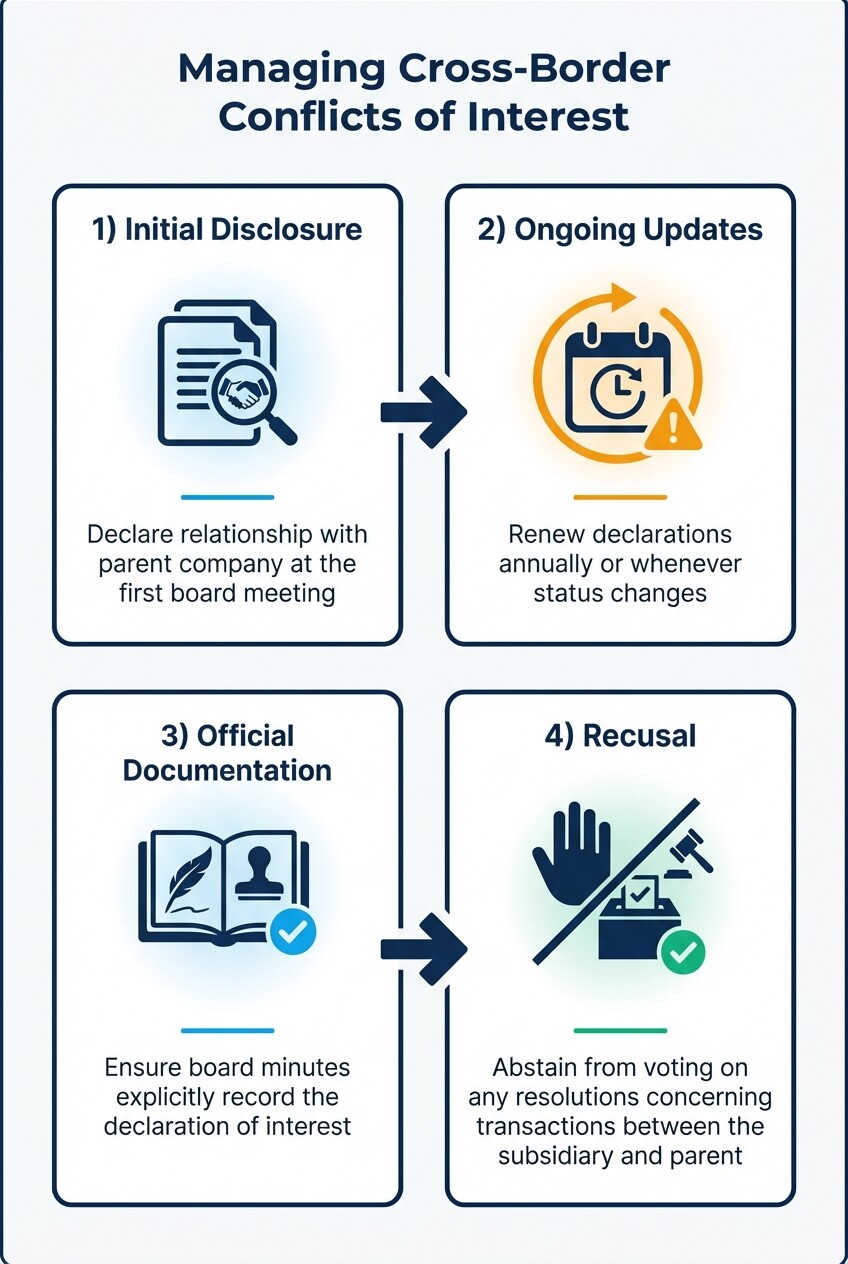
Foreign directors often represent parent companies, which creates natural conflict of interest risks when dealing with the Malaysian subsidiary. To navigate cross-border transactions safely, directors must formally disclose their interests and recuse themselves from relevant board votes.
Under Section 221 of the Companies Act 2016, directors must declare the nature and extent of any direct or indirect interest in a contract or proposed contract with the company.
To maintain compliance during cross-border dealings:
- Make a general disclosure of your relationship with the parent company at your first board meeting.
- Update your declarations annually or whenever your status in the parent company changes.
- Ensure the minutes of the board meeting explicitly record your declaration of interest.
- Abstain from voting on any resolution concerning transactions between the Malaysian subsidiary and the foreign parent entity.
Common Misconceptions About Foreign Directorships in Malaysia
Many foreign executives assume their liability in Malaysia is limited by their non-resident status or the parent company's corporate veil. This is false, as Malaysian law applies equally to all directors regardless of their physical location or nationality.
Another frequent myth is that "nominee" or "sleeping" directors bear no responsibility for the company's daily operations. Under Malaysian corporate law, there is no distinction between active, nominee, or non-executive directors regarding statutory compliance. A foreign director appointed merely to represent a shareholder's interest still carries full personal liability if the company fails to pay taxes, breaches employment laws, or commits environmental offenses.
Frequently Asked Questions
Can a foreigner be the sole director of a Malaysian company?
No. A Malaysian private company must have at least one director whose principal place of residence is in Malaysia. A foreigner can be the sole director only if they possess a valid work or residence pass and physically reside in Malaysia.
Do foreign directors need a work permit to be on the board?
A foreign director residing outside Malaysia does not need a Malaysian work permit to hold a board seat. However, if the director intends to travel to Malaysia frequently for active management or draw a local salary, an Employment Pass is required.
What are the penalties for late SSM filings?
Failing to lodge Annual Returns or audited financial statements on time results in compound fines levied against both the company and its individual directors. Persistent failures can lead to criminal prosecution and fines up to RM 50,000 per offense.
Are foreign directors personally liable for unpaid corporate taxes?
Yes. Under the Malaysian Income Tax Act 1967, directors can be held jointly and severally liable for the company's unpaid taxes if the revenue authority determines that the directors failed to ensure the company met its tax obligations.
When to Hire a Corporate Governance Lawyer
Engaging local legal counsel is essential before accepting a foreign directorship or when navigating complex cross-border compliance issues. A lawyer ensures your corporate structure meets SSM requirements and protects you from personal liability.
You should consult corporate governance lawyers in Malaysia if you are setting up a new subsidiary, need to draft robust D&O indemnification clauses, or are facing an SSM audit. Legal professionals can also assist in sourcing professional resident directors to satisfy local incorporation requirements safely.
Next Steps
Taking proactive steps early in your tenure prevents costly regulatory breaches. Begin by auditing your current compliance standing and securing the necessary local representation.
First, verify that your Malaysian subsidiary has a reliable company secretary, as they are legally responsible for submitting your filings to the SSM. Next, request a review of the company's D&O insurance policy to confirm it provides adequate localized coverage. Finally, establish a clear protocol for board meetings and conflict of interest declarations to ensure a transparent record of your governance efforts.