Expanding a Tech Business to Malaysia: Corporate Law FAQ
- 100% foreign ownership is permitted for most technology companies in Malaysia, especially those securing Malaysia Digital (MD) status.
- Incorporating a Sendirian Berhad (Sdn Bhd) typically takes one to two weeks once all compliance and identity documents are prepared.
- Malaysia Digital (MD) status replaced the former MSC Malaysia status in 2022, offering highly competitive corporate tax exemptions and streamlined foreign worker visas.
- Bumiputera equity requirements rarely apply to pure software or SaaS companies, but may be triggered if your tech intersects with regulated sectors like finance (fintech) or telecommunications.
- Data localization and privacy contracts must strictly adhere to the Personal Data Protection Act 2010 (PDPA) when transferring user data across borders.
Joint Venture vs. 100% Foreign-Owned Entity Alternatives
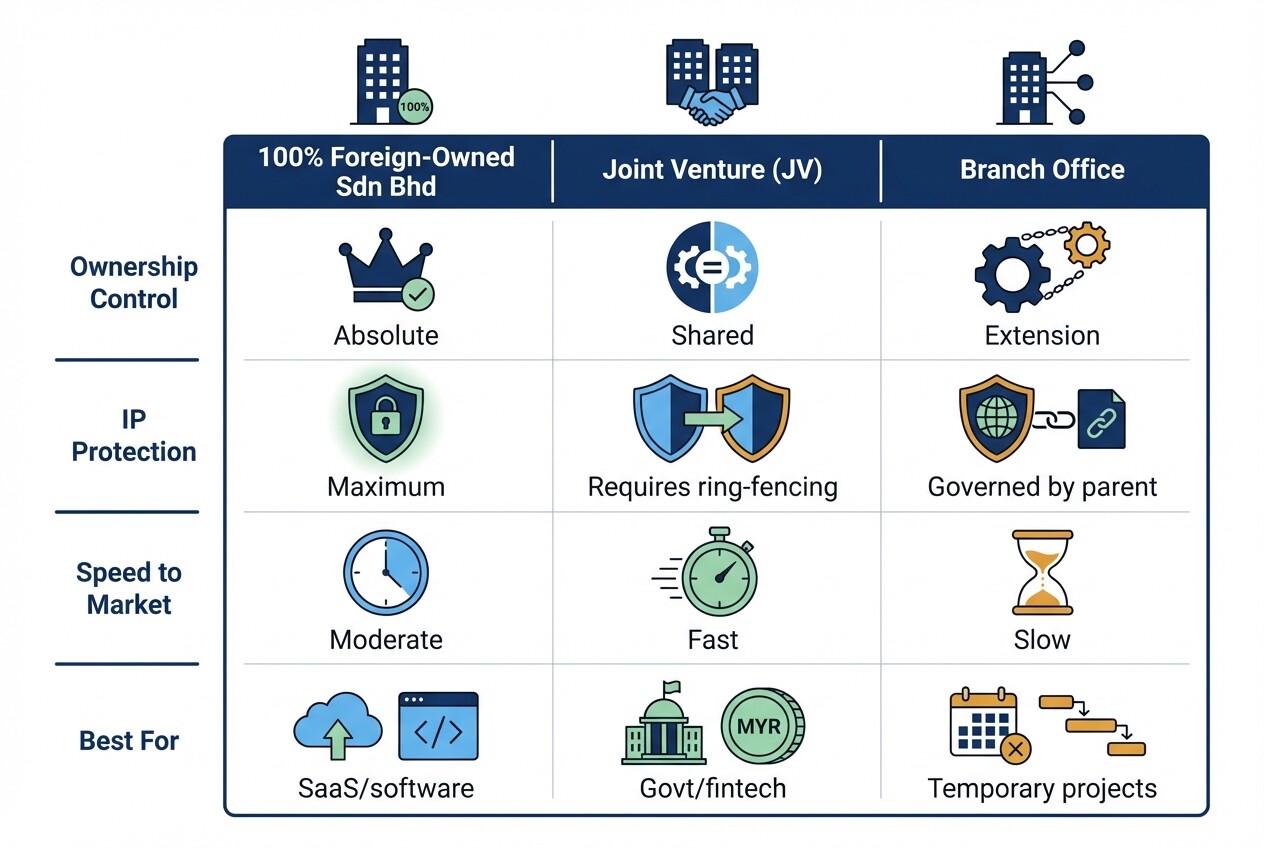
Foreign tech companies generally choose between establishing a 100% foreign-owned subsidiary or forming a Joint Venture (JV) with a local Malaysian partner. For most software, SaaS, and IT service providers, a 100% foreign-owned Sendirian Berhad (Sdn Bhd) is the optimal route to maintain absolute control over intellectual property and operations.
While full foreign ownership is standard in the tech sector, a Joint Venture may be necessary if your technology product enters highly regulated industries such as public infrastructure, defense, or financial services where local equity mandates apply.
| Structure | Ownership Control | IP Protection | Speed to Market | Best For |
|---|---|---|---|---|
| 100% Foreign-Owned Sdn Bhd | Absolute control by the parent company. | Maximum protection; parent dictates licensing. | Moderate (requires robust company secretarial setup). | SaaS, AI, pure software, e-commerce platforms. |
| Joint Venture (JV) | Shared with a local partner (often 51/49 splits). | Requires careful JV agreements to ring-fence core IP. | Fast (leverages partner's existing licenses and networks). | Government tech contracts, heavily regulated fintech. |
| Branch Office | Extension of the foreign parent. | Governed by parent company jurisdiction. | Slow (requires extensive parent company documentation). | Temporary, project-based expansions (rare for tech). |
Timeline and Process for Registering a Sendirian Berhad (Sdn Bhd)
Registering a standard private limited company (Sdn Bhd) in Malaysia takes approximately 7 to 14 working days through the digital MyCoID portal. The process requires appointing at least one resident director (who lives in Malaysia) and engaging a licensed Company Secretary.
The incorporation process follows a strict sequence managed by the Suruhanjaya Syarikat Malaysia (SSM), Malaysia's companies commission.
Company Registration Checklist
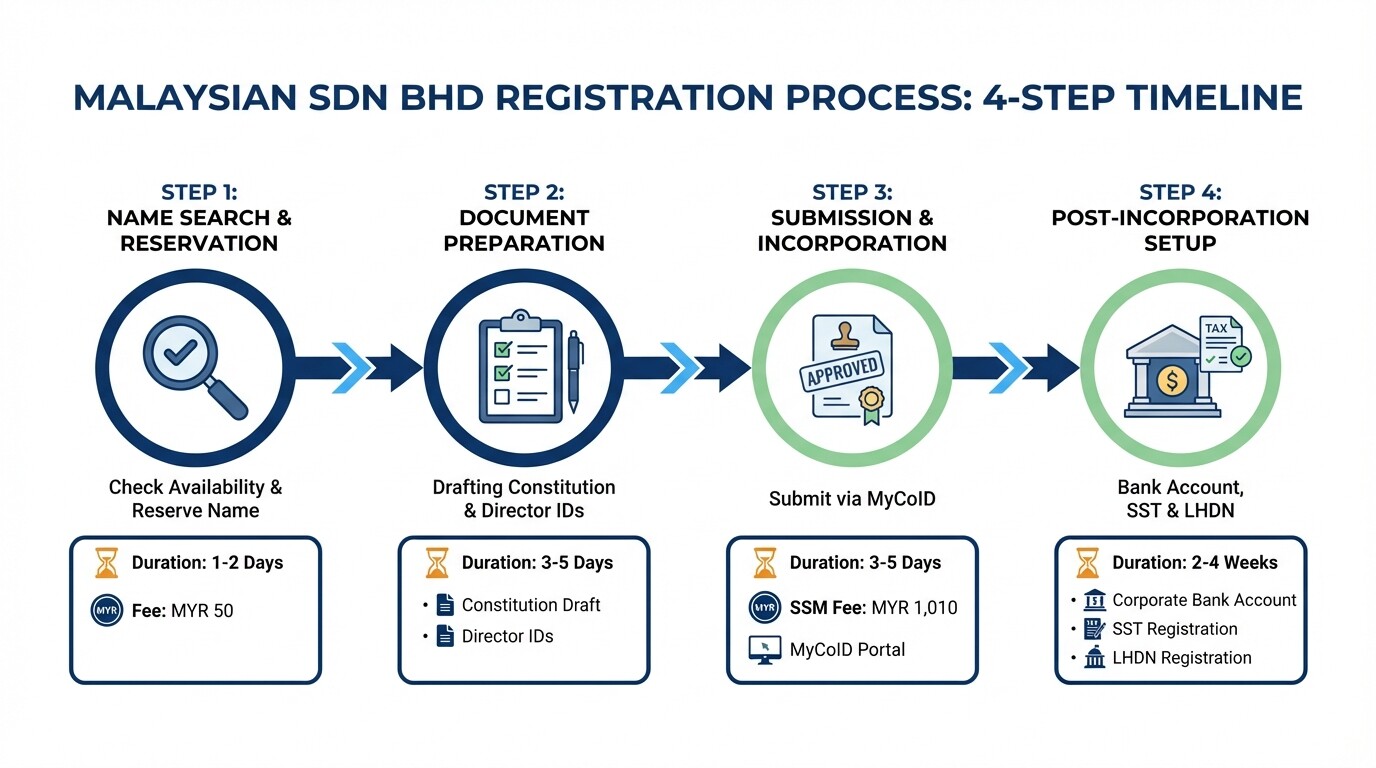
- Name Search and Reservation (1-2 days): Submit your proposed company name to SSM. The fee is MYR 50 per name reservation.
- Document Preparation (3-5 days): Draft the company's Constitution (optional but recommended for tech companies to dictate IP and shareholder rights) and gather director identification.
- Submission and Incorporation (3-5 days): Submit the Super Form via MyCoID and pay the standard SSM incorporation fee of MYR 1,010.
- Post-Incorporation Setup (2-4 weeks): Open a corporate bank account, register for the Sales and Service Tax (SST) if your revenue exceeds MYR 500,000, and register with the Inland Revenue Board (LHDN) for corporate tax.
Securing Malaysia Digital (MD) Status and Tax Incentives
Malaysia Digital (MD) is the national strategic initiative that succeeded MSC Malaysia, offering eligible tech companies significant financial and operational incentives. Acquiring MD status allows your company to access corporate tax exemptions of up to 100% for up to 10 years and fast-tracks the approval of Employment Passes for foreign tech talent.
To qualify, your business must propose a digital project that falls under promoted categories like Artificial Intelligence, Big Data, Cybersecurity, or SaaS development. The application is administered by the Malaysia Digital Economy Corporation (MDEC).
Key Benefits of MD Status
- Tax Exemptions: Pioneer Status (100% tax exemption on statutory income) or Investment Tax Allowance.
- Foreign Knowledge Workers: Exemption from standard local hiring quotas, allowing you to easily bring in specialized foreign developers or executives.
- Capital Flexibility: Freedom to source capital globally and borrow funds without tight central bank restrictions.
Navigating Bumiputera Equity Requirements and Operational Licenses
Most foreign tech companies operating purely in the digital space are exempt from mandatory local ownership rules. However, certain local operational licenses or entry into specific industries will trigger "Bumiputera" requirements, which mandate that 30% of the company's equity must be held by indigenous Malaysians.
Understanding which operational licenses you need is critical before incorporating, as it dictates your corporate structure.
- Wholesale and Retail Trade (WRT) License: Required if a foreign-owned company distributes physical goods in Malaysia. Pure digital software downloads or cloud services generally do not require a WRT license.
- Communications and Multimedia: If your tech involves VoIP, internet service provision, or broadcasting, you must apply for licenses from the Malaysian Communications and Multimedia Commission (MCMC), which often carry 30% Bumiputera equity conditions.
- Financial Technology: Payment gateways, digital banking, and crypto exchanges are regulated by Bank Negara Malaysia (BNM) and the Securities Commission (SC), requiring specific paid-up capital and often local partnerships.
Essential Commercial Contracts for Cross-Border Tech Operations
Cross-border tech operations require localized commercial contracts that align with the Malaysian Contracts Act 1950 and the Personal Data Protection Act 2010 (PDPA). Using foreign boilerplate templates often leaves critical gaps in intellectual property assignment and data privacy compliance.
Your legal strategy must include localized Terms of Service, Master Service Agreements (MSAs), and rigorous Data Processing Agreements (DPAs). Because Malaysia's PDPA restricts transferring personal data outside the country without user consent, your contracts must explicitly secure this permission.
Sample PDPA Cross-Border Consent Clause
Below is sample clause language for standard B2B SaaS agreements operating in Malaysia:
Data Protection and Cross-Border Transfer: "The Client acknowledges and agrees that the Service Provider may collect, process, and store personal data in accordance with the Personal Data Protection Act 2010 (PDPA). The Client expressly consents to the transfer of personal data to the Service Provider's servers located outside of Malaysia [Insert Country, e.g., Singapore/USA], provided that the Service Provider ensures a standard of protection for the transferred personal data that is comparable to the protection under the PDPA."
Common Misconceptions About Malaysian Corporate Law
- Misconception: You must have a local Malaysian partner to start a business. Reality: 100% foreign ownership is fully permitted for most standard business types under the Companies Act 2016, particularly in the technology, manufacturing, and international service sectors.
- Misconception: MSC Malaysia is still the primary tech incentive program. Reality: MSC Malaysia was entirely revamped and rebranded to Malaysia Digital (MD) in July 2022. Applications and frameworks must now align with the new MD criteria.
- Misconception: Foreign directors do not need to live in Malaysia. Reality: Under the Companies Act 2016, a Malaysian Sdn Bhd must have at least one director who ordinarily resides in Malaysia by having a principal place of residence within the country.
Frequently Asked Questions (FAQ)
What is the minimum paid-up capital for a foreign-owned tech company in Malaysia?
The legal minimum paid-up capital to incorporate a standard Sdn Bhd is just MYR 1. However, to hire foreign expatriates (Employment Pass), a 100% foreign-owned company must have a minimum paid-up capital of MYR 500,000.
Can a foreign tech company open a Malaysian corporate bank account without visiting?
It is highly challenging. Due to stringent Anti-Money Laundering (AML) regulations, most major Malaysian banks require at least one director or authorized signatory to be physically present in a branch for a face-to-face verification interview.
Does Malaysia impose taxes on foreign-sourced income?
Historically, Malaysia exempted foreign-sourced income. However, since January 1, 2022, foreign-sourced income remitted into Malaysia by resident companies is subject to tax, though certain exemptions apply to specific types of dividend income until 2026.
When to Hire a Corporate Lawyer
Engaging local legal counsel is highly recommended before you formally commit capital to the Malaysian market. You should hire a corporate lawyer when determining your market entry vehicle (JV vs. subsidiary), drafting specialized tech contracts (like SaaS agreements or software licensing), and navigating the regulatory overlap between data privacy (PDPA) and sector-specific licenses (like MCMC or BNM). A lawyer ensures your initial corporate structuring will not inadvertently block you from securing Malaysia Digital (MD) tax incentives later.
Next Steps for Your Malaysia Expansion
To begin your tech expansion, first finalize your market entry strategy by determining whether you require a local partner based on your target customer base. Next, initiate the name search via SSM and secure a licensed Malaysian Company Secretary to guide the incorporation. Simultaneously, review the Malaysia Digital (MD) requirements to see if your technology qualifies for tax incentives. For precise structuring and localized contract drafting, find a corporate lawyer in Malaysia who specializes in cross-border technology setups.