

- Malaysia operates a dual legal system. Non-Muslim family matters go to Civil Courts, while Muslim family matters are handled by Syariah Courts.
- The Law Reform (Marriage and Divorce) Act 1976 governs child custody for non-Muslim expatriates in Malaysia.
- Mediation resolves cross-border custody disputes faster and cheaper than litigation, keeping family details private.
- Moving a child out of Malaysia without formal consent or a court order can result in international abduction charges.
- Malaysian courts do not automatically recognize foreign custody orders. Parents must formally register them with the High Court.
Syariah and Civil Court Jurisdiction
Non-citizens in Malaysia face a dual legal system of Civil Courts and Syariah Courts. The recognized religion of the spouses determines the correct legal venue.
Civil Courts handle marriage, divorce, and child custody for non-Muslims. Syariah Courts have exclusive jurisdiction over Muslim family law. This division applies equally to Malaysian citizens and foreign expatriates.
Jurisdictional disputes happen if one spouse converts to Islam. The two court systems operate independently with different guiding principles. In these cross-religion disputes, civil courts have established that they retain jurisdiction to dissolve the marriage and determine custody if the marriage was originally registered under civil law.
Custody Laws for Expatriates
The Law Reform (Marriage and Divorce) Act 1976 is the main statute governing non-Muslim family law in Malaysia. It applies to expatriates legally residing in the country and dictates rules for custody, visitation, and financial maintenance based on the child's welfare.
To hear a custody or divorce case involving foreigners, the Malaysian Civil Courts require the parties to prove they are domiciled in Malaysia or that the wife has resided in the country for at least two years immediately before the petition.
The Act includes a rebuttable presumption that it is better for a child under seven to live with their mother. However, the court prioritizes the child's overall well-being, education, and emotional stability over automatic parental rights. Judges evaluate living conditions, income stability, and the ability to provide a secure environment anywhere in the world.
International Custody Mediation Checklist
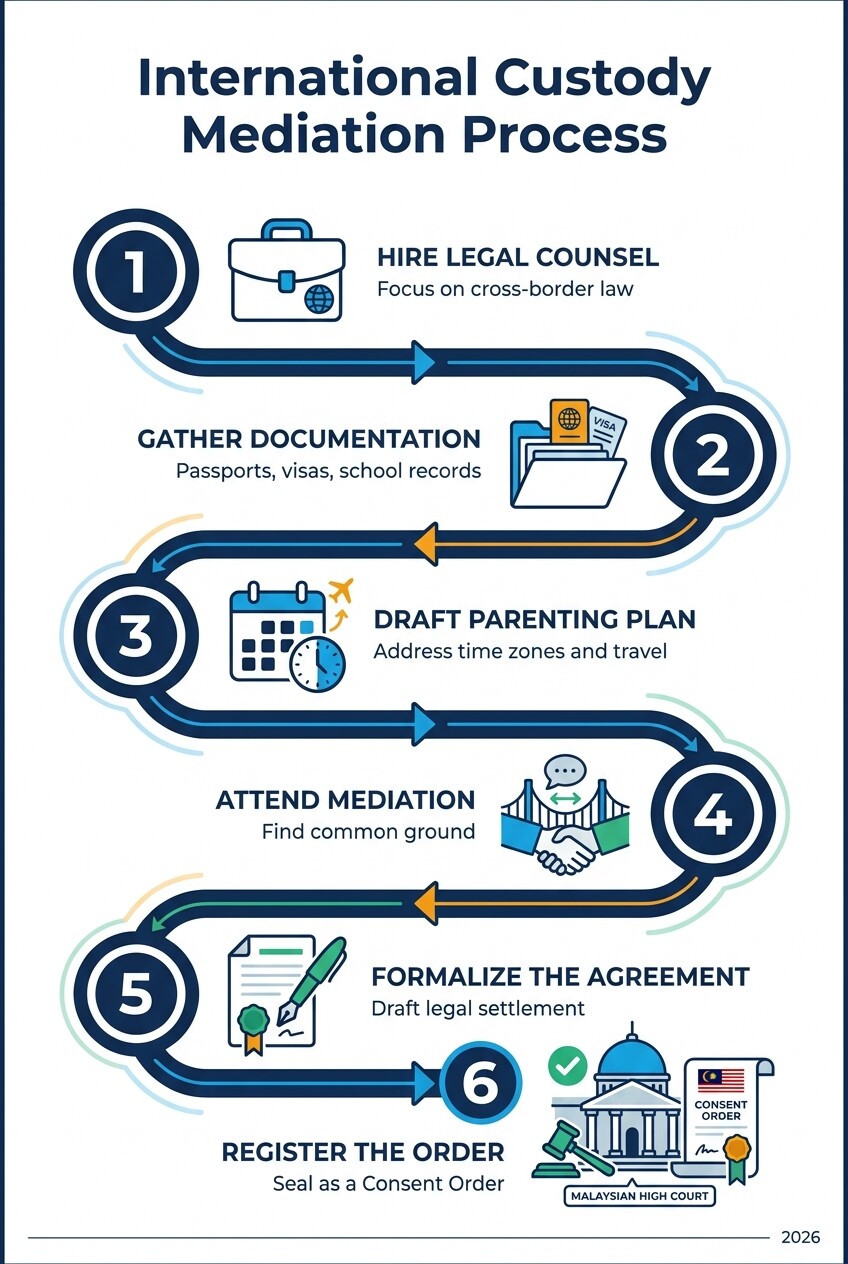
Mediation is a voluntary process where a neutral third party helps parents reach a custody agreement. It typically takes three to eight weeks in Malaysia. Many mediators accommodate virtual sessions, which is useful when one parent has already relocated abroad.
Follow this checklist to prepare for mediation:
- Hire legal counsel: Engage a lawyer who understands cross-border family law to advise you during negotiations.
- Gather documentation: Collect passports, visas, school records, medical files, and financial statements.
- Draft a parenting plan: Outline physical custody schedules, holiday arrangements, and communication methods. Account for international time zones and travel logistics.
- Attend mediation: Work with the mediator to find common ground based on the child's specific needs.
- Formalize the agreement: Have your lawyer draft the agreed terms into a legal settlement document.
- Register the order: Submit the agreement to the Malaysian High Court. Once sealed by a judge, it becomes a binding Consent Order with the same legal weight as a trial judgment.
Choosing Mediation Over Litigation
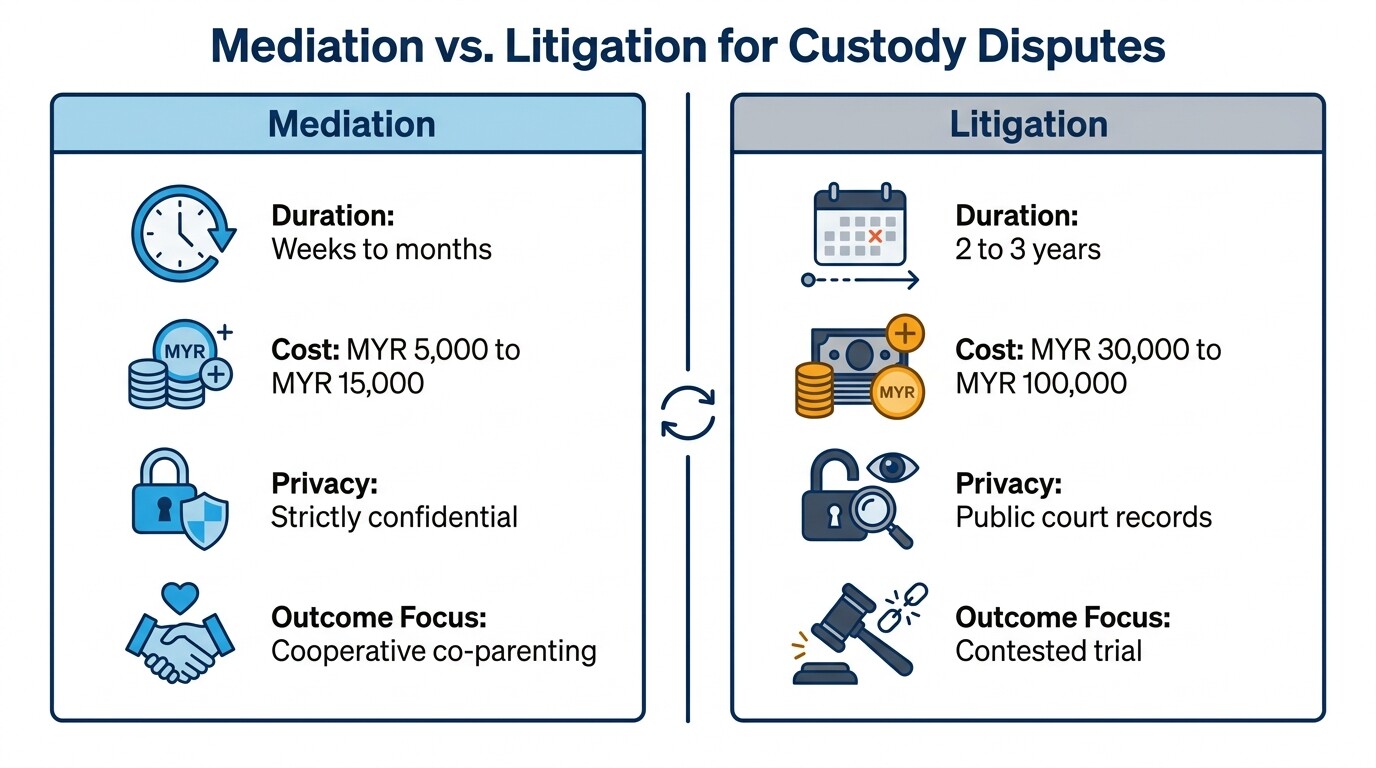
Traditional litigation in Malaysia is slow and expensive. A contested cross-border custody trial often takes two to three years and costs between MYR 30,000 and MYR 100,000 in legal fees. Mediation is usually concluded within a few weeks or months and costs between MYR 5,000 and MYR 15,000.
Court trials generate public records. Mediation is strictly confidential. Expatriate professionals often prefer mediation to keep family disputes and financial disclosures private. It also encourages a cooperative co-parenting relationship for raising a child across borders.
Risks of Unilateral Cross-Border Relocation
Moving a child out of Malaysia without the explicit consent of the other parent or a valid court order is a severe legal violation. This can lead to international child abduction charges and damage your legal custody rights.
Avoid these common errors during separation:
- Assuming custody allows relocation: Having day-to-day care of your child does not grant you the right to move them to your home country. You need written consent from the other parent or a relocation order from a Malaysian court.
- Ignoring immigration watchlists: During a pending custody dispute, a parent can apply for an injunction to place the child on a Malaysian immigration watchlist. You will be stopped at the airport if you attempt to leave.
- Relying on foreign passports: Holding a US, UK, or Australian passport does not exempt a child from Malaysian family law jurisdiction while they are habitually resident in Malaysia.
Enforcing Foreign Custody Orders in Malaysia
Malaysian courts do not automatically recognize foreign custody orders. You must register the foreign judgment in the Malaysian High Court to make it legally binding locally.
Because child custody arrangements are modifiable, Malaysian courts retain the right to review foreign orders based on the child's best interests. To enforce an overseas arrangement:
- Obtain a certified, court-sealed copy of the custody order from your home country.
- File an Originating Summons in the Malaysian High Court to recognize and enforce the order.
- Provide evidence that upholding the order serves the child's welfare and aligns with Malaysian public policy.
If the other parent contests the registration, the Malaysian court may hear the custody arguments again.
Getting Legal Help
You need legal counsel when managing cross-border complications or relocation risks. A lawyer ensures your mediation agreement complies with Malaysian law and translates into a legally binding court order.
Navigating the Malaysian legal system without local expertise can result in unenforceable agreements or accidental violations of immigration laws. Consult adr, mediation & arbitration lawyers in Malaysia if your spouse threatens to leave the country with your child, if you need to enforce a foreign custody order, or before you begin formal mediation sessions.
Start by organizing your legal documents, including marriage certificates, the child's birth certificates, passports, and any existing court orders. Keep these secure. Avoid making unilateral decisions about the child's residence or schooling, as this will count against you in legal proceedings. Schedule a consultation with a family law specialist to confirm your jurisdictional standing in Malaysia and plan a resolution strategy.