- 100% Foreign Ownership: Multinational tech companies can fully own their Malaysian subsidiaries and avoid the need for local joint-venture partners.
- Malaysia Digital (MD) Status: Acquiring MD status provides tech firms with up to 10-year tax exemptions and streamlined foreign talent visas.
- Corporate Structure: Incorporating a private limited company (Sdn Bhd) limits liability and meets requirements for government incentives.
- Data Compliance: Cross-border data transfers must adhere to the Personal Data Protection Act 2010 (PDPA) to avoid regulatory penalties.
- Resident Requirements: The Companies Act 2016 requires at least one company director to reside in Malaysia, even with 100% foreign equity.
Requirements for MD Status and Foreign Equity Limits
Tech companies operating in Malaysia can maintain 100% foreign equity if they meet specific capitalization and operational thresholds. Securing Malaysia Digital (MD) status (the successor to the MSC Malaysia initiative) grants foreign tech hubs access to zero-percent income tax rates for up to a decade and fast-tracked expatriate visas.
To qualify for MD status and retain full foreign ownership, your tech hub must focus on approved high-value activities like artificial intelligence, cybersecurity, fintech, or big data analytics. The government requires foreign-owned entities to inject a minimum paid-up capital of MYR 500,000 to sponsor foreign employees. You must also commit to hiring a specific percentage of local knowledge workers and maintain physical corporate offices in approved digital hubs. The Malaysia Digital Economy Corporation (MDEC) oversees this evaluation and weighs the technology's contribution to the local digital ecosystem.
Branch Office vs. Wholly Foreign-Owned Subsidiary
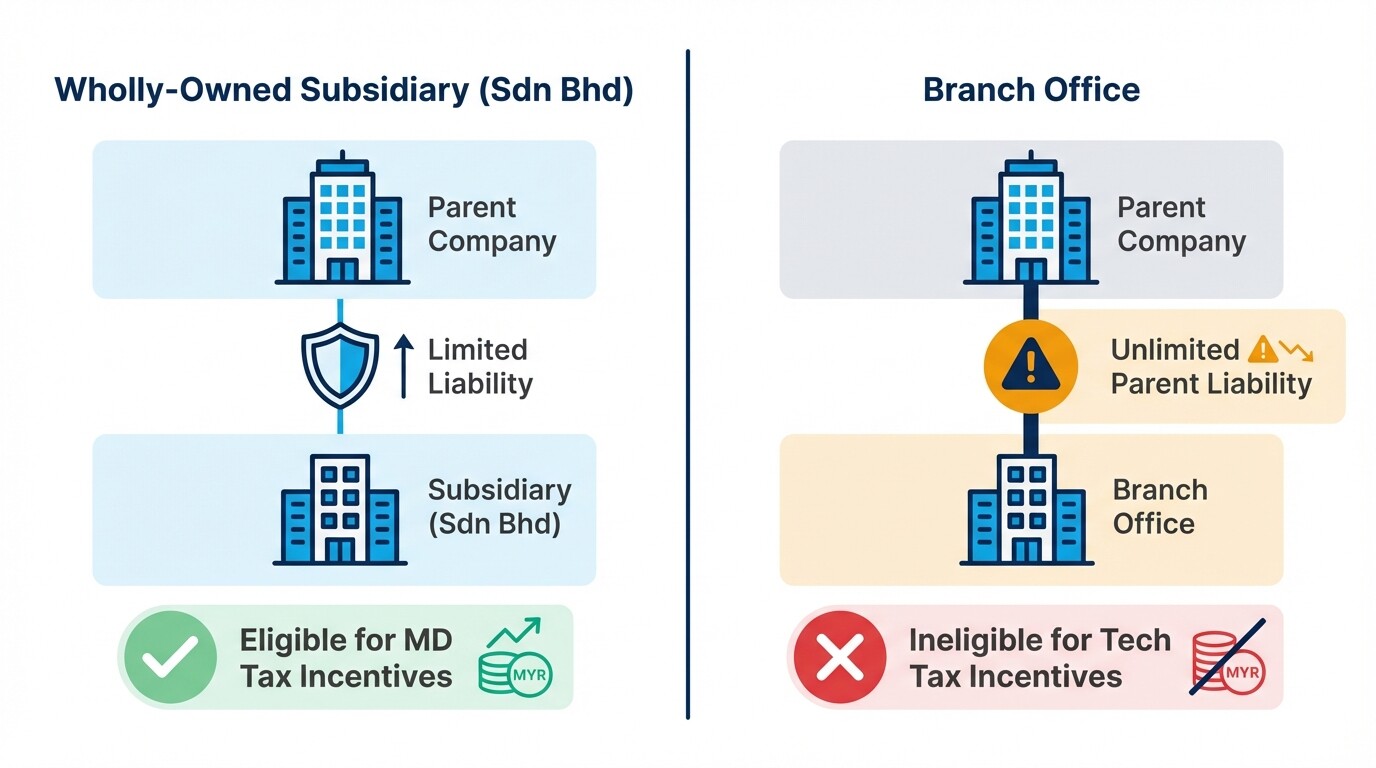
Establishing a wholly foreign-owned subsidiary (Sendirian Berhad, or Sdn Bhd) is more advantageous for a tech hub than registering a branch office. A subsidiary limits your parent company's legal liability and is the only structure eligible for comprehensive digital tax incentives in Malaysia.
A branch office is an extension of the foreign parent company, so the parent remains fully liable for the branch's debts and legal obligations. Branch offices are generally excluded from Malaysia Digital status and associated tax holidays.
| Feature | Wholly-Owned Subsidiary (Sdn Bhd) | Branch Office |
|---|---|---|
| Legal Status | Separate legal entity from the parent company. | Extension of the foreign parent company. |
| Parent Liability | Limited to the unpaid shares held. | Unlimited; parent company is fully liable. |
| Tax Incentives | Eligible for MDEC grants and tax holidays. | Ineligible for tech tax exemptions. |
| Annual Compliance | Must file audited accounts locally. | Must file parent and local branch accounts. |
| Best Used For | Regional headquarters, R&D centers, tech hubs. | Short-term contracts or temporary projects. |
Timelines for Business Registration and Expatriate Visas
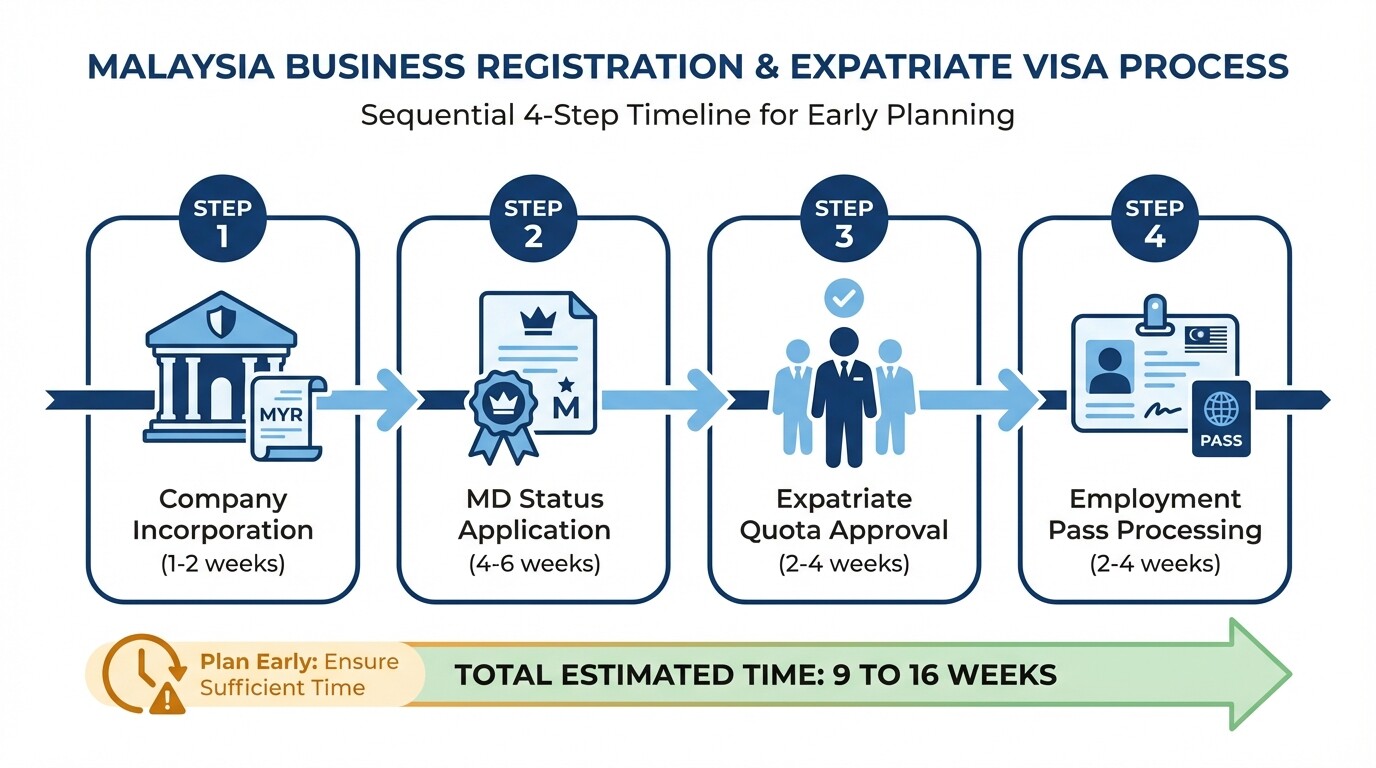
Registering your corporate entity takes one to two weeks, but securing the approvals to bring in foreign talent requires an additional four to eight weeks. Proper sequencing prevents delays in operational deployment.
- Company Incorporation: Registration takes 1 to 2 weeks through the Companies Commission of Malaysia (SSM). You must reserve your company name, appoint a resident director and company secretary, and submit your incorporation documents.
- MD Status Application: Once incorporated, you apply for Malaysia Digital status via MDEC. Expect a 4 to 6 week process. This involves presenting your business plan, local investment commitments, and technology framework.
- Expatriate Quota Approval: Before applying for individual visas, your company must apply for an expatriate projection quota through the Expatriate Services Division (ESD) or Xpats Gateway. This takes 2 to 4 weeks.
- Employment Pass Processing: Once the quota is approved, you apply for Employment Passes (EP) for your foreign tech workers. Passes are issued for one to five years depending on the applicant's base salary, specialized skill set, and pass category. Processing takes 2 to 4 weeks.
Regional Tech Hub Setup Checklist
Successfully launching a regional headquarters requires executing corporate, financial, and regulatory steps in a precise order.
- Pre-Incorporation
- Verify the proposed company name availability with SSM.
- Identify at least one resident director (citizen, permanent resident, or valid pass holder residing in Malaysia).
- Engage a licensed Malaysian Company Secretary.
- Incorporation & Banking
- Register the Sendirian Berhad (Sdn Bhd) entity and obtain the Certificate of Incorporation.
- Open a corporate bank account with a Malaysian bank.
- Inject the minimum paid-up capital of MYR 500,000 for 100% foreign-owned firms seeking to hire expats.
- Regulatory & Talent Acquisition
- Register with the Inland Revenue Board of Malaysia (LHDN) for corporate and employer tax files.
- Register with the Employees Provident Fund (EPF) and Social Security Organization (SOCSO) for local hires.
- Submit your business plan to MDEC for Malaysia Digital (MD) status.
- Apply for Expatriate Quota via the ESD portal for foreign engineers and executives.
Cross-Border Data Protection Compliance
Multinational tech firms transferring user or employee data outside of Malaysia must obtain explicit consent from data subjects to comply with the Personal Data Protection Act 2010 (PDPA). Failing to secure these channels exposes the company to criminal fines and director liability.
The PDPA's Eighth Principle forbids transferring personal data outside Malaysia unless the destination jurisdiction is officially whitelisted by the government or specific exceptions apply. Because a comprehensive whitelist has not been widely gazetted, tech companies rely on exceptions. You must explicitly outline cross-border data transfers in your privacy policies and obtain written consent from users and employees before routing data to foreign servers. Intra-group data transfer agreements should be executed between the Malaysian subsidiary and the foreign parent company to guarantee the data receives PDPA-equivalent protection abroad. For official compliance guidelines, companies must register with the Department of Personal Data Protection (JPDP).
Drafting Localized Employment Contracts
Tech companies must localize employment agreements to comply with the Malaysian Employment Act 1955. Importing standard US or European contracts often results in void clauses and labor disputes. Particular attention must be paid to termination protocols, working hours, and restrictive covenants.
Standard Silicon Valley employment clauses frequently conflict with Malaysian labor laws. Ensure your contracts address the following:
- Non-Compete Clauses: Under Section 28 of the Malaysian Contracts Act 1950, post-employment non-compete clauses are void and unenforceable. You cannot stop an employee from joining a competitor after they resign.
- Non-Solicitation: Because non-competes are void, you must rely on robust non-solicitation clauses to prevent client or staff poaching. Strict confidentiality clauses are also fully enforceable.
- Termination: Probationary periods typically last three to six months. Terminating an employee requires "just cause and excuse" under the Industrial Relations Act 1967. Employment cannot be terminated "at-will."
- IP Assignment: Clearly state that all code, software, and IP developed during working hours or using company resources are the exclusive property of the Malaysian subsidiary.
- Stock Options: Employee stock options (ESOPs) are taxable. When an employee exercises their options, the difference between the market value of the shares on the vesting or exercise date and the price paid is treated as a taxable employment benefit.
Common Misconceptions About Malaysia Tech Setup
Many multinational companies enter Malaysia with misunderstandings about ownership laws and labor rights. Addressing false assumptions early prevents structural mistakes during incorporation.
- "You need a local joint-venture partner." This is false for the technology sector. While certain strategic industries have Bumiputera (local) equity quotas, technology companies and software developers can be 100% foreign-owned.
- "Employment in Malaysia is at-will." Malaysia enforces strict labor protections. You cannot fire an employee without documenting "just cause and excuse," which involves a formal performance improvement plan (PIP) or a domestic inquiry for misconduct.
- "A branch office is the cheapest way to test the market." A branch avoids forming a new company but is more burdensome. It subjects the parent company to local liability and requires filing the parent's global financial statements locally. This structure also disqualifies the business from tech tax incentives.
When to Hire a Lawyer
Setting up a Malaysian subsidiary requires legal support to meet MDEC requirements and SSM guidelines. Legal counsel is necessary to draft localized employment agreements, execute cross-border data transfer policies, and manage resident director requirements. Using business registration lawyers in Malaysia ensures the tech hub meets local compliance standards and is structured for scalability.
Next Steps
- Reserve Your Entity Name: File an application with the Companies Commission of Malaysia (SSM) to secure your corporate name before drafting incorporation documents.
- Appoint a Resident Director: Identify a local resident director and engage a licensed company secretary to handle the mandatory incorporation filings.
- Secure Capital: Prepare the documentation to open a local corporate bank account and transfer the minimum required paid-up capital to unlock expatriate hiring capabilities.
- Initiate MD Status Strategy: Begin compiling your business plan, hiring projections, and technology framework to submit to MDEC for your Malaysia Digital status application.