Foreign Ownership Limits in Vietnam's Emerging Industries
- Vietnam's Law on Investment categorizes business activities into unrestricted, conditional, and prohibited sectors, heavily dictating where foreign capital can be deployed.
- Logistics and telecom sectors face strict foreign ownership caps ranging from 49% to 65%, often requiring joint ventures with local partners.
- High-tech manufacturing and renewable energy are highly incentivized sectors, frequently permitting 100% foreign ownership alongside significant tax holidays.
- Utilizing local nominee agreements to bypass ownership caps is legally void in Vietnam and puts foreign capital at total risk of forfeiture.
- Structuring market entry through compliant Business Cooperation Contracts (BCCs) or strategic joint ventures is essential for secure operations heading into 2026.
Identifying 'Conditional' vs. 'Prohibited' Sectors for Foreign Investors
Foreign investment in Vietnam is governed by the Law on Investment, which categorizes business lines into prohibited, conditional, and unrestricted sectors. Unrestricted sectors allow 100% foreign ownership, while conditional sectors require investors to meet specific criteria, partner with locals, or adhere to strict ownership caps.
To navigate market entry successfully, foreign investors must consult Vietnam's "Negative List," which outlines sectors entirely off-limits or restricted for foreign capital.
- Prohibited Sectors: These are completely closed to foreign investment. They include activities that impact national security, public health, and local heritage. Examples include the trade of endangered flora and fauna, specific narcotic substances, human cloning, and debt collection services.
- Conditional Sectors: Over 200 business lines require foreign investors to satisfy specific market access conditions. These conditions may dictate a maximum foreign ownership percentage, mandate a specific corporate structure (like a joint venture), or require sub-licenses. Examples include education, real estate trading, aviation, and telecommunications.
- Unrestricted Sectors: Any sector not featured on the Negative List is theoretically open to 100% foreign ownership, treating foreign investors equally with domestic entities.
You can verify the official list of conditional business lines through the National Business Registration Portal, managed by the Ministry of Planning and Investment (MPI).
Foreign Ownership Limits (FOL) in Logistics, Energy, and Telecom
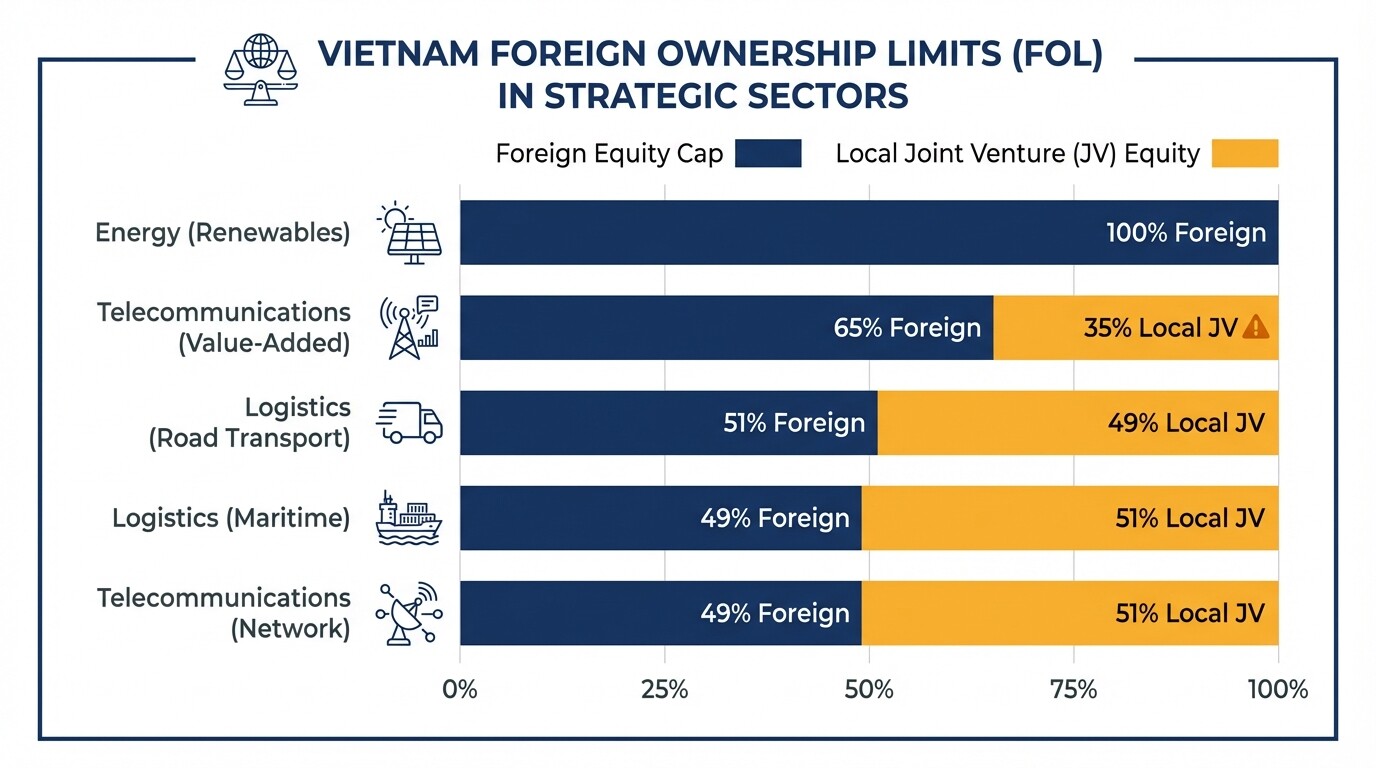
Vietnam restricts maximum foreign equity in strategic infrastructure and services to protect domestic interests. Limits vary based on Vietnam's WTO commitments, international free trade agreements, and local investment laws, typically ranging from 49% to 100% depending on the exact sub-sector.
Understanding these caps is crucial for structuring your local entity. If your target industry mandates a cap, you must find a local joint venture partner for the remaining equity.
| Sector | Foreign Ownership Limit | Strategic Market Access Conditions |
|---|---|---|
| Logistics (Road Transport) | Up to 51% | Requires a joint venture with a Vietnamese partner. 100% foreign ownership is not permitted for road freight. |
| Logistics (Maritime) | Up to 49% | Joint venture required. The proportion of foreign seafarers on Vietnamese-flagged vessels is also restricted. |
| Telecommunications (Network) | Up to 49% | Applies to facilities-based services (owning network infrastructure). Must form a joint venture with a licensed local operator. |
| Telecommunications (Value-Added) | Up to 65% | Applies to services without network infrastructure (e.g., internet access services, email). |
| Energy (Renewables) | Up to 100% | Generally open to wholly foreign-owned enterprises. Subject to strict grid connection approvals and the national Power Development Plan (PDP). |
Legal Structures for Nominee-Free Market Entry in 2026
Using local nominee structures to bypass foreign ownership limits is illegal in Vietnam and exposes investors to severe risks of asset loss. Instead, foreign investors should use compliant legal structures, such as phased joint ventures, multi-tiered holding companies, or Business Cooperation Contracts (BCCs) to securely enter restricted markets.
As regulatory scrutiny tightens approaching 2026, foreign companies must avoid "shadow ownership" agreements. If a dispute arises, Vietnamese courts routinely invalidate nominee agreements, leaving the foreign investor with no legal claim to the assets or the company.
Compliant alternative structures include:
- The Business Cooperation Contract (BCC): A BCC allows a foreign investor to partner with a Vietnamese company to share revenues or products without creating a new legal entity. This is highly effective in sectors like telecommunications where foreign equity limits are strict, but operational control and profit-sharing can be managed contractually.
- Strategic Joint Ventures (JVs): When an ownership cap applies (e.g., 49%), the foreign investor forms a JV with a local partner. To protect the foreign investor's interests, the Shareholders' Agreement (SHA) must be aggressively drafted with protective provisions, such as supermajority voting rights for critical business decisions, reserved matters, and clear exit mechanisms.
- Phased Equity Acquisition: In sectors where foreign ownership limits are expected to relax under upcoming trade agreement phases, investors can structure convertible loans or options agreements that automatically convert into equity once the regulatory cap is lifted.
Navigating the Investment Law Updates for High-Tech Manufacturing
The Vietnamese government actively incentivizes high-tech manufacturing through corporate income tax (CIT) breaks and land rent exemptions outlined in the recent updates to the Law on Investment. Foreign investors can hold 100% equity in this sector, provided their projects meet strict research and development (R&D), environmental, and technological transfer standards.
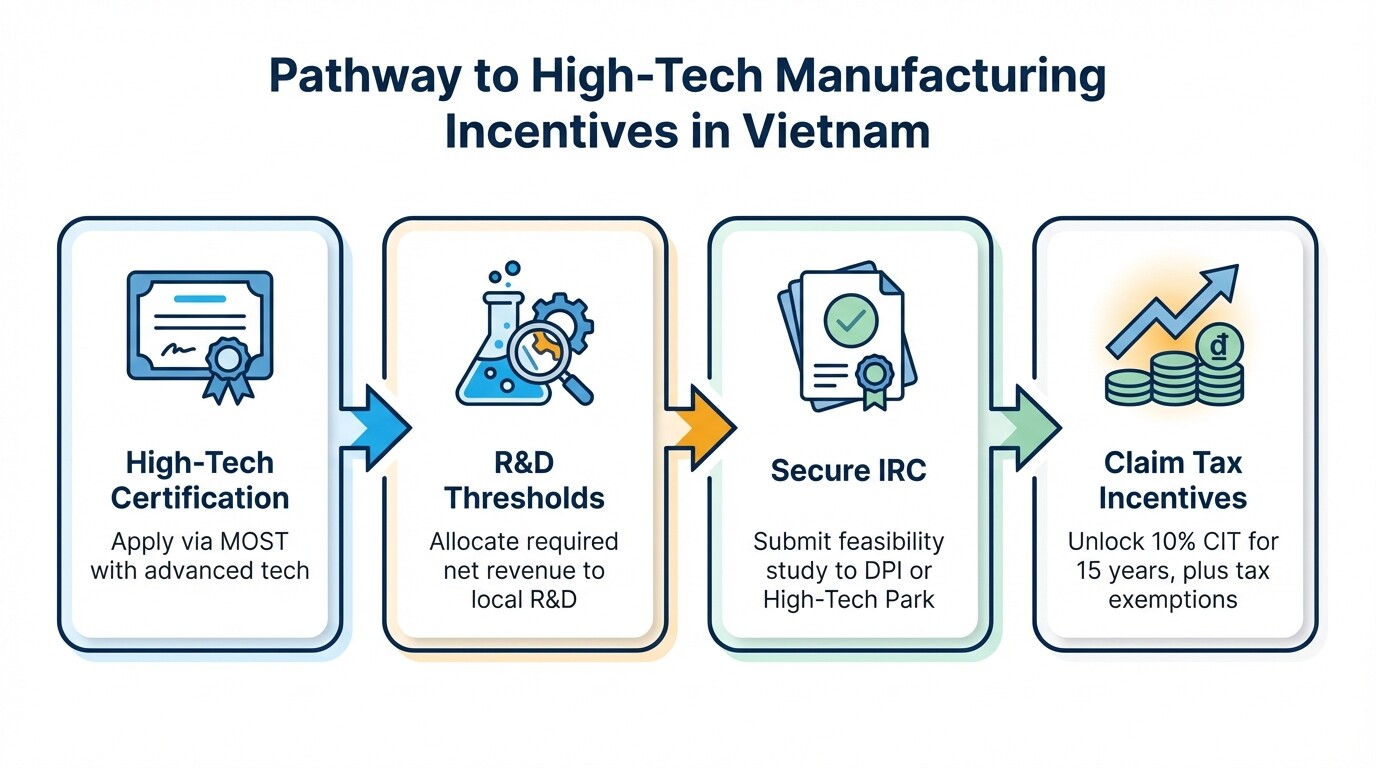
Vietnam is rapidly positioning itself as a "China Plus One" manufacturing alternative. To access the highest tier of government incentives in high-tech manufacturing, foreign entrants must follow a specific compliance pathway:
- Obtain High-Tech Enterprise Certification: Investors must apply for certification through the Ministry of Science and Technology (MOST). The project must apply advanced, eco-friendly technologies that meet local environmental standards.
- Meet Revenue and R&D Thresholds: A specific percentage of the company's annual net revenue must be allocated to R&D activities conducted within Vietnam.
- Secure the Investment Registration Certificate (IRC): Submit a detailed feasibility study proving the project's high-tech nature to the local Department of Planning and Investment (DPI) or the Management Board of the specific High-Tech Park (e.g., Saigon Hi-Tech Park).
- Claim Tax Incentives: Once certified, companies can access CIT rates as low as 10% for 15 years, combined with up to 4 years of total tax exemption and 9 years of a 50% tax reduction.
Dispute Resolution Options for Foreign Shareholders in Vietnamese Firms
Foreign shareholders facing domestic disputes can resolve conflicts through Vietnamese courts, domestic commercial arbitration, or international arbitration. For high-value joint ventures, international arbitration offers the most reliable enforcement, neutrality, and commercial expertise.
When entering a joint venture in Vietnam, dispute resolution clauses must be meticulously negotiated in the Shareholders' Agreement (SHA) and the company charter.
- International Arbitration: If the JV involves a foreign entity, the parties can select offshore arbitration centers like the Singapore International Arbitration Centre (SIAC). Vietnam is a signatory to the 1958 New York Convention, meaning foreign arbitral awards are generally recognized and enforceable in Vietnam, though the local recognition process can be lengthy.
- Domestic Arbitration: The Vietnam International Arbitration Centre (VIAC) is increasingly popular for mid-tier disputes. It is faster than local courts, allows proceedings to be conducted in English, and permits parties to select foreign arbitrators.
- Vietnamese Courts: Generally avoided by foreign investors due to prolonged timelines, lack of specialized commercial expertise, and proceedings strictly conducted in Vietnamese. Courts are typically only used as a last resort or for labor disputes and real estate matters where exclusive local jurisdiction applies.
Common Misconceptions About Foreign Investment in Vietnam
- Misconception: Nominee agreements are a safe workaround for ownership limits. Many foreign investors believe they can fund a local Vietnamese citizen to hold 100% of the shares in a restricted sector on their behalf. These contracts are legally void. In a dispute, the local nominee will be legally recognized as the sole owner of the business and its assets.
- Misconception: 100% foreign ownership is impossible. While logistics, telecom, and real estate face heavy restrictions, thousands of business lines-including manufacturing, IT services, and management consulting-allow 100% foreign ownership.
- Misconception: Obtaining an ERC means you can immediately operate. In conditional sectors, the Enterprise Registration Certificate (ERC) and Investment Registration Certificate (IRC) only establish the company. You cannot commence operations until you secure the relevant sub-licenses (e.g., a transport license or a retail establishment license).
Frequently Asked Questions
What is the difference between an IRC and an ERC?
An Investment Registration Certificate (IRC) is required for foreign investors to register an investment project and outlines the project's scope, capital, and location. An Enterprise Registration Certificate (ERC) is the actual certificate of incorporation that creates the legal entity. Foreign-owned companies generally need both.
Can a foreign-owned company buy land in Vietnam?
No. Under the Vietnamese Constitution, land is collectively owned by the people and managed by the State. Foreign-owned enterprises cannot purchase land outright but can lease land from the State or from authorized developers in industrial zones for up to 50 years (or 70 years in special economic zones).
How long does it take to register a foreign-owned company in Vietnam?
For unrestricted sectors, obtaining the IRC and ERC typically takes 4 to 6 weeks. For conditional sectors that require approvals from multiple ministries (such as telecom or education), the process can take 3 to 6 months or longer.
When to Hire a Lawyer & Next Steps
Market entry into Vietnam requires precise legal structuring, particularly when targeting conditional sectors with foreign ownership limits. You should hire legal counsel when:
- You need to structure a joint venture agreement and draft protective shareholder provisions.
- Your target sector is on the conditional list and requires complex sub-licensing.
- You are planning a high-tech manufacturing project and want to negotiate maximum tax and land incentives with provincial authorities.
Next Steps:
- Determine the exact Vietnamese Standard Industrial Classification (VSIC) codes for your intended business activities.
- Cross-reference these codes with Vietnam's Negative List and WTO commitments to identify any foreign ownership caps.
- Consult with business registration lawyers in Vietnam to evaluate compliant entry structures, such as a Business Cooperation Contract or a strategic Joint Venture.