- Foreign investors can retain 100% equity in Malaysian joint ventures by securing Malaysia Digital (MD) status. This bypasses traditional local ownership quotas.
- Separate pre-existing background IP from newly created foreground IP to protect the foreign parent company's core technology.
- Use deadlock provisions like Russian Roulette or Texas Shootout to prevent operational paralysis in 50/50 partnerships.
- International arbitration via the Asian International Arbitration Centre (AIAC) provides confidentiality and cross-border enforceability for dispute resolution.
- Deploying foreign technical staff to Malaysia requires Employment Passes from the Expatriate Services Division and compliance with the Employment Act 1955.
Navigating Equity Limits and Regulatory Compliance
Foreign investors can hold up to 100% equity in Malaysian tech companies, particularly those with Malaysia Digital (MD) status from the Malaysia Digital Economy Corporation (MDEC). Certain sub-sectors like telecommunications network operations or regulated financial technology may still impose local ownership requirements (Bumiputera quotas) ranging from 30% to 51%.
A joint venture usually takes the form of a private limited company (Sendirian Berhad or Sdn. Bhd.). Forming this entity through the Companies Commission of Malaysia (SSM) requires shareholder agreements aligned with the Companies Act 2016. To ensure compliance while maximizing control, structure investments by:
- Applying for MD Status: This gives tech companies flexibility in foreign equity ownership and hiring foreign workers.
- Issuing Preference Shares: A foreign partner can maintain preferential dividend rights and specific veto powers even with a minority of ordinary voting shares.
- Checking Sector Clearances: Review policies from the Malaysian Communications and Multimedia Commission (MCMC) or Bank Negara Malaysia (BNM) to identify equity caps before drafting the term sheet.
Intellectual Property Transfer and Technology Licensing
Protect proprietary technology by drawing clear contractual boundaries between pre-existing background IP and newly developed foreground IP. Cross-border partners must execute formal IP assignment and licensing agreements. This ensures the Malaysian JV has the legal right to commercialize the technology without infringing on the foreign parent's core assets.
Joint ventures involve sharing trade secrets and source code. A standard Non-Disclosure Agreement is not enough. The JV agreement must state the foreign partner retains absolute ownership of their original technology, granting a limited, revocable license to the JV.
Sample Licensing Clause: Subject to the terms of this Agreement, the Foreign Partner grants the Joint Venture Company a limited, non-exclusive, non-transferable, and revocable license to use the Background Intellectual Property solely to develop and commercialize the Specific Tech Product in Malaysia. No ownership rights in the Background Intellectual Property transfer to the Joint Venture Company or the Local Partner. All Foreground Intellectual Property developed jointly by the Parties is owned by the Joint Venture Company, subject to a separate assignment agreement.
Exit Strategies and Deadlock Resolution
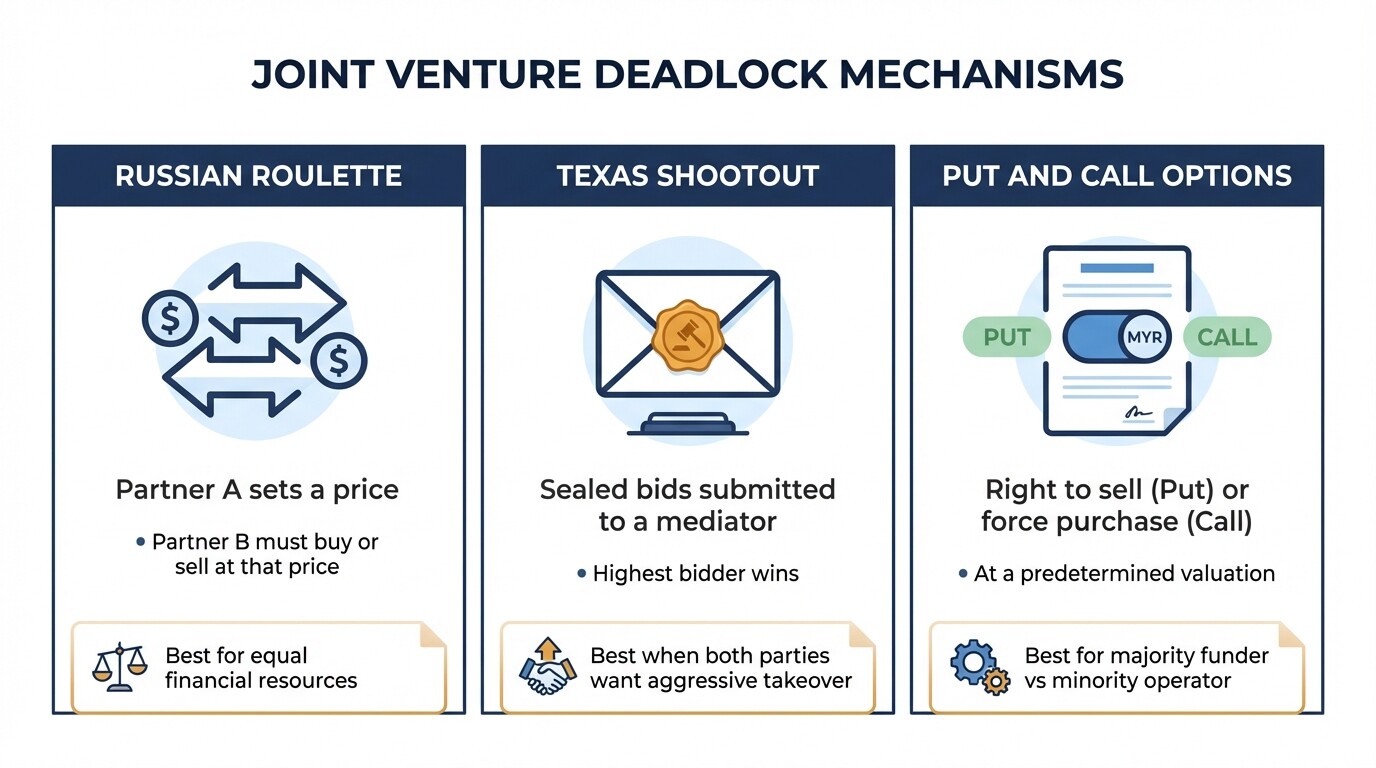
A joint venture agreement must include exit mechanisms and deadlock resolution clauses. When partners hold 50/50 voting rights or share veto powers, clauses that force a buyout or clean separation ensure the company can continue functioning or be liquidated.
Without these mechanisms, a dispute over product development or market expansion can trap both parties in a stagnant company. Corporate lawyers structure these exits using specific trigger events, such as a material breach, bankruptcy, or a continuous failure to pass board resolutions.
Common deadlock mechanisms include:
- Russian Roulette: Partner A offers to buy Partner B's shares at a stated price. Partner B must either accept the offer or buy Partner A's shares at that exact price. This works well for 50/50 JVs where both partners have similar financial resources.
- Texas Shootout: Both partners submit sealed bids to an independent mediator. The highest bidder buys the other partner's shares at the bid price. This applies when both parties aggressively want to take over the JV.
- Put and Call Options: These grant one partner the right to sell their shares to the other (Put), or the right to force the other to sell their shares (Call) at a predetermined valuation. This fits JVs between a majority foreign funder and a minority local operator.
Resolving Shareholder Disputes
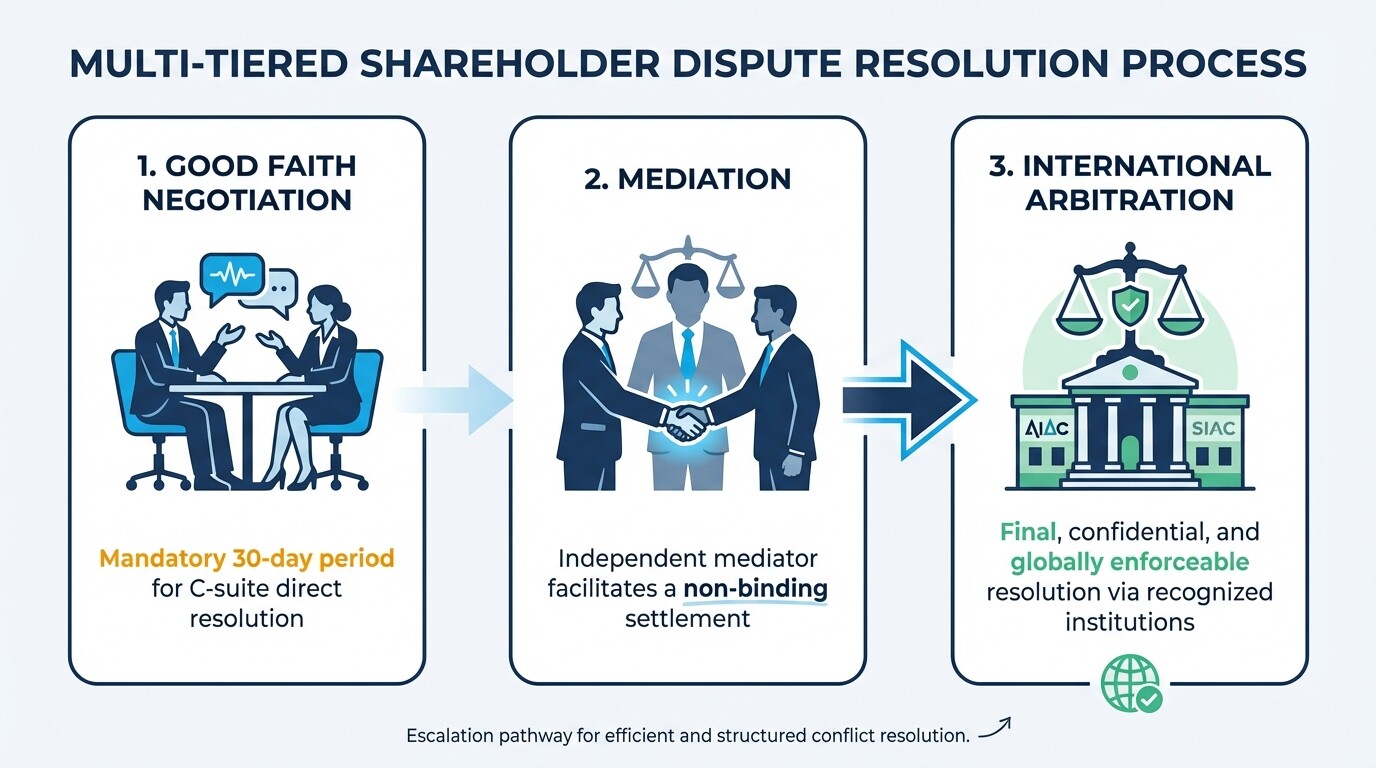
International arbitration is the primary dispute resolution method for cross-border tech JVs in Malaysia. It offers confidentiality, specialized arbitrators, and global enforceability. Selecting a neutral seat and institutional rules minimizes local court interference and protects commercial data from public records.
Malaysia is a signatory to the New York Convention. Arbitration awards rendered here are enforceable in over 160 countries. Mandate a multi-tiered approach in the dispute resolution clause:
- Good Faith Negotiation: A mandatory 30-day period where C-suite executives attempt to resolve the issue directly.
- Mediation: Engagement of an independent mediator to facilitate a non-binding settlement.
- Arbitration: Final resolution through a recognized institution, such as the Asian International Arbitration Centre (AIAC) in Kuala Lumpur or the Singapore International Arbitration Centre (SIAC). The clause should specify the number of arbitrators, the language of proceedings, and the governing law.
Managing Employment Liabilities for Global Staff
Transferring foreign technical staff to a Malaysian JV requires compliance with immigration laws and the Employment Act 1955. Foreign partners must secure Employment Passes (EP) for expatriates and ensure employment contracts meet Malaysian statutory minimums for termination and benefits.
Misclassifying transferred employees or failing to secure the correct visas can result in deportation and penalties for the JV's directors. Manage global staff transfers through these steps:
- e-Xpats System: Tech companies with MD status can expedite Employment Pass applications through MDEC's immigration channel, bypassing some requirements of the Expatriate Services Division (ESD).
- Dual-Contract Structures: Use secondment agreements where the expatriate remains employed by the foreign parent company but is legally seconded to the Malaysian JV. This protects their home-country pension and benefits.
- Statutory Compliance: Ensure all locally hired staff and applicable expatriates receive protections mandated by the Employment Act 1955. This includes maximum working hours, statutory sick leave, and contributions to the Employees Provident Fund (EPF).
Common Misconceptions
Foreign tech companies often assume joint venture structures are entirely flexible and immune from local regulatory oversight. Correcting these assumptions early prevents compliance failures and shareholder disputes.
- Bumiputera quotas do not apply to all companies. While some strategic sectors mandate local ethnic majority ownership, most tech and digital services companies can be 100% foreign-owned.
- Foreign law cannot govern the entire JV. The shareholder agreement can use foreign law, but the joint venture entity is a Malaysian Sdn. Bhd. It must adhere to the Malaysian Companies Act 2016 for all corporate governance.
- Non-compete clauses are not universally enforceable. Under Section 28 of Malaysia's Contracts Act 1950, post-termination non-compete clauses against employees are void. However, restrictions between corporate JV partners can be enforced if drafted reasonably to protect legitimate business interests.
FAQs
What is the minimum paid-up capital for a foreign-owned tech JV in Malaysia?
A basic Sdn. Bhd. can be incorporated with a minimal amount, but a company with foreign equity generally requires a minimum paid-up capital of RM 500,000 to RM 1,000,000 depending on the sector. This is highly relevant if the company intends to hire expatriates.
Can a foreign director reside outside of Malaysia?
A Malaysian Sdn. Bhd. must have at least one resident director whose principal place of residence is in Malaysia. The foreign tech partner can appoint non-resident directors to the board as long as the local resident requirement is met.
How long does it take to incorporate a joint venture company in Malaysia?
Once all shareholder agreements are signed and compliance documents are prepared, incorporation via the SSM online portal takes 3 to 5 working days. Opening a corporate bank account and securing industry licenses can take several weeks or months.
Next Steps
- Execute a Non-Disclosure Agreement (NDA): Before discussing proprietary tech or market strategies with a potential Malaysian partner, sign an NDA governed by a mutually agreed jurisdiction.
- Draft a Term Sheet: Outline the core business objectives, equity split, board representation, and IP ownership rules.
- Engage a Corporate Lawyer: Do this before sharing IP or transferring capital. A legal professional will translate the term sheet into a formal Joint Venture Agreement and manage the incorporation. You can browse verified contract lawyers in Malaysia through the Lawzana directory to find specialists in cross-border tech partnerships.