


- New Zealand strictly enforces border controls, requiring careful alignment between the New Zealand Customs Service and the Ministry for Primary Industries.
- Properly classifying goods and utilizing tariff concessions can legally eliminate import duties for foreign suppliers.
- Non-compliance with biosecurity rules for packaging and untreated wood is the leading cause of expensive border holds.
- Importers of record are strictly liable for documentation accuracy, meaning you cannot completely outsource legal liability to a freight forwarder.
- Contesting customs valuations is a time-sensitive process that starts with a formal administrative review within 20 working days of an assessment.
New Zealand Import Compliance Checklist
Successfully clearing goods at the New Zealand border requires strict adherence to both customs and biosecurity protocols. Use this checklist to prepare your shipments before they leave the port of origin.
- Register for a Customs Client Code: Obtain your unique identifier from NZ Customs to act as an importer of record.
- Confirm the Tariff Classification: Identify the correct 8-digit or 10-digit Harmonized System code under the New Zealand Working Tariff Document.
- Check for Tariff Concessions: Search the consolidated list of approvals to see if your goods qualify for duty-free entry.
- Verify Import Health Standards: Check Ministry for Primary Industries guidelines to ensure your product is legally allowed into the country.
- Prepare the Commercial Invoice: Ensure the invoice lists the true transaction value, currency, country of origin, and Incoterms.
- Secure Biosecurity Certificates: Obtain required fumigation or phytosanitary certificates, especially for wood packaging materials and agricultural products.
- Lodge the Entry: Submit your electronic import entry via the Trade Single Window system prior to the vessel arriving in New Zealand.
How to Determine Tariff Classifications and Duty Concessions
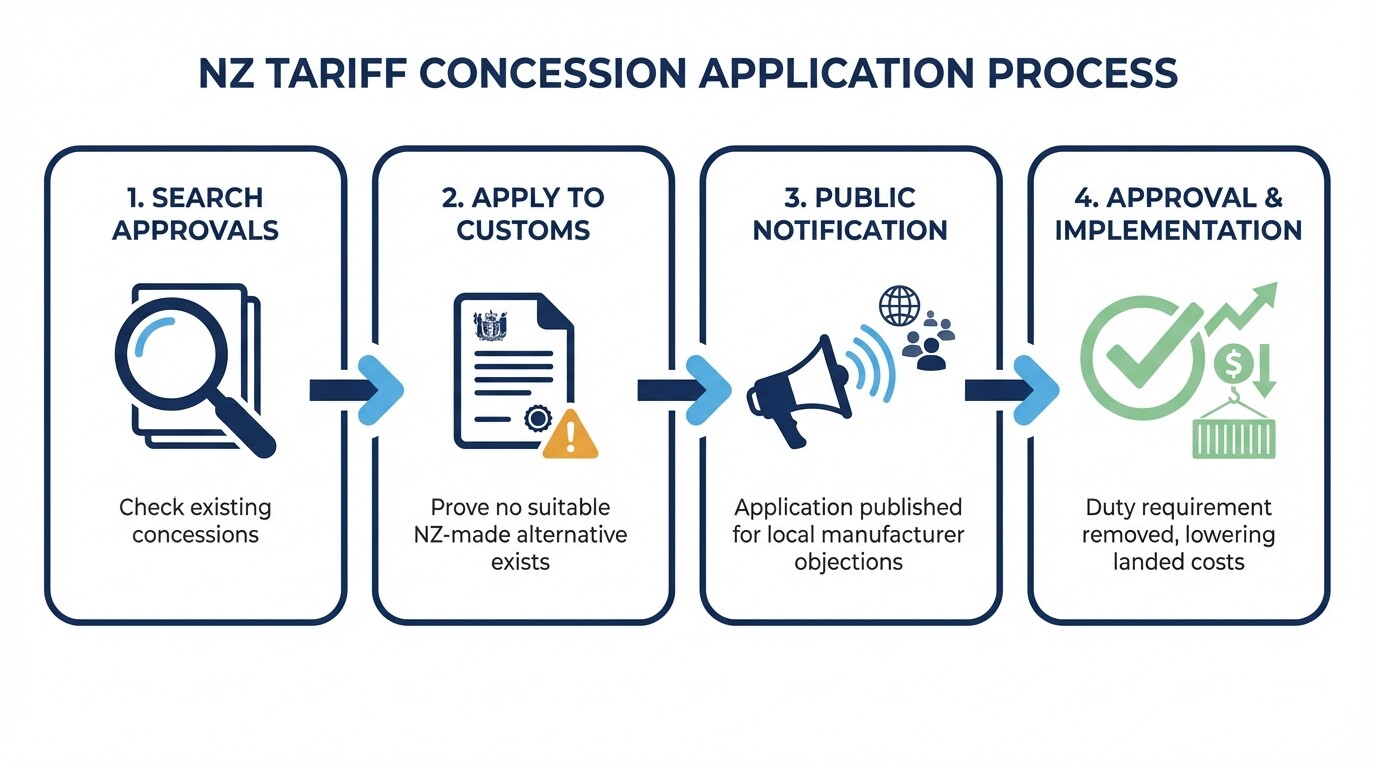
All goods imported into New Zealand must be classified under the Working Tariff Document, which dictates the applicable duty rate. Securing a tariff concession can eliminate duty costs entirely if no suitable equivalent goods are manufactured locally.
New Zealand categorizes imports using the international Harmonized System, adding specific national digits for localized tracking. Getting the classification wrong can result in overpaying duties or facing infringement penalties for underpayment. Suppliers should consult the official Working Tariff Document published by the New Zealand Customs Service to determine base rates.
If your goods face a high tariff but do not compete with New Zealand manufacturers, you can apply for a Tariff Concession. The process involves:
- Searching existing approvals: Many specific industrial or commercial goods already have active concessions that any importer can claim.
- Applying for a new concession: If no concession exists, you can submit an application to Customs proving that suitable alternative goods are not produced in New Zealand.
- Public notification: Customs publishes the application, allowing local manufacturers to object.
- Approval and implementation: Once approved, the concession removes the duty requirement, dramatically lowering landed costs.
Biosecurity Requirements and MPI Compliance
The Ministry for Primary Industries enforces some of the strictest biosecurity laws globally to protect New Zealand agriculture and natural environment. Goods, packaging, and shipping containers must be free of contamination and comply with specific Import Health Standards.
Any biological material, agricultural product, or item packed in untreated wood will trigger heavy scrutiny. The Ministry for Primary Industries requires global suppliers to meet strict decontamination and reporting standards before goods arrive. You can review specific commodity rules through the Ministry for Primary Industries import portal.
To prevent border delays, suppliers must adhere to these core biosecurity rules:
- Wood Packaging Restrictions: All timber packaging, pallets, and dunnage must be treated and stamped according to ISPM 15 standards.
- Brown Marmorated Stink Bug Rules: Goods manufactured in or shipped from high-risk countries during the stink bug season require approved offshore treatment.
- Cleanliness Declarations: Sea containers must be accompanied by a quarantine declaration confirming they are free of soil, plant material, and pests.
- Import Permits: Certain high-risk items like seeds, animal products, or used machinery require specialized permits applied for well in advance of shipping.
Standard Timelines for Customs Clearance and Border Holds
Standard electronic customs clearance in New Zealand typically takes 24 to 48 hours for compliant shipments submitted via the Trade Single Window. However, shipments selected for biosecurity inspections or customs document checks can face border holds lasting several days to weeks.
Suppliers should factor these average processing timelines into their supply chain planning:
| Clearance Stage | Standard Processing Time | Potential Delays |
|---|---|---|
| Electronic Entry Lodgement | Instant to 4 hours | System outages or formatting errors. |
| Standard Customs Clearance | 24 to 48 hours | Missing commercial invoices or valuation queries. |
| Documentary Review Hold | 3 to 7 days | Customs requiring proof of payment or origin certificates. |
| Biosecurity (MPI) Inspection | 5 to 14 days | Facility backlogs or requiring fumigation upon arrival. |
Lodging your import entry before the ship arrives is the most effective way to secure fast clearance. If a hold occurs, prompt communication with your customs broker and immediate provision of requested commercial documents will minimize storage fees at the port.
Cost Estimates for Compliance Audits and Appeals
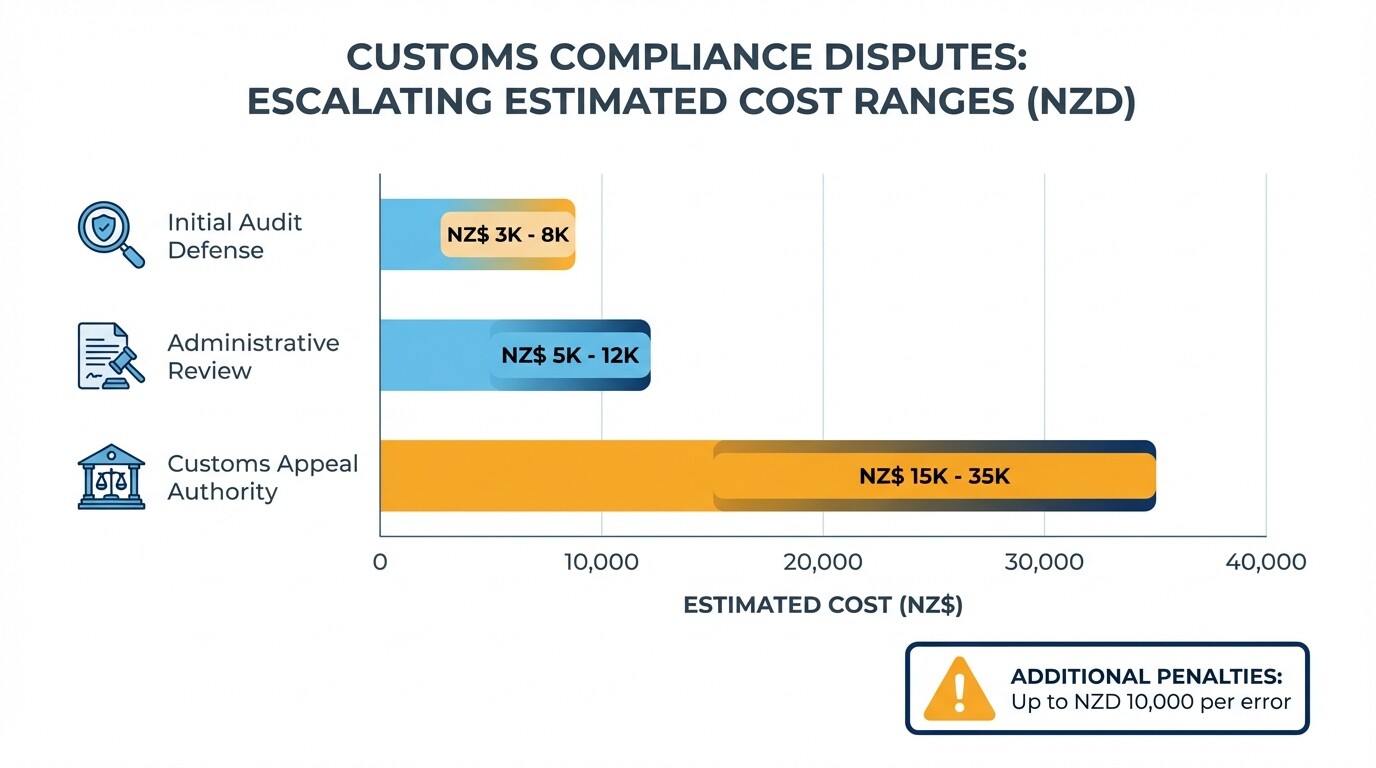
Importers facing customs compliance audits or initiating legal appeals should budget between NZD 5,000 and 30,000, depending on the complexity of the case. Costs fluctuate based on whether the dispute is resolved administratively or requires a formal hearing.
New Zealand Customs actively audits global suppliers and local importers to ensure correct valuation, origin declarations, and tariff classifications. If Customs issues an assessment for underpaid duties, challenging the decision incurs legal and administrative costs.
- Initial Audit Defense: Responding to a Customs audit notice and preparing a defense typically costs between NZD 3,000 and 8,000 in legal and advisory fees.
- Administrative Review: Requesting an internal review of a disputed valuation or tariff decision generally ranges from NZD 5,000 to 12,000.
- Customs Appeal Authority: Taking a case to the formal tribunal involves preparation of evidence, expert testimony, and hearing representation, costing between NZD 15,000 and 35,000.
- Penalties: If an audit reveals careless errors, Customs can issue administrative penalties up to NZD 10,000 per error, on top of the shortfall duty and use-of-money interest.
Strategies for Contesting Customs Valuation Decisions
Disputing a customs valuation requires formally requesting an administrative review by Customs within 20 working days of the assessment. The most effective strategy involves proving the transaction value method was incorrectly rejected by supplying detailed commercial documentation.
Customs typically values goods based on the "transaction value," which is the actual price paid or payable for the goods. Disputes often arise when Customs suspects the declared value is artificially low due to a relationship between the buyer and seller, such as parent and subsidiary companies.
To successfully contest a valuation decision, execute the following strategies:
- Prove an Arm's Length Transaction: Supply transfer pricing studies, intercompany agreements, and historical pricing data to show the relationship did not influence the price.
- Submit Detailed Cost Breakdowns: Provide itemized invoices separating the cost of the goods from international freight, insurance, and local New Zealand marketing costs.
- File a Timely Application for Review: You must submit a Part 8 Application for Review within 20 working days. Missing this deadline generally solidifies the Customs assessment.
- Escalate to the Customs Appeal Authority: If the internal review fails, you have 20 working days to file an appeal to the independent tribunal, where legal representation is highly recommended.
Common Misconceptions About Importing to New Zealand
Global suppliers frequently misjudge the rigidity of New Zealand import laws, leading to unexpected delays and fines. Understanding the reality of these rules is critical for smooth border operations.
- Freight forwarders hold all the liability: Many suppliers believe their shipping agent absorbs all legal responsibility for customs declarations. In New Zealand, the importer of record remains strictly liable for errors, meaning you will pay the fines even if your broker made the mistake.
- Standard international packaging is always acceptable: Suppliers often assume standard wooden pallets are fine. New Zealand biosecurity will halt and potentially destroy or export shipments on untreated wood pallets at the importer's expense.
- Valuation errors only require paying the difference: Importers often think a valuation mistake just means paying the owed duty later. New Zealand Customs routinely issues compensatory penalties and infringement notices for careless valuation errors, compounding the financial impact.
FAQs About NZ Import Regulations
Do I need an import license to bring goods into New Zealand?
Most standard commercial goods do not require an import license in New Zealand. However, specific high-risk items like firearms, hazardous chemicals, and certain agricultural products require explicit permits from relevant government ministries.
What is a Customs Client Code?
A Customs Client Code is a unique identification number required for any business or individual importing goods valued over NZD 1,000. It tracks your import history and is necessary to lodge an electronic import entry.
How are import duties and GST calculated?
Import duty is calculated as a percentage of the Customs Value of the goods. New Zealand Goods and Services Tax is then calculated at 15 percent on the sum of the Customs Value, the import duty, and the international freight and insurance costs.
Can I appeal a biosecurity destruction order?
Yes, you can appeal a Ministry for Primary Industries directive to destroy or reship goods. You must act immediately through your customs broker to request alternative treatments, such as specialized fumigation, before the destruction order is executed.
When to Hire an International Trade Lawyer
You should engage an international trade lawyer immediately if you receive a notice of a formal Customs audit, a reassessment of duties, or a penalty notice. Legal intervention is also necessary when applying for complex tariff concessions or structuring international transfer pricing models to survive border scrutiny.
Trying to litigate a valuation dispute or navigate a Customs Appeal Authority hearing without specialized counsel often results in upheld penalties. If you are a global supplier facing border holds, complex biosecurity compliance issues, or valuation disputes, contacting experienced international trade law attorneys in New Zealand ensures your rights are protected and your supply chain remains operational.