

- International companies must incorporate a local subsidiary through the Corporate Affairs Commission to operate in Nigeria.
- The minimum authorized share capital for any foreign-owned entity in Nigeria is NGN 100,000,000.
- Energy companies must comply with the Nigerian Oil and Gas Industry Content Development Act. This law mandates preference for local labor, materials, and equity ownership.
- Foreign personnel require a Business Permit and Expatriate Quotas from the Ministry of Interior to work legally in the country.
- Regulatory clearance involves multiple agencies and ends with operational licensing from the Nigerian Upstream Petroleum Regulatory Commission.
Corporate Affairs Commission Incorporation
The Companies and Allied Matters Act 2020 prohibits foreign companies from doing business directly in Nigeria. Foreign entities must register a local subsidiary. The Corporate Affairs Commission (CAC) manages the digitized registration process. The standard corporate vehicle for a foreign subsidiary is a Private Company Limited by Shares (LTD).
The parent company must provide its certificate of incorporation and a board resolution authorizing the Nigerian entity. The Nigerian entity must have a minimum issued share capital of NGN 100,000,000. You do not need to deposit this capital immediately before registration. However, the CAC and the Federal Inland Revenue Service calculate statutory fees based on this volume.
Registration requires at least two directors. Both can be foreign nationals. Appointing at least one resident director simplifies banking and administrative setup. You must also appoint a verified local company secretary and provide a registered office address in Nigeria.
Energy Sector Subsidiary Registration Checklist
Use this checklist to prepare documentation for the CAC and energy regulators:
- Parent company documents: Notarized certificate of incorporation and board resolution.
- Identification: Government-issued passports for proposed directors and shareholders.
- Signatures: E-signatures for the Memorandum and Articles of Association.
- Capitalization: Proof of NGN 100,000,000 minimum share capital allocation.
- Local representation: Details of the appointed Nigerian company secretary.
- Tax registration: Application for a Tax Identification Number generated with the CAC certificate.
Local Content Requirements in the Energy Sector
The Nigerian Oil and Gas Industry Content Development Act regulates foreign participation in the energy sector. The law requires operators and service companies to give preference to Nigerian indigenous service companies for specific contracts and services.
An indigenous company has at least 51% of its equity owned by Nigerians. Foreign energy companies wanting to provide upstream services, drilling, or engineering operations must form an incorporated joint venture. The local partner must hold the 51% majority stake. The Act requires companies to submit a Nigerian Content Plan to the Nigerian Content Development and Monitoring Board before bidding on licenses or projects.
Foreign subsidiaries must register on the Nigerian Joint Qualification System (NIPEX JQS) portal. This platform is the central clearinghouse for oil and gas contracts. It tracks compliance with local content quotas for labor, material sourcing, and technology transfer.
Structuring Joint Ventures with Local Partners
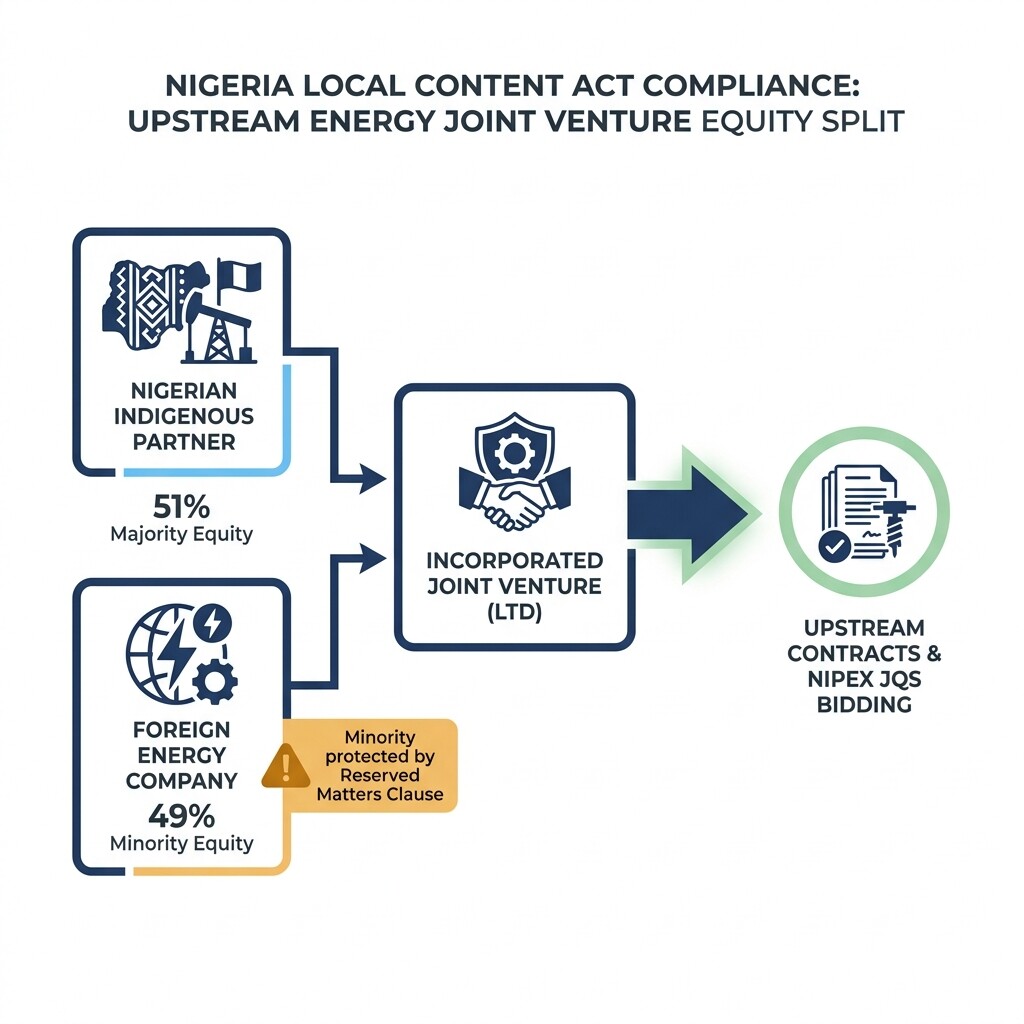
Joint ventures are the primary legal structure for foreign energy companies to satisfy local content laws and maintain technical oversight. Because the Nigerian partner must hold at least 51% equity, the Joint Venture Agreement must balance equity ownership with operational control and profit distribution.
Foreign investors protect their interests through strategic board representation, reserved matter clauses, and technical services agreements. The foreign entity can retain operational control over technical aspects by drafting minority protection rights into the Shareholders Agreement.
Sample Reserved Matters Clause
Technical partners should include reserved matters in the Joint Venture Agreement that require unanimous or supermajority board approval.
Sample Clause Language: "Notwithstanding the equity distribution between the Local Partner and the Foreign Partner, the Parties agree that the following Reserved Matters shall require the affirmative vote of at least one Director appointed by the Foreign Partner: (a) any alteration to the Company's Memorandum and Articles of Association; (b) the approval of the annual operating budget and business plan; (c) the incurrence of debt exceeding USD 500,000 or its Naira equivalent; and (d) the appointment or removal of the Chief Technical Officer."
Expatriate Quotas and Business Permits
A foreign-owned subsidiary cannot employ foreign nationals in Nigeria without an Expatriate Quota. The company must also hold a Business Permit. The Federal Ministry of Interior grants both authorizations. The Business Permit is the official authorization for a company with foreign ownership to operate in Nigeria.
The Expatriate Quota regulates the number of foreign technical experts and managers the company can employ. The company must prove that the required skills are unavailable in the Nigerian labor market to obtain these quotas. The application requires CAC incorporation documents, tax clearance certificates, a feasibility report, and a Certificate of Capital Importation (a bank document confirming the inflow of foreign currency for investment).
Quotas are granted for two to three years and are renewable. The company must demonstrate it is actively training Nigerian understudies to assume the expatriate roles.
Expected Timelines and NUPRC Licensing
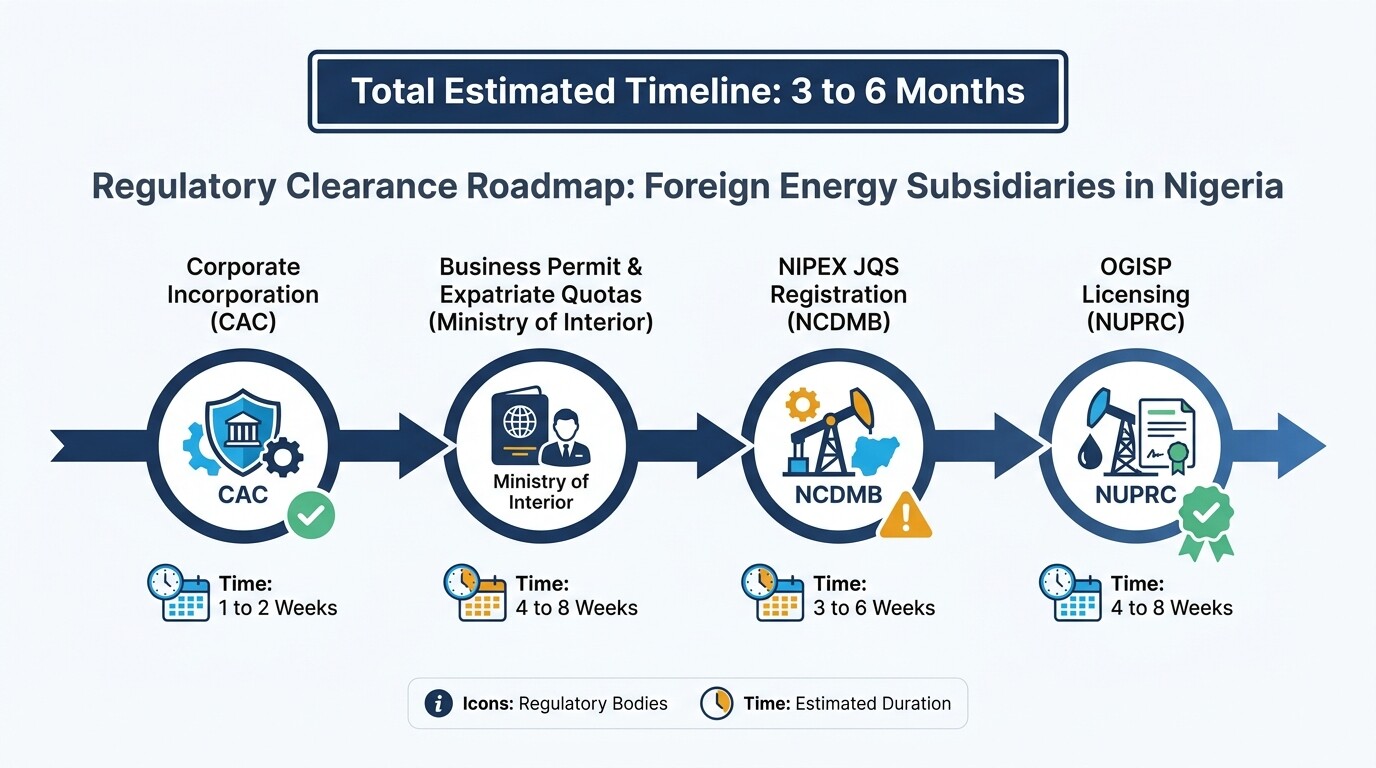
Registering an energy company in Nigeria takes three to six months from CAC name reservation to industry licensing. After incorporation, upstream sector companies must apply for an Oil and Gas Industry Service Permit (OGISP) from the Nigerian Upstream Petroleum Regulatory Commission. This permit must be renewed annually.
| Regulatory Step | Authority | Estimated Timeline | Estimated Official Fees |
|---|---|---|---|
| Corporate Incorporation | CAC | 1 to 2 Weeks | NGN 500,000 - 800,000 |
| Business Permit & Quotas | Ministry of Interior | 4 to 8 Weeks | USD 1,000 - 3,000 |
| NIPEX JQS Registration | NCDMB | 3 to 6 Weeks | NGN 200,000 |
| OGISP Licensing | NUPRC | 4 to 8 Weeks | NGN 150,000 - 1,500,000 |
Note: Timelines assume all documentation is complete. NUPRC permit fees vary based on the service category (General, Major, or Specialized).
Common Registration Misconceptions
Branch offices: Many investors believe they can execute short-term energy contracts using their foreign corporate entity. The Companies and Allied Matters Act prohibits this. Any foreign company doing business in Nigeria must incorporate a separate local subsidiary.
Foreign ownership limits: The CAC allows 100% foreign ownership of a Nigerian LTD. However, the Nigerian Oil and Gas Industry Content Development Act restricts what that company can do in the energy sector. Without 51% Nigerian equity, the company cannot bid on most upstream service contracts.
Expatriate quotas: Companies often assume Expatriate Quotas are perpetual work permits. They are granted for a specific duration with the condition that a Nigerian understudy receives training. The Ministry of Interior will refuse to renew the quota if the company fails to demonstrate local capacity building.
Legal Counsel and Next Steps
Nigerian corporate law, immigration procedures, and local content regulations require specialized legal counsel. Engage corporate counsel when structuring your joint venture. Equity misallocations can disqualify your subsidiary from energy sector contracts.
A lawyer negotiates local partnerships, drafts the Memorandum and Articles of Association, and handles regulatory filings with the CAC, Ministry of Interior, and NUPRC. Consult experienced business registration lawyers in Nigeria to maintain compliance and protect foreign investments.
- Identify and vet a Nigerian corporate partner to meet local content requirements for the specific energy sub-sector.
- Draft a Joint Venture Agreement outlining equity distribution, board representation, and technology transfer protocols.
- Gather notarized incorporation documents from the foreign parent company and secure government-issued IDs for proposed directors.
- Engage Nigerian corporate counsel to reserve the proposed company name with the CAC and begin incorporation filings.