- CCI is Non-Negotiable: You must obtain an electronic Certificate of Capital Importation (eCCI) within 24 hours of bringing foreign capital into Nigeria to legally guarantee your future right to repatriate funds.
- Taxes Precede Repatriation: The Nigerian government requires you to pay Withholding Tax (WHT)-typically 10%-and obtain a tax clearance certificate before you can remit dividends abroad.
- NAFEM is the Standard: All official foreign exchange transactions for investors now route through the Nigerian Autonomous Foreign Exchange Market (NAFEM), following recent Central Bank of Nigeria unifications.
- FX Liquidity Dictates Timelines: While the law guarantees your right to repatriate profits, actual remittance timelines depend entirely on the dollar liquidity of your local commercial bank.
Navigating Central Bank of Nigeria (CBN) Foreign Exchange Regulations
The Central Bank of Nigeria (CBN) strictly regulates the inflow and outflow of foreign currency under the Foreign Exchange (Monitoring and Miscellaneous Provisions) Act. Foreign investors must route all capital through Authorized Dealers (commercial banks) and comply with CBN directives to protect their legal right to repatriate capital and profits.
The CBN has recently shifted its policy to unify multiple exchange rate windows into a single market known as the Nigerian Autonomous Foreign Exchange Market (NAFEM). This transition aims to reflect market-driven rates, replacing the previously pegged official rates. While the Nigerian Investment Promotion Commission (NIPC) Act guarantees foreign investors the unconditional transferability of dividends and capital, exercising this right practically requires flawless compliance with CBN documentation protocols. Attempting to bypass Authorized Dealers or using parallel black markets violates anti-money laundering (AML) laws and instantly disqualifies your funds from legal repatriation protection.
Certificate of Capital Importation (CCI) Application Checklist
A Certificate of Capital Importation (CCI) is the mandatory digital document issued by an Authorized Dealer proving foreign capital legally entered Nigeria. You must secure this electronic CCI (eCCI) within 24 hours of the capital inflow to secure your legal authority to purchase foreign exchange for future repatriation.
If you are importing cash (equity or loan) or machinery, your local Nigerian bank requires specific documentation to process the eCCI. Missing the 24-hour window requires a complex, time-consuming late application process directly with the CBN. Gather these documents before initiating your wire transfer:
- Board Resolution: A formal resolution from the Nigerian subsidiary's board authorizing the foreign investment or loan.
- SWIFT Telex Copy: The verifiable SWIFT message from the remitting foreign bank showing the exact inflow of funds.
- Purpose of Investment: A detailed letter stating whether the funds are for equity participation, a specialized project, or an intercompany loan.
- Incorporation Documents: Certified true copies of the Nigerian company's Certificate of Incorporation and Memorandum and Articles of Association.
- Customer Instruction: A formal instruction letter from the Nigerian beneficiary company directing the bank to issue the eCCI.
- Customs Documentation (For Goods/Machinery): If importing capital as equipment, you must provide the Single Goods Declaration (SGD) form and Clean Report of Inspection.
Legal Steps for Repatriating Dividends and Business Profits
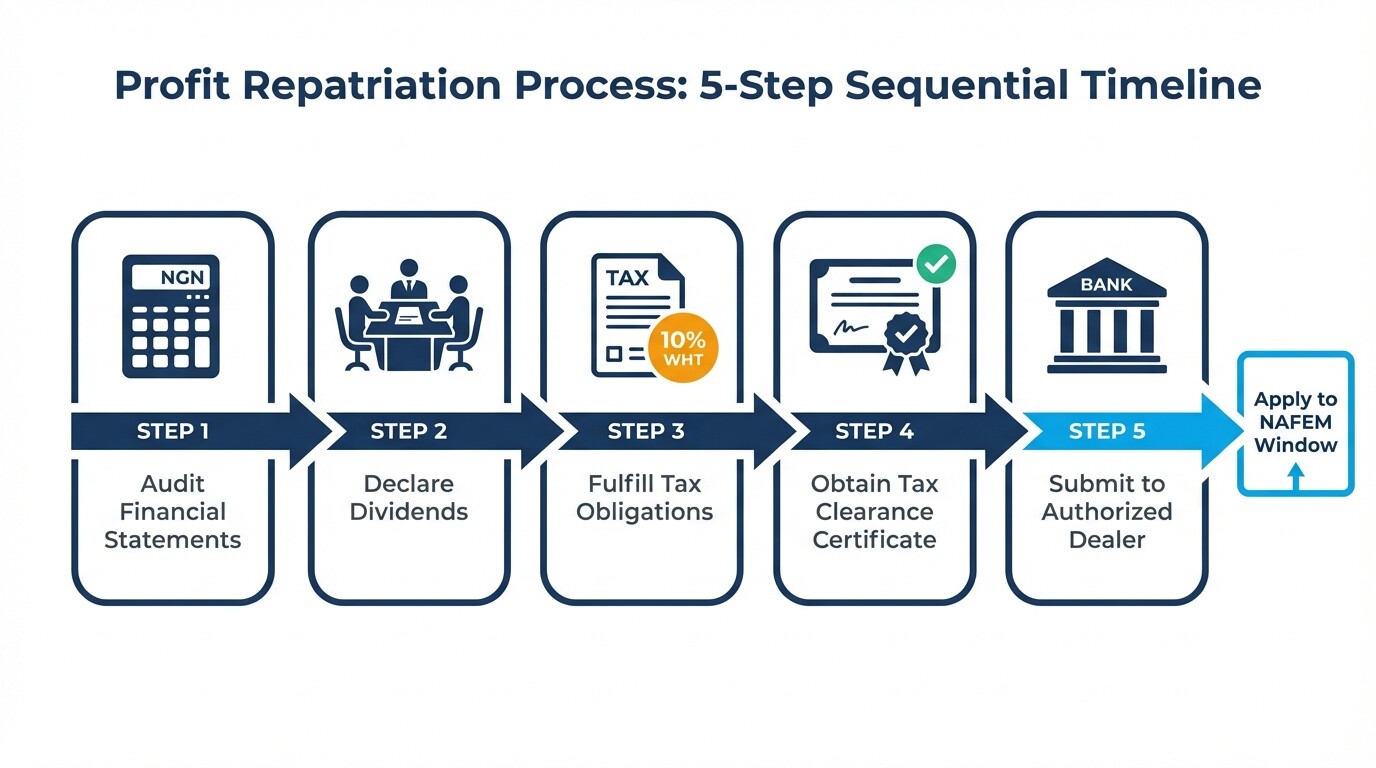
Repatriating profits requires applying through an Authorized Dealer using the official forex market after fulfilling all local tax and corporate obligations. You cannot legally remit dividends out of Nigeria until you declare them formally, pay applicable taxes, and secure regulatory clearance.
To process a repatriation request successfully, follow these procedural steps:
- Audit Financial Statements: Finalize and audit your Nigerian entity's financial statements for the fiscal year to establish the exact profit available for distribution.
- Declare Dividends: Pass a board resolution and secure shareholder approval at an Annual General Meeting (AGM) declaring the specific dividend amount.
- Fulfill Tax Obligations: Deduct the mandatory 10% Withholding Tax (WHT) from the dividends-or 7.5% if your home country has a Double Taxation Agreement with Nigeria-and remit it to the Federal Inland Revenue Service (FIRS).
- Obtain Tax Clearance: Secure a Tax Clearance Certificate (TCC) from FIRS proving your company has no outstanding tax liabilities.
- Submit to Authorized Dealer: Present your eCCI, audited accounts, board resolution, dividend warrant, and TCC to your commercial bank. The bank will then bid for foreign exchange on NAFEM on your behalf.
Official FX Windows vs. Alternative Financial Structuring
Foreign investors typically use the Nigerian Autonomous Foreign Exchange Market (NAFEM) for official repatriation, but systemic dollar shortages often delay these transfers. Comparing the official window with legal alternative financial structures helps multinationals optimize their liquidity while remaining compliant.
| Strategy | Legal Framework | Processing Time | Primary Risk or Drawback |
|---|---|---|---|
| NAFEM Repatriation | Standard CBN process using eCCI and Authorized Dealers. | Weeks to months (depends on bank liquidity). | High exposure to Naira devaluation while waiting in the FX queue. |
| Intercompany Loans | Structured debt agreements between parent and subsidiary. Requires initial eCCI for the loan. | Predictable schedule based on loan terms. | Strict CBN caps on interest rates and limits on debt-to-equity ratios. |
| Local Re-investment | Reallocating trapped Naira into local government bonds or expanding Nigerian operations. | Immediate. | Funds remain in Naira, subject to local inflation and currency risk. |
| Export Proceeds Retention | Exporting Nigerian goods and legally retaining the foreign currency in a local Domiciliary Account. | Fast, once the export transaction clears. | Operationally complex; requires setting up a compliant export arm. |
Common Misconceptions About Nigerian Exchange Controls
Foreign companies frequently misunderstand Nigerian currency laws, leading to trapped funds or severe compliance penalties. Clarifying these regulatory myths prevents costly strategic errors during market entry or expansion.
- "A free-floating Naira means immediate access to dollars." While Nigeria unified its exchange rates to reflect market realities, rate unification does not equal immediate FX liquidity. Commercial banks still face dollar shortages, meaning you may have to wait in a queue for weeks to convert large sums of Naira back to USD, even with perfect documentation.
- "You can apply for a CCI at any time after the funds arrive." Many investors assume they can sort out the paperwork months after injecting capital. The CBN mandates that eCCIs be processed within 24 hours of the funds hitting the local account. Late applications require special CBN approval, which is rarely granted without penalty.
- "Cryptocurrency is a viable legal workaround for repatriation." Using digital assets to bypass the official banking system for corporate repatriation is prohibited. The CBN strictly regulates how banks interact with cryptocurrency entities, and attempting to route corporate dividends through crypto channels violates both exchange controls and AML laws.
Dispute Prevention Strategies With Local Banks
Delays in processing foreign exchange requests are the primary source of conflict between foreign companies and Nigerian commercial banks. Preventing disputes requires proactive documentation, strict compliance with anti-money laundering protocols, and continuous communication with your Authorized Dealer.
Banks operate under intense regulatory scrutiny from the CBN and face massive fines for facilitating non-compliant capital flights. To prevent your funds from being flagged or stalled:
- Pre-Clear Complex Transactions: Before wiring significant capital into Nigeria, have your legal team review the exact SWIFT narratives and investment structures with your local bank's FX desk to ensure they meet current eCCI criteria.
- Segregate Capital Accounts: Keep foreign investment capital and operational revenue in clearly separated accounts. Commingling funds makes it difficult for bank auditors to trace the exact origin of capital, which frequently delays eCCI issuance.
- Maintain Current KYC: Ensure your local entity's Know Your Customer (KYC) data, directorship details, and tax filings are continuously updated with the bank. Expired corporate documents will trigger automatic halts on any outward remittance requests.
Frequently Asked Questions
What happens if I lose my Certificate of Capital Importation?
Since 2017, the CBN has digitized the system, meaning physical certificates are no longer used. If you lose track of your electronic CCI (eCCI) reference number, your Authorized Dealer can retrieve it from the central database using your company details and the original transaction dates.
Can a foreign branch office repatriate profits from Nigeria?
No, a foreign branch cannot legally repatriate profits because Nigerian law (CAMA 2020) does not recognize branch offices as separate legal entities capable of doing business. You must incorporate a distinct Nigerian subsidiary to generate revenue, obtain a CCI, and legally remit profits.
Are management fees subject to the same repatriation rules as dividends?
Yes, but with additional regulatory hurdles. To repatriate management or royalty fees, you must first register the underlying technology transfer or management agreement with the National Office for Technology Acquisition and Promotion (NOTAP) and present the NOTAP certificate to your bank.
How much does it cost to obtain an eCCI?
The issuance of an eCCI by a commercial bank is typically an administrative banking service and does not carry a statutory government fee. However, banks may charge standard transaction, SWIFT, or processing fees for the incoming wire transfer.
When to Hire a Lawyer
Engaging local legal counsel is critical before transferring any initial capital into Nigeria or signing joint venture agreements. A lawyer ensures your corporate structure qualifies for a CCI, registers your intellectual property agreements with NOTAP, and protects your unconditional right to repatriate funds under Nigerian law.
If you are currently facing trapped funds or need to restructure your Nigerian investments to optimize tax and liquidity outcomes, consulting corporate and commercial lawyers in Nigeria will provide the strategic leverage needed to navigate CBN frameworks.
Next Steps for Foreign Investors
- Verify Existing Capital Inflows: Audit your current Nigerian operations to ensure every historical foreign capital injection has a corresponding and valid eCCI.
- Review Tax Compliance: Work with local accountants to confirm your withholding tax and corporate income tax filings are up to date, securing your Tax Clearance Certificate.
- Engage an Authorized Dealer: Establish a relationship with the foreign exchange desk of a Tier-1 Nigerian commercial bank to understand their current NAFEM bidding timelines and dollar liquidity status.