- Foreign-owned BPOs must file a General Information Sheet (GIS) with the SEC within 30 days of their annual stockholders' meeting.
- While the Revised Corporation Code allows for 100% foreign ownership in the BPO sector, the Corporate Secretary must be a Filipino citizen and resident.
- Compliance is not limited to the SEC; BPOs registered with PEZA or the BOI have additional monthly and annual reporting obligations to maintain tax incentives.
- Failure to comply with "MC 28" (designating an official email and mobile number) can lead to significant administrative penalties and delays in document processing.
Corporate Compliance Checklist for Foreign BPOs
To maintain good standing in the Philippines, a foreign-owned BPO must adhere to a rigorous schedule of filings. This checklist covers the primary requirements for a standard domestic corporation with foreign equity.
| Requirement | Deadline | Authority |
|---|---|---|
| General Information Sheet (GIS) | Within 30 days from the date of the annual stockholders' meeting | SEC |
| Audited Financial Statements (AFS) | Depends on the last digit of the SEC registration number (usually April-May) | SEC & BIR |
| Business Permit Renewal | On or before January 20th annually | Local Government Unit (LGU) |
| Income Tax Return (ITR) | April 15th (for calendar year entities) | Bureau of Internal Revenue (BIR) |
| PEZA/BOI Annual Reports | Varies (typically includes TIMTA reports and progress reports) | PEZA or BOI |
| Beneficial Ownership Disclosure | Included in the GIS filing | SEC |
How the Revised Corporation Code Affects Foreign BPOs
The Revised Corporation Code (Republic Act No. 11232) simplified the process of doing business in the Philippines by removing the minimum number of incorporators and introducing the One Person Corporation (OPC). For foreign BPOs, this means greater flexibility in structuring their local subsidiary without the historical requirement of finding five individual "dummy" incorporators to hold qualifying shares.
The law also formalized the use of remote communication for board meetings and stockholders' meetings. This is a critical development for international companies, as it allows foreign directors to participate in governance and vote on corporate actions via video conferencing from their home countries. However, these procedures must be explicitly outlined in the company's bylaws to ensure all resolutions are legally binding and enforceable.
Understanding Local Director and Residency Mandates
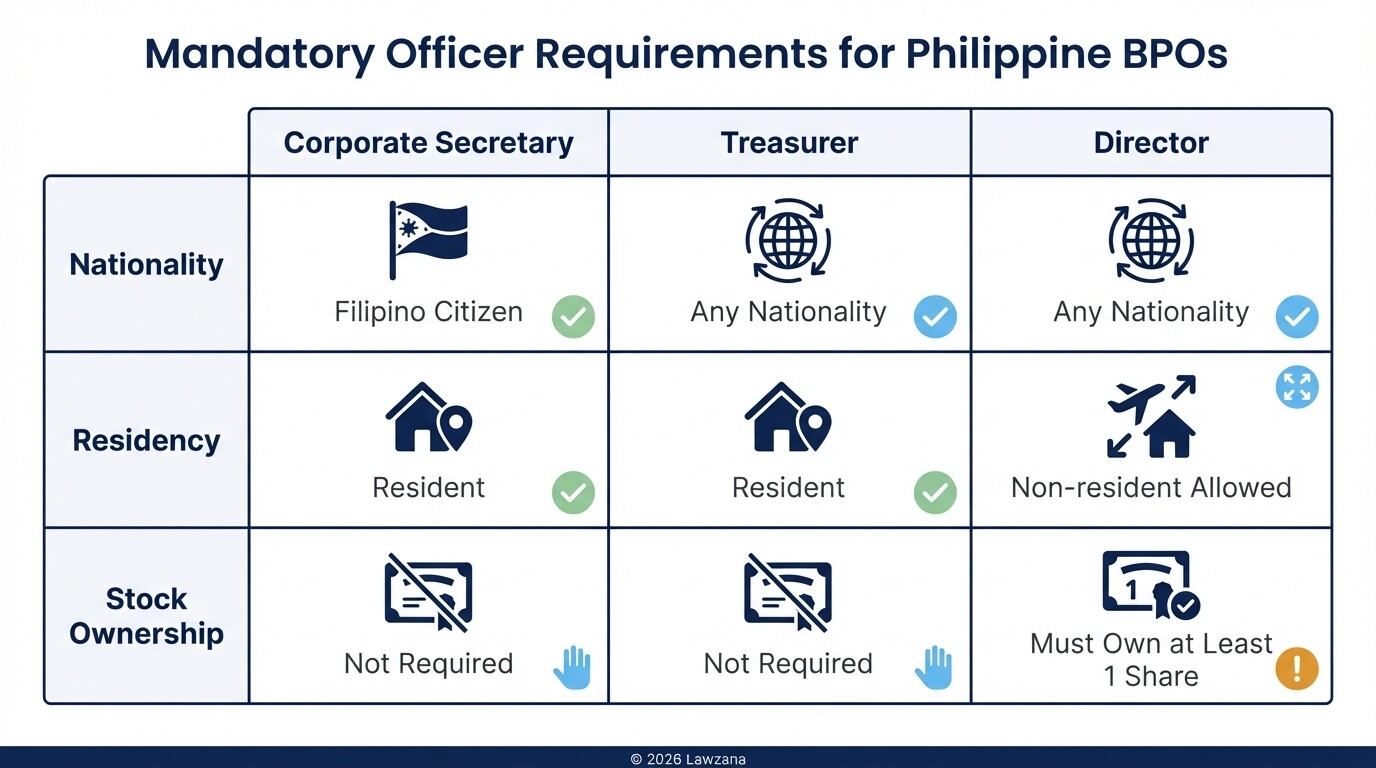
Philippine law permits majority or 100% foreign ownership of BPO companies because they are considered "export enterprises," but specific officer roles remain restricted to locals. While directors do not need to be Filipino citizens, the Corporate Secretary must be a Filipino citizen and a resident of the Philippines.
The Treasurer of the corporation is also required to be a resident of the Philippines, though they do not necessarily have to be a Filipino citizen. It is common for foreign BPOs to appoint a trusted local consultant or a senior local employee to these roles. These mandates ensure that the Philippine government has a local point of contact who is personally and legally accountable for the corporation's compliance with local statutes.
Mandatory Annual Disclosures and SEC Reportorial Requirements
Every foreign-owned corporation registered in the Philippines must submit an annual General Information Sheet (GIS) and Audited Financial Statements (AFS) to the Securities and Exchange Commission (SEC). The GIS is a snapshot of the company's current structure, listing the names of directors, officers, and the breakdown of share ownership, including the disclosure of "Beneficial Owners" to combat money laundering.
Beyond the SEC, BPOs often enjoy tax holidays or reduced corporate income tax rates (5% on Gross Income Earned) by registering with the Philippine Economic Zone Authority (PEZA). To keep these perks, companies must submit:
- Monthly performance reports
- Annual Tax Incentives Management and Transparency Act (TIMTA) reports
- Validated copies of their annual ITR
Failure to submit these reports to PEZA can result in the suspension of VAT-zero rating on local purchases or even the cancellation of the company's registration, leading to massive retroactive tax liabilities.
Managing Corporate Secretary Obligations for Smooth Operations
The Corporate Secretary in the Philippines acts as the primary custodian of corporate records and the liaison between the company and the SEC. This role is not merely administrative; the Secretary is responsible for certifying board resolutions, maintaining the Stock and Transfer Book, and ensuring that all corporate actions comply with the company's bylaws and the Revised Corporation Code.
For a foreign BPO, the Corporate Secretary's most vital duty is the preparation of "Secretary's Certificates." These documents are required for almost every corporate action in the Philippines, from opening a local bank account to signing an office lease or authorizing a representative to deal with the Bureau of Customs. Managing these obligations effectively requires a Secretary who is deeply familiar with Philippine administrative law and the specific nuances of SEC electronic filing systems like the Electronic Simplified Processing of Annual Reports (eSPARC).
Common Misconceptions About Philippine Corporate Governance
"We don't need a local office if we work entirely online." Even if a BPO operates virtually, a physical "Registered Office Address" is mandatory for SEC registration and for the issuance of a Mayor's Permit. This address is where official legal notices are served. Using a mere "virtual office" without a physical presence can lead to issues with the Bureau of Internal Revenue (BIR) during their mandatory premises inspection.
"Foreign directors can't own shares in the company." Directors must own at least one share of the capital stock of the corporation. In a foreign-owned BPO, these directors can be foreigners. The misconception often stems from "Nationalized" industries (like land ownership or retail), but since BPOs are generally export-oriented, foreign directors can and should hold their qualifying shares directly.
Does a foreign BPO need a minimum paid-up capital?
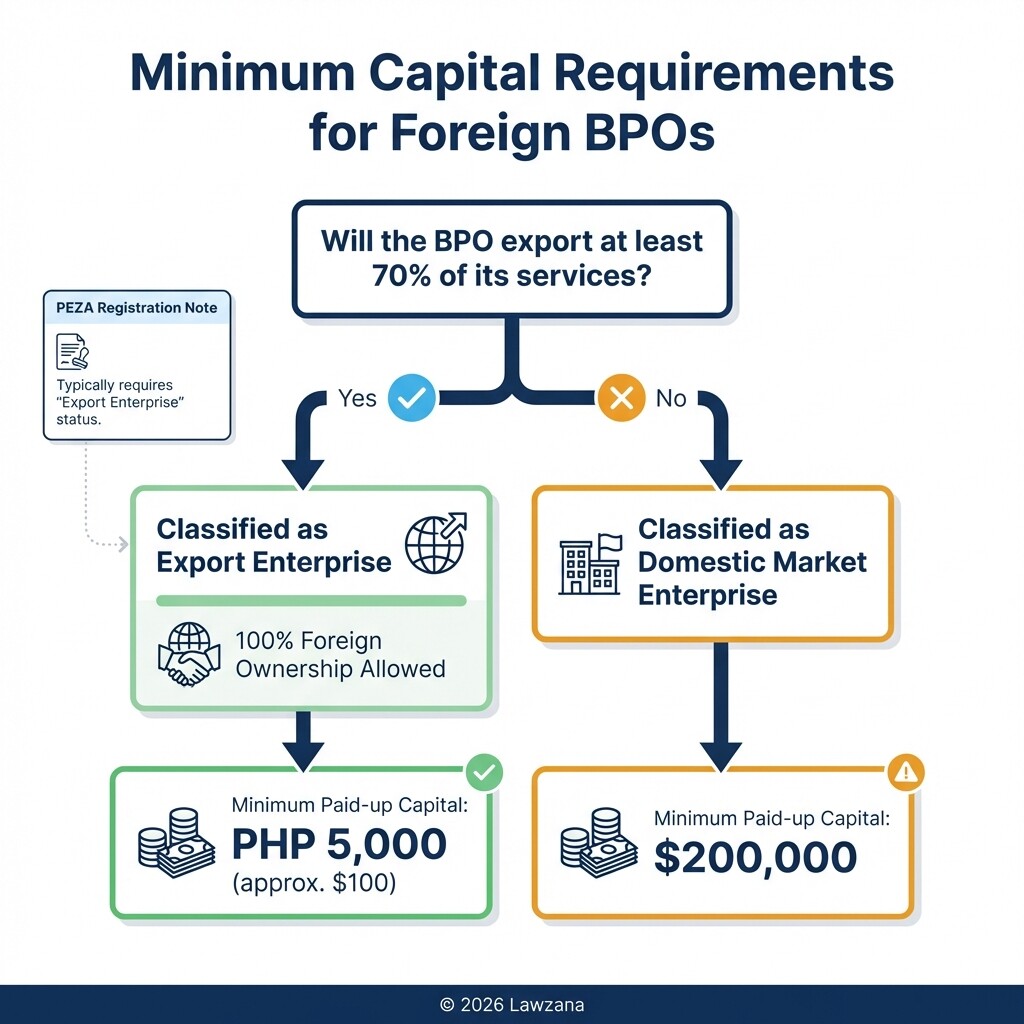
For export-oriented BPOs (where at least 70% of services are sold to clients outside the Philippines), the $200,000 minimum capital for foreign-owned firms is generally waived. Most BPOs can start with a paid-up capital as low as 5,000 PHP, though higher amounts are recommended to cover initial operating expenses and to demonstrate financial capacity to the SEC.
Can a foreign CEO be the Treasurer of the Philippine subsidiary?
Yes, provided the foreign CEO is a resident of the Philippines. The law requires the Treasurer to be a resident to ensure they are within the jurisdiction of Philippine courts and regulators; however, they do not need to be a Filipino citizen.
What is "MC 28" and why does it matter?
SEC Memorandum Circular No. 28 requires all corporations to create and designate a specific, official email address and mobile phone number for transactions with the SEC. This is mandatory for all BPOs. If you do not file this designation, the SEC will not accept your annual GIS or AFS, leading to "non-compliant" status and heavy fines.
How often must stockholders meet?
The corporation must hold an annual stockholders' meeting on the date fixed in the bylaws. If no date is fixed, the law mandates it be held on any day in April. Minutes of this meeting must be recorded in the corporate minutes book and reflect the election of the board of directors for the upcoming year.
When to Hire a Lawyer
Navigating Philippine corporate law requires professional legal intervention during the initial structuring phase and whenever a major change in ownership or business activity occurs. You should consult a lawyer if:
- You are transitioning from a 60/40 ownership structure to a 100% foreign-owned entity.
- You need to draft complex bylaws that allow for remote board voting and electronic signatures.
- You are facing an SEC audit or have received a "Notice of Violation" for late reportorial filings.
- You are negotiating a large-scale office lease or service agreement that requires specific indemnification clauses under Philippine law.
Next Steps
- Appoint a Resident Agent or Corporate Secretary: Ensure you have a qualified Filipino resident to handle your initial SEC filings and local mandates.
- Review Your Bylaws: Check if your current corporate documents allow for virtual meetings to accommodate your foreign directors.
- Register with the SEC e-Portal: Set up your accounts on the Securities and Exchange Commission eSPARC and Electronic Filing and Submission Tool (eFAST) platforms immediately.
- Audit Your PEZA/BOI Compliance: If you are claiming tax incentives, perform a quarterly check of your reportorial submissions to avoid losing your "Good Standing" certificate.