- Data privacy enforcement. The National Privacy Commission requires foreign companies processing local data to comply with the Data Privacy Act of 2012, mandating proper data-sharing agreements and localized security measures.
- Worker misclassification penalties. Labeling a worker as an independent contractor does not bypass Philippine labor laws. If you control how they work, they are legally regular employees entitled to statutory benefits.
- Joint liability risks. Foreign multinationals can be jointly liable for labor violations committed by their local Business Process Outsourcing (BPO) vendors.
- Location-based tax incentives. Accessing tax holidays through the Philippine Economic Zone Authority (PEZA) typically requires locating operations in accredited IT parks or buildings.
Structuring International Service Agreements Securely
Secure international service agreements explicitly define data ownership, governing law, and service level expectations. This structure protects foreign multinationals from local regulatory breaches and financial liabilities when partnering with Philippine BPO vendors.
When drafting a Master Services Agreement (MSA) with a Philippine vendor, clearly separate your corporate identity from the local operation. State explicitly that the vendor is an independent entity responsible for hiring, firing, and managing its employees. Omitting these boundaries invites joint liability claims, making the foreign client responsible for unpaid local wages.
Sample Governing Law and Arbitration Clause
A precise dispute resolution mechanism prevents multinationals from facing lengthy local court proceedings. Below is a standard framework for cross-border BPO contracts.
"Governing Law and Dispute Resolution: This Agreement shall be governed by and construed in accordance with the laws of [Foreign Jurisdiction, e.g., the State of New York], excluding its conflict of law principles. Any dispute, controversy, or claim arising out of or relating to this Agreement, or the breach, termination, or invalidity thereof, shall be settled by arbitration administered by the [e.g., Singapore International Arbitration Centre (SIAC)] in accordance with its Arbitration Rules in force at the time of applying for arbitration. The seat of the arbitration shall be [e.g., Singapore]. The language of the arbitration shall be English."
The Data Privacy Act and Offshore Data Handling
The Philippine Data Privacy Act of 2012 (Republic Act No. 10173) applies to any entity processing the personal data of Philippine citizens or data processed within the Philippines on behalf of foreign entities. Multinationals must register with the National Privacy Commission (NPC) and implement strict data-sharing agreements.
Foreign companies outsourcing to the Philippines frequently transfer sensitive customer data across borders. The law requires both the foreign client (the Personal Information Controller) and the local BPO (the Personal Information Processor) to sign clear data outsourcing agreements. You must ensure your local vendor appoints a dedicated Data Protection Officer (DPO) and conducts regular Privacy Impact Assessments. Non-compliance results in fines ranging from 500,000 PHP to 5,000,000 PHP and potential imprisonment for responsible officers.
Avoiding Employee Misclassification: Contractors vs. Regular Employees
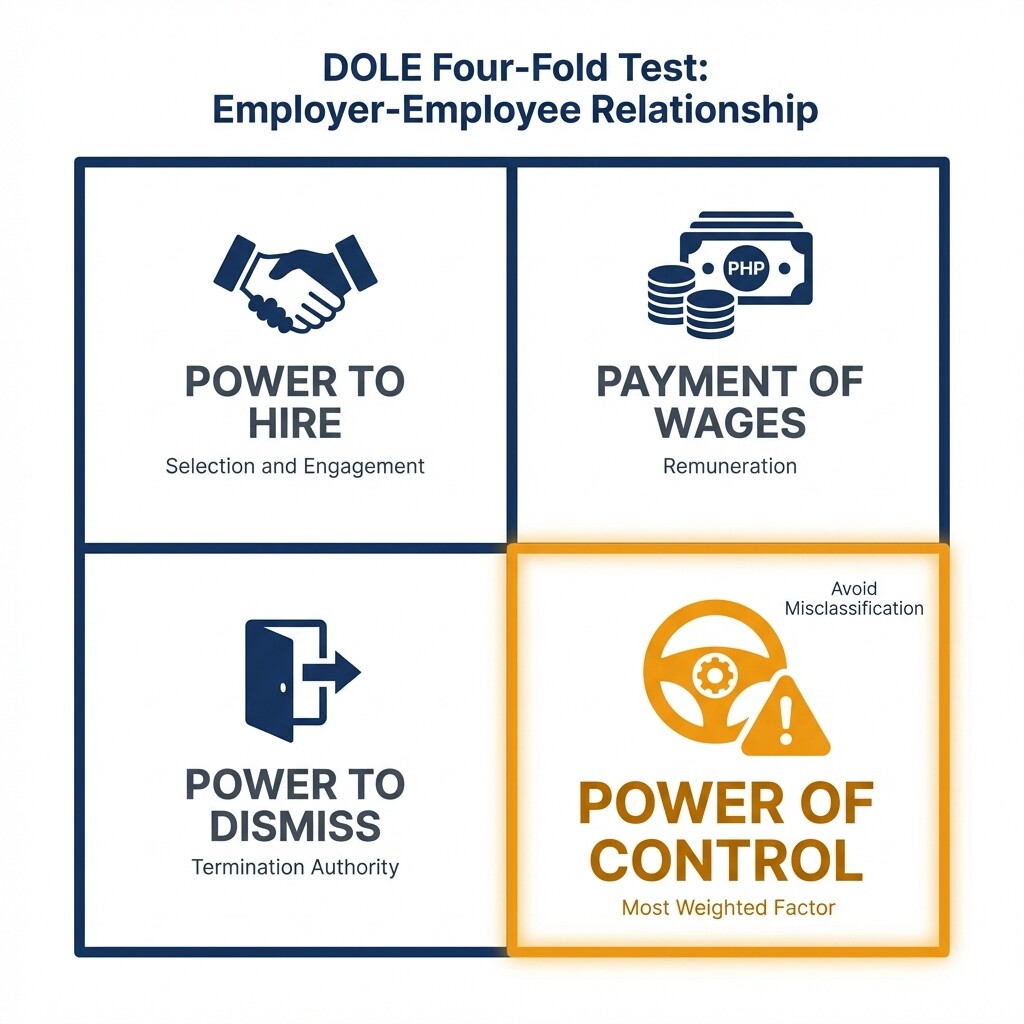
Philippine labor law strongly protects workers. Authorities readily reclassify independent contractors as regular employees if the employer exercises control over how they perform their work. Misclassification exposes foreign companies to financial penalties and retroactive benefits claims under the Department of Labor and Employment (DOLE).
The DOLE uses a "four-fold test" to determine if an employer-employee relationship exists. This test examines who hires, who pays wages, who dismisses, and who controls the method of work. The "control test" carries the most weight. If foreign managers dictate the exact schedule, methods, and daily tasks of a remote worker, that worker is legally a regular employee, regardless of the contract language. Foreign companies can avoid this by hiring through an Employer of Record (EOR) or by managing only the final output of independent contractors.
Navigating PEZA and BOI Tax Incentive Requirements
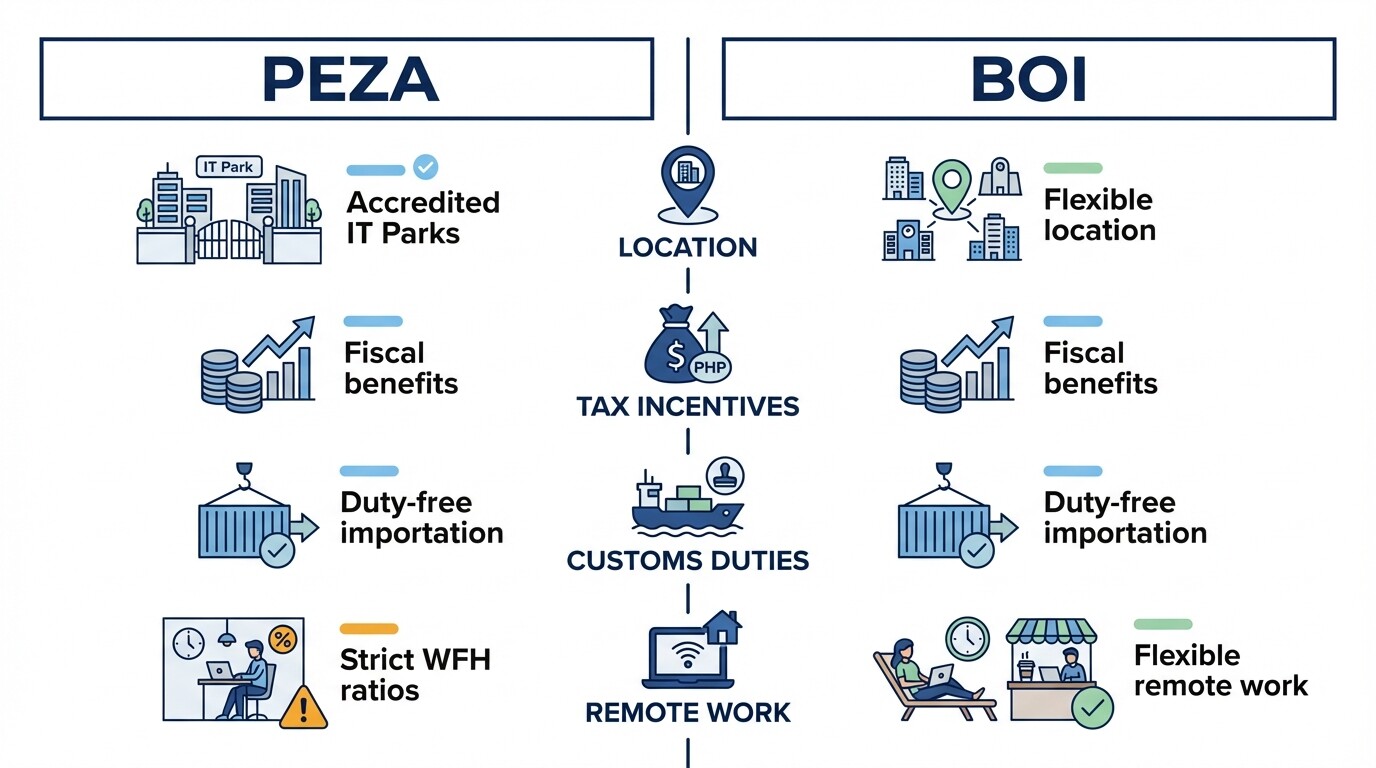
The Philippine Economic Zone Authority (PEZA) and the Board of Investments (BOI) offer tax holidays and duty exemptions to foreign firms setting up IT-BPO operations. Securing these incentives requires locating your business in designated economic zones and maintaining specific local employment and operational ratios.
Choosing between PEZA and BOI depends on your operational setup and real estate strategy. The Corporate Recovery and Tax Incentives for Enterprises (CREATE) Act harmonized many incentives, but registration requirements still differ.
| Feature | PEZA Requirements | BOI Requirements |
|---|---|---|
| Location | Must operate within accredited IT Parks or Special Economic Zones. | Flexible location across the Philippines. |
| Tax Incentives | Income Tax Holiday (4-7 years), followed by a 5% Special Corporate Income Tax. | Income Tax Holiday (4-7 years), followed by enhanced deductions. |
| Customs Duties | Tax and duty-free importation of capital equipment. | Duty exemptions on specific imported capital equipment. |
| Remote Work | Strict regulations on Work-From-Home ratios to maintain tax incentives. | Flexible remote work policies for registered entities. |
Managing Employer Liability and Cross-Border Dispute Resolution
Cross-border employer liability occurs when a foreign entity is deemed a co-employer of the local BPO staff, making them jointly liable for labor claims. Prevent this by enforcing vendor independence clauses and opting for international arbitration over local litigation for vendor disputes.
Under DOLE Department Order 174, a contracting arrangement is "labor-only contracting" if the local vendor lacks substantial capital or investment. In these cases, the foreign principal is treated as the direct employer of the vendor's staff. Under the principle of solidary liability, BPO workers can enforce unpaid wages, benefits, or illegal dismissal claims against the multinational company's local assets or subsidiary. Audit your local vendors annually to ensure they maintain sufficient capitalization and full DOLE compliance.
BPO Legal Compliance Setup Checklist
Executing a compliant BPO setup in the Philippines requires adherence to corporate, labor, and tax regulations. Use this checklist to structure your operations securely.
- Conduct vendor due diligence: Verify the BPO vendor's incorporation documents, DOLE registration, and financial capitalization.
- Draft the MSA: Include independent contractor clauses, specific SLAs, and an international arbitration provision.
- Execute a data agreement: Detail data breach protocols and liability caps according to the Philippine Data Privacy Act.
- Verify NPC registration: Confirm the vendor has an active Data Protection Officer and is registered with the National Privacy Commission.
- Establish output-based KPIs: Restructure management workflows to measure vendor output rather than controlling the daily methods of individual workers.
- Apply for tax incentives: Submit project feasibility studies to PEZA or BOI before formal commercial operations begin.
Common Misconceptions About Philippine Outsourcing
Foreign executives often approach Philippine outsourcing with assumptions based on US or European laws. This leads to compliance failures.
- Foreign governing law overrides local rules. You can apply foreign law to a commercial contract, but you cannot contract out of Philippine labor laws for workers located in the Philippines. DOLE regulations regarding minimum wage, 13th-month pay, and security of tenure apply territorially.
- BPO workers are the vendor's problem. Solidary liability means a foreign client can be held jointly responsible if the local vendor fails to pay statutory wages or government contributions. The client is viewed as the indirect employer.
- Independent contracts prevent regular employment. Contract titles do not determine employment status in the Philippines. The working arrangement dictates legal status. If you dictate a worker's hours and methods, they are an employee entitled to benefits.
Statutory Benefits and Direct Hiring Rules
Foreign companies can hire independent professionals directly in the Philippines. However, if the company dictates working hours, provides equipment, and controls daily work methods, those workers are legally regular employees. This triggers tax and statutory benefit obligations.
One of the most strictly enforced benefits is 13th-month pay. This is a mandatory benefit equivalent to one-twelfth of an employee's basic annual salary. BPO vendors must pay this to their employees by December 24 every year. Foreign clients need to factor this statutory requirement into their vendor pricing models to ensure their local partners can meet legal payroll obligations.
When to Hire a Philippine Corporate Lawyer
Engage local legal counsel before signing a Master Services Agreement with a Philippine BPO vendor or setting up a local subsidiary. Legal structuring prevents solidary liability, ensures data processing agreements meet National Privacy Commission standards, and streamlines PEZA or BOI registration. Managing DOLE labor audits or data breaches without local representation exposes your business to financial and reputational risk.
Next Steps
To protect your operations and ensure compliance in the Philippines, take these immediate actions:
- Audit your current vendor agreements to ensure they contain strict indemnification and data privacy clauses.
- Review your management practices to confirm you are not exercising direct control over outsourced personnel.
- Consult with corporate and commercial lawyers in the Philippines to assess your eligibility for tax incentives and finalize your legal setup.