- Strategic Tax Incentives: The 2026 International Headquarters Award (IHQ) offers a concessionary tax rate of 10% or lower on incremental income for qualifying corporations.
- Minimum Investment Requirements: Firms must commit to a minimum annual total business expenditure of SGD 2 million and hire at least 10 professionals by the end of the incentive period.
- New Refundable Investment Credit (RIC): To align with global minimum tax standards (Pillar Two), Singapore now provides high-value HQs with refundable credits to offset corporate tax or receive cash grants.
- Employment Compliance: Executive transfers are governed by the COMPASS (Complementarity Assessment Framework) points-based system, prioritizing high-earning, specialized talent.
- Strict Governance: Every Singapore-incorporated HQ must appoint at least one locally resident director and a qualified company secretary within six months of incorporation.
Checklist: Strategic Roadmap for Singapore HQ Setup
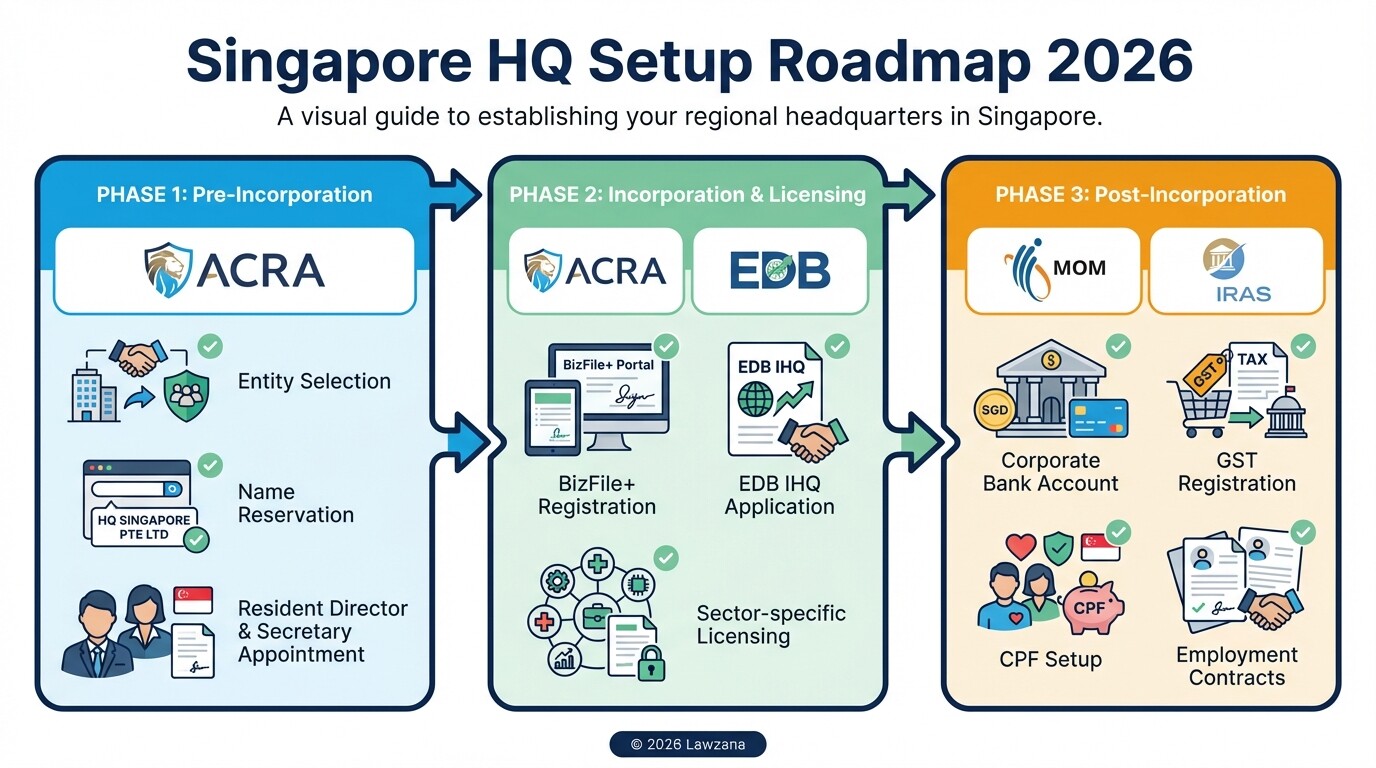
Establishing a regional headquarters requires a phased approach to ensure compliance with the Accounting and Corporate Regulatory Authority (ACRA) and the Economic Development Board (EDB). This checklist covers the legal and operational milestones for 2026.
-
Pre-Incorporation Phase
- Define the corporate structure (Subsidiary, Branch, or Representative Office).
- Verify the availability of the proposed company name via the ACRA portal.
- Appoint at least one director who is a Singapore Citizen, Permanent Resident, or EntrePass/Employment Pass holder.
- Appoint a qualified Company Secretary (required by law).
-
Incorporation & Licensing Phase
- Execute the Constitution of the Company and shareholder agreements.
- Register the company through BizFile+ and pay the registration fee (approx. SGD 315).
- Apply for the International Headquarters Award (IHQ) via the EDB.
- Secure necessary business licenses (e.g., financial services, telecommunications).
-
Post-Incorporation Compliance
- Open a Singapore corporate bank account (requires physical presence of directors in many cases).
- Register for Goods and Services Tax (GST) if annual taxable turnover exceeds SGD 1 million.
- Draft employment contracts compliant with the Employment Act.
- Register for the Central Provident Fund (CPF) for local employees.
Qualification Criteria for the 2026 International Headquarters Award
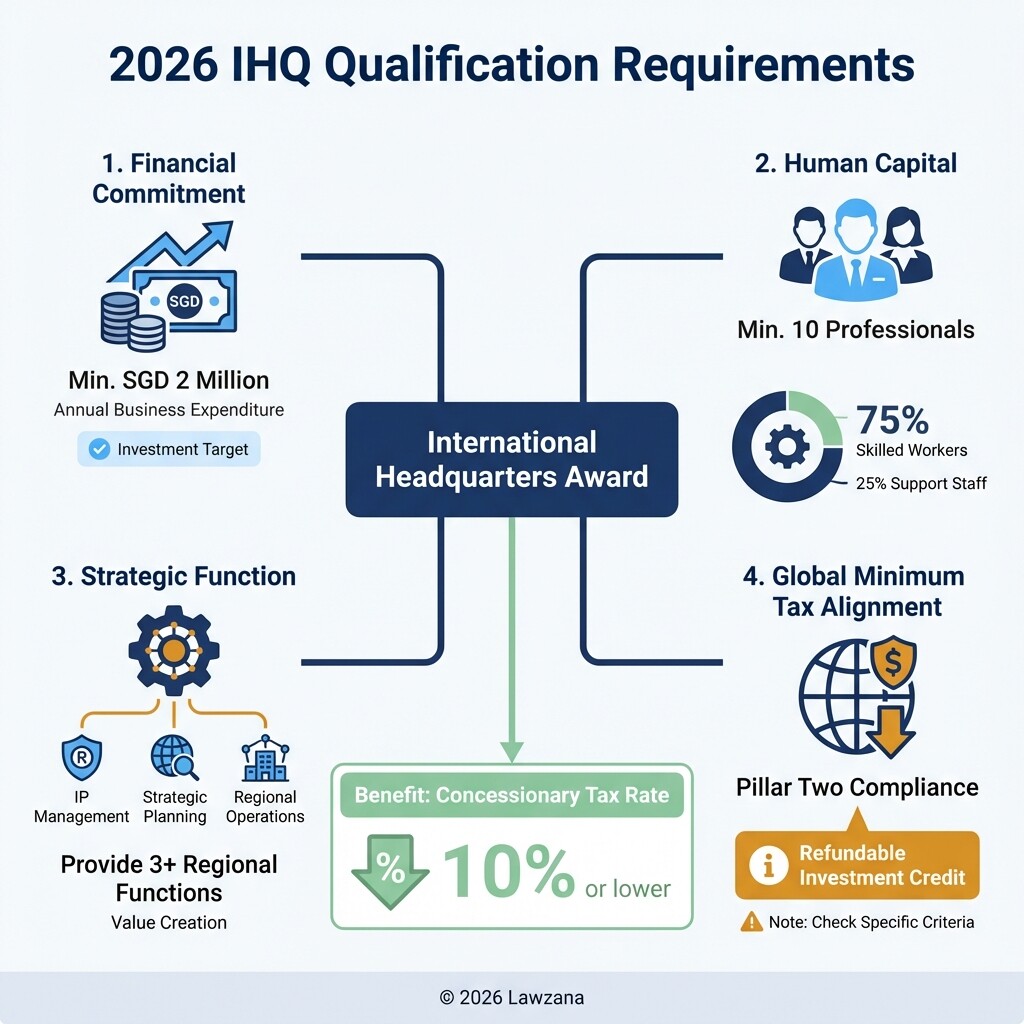
The International Headquarters Award (IHQ) is a tax incentive managed by the Economic Development Board (EDB) designed to encourage multinational corporations (MNCs) to manage regional operations from Singapore. Qualifying companies can benefit from a concessionary tax rate of 10% or less on qualifying income for a period of five to ten years.
To qualify for the IHQ in 2026, a corporation must demonstrate that the Singapore office serves as the nerve center for the region, providing at least three specialized functions such as strategic business planning, legal and IP management, or regional logistics. The EDB evaluates applications based on "Total Business Expenditure" (TBE) and the creation of high-value local jobs. Specifically, the HQ must maintain a minimum TBE of SGD 2 million and ensure that at least 75% of the staff are skilled workers or professionals.
Singapore has also introduced the Refundable Investment Credit (RIC) to remain competitive under the Global Anti-Base Erosion (GloBE) rules. This credit supports HQs engaged in high-value activities like digital transformation and sustainability R&D. The RIC is particularly useful for MNCs affected by the 15% global minimum tax, as it provides a path to offset tax liabilities through significant capital investment or labor cost support.
Corporate Governance Standards for Singapore Entities
Corporate governance in Singapore is governed primarily by the Companies Act 1967 and the Code of Corporate Governance, ensuring a high level of transparency and investor protection. All Singapore-registered entities must maintain meticulous records, including registers of directors, shareholders, and "registrable controllers" (ultimate beneficial owners).
A Singapore HQ must adhere to strict filing timelines; annual financial statements must be prepared in accordance with Singapore Financial Reporting Standards (SFRS). Failure to hold an Annual General Meeting (AGM) or file an Annual Return (AR) can lead to enforcement actions by ACRA against the company directors. Furthermore, the role of the Resident Director is not merely a formality; they carry legal fiduciary duties to act in the best interest of the company and ensure regulatory compliance.
For larger MNCs, the 2026 standards place an increased emphasis on Environmental, Social, and Governance (ESG) reporting. While mandatory climate reporting initially applied to listed companies, the government has signaled that large non-listed companies with significant turnover will soon face similar requirements. HQ entities should establish internal governance frameworks that account for carbon footprint tracking and diversity in leadership.
Estimated Costs for Incorporation and Office Leasing
Setting up an HQ in Singapore involves significant upfront capital, primarily driven by high-quality commercial real estate and specialized legal services. While digital incorporation is affordable, the operational "run rate" for a regional hub reflects Singapore's status as a premium global tier-one city.
Below is a breakdown of estimated costs for 2026:
| Expense Category | Description | Estimated Cost (SGD) |
|---|---|---|
| ACRA Registration | Name reservation and incorporation fee | $315 |
| Legal Setup Fees | Drafting of Constitution, Shareholder Agreements, and EDB applications | $10,000 - $35,000 |
| Annual Compliance | Corporate Secretary and resident director services | $3,000 - $8,000 per year |
| Prime Office Lease | Monthly rent per sq. ft. (Grade A in CBD) | $12 - $16 per sq. ft. |
| Executive Salary | Regional Director / C-Suite annual base | $250,000 - $450,000+ |
Office leasing in 2026 continues to shift toward "green-certified" buildings in the Central Business District (CBD) and the Jurong Lake District. Multinational corporations should budget for a security deposit equivalent to three to six months of rent, depending on the company's credit history and the length of the lease agreement.
Regional Comparison: Singapore vs. Hong Kong and Vietnam
Choosing a regional headquarters requires balancing tax efficiency with operational costs and political stability. While Singapore remains the dominant choice for regional treasury and IP management, Vietnam is emerging as a manufacturing-heavy alternative, and Hong Kong remains a gateway for China-centric operations.
| Feature | Singapore | Hong Kong | Vietnam |
|---|---|---|---|
| Corporate Tax | 17% (Incentives lower it to 0-10%) | 16.5% (Two-tiered) | 20% (Various tax holidays) |
| IP Protection | Ranked #1 in Asia | Strong | Improving but nascent |
| Primary Advantage | Political stability; ASEAN access | Access to Mainland China | Lower labor/land costs |
| Language | English (Official/Business) | English and Cantonese | Vietnamese |
Singapore's primary advantage in 2026 is its extensive network of over 100 Double Taxation Agreements (DTAs), which significantly reduces withholding tax on cross-border transactions within Asia. Hong Kong offers a similar tax environment but faces different geopolitical considerations. Vietnam, while significantly cheaper for labor, lacks the sophisticated legal infrastructure required for high-level regional treasury or legal headquarters.
Employment Law and International Executive Transfers
Relocating executives to a Singapore HQ is governed by the Ministry of Manpower (MOM) and the COMPASS points-based system. This framework assesses candidates based on individual qualifications (salary, education) and company-level attributes (diversity, local hiring support).
For an international transfer to be successful, the candidate must typically earn a minimum monthly salary of SGD 5,000 (higher for the financial sector and older candidates). Executives at the HQ level usually qualify for the Overseas Networks & Expertise (ONE) Pass or higher-tier Employment Passes, which offer more flexibility for their families. It is critical to note that Singapore does not have a "fire-at-will" labor culture; while employment is contract-based, companies must follow "fair dismissal" guidelines to avoid claims of wrongful discharge under the Employment Act.
The Ministry of Manpower requires employers to contribute to the Central Provident Fund (CPF) for local citizens and permanent residents, but not for foreign employees on Employment Passes. When drafting executive contracts, legal counsel should include specific clauses regarding non-compete agreements and IP assignment, as Singapore courts strictly scrutinize the "reasonableness" of restrictive covenants.
Common Misconceptions
"Singapore is a tax haven for shell companies."
Singapore is not a tax haven; it is a high-substance jurisdiction. To qualify for tax incentives or even to maintain a bank account, companies must demonstrate real economic activity, including physical office space and local employment. Regulatory bodies like ACRA and MAS (Monetary Authority of Singapore) actively monitor for "letterbox" companies to prevent money laundering.
"You need a local majority shareholder to incorporate."
Unlike some other Southeast Asian nations, Singapore allows 100% foreign ownership of companies in almost all sectors. There is no requirement for a local partner or majority shareholder. The only "local" requirement is that at least one director must be an ordinary resident of Singapore.
Frequently Asked Questions
Can a foreign company act as its own director in Singapore?
No. Under the Companies Act, at least one director must be a natural person (not a corporate entity) and must be a resident of Singapore. However, other directors can be foreign individuals or corporate entities.
How long does it take to set up an HQ and receive tax incentives?
Company incorporation usually takes 1 to 3 days once documents are ready. However, applying for and receiving approval for the International Headquarters Award (IHQ) from the EDB can take 6 to 12 months, as it involves detailed negotiations and commitments.
Does the 15% global minimum tax (Pillar Two) make Singapore incentives useless?
No. Singapore has introduced the Refundable Investment Credit (RIC) and other non-tax grants to ensure that high-value HQs still receive significant financial support that is compliant with global tax standards.
What are the "statutory audit" requirements?
All Singapore companies must be audited unless they qualify as a "small company." A company is "small" if it meets at least two of these three criteria: total revenue under SGD 10 million, total assets under SGD 10 million, or fewer than 50 employees.
When to Hire a Lawyer
Navigating the 2026 legal landscape in Singapore requires professional expertise when dealing with cross-border tax structuring or government incentive negotiations. You should consult a corporate lawyer if you are:
- Applying for the International Headquarters Award (IHQ) or other EDB incentives.
- Drafting complex shareholder agreements involving multiple international jurisdictions.
- Transferring high-level IP assets into a Singapore holding structure.
- Navigating an executive transfer that involves specialized visa categories like the ONE Pass.
- Ensuring compliance with the evolving ESG and climate-reporting mandates.
Next Steps
- Conduct a Feasibility Study: Evaluate your current regional business expenditure to see if you meet the SGD 2 million TBE threshold for IHQ incentives.
- Engage with the EDB: Reach out to the Economic Development Board early to discuss your strategic plans and potential eligibility for credits.
- Appoint Local Representatives: Secure a resident director and company secretary to begin the formal ACRA registration process.
- Draft Governance Documents: Work with legal counsel to create a Constitution that accommodates your global corporate hierarchy while adhering to Singapore's Companies Act.