- Foreign companies can hire remote workers in the Philippines using independent contractor agreements, an Employer of Record (EOR), or a local subsidiary.
- An EOR shifts local labor compliance to a third party. Incorporating a Regional Operating Headquarters (ROHQ) offers tax incentives for firms needing direct operational control.
- Misclassifying employees as independent contractors creates severe tax and labor liabilities under the Department of Labor and Employment (DOLE).
- Unstructured remote hiring can trigger Permanent Establishment (PE) status, which subjects a foreign company's local revenue to Philippine corporate income tax.
Employer of Record vs. Local Subsidiary
Foreign businesses can employ workers in the Philippines through an Employer of Record (EOR) or by setting up a local subsidiary. An EOR acts as the legal employer for local compliance. A subsidiary requires corporate registration but gives you complete operational control.
Choosing the right structure depends on your headcount, budget, and long-term business goals. An established EOR with proper capitalization can also sponsor 9(g) pre-arranged employment visas if you need to relocate foreign management to oversee your remote team.
Structural Comparison
| Feature | Employer of Record (EOR) | Local Subsidiary | Independent Contractor |
|---|---|---|---|
| Legal employer | The EOR partner | Your foreign company's local entity | The worker (self-employed) |
| Setup time | 1 to 2 weeks | 8 to 12 weeks | Immediate |
| Upfront costs | Low (monthly per-employee fee) | High (incorporation and capital fees) | None |
| Compliance liability | Assumed by the EOR | Assumed by your local subsidiary | Placed on the contractor |
| Control level | Day-to-day management only | Complete legal and operational control | Results-based only |
| Ideal for | Testing the market, small teams | Long-term presence, large teams | Short-term, project-based work |
Timelines for Incorporating a Regional Operating Headquarters (ROHQ)
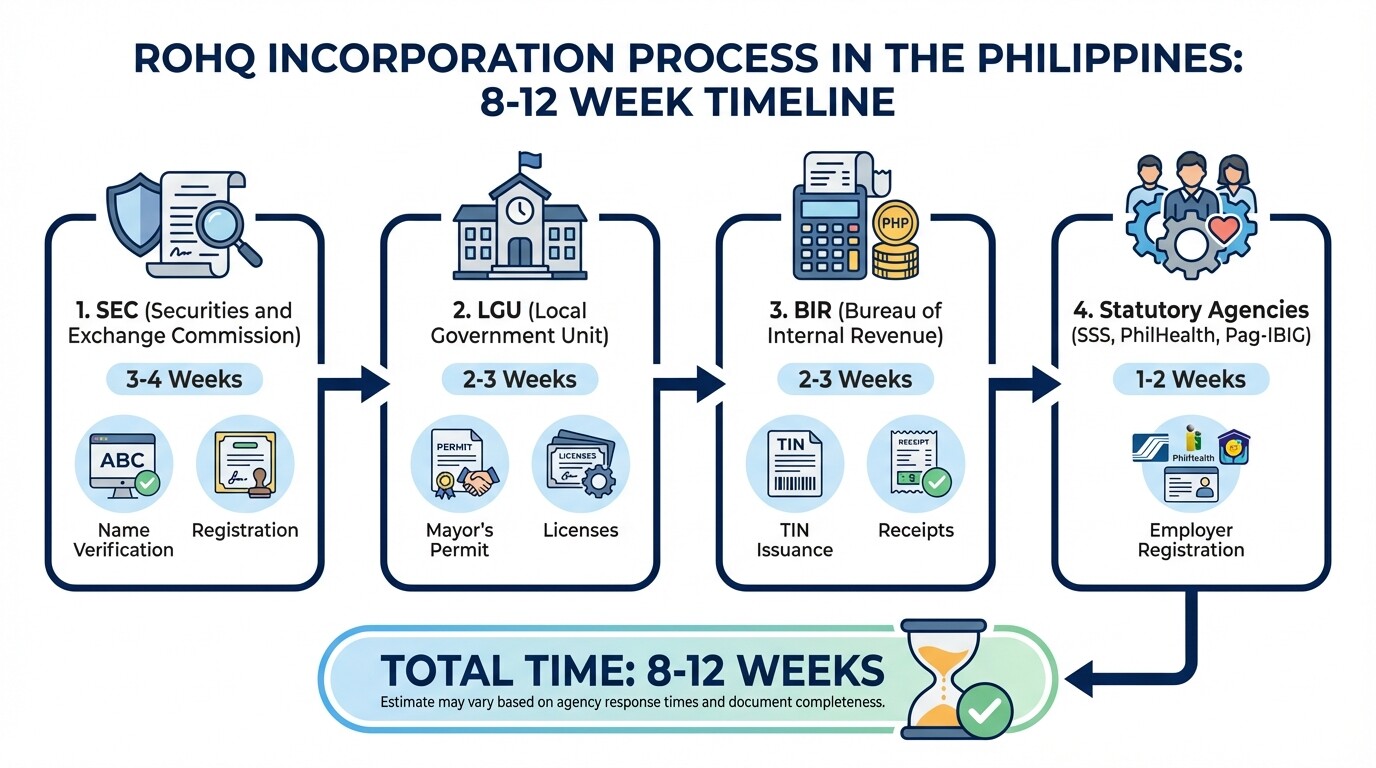
Incorporating a Regional Operating Headquarters (ROHQ) in the Philippines takes 8 to 12 weeks after submitting complete documents. An ROHQ is a multinational company branch that provides administrative and technical support to its affiliates. It requires a minimum inward remittance of $200,000 USD.
The registration process involves several government agencies:
- Securities and Exchange Commission (SEC): Name verification and primary registration take 3 to 4 weeks. You must submit proof of foreign incorporation and board resolutions.
- Local Government Unit (LGU): Securing the Mayor's Permit and business licenses from the specific city takes 2 to 3 weeks.
- Bureau of Internal Revenue (BIR): Registering for a Tax Identification Number (TIN), stamping books of accounts, and securing authority to print receipts takes 2 to 3 weeks.
- Statutory Benefit Agencies: Registering as an employer with the Social Security System (SSS), PhilHealth, and Pag-IBIG Fund requires 1 to 2 weeks. This often processes concurrently with BIR registration.
Foreign investors must comply with the Revised Corporation Code of the Philippines.
Managing Cross-Border Contracts and Intellectual Property
Protecting intellectual property (IP) when hiring Philippine remote workers requires explicit assignment clauses. Without these provisions, the Intellectual Property Code of the Philippines defaults ownership rights to the creator.
Philippine labor law applies to all employees working within its borders, regardless of where the employer is headquartered. Contracts must reflect mandatory benefits like 13th-month pay, five days of service incentive leave, and statutory holiday pay.
Sample IP Assignment Clause
To ensure your company retains all rights to work produced by remote Philippine talent, include localized assignment language in your agreements:
Intellectual Property Rights and Assignment: The Contractor agrees that all work product, designs, code, written materials, and inventions created, developed, or produced during the engagement (collectively, "Work Product") are the exclusive property of the Company. If any Work Product does not qualify as a "work made for hire" under the Intellectual Property Code of the Philippines (Republic Act No. 8293), the Contractor hereby irrevocably assigns and transfers to the Company all worldwide rights, title, and interest in the Work Product, including all copyrights, patents, and other intellectual property rights, without further compensation. The Contractor will execute any documents necessary to perfect the Company's title to such Work Product.
Mitigating Permanent Establishment Tax Risks
A foreign company triggers a Permanent Establishment (PE) in the Philippines if its remote workers negotiate contracts, conclude sales, or maintain a fixed place of business on its behalf. This subjects the foreign company's income generated in the Philippines to the 25% standard corporate income tax under the Bureau of Internal Revenue (BIR).
To protect your global revenue from Philippine taxation, strictly define the roles of your local workers:
- Limit signing authority: Remote workers and contractors should never sign commercial contracts or bind the foreign company legally.
- Separate sales from fulfillment: If workers handle customer service or back-office tasks, ensure they do not finalize sales or negotiate pricing.
- Use an EOR: Hiring through an Employer of Record creates a legal buffer. The workers are officially employed by a tax-paying Philippine entity rather than directly by your foreign corporation.
- Monitor physical spaces: Avoid leasing local office space directly under the foreign company's name.
Common Misconceptions About Hiring in the Philippines
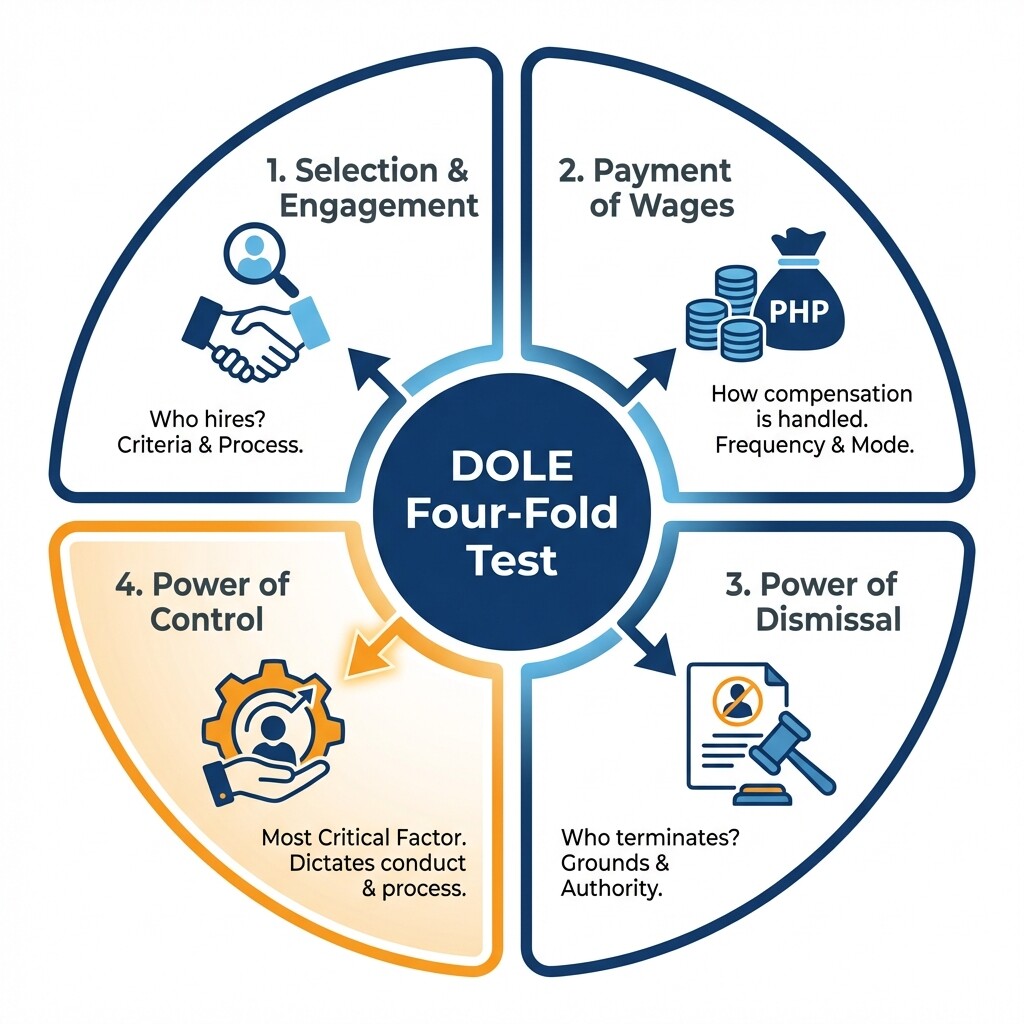
Many foreign employers believe that labeling a worker as an "independent contractor" removes employer liabilities. However, the Philippine Department of Labor and Employment (DOLE) uses a "four-fold test" to determine if an employer-employee relationship exists. This test examines who selects the worker, who pays wages, who has the power of dismissal, and who controls the worker's conduct. If the company exercises control over how the worker does their job, DOLE classifies them as an employee.
- Foreign law governs the contract: Employers often believe that applying US or UK law overrides Philippine law. If the worker lives in the Philippines and meets the legal definition of an employee, Philippine labor tribunals apply local laws. This includes mandatory severance and protection against unjust termination.
- Contractors are never entitled to 13th-month pay: Legitimate independent contractors do not receive statutory benefits and are responsible for their own taxes, SSS, PhilHealth, and Pag-IBIG contributions. But if DOLE deems a contractor misclassified, the employer must provide back pay for unpaid 13th-month pay, leave credits, and statutory contributions.
Pre-Litigation Strategies for Remote Contractor Disputes
Resolving disputes with remote Philippine contractors before litigation prevents costly cross-border lawsuits and protects confidential information. When an independent contractor breaches an agreement, swift administrative action is effective:
- Issue a demand letter: Engage local counsel to draft a demand letter citing specific breaches of the Philippine Civil Code or the signed agreement. This often compels compliance without tribunal intervention.
- Suspend access and payments: Immediately revoke access to company systems, software, and client data. Withhold final invoice payments pending resolution of the dispute.
- Invoke mediation or arbitration: If your contract includes an alternative dispute resolution (ADR) clause, initiate mediation. This is faster and more private than the Philippine court system.
When to Hire a Corporate Lawyer
Foreign companies should engage legal counsel before hiring remote workers. A lawyer helps draft localized independent contractor agreements that survive the DOLE four-fold test. They also handle the legal structuring for an ROHQ or subsidiary. If you receive a labor complaint from a former remote worker, legal representation prevents default judgments. Working with corporate and commercial lawyers in the Philippines keeps your cross-border hiring compliant.
Next Steps for Foreign Employers
- Assess hiring needs: Determine if your Philippine team will perform core business functions (requiring strict control) or peripheral tasks (suitable for independent contractors).
- Select a legal structure: Choose between direct contractor agreements, an EOR, or a local subsidiary based on your risk tolerance and budget.
- Localize contracts: Have a local corporate attorney review your employment or contractor agreements. Insert valid IP assignment, confidentiality, and dispute resolution clauses tailored to Philippine jurisdiction.