Wrongful Dismissal in the Philippines: Employee Rights and Evidence
- Due process is mandatory: Employers cannot fire you without providing a valid legal reason and following the strict procedural requirements under the Philippine Labor Code.
- Evidence is your strongest asset: Keep secure copies of your Notice to Explain, termination letters, email correspondence, and chat logs before your corporate access is revoked.
- Quitclaims are not absolute: Signing a waiver or quitclaim does not automatically strip you of your right to file an illegal dismissal case, especially if you were forced to sign or received an unfairly low settlement.
- Conciliation comes first: All illegal dismissal cases must pass through the Department of Labor and Employment's (DOLE) mandatory 30-day conciliation process before reaching a Labor Arbiter.
What Are the Grounds for Legal Termination?
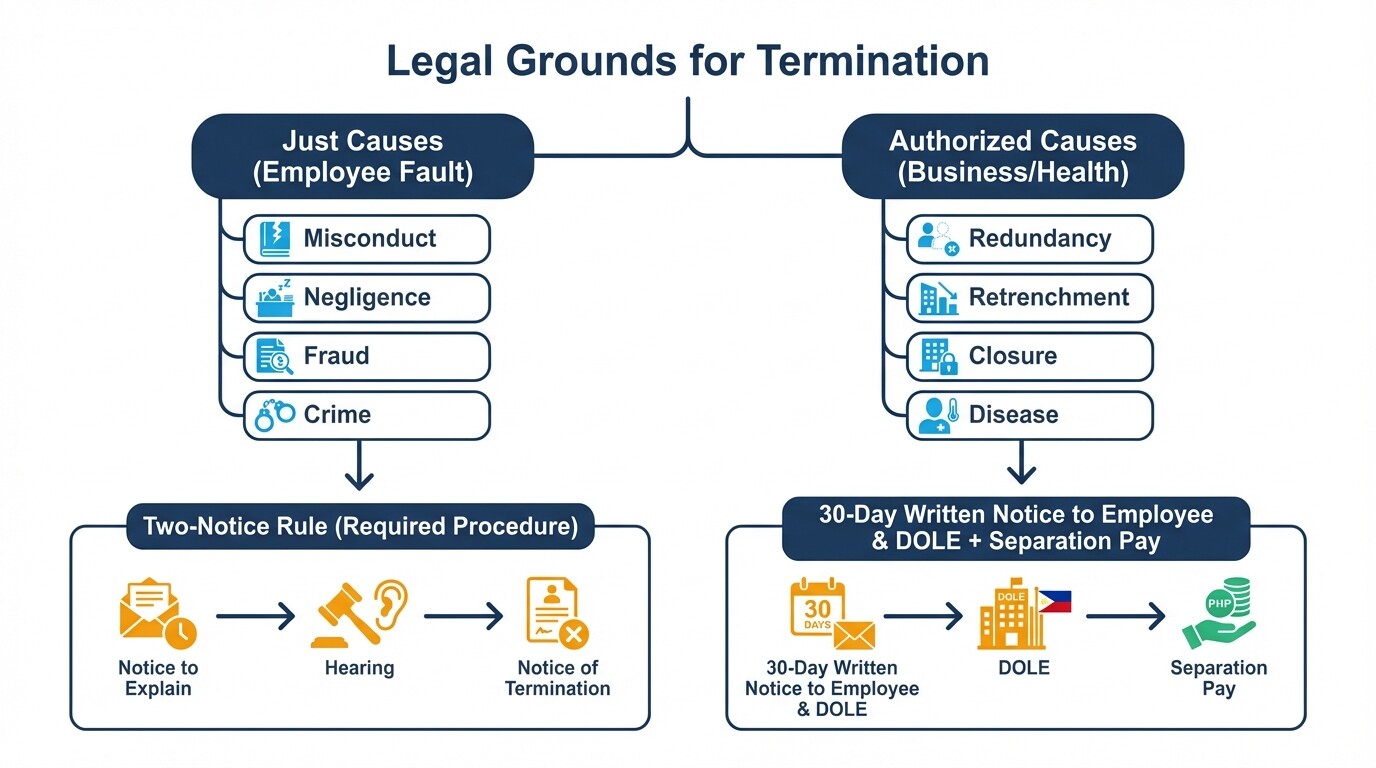
Philippine labor law requires employers to have a legally valid reason to terminate an employee, categorized strictly as either a "just cause" or an "authorized cause." Firing someone for any reason outside of these categories constitutes illegal dismissal.
Just Causes Just causes are terminations triggered by the employee's own wrongful actions or negligence. Under Article 297 of the Labor Code, these include:
- Serious misconduct or willful disobedience of lawful orders.
- Gross and habitual neglect of duties.
- Fraud or willful breach of trust (loss of confidence).
- Commission of a crime against the employer or their immediate family.
When terminating for a just cause, employers must follow the "Two-Notice Rule." You must receive a first notice (Notice to Explain) detailing the charges and giving you ample time to respond, followed by a hearing or conference, and finally, a second written notice of termination.
Authorized Causes Authorized causes are terminations initiated by the employer for business or health reasons, not due to the employee's fault. Under Articles 298 and 299, these include:
- Installation of labor-saving devices or redundancy.
- Retrenchment to prevent severe business losses.
- Closure or cessation of business operations.
- A disease that cannot be cured within six months, making continued employment prejudicial to the employee or colleagues.
For authorized causes, the employer must serve a written notice to both the employee and DOLE at least 30 days before the termination takes effect. The employer is also required to pay separation pay, which generally ranges from one-half to one month's salary for every year of service, depending on the specific authorized cause.
Illegal Dismissal vs. Constructive Dismissal Comparison
Illegal dismissal involves a direct termination without valid cause or due process, while constructive dismissal happens when an employer forces you to resign by making your work environment hostile or unbearable. Both are serious labor violations, but they look very different in practice.
| Feature | Illegal Dismissal | Constructive Dismissal |
|---|---|---|
| Definition | An explicit firing of an employee without a valid legal ground or without following mandatory legal procedures. | A forced resignation where continued employment is rendered impossible, unreasonable, or unlikely. |
| Employer Action | Issues a termination letter or verbally tells the employee they are fired. | Imposes demotions, salary deductions, transfer to an impossible location, or verbal abuse. |
| Employee Action | Employee is forced out of the workplace against their will. | Employee submits a resignation letter because they feel they have no other choice. |
| Burden of Proof | The employer must prove the dismissal was valid and followed due process. | The employee must first prove that their resignation was forced by the employer's hostile actions. |
| Legal Remedy | Reinstatement without loss of seniority rights, plus full backwages. | Same as illegal dismissal; resignation is treated in law as an illegal termination. |
Evidence Checklist: Critical Documentation for Your Case
Winning a labor dispute at the National Labor Relations Commission (NLRC) heavily relies on documentary evidence proving both the existence of your employment and the circumstances surrounding your exit. Start gathering these documents the moment you suspect you are being unfairly targeted.
- The Notice to Explain (NTE): Save the exact document given to you outlining your alleged infractions. This proves what charges the employer initially claimed.
- Your Written Reply: Keep a time-stamped or received copy of your response to the NTE.
- Notice of Termination: This is the final document stating you are fired. It establishes the exact date and stated reason for your dismissal.
- Emails and Chat Logs: Back up relevant communications regarding your performance, disputes with management, or hostile behavior. Forward them to your personal email or take screenshots before your company access is blocked.
- Payslips and Bank Statements: These establish your salary rate, which the NLRC uses to calculate potential backwages and separation pay in Philippine Pesos (PHP).
- Employment Contract and ID: These prove the employer-employee relationship, which is the foundational requirement for any NLRC complaint.
- Witness Affidavits: Statements from willing coworkers who observed the unfair treatment, lack of due process, or the hostile environment that forced you to resign.
The Danger of Signing Quitclaims and Waivers
Signing a quitclaim or waiver does not automatically prevent you from pursuing an illegal dismissal complaint if the document was signed under duress, fraud, or for a highly inadequate settlement. Employers often present quitclaims alongside final paychecks, pressuring departing employees to waive their right to sue in exchange for money they are already legally owed.
The Philippine Supreme Court consistently rules that quitclaims are generally frowned upon as contrary to public policy. A quitclaim may be invalidated by the NLRC if you can prove you were forced to sign it out of desperate financial necessity or if the amount you received was unreasonably low compared to what you are legally entitled to. However, if the settlement amount is fair, negotiated voluntarily, and signed with a clear understanding of the terms, the NLRC will uphold it. Always review release documents carefully and never rush to sign them under pressure.
Common Misconceptions About Wrongful Dismissal
Misunderstanding Philippine labor laws often causes wrongfully terminated employees to forfeit their rights or miss critical filing deadlines.
- "Probationary employees can be fired anytime without reason." Probationary employees still enjoy security of tenure. They can only be terminated for a just cause or if they fail to qualify as regular employees in accordance with reasonable standards made known to them at the time of their engagement.
- "A verbal notice of termination is enough." Philippine law strictly requires written notices. A verbal dismissal, even if the employer has a valid reason, violates the employee's right to due process and entitles the employee to nominal damages.
- "I cannot afford to file a labor case." Filing a complaint with the NLRC is highly accessible. The initial conciliation phase is free, and you are not required to hire private legal representation immediately, though having a lawyer significantly improves your chances during formal proceedings.
Step-by-Step Process for Filing a Complaint with DOLE/NLRC
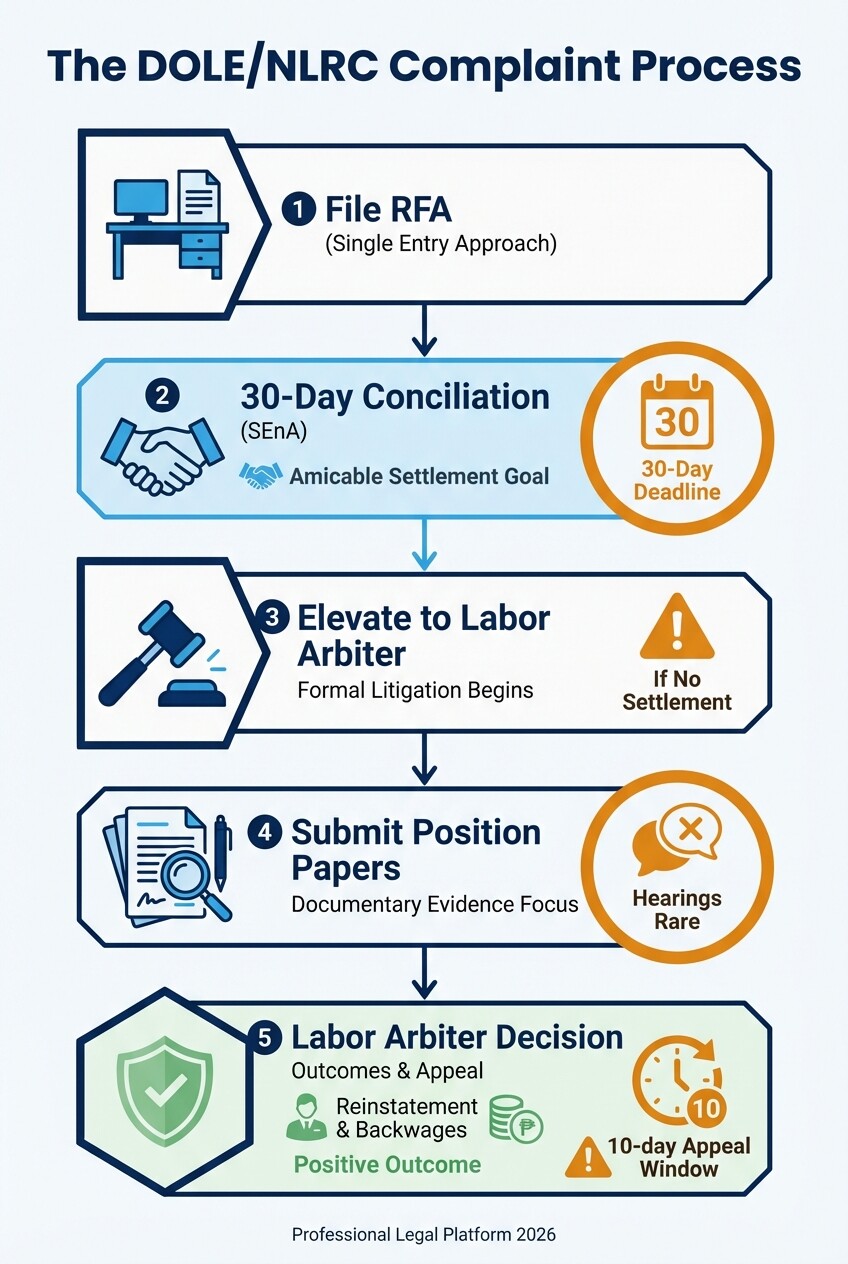
Filing a wrongful dismissal complaint requires following a structured grievance mechanism designed to encourage settlement before advancing to full litigation.
- File a Request for Assistance (RFA): Start by filing an RFA through the Single Entry Approach (SEnA) desk at the nearest DOLE or NLRC regional branch. This initiates the mandatory conciliation process.
- Attend SEnA Conferences: A SEnA Desk Officer (SEADO) will schedule conferences within a 30-day period. The goal is to facilitate an amicable settlement between you and your employer (e.g., agreeing on a severance package).
- Elevate to the Labor Arbiter: If no settlement is reached within 30 days, the SEADO will issue a Referral to the NLRC. You will then formally file a complaint for illegal dismissal and the case is raffled to a Labor Arbiter.
- Submit Position Papers: The Labor Arbiter will require both parties to submit verified Position Papers containing their arguments, legal bases, and documentary evidence. Hearings are rarely conducted; the decision is based primarily on these papers.
- Receive the Decision: The Labor Arbiter issues a written decision. If you win, the Arbiter may award reinstatement, backwages, moral and exemplary damages, and attorney's fees. Either party can appeal the decision to the NLRC Commission Proper within 10 calendar days.
Frequently Asked Questions
How long do I have to file an illegal dismissal case?
Under the Philippine Labor Code, you have four (4) years from the date of your termination to file an illegal dismissal complaint. Claims for unpaid wages or monetary benefits must be filed within three (3) years.
Can I choose separation pay instead of going back to work?
Yes. While the primary remedy for illegal dismissal is reinstatement, you can request separation pay instead (usually calculated at one month's salary per year of service) if the relationship with your employer is severely strained, known legally as "strained relations."
What are backwages?
Backwages are the compensation an illegally dismissed employee should have earned from the time they were unjustly terminated up to the time they are actually reinstated or paid separation pay.
When to Hire a Labor Lawyer and Next Steps
While you can represent yourself during the initial SEnA conciliation phase, it is highly advisable to hire a lawyer once the case elevates to the NLRC Labor Arbiter. The formal phase requires drafting a legally sound Position Paper, properly authenticating documentary evidence, and citing relevant Supreme Court jurisprudence. A skilled lawyer will ensure your monetary claims are accurately computed and your rights are aggressively defended.
If you have recently been terminated and suspect your rights were violated, do not sign any waivers or quitclaims until you seek legal counsel. Start gathering your employment documents, download copies of your communications, and connect with experienced litigation lawyers in the Philippines to evaluate the strength of your case and guide you through the DOLE/NLRC process.