- Service Level Agreements (SLAs) in the Philippines are governed by the Civil Code and specific statutes like the Data Privacy Act of 2012.
- Service credits are the primary remedy for performance failures, acting as a pre-agreed discount on fees rather than a penalty.
- Intellectual Property (IP) clauses must distinguish between "Background IP" (pre-existing) and "Foreground IP" (developed during the contract).
- The Philippines Data Privacy Act (DPA) requires a mandatory Data Processing Agreement (DPAg) when BPO firms handle personal data.
- Liability caps are standard but often exclude cases of gross negligence, willful misconduct, or specific data privacy violations.
What is an SLA in the Philippine BPO Industry?
A Service Level Agreement (SLA) is a legally binding document that defines the required standard of service, measurable performance metrics, and remedies for failures between a client and a Business Process Outsourcing (BPO) provider. In the Philippines, these are essential components of a Master Services Agreement (MSA) that ensure operational alignment and risk mitigation in high-value outsourcing partnerships.
Under Philippine law, the SLA serves as the "law between the parties." Because the BPO sector is a primary economic driver, Philippine courts generally uphold the technical specifications and penalty structures within these agreements, provided they do not violate public policy or involve unconscionable penalties.
How are critical KPIs and service credits defined in a BPO SLA?
KPIs (Key Performance Indicators) are the quantitative metrics used to measure a provider's performance, while service credits are financial adjustments-usually deductions from the service fee-provided to the client when those metrics are not met. These must be defined with mathematical precision to avoid disputes during the billing cycle.
In a typical Philippine BPO contract (such as voice, back-office, or IT support), KPIs are categorized by priority. If a provider fails to meet a "Critical" KPI, a specific percentage of the monthly invoice is credited back to the client.
Common BPO KPIs in the Philippines:
- System Uptime: Often set at 99.9%, measuring the availability of the technical infrastructure.
- Average Handle Time (AHT): The duration of a transaction or customer interaction.
- First Contact Resolution (FCR): The percentage of issues resolved without a follow-up.
- Quality Assurance (QA) Scores: Subjective audits of agent performance based on a predefined rubric.
| Performance Tier | Metric Achievement | Service Credit (Example) |
|---|---|---|
| Target Met | 98% - 100% | 0% (Full Payment) |
| Minor Breach | 95% - 97.9% | 2% of Monthly Fee |
| Major Breach | 90% - 94.9% | 5% of Monthly Fee |
| Critical Failure | Below 90% | 10% + Right to Terminate |
What are the standard liability caps for data breaches in outsourcing?
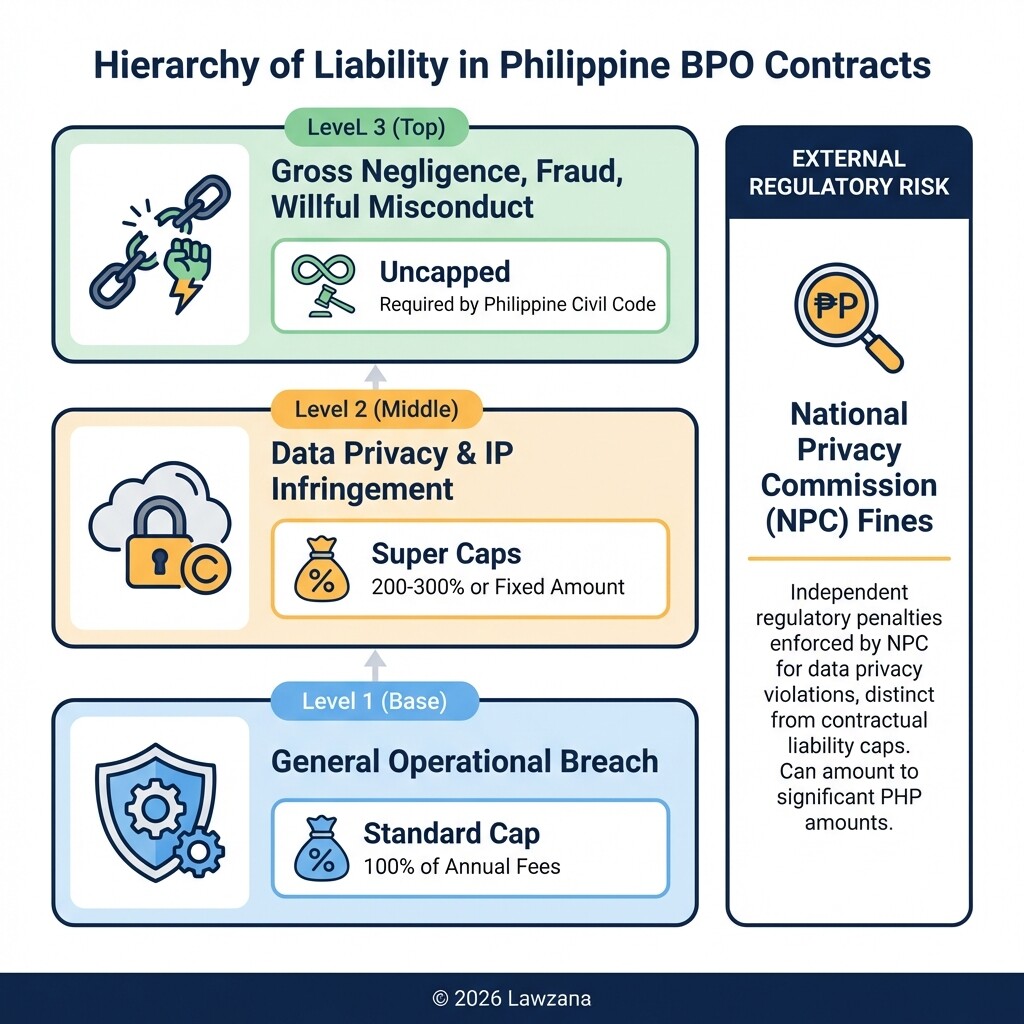
Liability caps in Philippine BPO contracts limit the total financial exposure of a service provider in the event of a contract breach or data loss. These caps are typically structured as a "multiplier" of the fees paid over a specific period (e.g., 12 months) or a fixed amount in Philippine Pesos (PHP) or US Dollars (USD).
While BPO providers push for low caps to protect their margins, clients often demand higher limits for data breaches due to the significant fines imposed by the National Privacy Commission (NPC). It is common to see "super caps" or "carve-outs" where liability for data privacy violations is significantly higher than for general operational errors.
Key considerations for liability clauses:
- General Liability Cap: Usually 100% of the annual contract value.
- Data Breach Carve-out: Often capped at 200-300% of contract value or left uncapped in extreme cases.
- Excluded Damages: Most contracts exclude "consequential" or "indirect" damages, such as lost profits or reputational harm.
- Gross Negligence: Under the Civil Code of the Philippines, liability resulting from fraud, bad faith, or gross negligence cannot be waived or capped.
Who owns the Intellectual Property of developed workflows?
Intellectual Property (IP) ownership in Philippine BPO contracts is divided into "Background IP" and "Foreground IP." Unless explicitly stated otherwise, the party who created the IP retains ownership, but BPO contracts typically override this with "work-for-hire" provisions.
The Intellectual Property Office of the Philippines (IPOPHL) governs these rights under Republic Act No. 8293. For BPO firms, the most contentious area is often the "workflow" or "process improvement" developed during the engagement.
- Client Ownership (Foreground IP): The client typically owns all deliverables, data, and unique processes specifically created for their business during the contract term.
- Provider Ownership (Background IP): The BPO provider retains ownership of its proprietary software, training modules, and generic methodologies used across multiple clients.
- License Grants: The BPO provider usually grants the client a non-exclusive, royalty-free license to use any integrated provider IP necessary to operate the deliverables.
What is the difference between termination for convenience and termination for cause?
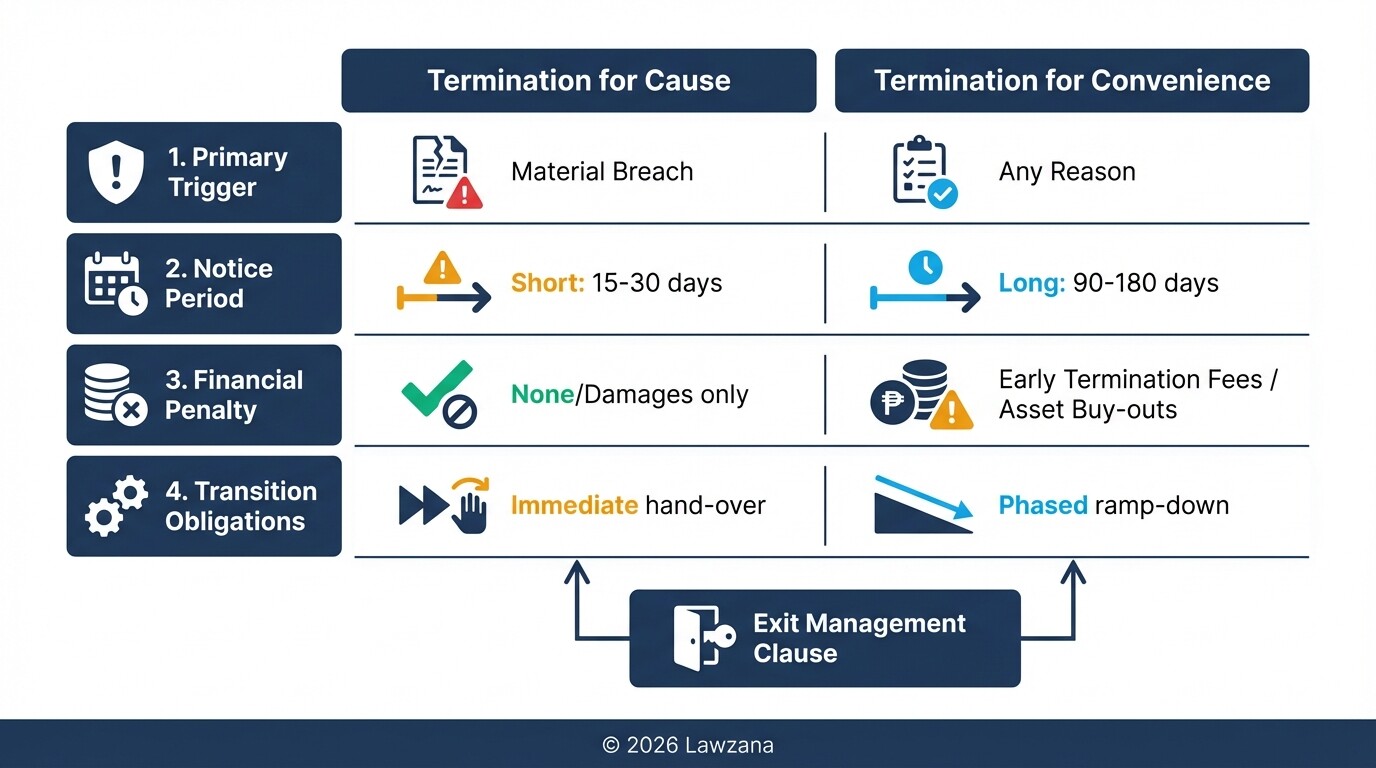
Termination clauses define how a BPO relationship ends, which is critical in the Philippines given the high costs of "ramp-down" and employee severance.
Termination for Cause
This occurs when one party commits a material breach of contract. Examples include a persistent failure to meet KPIs (SLA default), insolvency, or a data breach. In these cases, the non-breaching party can end the contract immediately or after a short "cure period" (usually 15-30 days) without paying an exit fee.
Termination for Convenience
This allows either party to end the contract for any reason, provided they give sufficient notice. In the Philippine BPO sector, notice periods are typically long-between 90 and 180 days-to allow for the transition of services and to comply with Philippine Labor Code requirements regarding redundant staff.
Transition Assistance: Regardless of the reason for termination, the SLA should include an "Exit Management" clause. This obligates the provider to assist in transferring data and knowledge to the client or a new provider for a set fee, ensuring no service interruption.
How does the Data Privacy Act of 2012 affect BPO contracts?
The Data Privacy Act of 2012 (RA 10173) is the most critical regulatory framework for BPOs in the Philippines. It distinguishes between a Personal Information Controller (PIC) (the client) and a Personal Information Processor (PIP) (the BPO firm).
The law mandates that any BPO contract involving the processing of personal data must include a Data Processing Agreement (DPAg). This agreement must outline the scope of processing, the duration of the data retention, and the technical, physical, and organizational security measures the BPO firm must implement.
Mandatory DPA Compliance Checklist:
- Encryption: Requirements for data at rest and in transit.
- Sub-processing: The BPO firm cannot outsource data processing to a third party without the client's prior written consent.
- Breach Notification: The PIP must notify the PIC within 24 to 72 hours of discovering a data breach so the PIC can notify the National Privacy Commission.
- Audit Rights: The client must have the right to inspect the BPO firm's facilities and security protocols.
Common Misconceptions about Philippine BPO Contracts
"Service credits are the same as damages."
In the Philippines, service credits are usually considered an "exclusive remedy" for failing to meet KPIs. This means if you accept a service credit for a slow response time, you generally cannot sue for additional damages for that specific delay unless the contract allows for it.
"Standard US or UK templates are sufficient."
Foreign firms often use their home-country templates, but these often fail to address Philippine-specific issues like the "13th-month pay" in cost-plus contracts, local holidays (which affect SLA uptime), or the specific mandatory language required by the National Privacy Commission.
"Termination for convenience is free."
While you can terminate "for convenience," BPO contracts in the Philippines often include "Early Termination Fees" to cover the provider's unamortized costs for dedicated equipment, office space, and recruitment.
FAQ
Can a BPO provider limit its liability for data privacy fines?
While providers often attempt to cap this liability, the National Privacy Commission may still hold parties accountable. Most clients insist that data privacy indemnity remains outside the general liability cap.
What happens if an SLA metric is impossible to meet due to a local typhoon?
Most Philippine BPO contracts include a Force Majeure clause. This suspends SLA obligations and service credit accrual during "Acts of God," such as typhoons or earthquakes, provided the BPO firm has a functional Business Continuity Plan (BCP).
Is an electronic signature valid for BPO contracts in the Philippines?
Yes, under the Electronic Commerce Act of 2000 (RA 8792), electronic signatures are legally recognized and binding in the Philippines, which is common practice for international BPO agreements.
When to Hire a Lawyer
Navigating BPO contracts in the Philippines requires a blend of commercial and regulatory expertise. You should consult a lawyer if:
- You are drafting a Master Services Agreement (MSA) for a long-term outsourcing partnership.
- You need to negotiate "super caps" or liability carve-outs for data breaches.
- You are facing a "Critical Failure" in service delivery and need to initiate termination for cause.
- You need to ensure your Data Processing Agreement (DPAg) complies with the latest circulars from the National Privacy Commission.
Next Steps
- Audit Current KPIs: Review your existing service metrics to ensure they are realistic and measurable.
- Verify Data Privacy Status: Check if your current SLA includes a DPAg that identifies the PIC and PIP roles clearly.
- Draft an Exit Plan: Ensure your contract has a clear "Transition Assistance" section to avoid being held hostage by a provider during a breakup.
- Consult a Local Specialist: Engage a Philippine legal expert to review your liability and IP clauses to ensure they are enforceable under local statutes.