- A foreign divorce is not automatically recognized in the Philippines; it requires a court process called a Petition for Judicial Recognition of Foreign Judgment.
- Article 26 of the Family Code allows a Filipino spouse to remarry if their foreign spouse successfully obtained a valid divorce abroad.
- You must prove both the foreign divorce decree and the specific foreign law that allows the divorce to be recognized by Philippine courts.
- The process typically takes between 12 to 24 months depending on the court's docket and the complexity of the case.
- Once the court grants the recognition, you must annotate your marriage record at the Philippine Statistics Authority (PSA) to legally change your status to "Single."
What is the legal basis for recognizing a foreign divorce in the Philippines?
The Philippines does not have a domestic divorce law, but Article 26, Paragraph 2 of the Family Code provides a critical exception for mixed marriages. This law allows a Filipino citizen to be capacitated to remarry under Philippine law if their alien (foreign) spouse obtains a valid divorce abroad that allows that foreign spouse to remarry.
This provision was designed to avoid the "absurd" situation where a foreigner is no longer married to a Filipino, but the Filipino is still legally tied to the foreigner. Over the years, the Supreme Court has expanded this interpretation. Today, even if the Filipino spouse is the one who initiated or filed for the divorce abroad, the Philippine courts can still recognize it, provided the divorce is valid under the foreign spouse's national law.
What are the legal requirements under Article 26 of the Family Code?
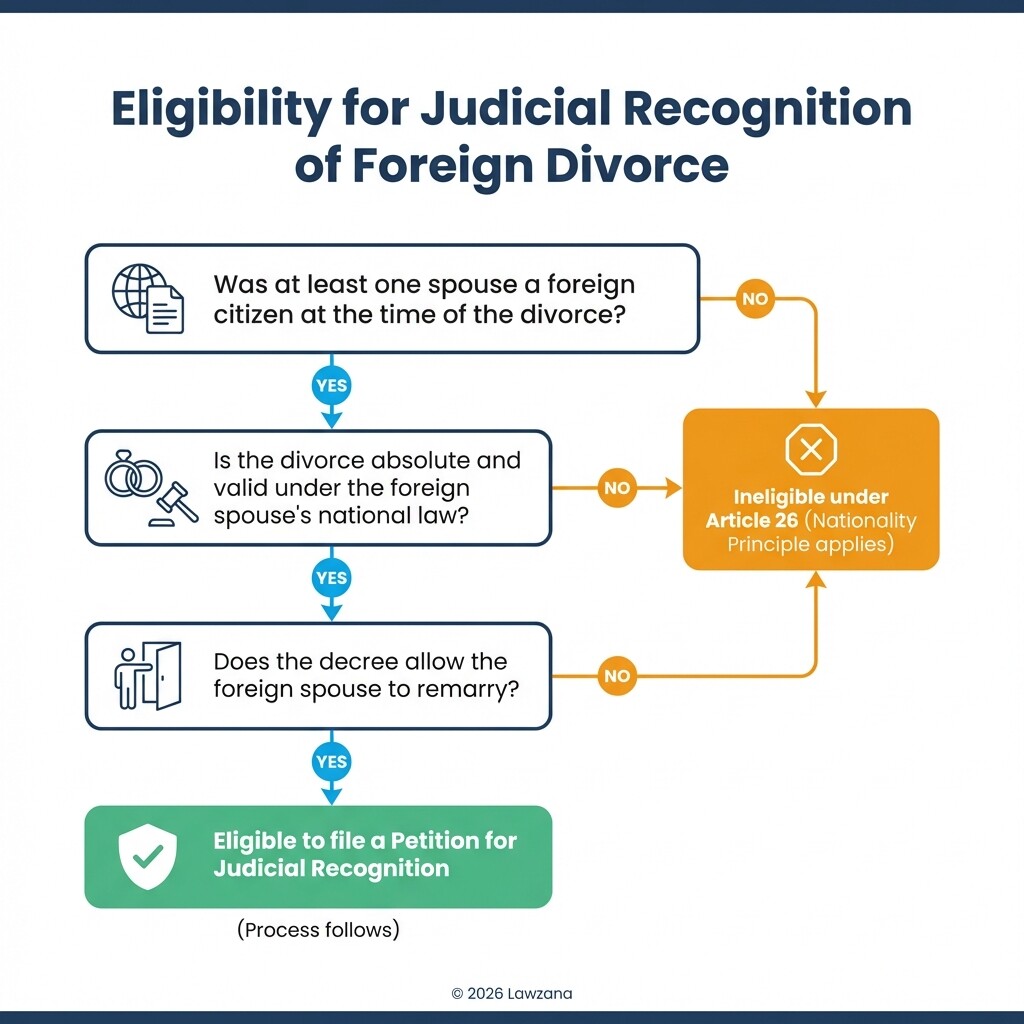
To qualify for recognition under Article 26, the petitioner must establish that a valid marriage existed and that one of the parties was a foreigner at the time of the divorce. The core of the requirement is proving that the divorce was legally obtained and that it granted the foreign spouse the capacity to remarry.
The following criteria must be met:
- Valid Mixed Marriage: The marriage must have been between a Filipino and a foreigner, or both were Filipinos at the time of marriage but one later became a naturalized citizen of another country before the divorce.
- Valid Foreign Divorce: The divorce must be absolute and valid according to the national law of the foreign spouse.
- Capacity to Remarry: The foreign decree must specifically allow the foreign spouse to remarry under their country's laws.
How do you file a Petition for Judicial Recognition of Foreign Judgment?
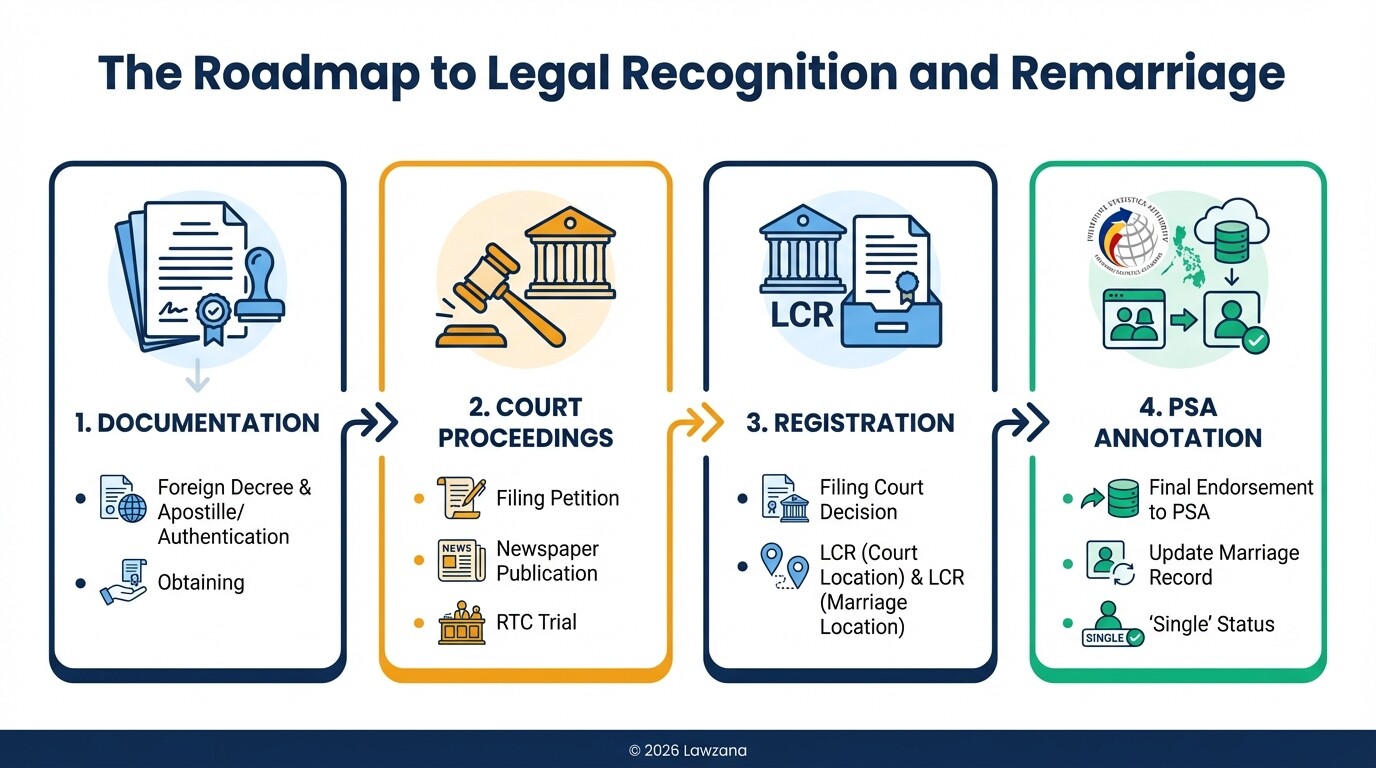
A Petition for Judicial Recognition of Foreign Judgment is a special proceeding filed in the Regional Trial Court (RTC) where the petitioner resides or where the marriage was recorded. Since Philippine courts do not take "judicial notice" of foreign laws, you must formally plead and prove the foreign law as a fact during the trial.
The procedural steps include:
- Filing the Petition: Your lawyer prepares and files the petition at the appropriate Regional Trial Court.
- Order of Hearing and Publication: The court issues an order setting the case for hearing. This order must be published in a newspaper of general circulation once a week for three consecutive weeks.
- Manning the Office of the Solicitor General (OSG): The OSG and the Office of the Provincial or City Prosecutor are notified to ensure there is no collusion and that the state's interest in protecting marriage is upheld.
- Presentation of Evidence: You must present the divorce decree and the foreign law, often requiring an expert witness or authenticated documents from the foreign country.
- Court Decision: If the evidence is sufficient, the court issues a Decision granting the recognition of the foreign divorce.
Which documents are essential for the court process?
Documentation is the most critical phase of the recognition process because the court requires "prima facie" evidence of the foreign judgment and the foreign law. All documents issued abroad must be duly authenticated or contain an Apostille from the issuing country to be admissible in Philippine courts.
Essential documents include:
- Certified True Copy of the Foreign Divorce Decree: The official document issued by the foreign court or authority ending the marriage.
- Official Copy of the Foreign Divorce Law: A copy of the specific statutes of the foreign country, often requiring a certificate from the foreign country's embassy or a legal expert's deposition.
- PSA Marriage Contract: The original marriage certificate on security paper (if the marriage was in the Philippines) or the Report of Marriage (if the marriage was abroad).
- Birth Certificate of the Petitioner: To prove Filipino citizenship.
- Proof of Citizenship of the Foreign Spouse: A copy of the foreign spouse's passport or naturalization certificate at the time of the divorce.
How long does the recognition process take and what are the costs?
The timeline for recognizing a foreign divorce in the Philippines generally ranges from 12 to 24 months. This duration depends heavily on the specific court's declogging efforts, the availability of witnesses, and the speed of the OSG's response.
| Expense Category | Estimated Cost (PHP) |
|---|---|
| Filing Fees | ₱5,000 - ₱10,000 |
| Publication Fees | ₱15,000 - ₱30,000 |
| Legal/Attorney's Fees | ₱100,000 - ₱250,000+ (Varies by firm) |
| Authentication/Apostille | ₱5,000 - ₱15,000 |
| Total Estimated Cost | ₱125,000 - ₱300,000 |
Note: Regional Trial Courts in Metro Manila may have longer wait times compared to provincial courts due to a higher volume of cases.
How do you update your civil status at the Philippine Statistics Authority (PSA)?
Winning the court case is not the final step; you must ensure the judgment is recorded in the civil registry to update your status. Without this annotation, the PSA will still issue a Marriage Certificate that shows you are "Married," which will prevent you from obtaining a Certificate of No Marriage (CENOMAR) for a future wedding.
Once the court decision becomes final and executory:
- Entry of Judgment: Obtain the Certificate of Finality from the court.
- Registration with the Local Civil Registrar (LCR): Register the Court Decision and Certificate of Finality with the LCR of the city where the court is located.
- Annotation of Marriage Record: The LCR where the marriage was originally registered will annotate the marriage contract.
- PSA Endorsement: The LCR forwards the annotated record to the Philippine Statistics Authority. You can then request a new PSA Marriage Contract with the annotation stating the marriage is dissolved.
Common Misconceptions About Foreign Divorce in the Philippines
Myth 1: "A foreign divorce is automatic if I am married to a foreigner."
Many believe that simply having a divorce paper from the U.S. or Japan is enough to remarry in the Philippines. This is false. A Philippine court must first "recognize" that foreign judgment through a formal legal proceeding before it has any legal effect in the country.
Myth 2: "Only the foreign spouse can file for divorce for it to be recognized."
In the past, this was a strict rule. However, the Supreme Court ruling in Republic v. Manalo (2018) clarified that even if the Filipino spouse initiates the divorce abroad, the Philippine courts can still recognize it under Article 26 of the Family Code.
Myth 3: "I can just get a lawyer to 'fix' my PSA records without going to court."
There is no "shortcut" or administrative process to change your status from married to single following a foreign divorce. Anyone promising to update your PSA records without a court case is likely engaging in fraud, which can lead to criminal charges for bigamy or falsification of documents.
FAQ
Can I remarry immediately after getting a foreign divorce?
No. You must first complete the Judicial Recognition process in a Philippine court and have the decision annotated on your PSA marriage record. Until then, you are still considered "Married" under Philippine law.
Do I need to fly back to the Philippines for the court case?
Not necessarily. Most courts allow the petitioner to testify via video conferencing (remote testimony) or through depositions, provided your lawyer files the proper motions. However, your physical presence can sometimes expedite certain requirements.
What happens if both of us were Filipinos at the time of the divorce?
If both parties were Filipinos when the divorce was obtained, the Philippines will generally not recognize the divorce, as Philippine law follows the "nationality principle" (Article 15, Civil Code). Divorce is only recognized if at least one spouse was a foreigner at the time the divorce was granted.
Does the court recognize "online" or "mail-order" divorces?
The court will only recognize a divorce that is valid and legally binding under the national law of the foreign spouse. If the foreign country recognizes the online decree as a valid legal act, the Philippine court may consider it, but it requires rigorous proof of that country's laws.
When to Hire a Lawyer
You must hire a lawyer to handle a Petition for Judicial Recognition of Foreign Judgment. This is a technical legal proceeding that involves "proving" foreign law, which requires specific expertise in the Rules of Court. You should seek legal counsel if:
- You have obtained a foreign divorce and plan to remarry in the Philippines.
- You need to update your Philippine passport to your maiden name after a foreign divorce.
- You are a foreigner who was previously married to a Filipino and want to ensure your ex-spouse's records are cleared in the Philippines.
- Your initial attempts to register the foreign decree at the PSA were rejected.
Next Steps
- Gather your documents: Secure a certified copy of your foreign divorce decree and have it Apostilled or authenticated.
- Consult a Philippine Family Lawyer: Have your documents reviewed to ensure they meet the requirements of Article 26.
- Request your PSA Marriage Contract: Obtain a fresh copy of your marriage certificate to ensure all details match your divorce decree.
- File the Petition: Work with your lawyer to file the case in the correct jurisdiction to begin the 12-to-24-month timeline.