


- The financial limit for filing a lawsuit in Ontario Small Claims Court is $35,000 CAD, excluding interest and court costs.
- Plaintiffs generally have exactly two years from the date the dispute arose to file their claim under the Ontario Limitations Act.
- Winning a judgment does not mean the court will collect the money for you; plaintiffs are entirely responsible for executing collection methods.
- A mandatory Settlement Conference takes place before any trial to encourage both parties to resolve the dispute out of court.
- Strict procedural rules govern how you must deliver court documents to a defendant, known as "serving the claim."
Small Claims Court Documentation Checklist
A successful Small Claims Court filing requires specific standardized forms and supporting evidence to prove your financial loss. Gathering these documents before filing prevents procedural delays and strengthens your position during settlement discussions.
To prepare a robust case, compile the following documentation before drafting your claim:
- Form 7A (Plaintiff's Claim): The official mandatory court form outlining your allegations and the exact financial relief you are seeking.
- Signed Contracts: Any written agreements, leases, or service contracts that establish the legal relationship between you and the defendant.
- Financial Records: Unpaid invoices, receipts, bank statements, or bounced checks that quantify your exact monetary loss.
- Communication Logs: Printed emails, text messages, and formal demand letters showing your attempts to resolve the issue before suing.
- Physical Evidence: Time-stamped photographs or videos of property damage, defective work, or personal injuries.
- Expert Estimates: Written quotes from licensed professionals detailing the cost to repair damages caused by the defendant.
Preparing the Plaintiff's Claim
The Plaintiff's Claim is the foundational document that starts your lawsuit, outlining exactly who you are suing, what they owe you, and why. You must complete Form 7A and file it online through the Ontario Ministry of the Attorney General portal or in person at the local courthouse.
Drafting a strong claim requires clarity and precision rather than complex legal language. Follow these rules when preparing your filing:
- Identify the Exact Legal Entity: Ensure you are suing the correct legal name of the corporation or individual. Suing a "doing business as" name without the underlying legal entity can render your judgment unenforceable.
- State the Facts Chronologically: Write a clear, date-ordered narrative of what happened. Do not include emotional grievances or irrelevant background information.
- Calculate Damages Precisely: Break down the $35,000 (or less) into specific line items. If you are claiming $10,000, the court needs to see exactly how you arrived at that number.
- Pay the Filing Fee: The standard fee for filing a Plaintiff's Claim in Ontario is $108 CAD for infrequent claimants, which is payable at the time of submission.
Serving the Defendant in Ontario
Serving the defendant means formally delivering the court-issued Plaintiff's Claim to ensure they have legal notice of the lawsuit. In Ontario, you must serve the defendant within six months of the claim being issued and file an Affidavit of Service (Form 8A) as proof.
Ontario law dictates strict rules for how documents must be delivered. Acceptable methods include:
- Personal Service: Handing the document directly to the individual defendant. If they refuse to take it, you can drop it at their feet while explaining what it is.
- Alternative to Personal Service: Leaving the document with an adult resident at the defendant's home and mailing a second copy to the same address on the same or next day.
- Corporate Service: Handing the document to an officer, director, or authorized agent at the corporation's registered head office.
- Registered Mail: You may serve a claim by registered mail or courier, provided you receive a signature verifying receipt.
The Settlement Conference Process
A Settlement Conference is a mandatory meeting with a judge or deputy judge designed to resolve the dispute without going to a full trial. This confidential session allows both parties to present their side informally and receive a candid assessment of the case's merits.
Preparation is critical for a successful Settlement Conference. Here is what to expect during this phase:
- Mandatory Attendance: Both parties must attend. If the defendant fails to show up, the judge may strike their defense and grant you a default judgment.
- Confidential Discussions: Nothing discussed during the conference can be used against either party at a future trial. This encourages open, honest negotiation.
- Judicial Feedback: The judge will review the evidence, highlight weaknesses in both sides, and suggest realistic settlement terms.
- Binding Agreements: If a compromise is reached, the judge will draft a binding Terms of Settlement. If either party breaches this agreement, the other can immediately request a court judgment.
Timeline Expectations from Filing to Judgment
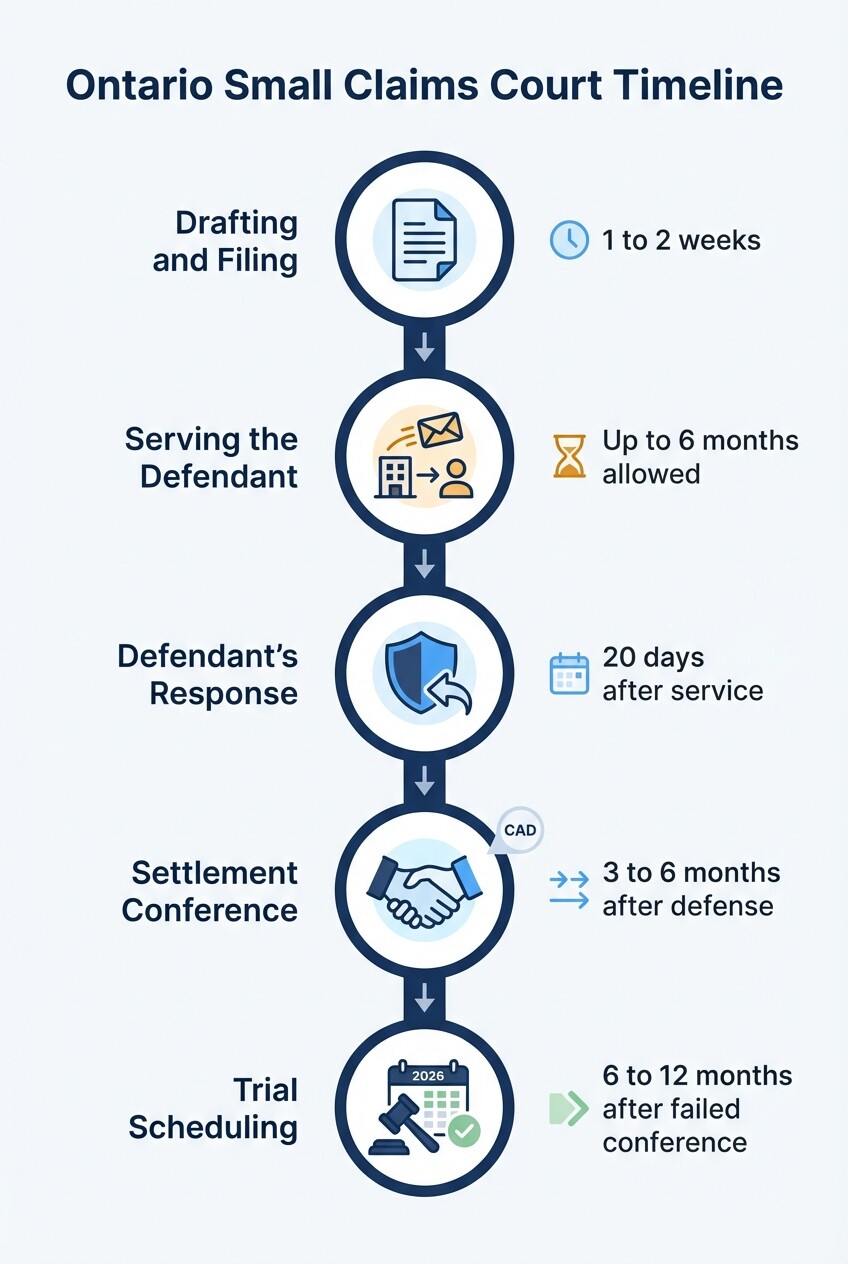
Resolving a small claims dispute in Ontario typically takes between six months and two years, depending on court backlogs and whether the case settles early. Defendants have 20 days to file a defense, after which court scheduling heavily dictates the pace.
| Process Stage | Average Timeline Expectation |
|---|---|
| Drafting and Filing | 1 to 2 weeks |
| Serving the Defendant | Up to 6 months allowed by law |
| Defendant's Response | 20 days after being served |
| Settlement Conference | 3 to 6 months after a defense is filed |
| Trial Scheduling | 6 to 12 months after a failed Settlement Conference |
Enforcing a Judgment: Seizure and Sale vs. Garnishment
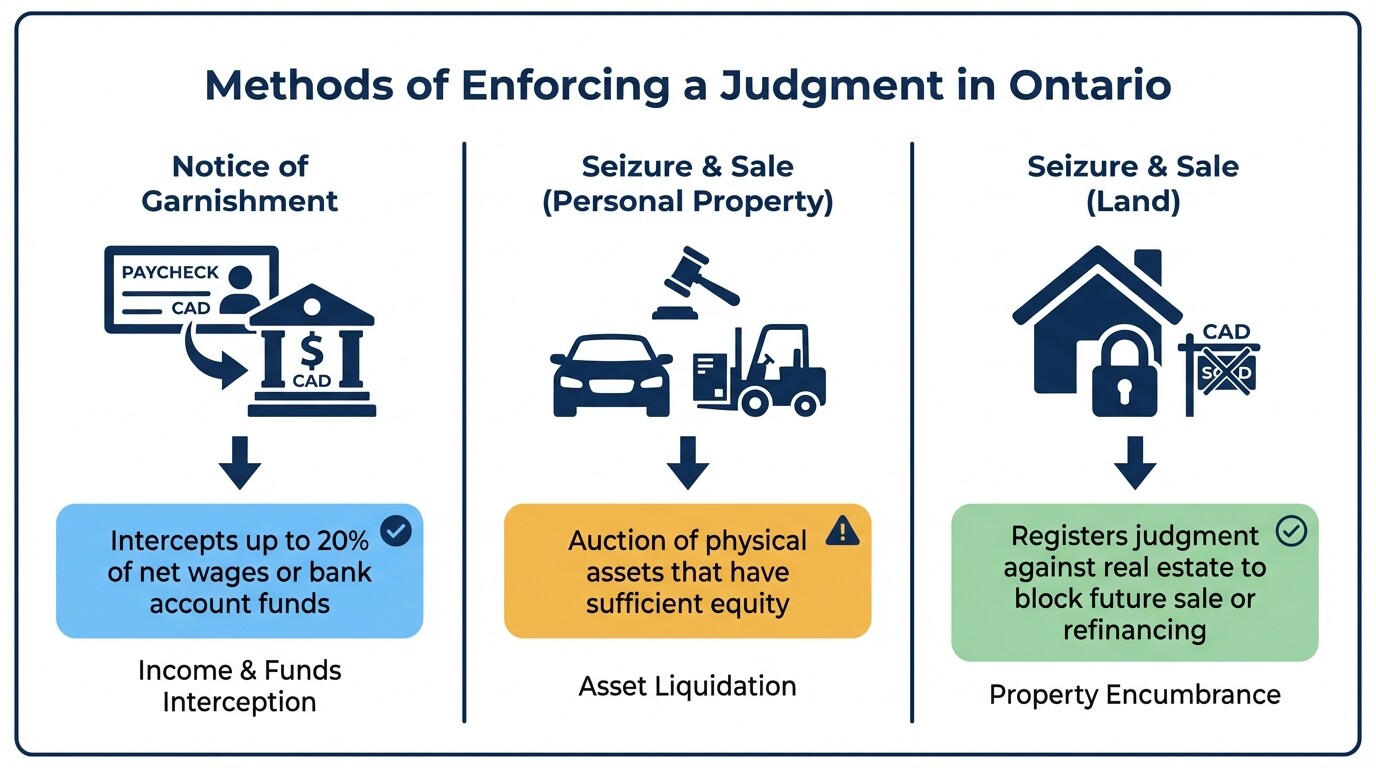
The court does not collect money on your behalf after you win a lawsuit; you are entirely responsible for enforcing the judgment. The two most common methods in Ontario are issuing a Notice of Garnishment to intercept funds or a Writ of Seizure and Sale to target physical assets.
Choosing the right enforcement strategy depends on what you know about the debtor's financial situation:
- Notice of Garnishment: This allows you to legally intercept money owed to the debtor by a third party. You can garnish up to 20 percent of the debtor's net wages or seize funds directly from their bank account.
- Writ of Seizure and Sale of Personal Property: This directs court enforcement officers to seize and auction the debtor's physical assets, such as vehicles or business equipment. The asset must have enough equity to cover the seizure costs and the debt.
- Writ of Seizure and Sale of Land: You can register your judgment against the debtor's real estate. While you may not force a sale immediately, the debtor cannot sell or refinance the property without paying your judgment first.
Common Misconceptions About Small Claims Court
Many plaintiffs enter the small claims process with unrealistic expectations about the speed and guaranteed outcomes of their case. Understanding how the system actually works prevents frustration and wasted legal expenses.
- Mistake: Assuming the court does the investigating. The judge will only review the evidence you bring to court. It is entirely your responsibility to subpoena witnesses, gather financial records, and prove your case on a balance of probabilities.
- Mistake: Believing judgments guarantee payment. A court order proves you are legally owed money, but it cannot create money if the defendant is bankrupt or hiding assets. Evaluating the defendant's ability to pay before suing is crucial.
- Mistake: Thinking you cannot hire legal help. While designed for self-representation, the rules of evidence and procedure are complex. Retaining an experienced professional from a trusted legal directory can significantly improve your chances of procedural compliance and success.
Frequently Asked Questions
What happens if the defendant ignores the claim?
If the defendant fails to file a Defense (Form 9A) within 20 days of being served, you can file for a "Default Judgment." This allows you to win the case automatically and proceed directly to enforcing the debt without a trial.
Can I sue for pain and suffering in Small Claims Court?
Yes, you can claim general damages for pain and suffering, defamation, or emotional distress in Small Claims Court, provided the total financial demand does not exceed the $35,000 limit. However, proving these subjective damages requires strong medical or expert evidence.
What if my damages are more than the $35,000 limit?
If your claim exceeds $35,000, you have two choices: you can abandon the excess amount and proceed in Small Claims Court, or you can pursue the full amount by filing an action in the Superior Court of Justice, which is significantly more complex and expensive.
Do I have to pay the defendant's legal fees if I lose?
Yes, the judge has the discretion to award "costs" to the successful party. If you lose, you may be ordered to pay a portion of the defendant's legal fees and court expenses, typically capped at 15 percent of the claim amount.
When to Hire a Lawyer
While Small Claims Court is designed for self-representation, hiring a legal professional is highly recommended when dealing with complex corporate defendants, nuanced contract law, or difficult enforcement proceedings. A lawyer or paralegal can ensure strict procedural compliance and maximize your chances of recovery.
Consider seeking legal representation if:
- You are unsure of the correct legal entity to name in your lawsuit.
- The limitation period for your claim is rapidly approaching.
- The defendant has filed a counter-claim against you for a substantial amount.
- You need to cross-examine expert witnesses during a trial.
- You have won a judgment but the debtor is hiding assets or refusing to pay.
Next Steps
Initiating a small claim requires organizing your evidence and securing the correct legal forms before taking any formal court action. Follow these immediate steps to get your lawsuit off the ground efficiently.
- Send a Final Demand: Draft and send a formal, date-stamped demand letter outlining the debt and providing a strict deadline for payment before court action.
- Locate the Defendant: Confirm the exact residential address or corporate registered office of the defendant to ensure you can serve them legally.
- Compile Your Evidence: Gather all contracts, photos, and communication logs outlined in the documentation checklist above.
- Draft Form 7A: Download the Plaintiff's Claim form from the Ontario government website and carefully draft your statement of facts.
- Consult a Professional: If your case involves complex legal arguments or aggressive counter-claims, consult a legal professional to review your documentation before filing.