


- Most consumer privacy class actions in Canada operate on an opt-out basis, meaning you are automatically included if you meet the class definition.
- You do not need to pay out-of-pocket legal fees to participate; lawyers are typically paid a percentage of the final settlement or court award.
- Certification is the most critical stage of a Canadian class action, where a judge determines if the case is suitable to proceed as a collective group.
- Damages can be awarded for "intrusion upon seclusion," meaning you may receive compensation for the loss of privacy itself, even without proven financial loss.
- High-profile breaches often result in national classes, covering residents across all provinces and territories under a single legal umbrella.
Checklist: What to Do After a Data Breach Notification
When a company notifies you that your personal information has been compromised, your actions in the first 48 hours can impact your eligibility for future legal remedies. Use this checklist to protect your rights and prepare for potential class action participation.
- Preserve the Notification: Save the original email or letter sent by the company. This is your primary evidence that you are a member of the affected class.
- Document Immediate Impacts: Take screenshots or notes of any unauthorized transactions, suspicious login attempts, or "phishing" messages received after the breach.
- Record Out-of-Pocket Expenses: Keep receipts for credit monitoring services, identity theft insurance, or time spent (log your hours) resolving issues related to the leak.
- Check Your Eligibility: Visit the websites of reputable Canadian class action law firms to see if a claim has already been filed against the specific company.
- Update Security Credentials: Change passwords and enable multi-factor authentication (MFA) on all sensitive accounts, especially those sharing the same credentials as the breached account.
- Monitor Credit Reports: Request a free credit report from Equifax or TransUnion Canada to check for unauthorized accounts opened in your name.
What Are the Legal Criteria for Certifying a Privacy Class Action?
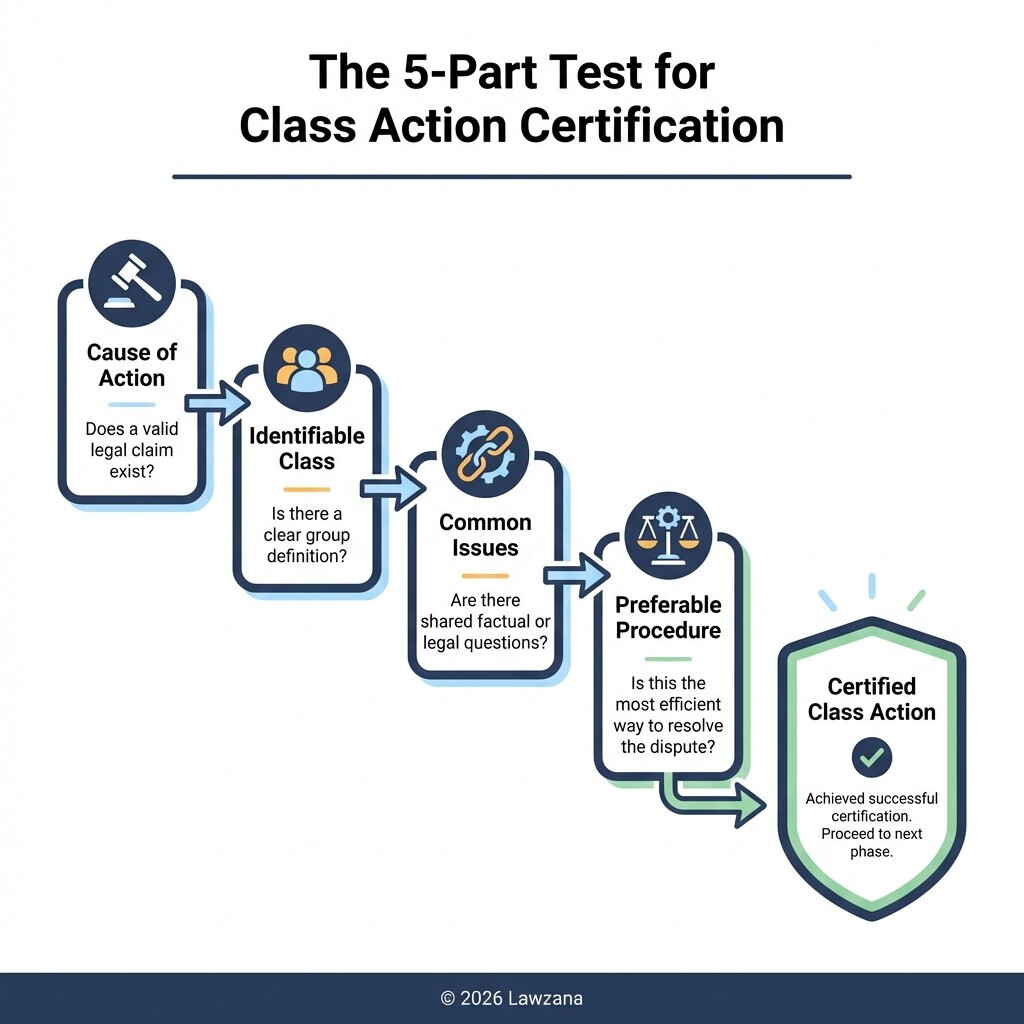
To proceed as a class action in Canada, a lawsuit must first pass a "certification" hearing where a judge confirms the case meets specific statutory requirements. This process ensures that the claims of hundreds or thousands of people are similar enough to be resolved in a single proceeding rather than through individual trials.
The court applies a five-part test found in provincial legislation, such as Ontario's Class Proceedings Act:
- Cause of Action: The pleadings must disclose a valid legal claim (e.g., negligence, breach of contract, or the privacy tort of "intrusion upon seclusion").
- Identifiable Class: There must be a clear definition of who belongs to the group (e.g., "All Canadian residents whose data was stored on Server X between January and June").
- Common Issues: The claims of the class members must raise significant factual or legal questions that can be answered for everyone at once.
- Preferable Procedure: A class action must be the most efficient and fair way to resolve the dispute compared to other methods.
- Representative Plaintiff: There must be a "lead plaintiff" who can fairly represent the interests of the entire class without a conflict of interest.
What Is the Difference Between Opt-in and Opt-out Systems in Canada?
In Canada, the vast majority of privacy class actions are "opt-out" for residents of the province where the case is filed. This means that if you fit the description of the affected group, you are legally bound by the outcome of the case unless you actively take steps to remove yourself.
- Opt-out System: Designed to promote access to justice, this system assumes everyone affected wants to participate. If a settlement is reached, the lawyers will notify you via mail, email, or public advertisements on how to claim your share. If you do nothing, you stay in the class but lose the right to sue the company individually later.
- Opt-in System: This is occasionally used for "non-residents" in certain provincial jurisdictions. If a class action is filed in British Columbia, for example, a resident of Ontario might need to proactively sign up to be included in that specific BC-based lawsuit.
- National Classes: Most major data breaches result in a "national class" filed in a major hub like Toronto, Vancouver, or Montreal. These are almost always opt-out for all Canadians, regardless of which province they live in.
How Do You Prove Damages for Loss of Privacy and Emotional Distress?
Proving damages in a privacy case is unique because the harm is often intangible, such as the "loss of control" over personal data or the anxiety of potential future identity theft. Canadian courts recognize that privacy has inherent value, even if a hacker hasn't yet used your credit card.
Plaintiffs typically seek compensation through three main avenues:
- Intrusion Upon Seclusion: This is a "tort" (a civil wrong) recognized by Canadian courts. It allows for "moral damages" or "nominal damages" simply because a person's private space was invaded in a way that would be highly offensive to a reasonable person. Awards for this usually range from $1,000 to $5,000 per person.
- Actual Financial Loss: If the data breach led to identity theft, fraudulent bank withdrawals, or the cost of hiring a credit repair agency, these "pecuniary damages" can be claimed with specific evidence like bank statements and receipts.
- Emotional Distress: While harder to prove, significant psychological impact (diagnosed anxiety or severe distress) resulting from the breach can increase the settlement amount, though courts generally set a high bar for "compensable" distress.
What Is the Timeline for Settlements in Multi-jurisdictional Claims?
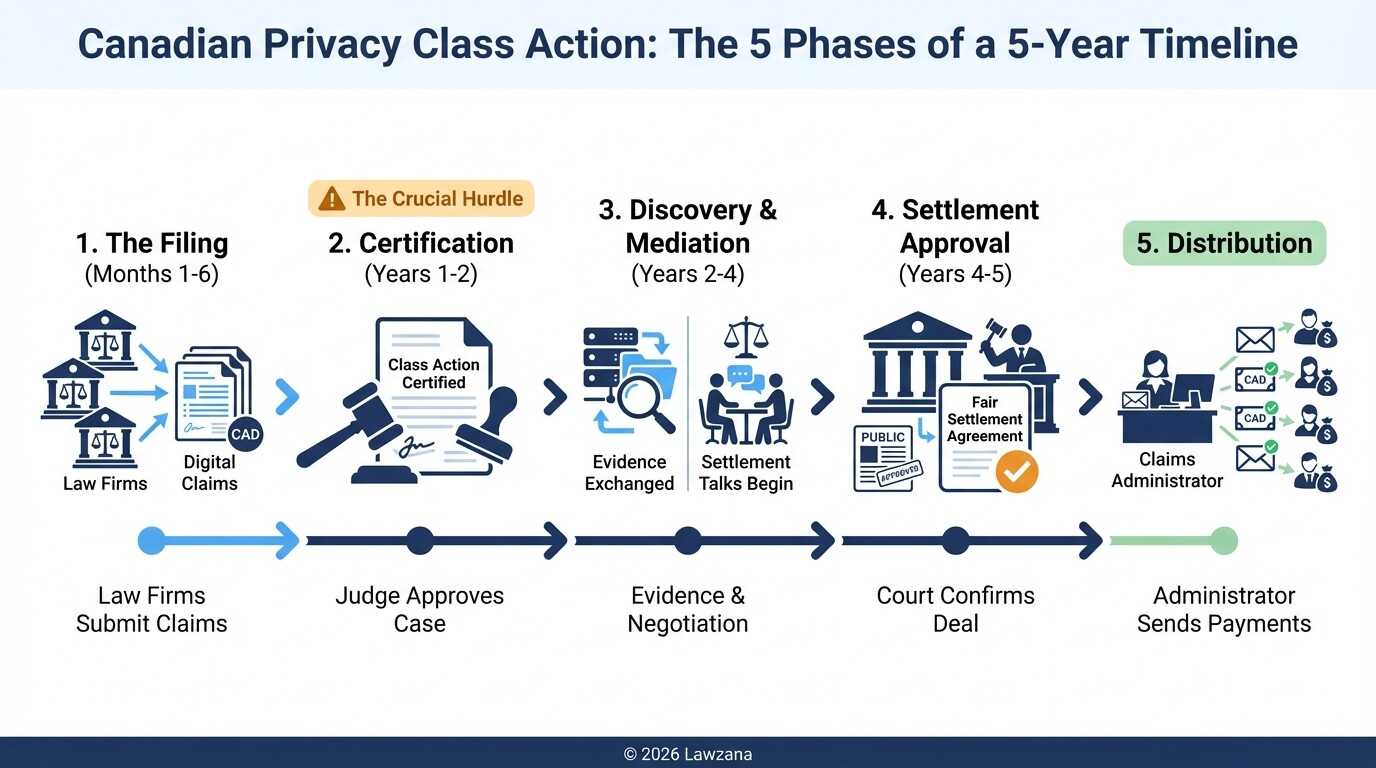
A consumer privacy class action in Canada typically takes between two to five years from the initial filing to the distribution of settlement funds. Because major data breaches often involve companies operating across borders, the legal process can be slowed down by jurisdictional disputes and complex discovery phases.
The timeline generally follows these phases:
- The Filing (Month 1-6): Multiple law firms may file competing claims. A judge may have to decide which firm will take the lead.
- Certification (Year 1-2): This is the "make or break" moment. If the judge refuses to certify the class, the case effectively ends unless it is successfully appealed.
- Discovery and Mediation (Year 2-4): The parties exchange evidence and often enter settlement negotiations. Most privacy cases settle during this phase to avoid the cost and reputation damage of a public trial.
- Settlement Approval (Year 4-5): A judge must review the settlement to ensure it is "fair, reasonable, and in the best interests of the class."
- Distribution: Once approved, a third-party claims administrator is hired to process applications and mail checks to class members.
How to Find a Lead Plaintiff Lawyer for Data Breach Cases
Finding the right legal representation for a privacy breach is different from hiring a lawyer for a personal injury or a divorce. You are looking for a firm that has the resources to litigate against multi-billion dollar corporations and a track record in "Complex Litigation."
- Check Class Action Registries: The Canadian Bar Association maintains a National Class Action Database where you can search for active privacy cases by company name.
- Evaluate Firm Experience: Look for firms that have successfully handled high-profile breaches (e.g., the Lifelabs, Desjardins, or MGM breaches). Review their "Past Successes" or "Current Cases" pages.
- Understand the Fee Structure: In Canada, class action lawyers work on a contingency basis. They typically take 25% to 33% of the final settlement. Ensure the firm you choose has the financial backing to pay for expert witnesses and technical data forensic specialists.
- The Representative Plaintiff Role: If you were among the first to be notified and have documented damages, you can ask a firm to be the "Representative Plaintiff." This involves more work-such as giving a deposition-but often results in an "honorarium" (a small additional payment) of $1,000 to $10,000 for your service to the class.
Common Misconceptions About Privacy Class Actions
"I will receive thousands of dollars if I join."
In reality, unless you have suffered significant, proven financial loss through identity theft, the payout for most privacy class actions ranges from $50 to $500 per person. These lawsuits are more about holding companies accountable and deterring future negligence than about creating a windfall for individuals.
"I have to pay a fee to join the class action."
You should never be asked to pay an upfront fee to join a consumer class action in Canada. The legal fees are paid out of the final settlement amount before the money is distributed to the class. If a firm asks for a retainer to join a class action, it is a significant red flag.
"I need to file my own lawsuit to get paid."
Because most of these cases are "opt-out," you are usually already part of the lawsuit. Filing your own individual claim for a standard data breach is often counterproductive and expensive. Your role is simply to wait for the settlement notice and file a claim form when the time comes.
FAQ
How do I know if I am part of a class action?
If the court certifies the class, the defendant company is usually required to send a notice to all affected customers via the email or mailing address they have on file. You can also monitor the Privacy Commissioner of Canada website for announcements regarding major breaches.
Can I sue for a data breach if the company is based in the US?
Yes, as long as the company does business in Canada and the breach affected Canadian residents. Canadian courts frequently assert jurisdiction over international corporations that collect the personal data of Canadians.
What happens if I move after the breach occurs?
You are still part of the class based on your residency at the time of the breach or during the period defined in the class definition. It is important to update your contact information with the "Claims Administrator" once a settlement is announced to ensure you receive your payment.
When to Hire a Lawyer
While you do not need to hire a personal lawyer to be a member of a class action, you should consult with a specialized class action firm if:
- You have suffered direct financial losses exceeding $10,000 due to identity theft linked to the breach.
- You wish to serve as the "Lead Plaintiff" to ensure the case is prosecuted vigorously.
- You have received a "Notice of Settlement" and believe the terms are unfair or that you should be excluded so you can pursue a high-value individual claim.
- You are a business owner whose proprietary data was leaked, as your damages may be significantly higher than those of a standard consumer.
Next Steps
- Secure your accounts: Immediately change passwords and enable two-factor authentication on all sensitive digital platforms.
- Search the registries: Check the CBA National Class Action Database to see if a claim has been filed against the company that lost your data.
- Sign up for updates: Most law firms have a "Contact Us" or "Join This Action" form on their website for specific cases; submit your info to receive updates on settlement progress.
- Monitor your credit: Use tools like Borrowell or Credit Karma Canada to watch for unauthorized changes to your credit file.
- Wait for the notice: Understand that class actions move slowly. Keep your breach notification in a safe place until the "Claims Period" opens.