
Contested vs. Uncontested Divorce in Ontario: Expat Legal Fees and Cross-Border Mistakes
What is the Difference Between Contested and Uncontested Divorce?
An uncontested divorce means both spouses agree on all key issues, allowing for a streamlined, often paper-based court process. A contested divorce requires a judge to resolve disputes over property division, spousal support, or child custody through litigation.
Choosing the right path drastically impacts your financial stability and emotional well-being. For expats dealing with the added stress of immigration status or international ties, minimizing conflict through an uncontested separation is highly recommended.
| Feature | Uncontested Divorce | Contested Divorce |
|---|---|---|
| Agreement Level | Full agreement on all terms | Disagreement on one or more core issues |
| Court Appearances | Rarely required; mostly paperwork | Multiple hearings, case conferences, and trials |
| Average Cost | $1,500 - $3,000 CAD | $15,000 - $50,000+ CAD per spouse |
| Timeline | 4 to 6 months | 18 to 36+ months |
| Stress Level | Low to moderate | High and adversarial |
Jurisdictional Eligibility and Residency Requirements in Ontario
To file for divorce in Ontario as a foreign national or expat, at least one spouse must have lived in the province for a minimum of one full year immediately preceding the application. Your citizenship status and the country where you were married do not prevent you from divorcing in Canada, provided this residency rule is met.
Under the federal Divorce Act, Canadian courts hold the authority to grant a divorce based on habitual residence. If neither you nor your spouse meets the one-year Ontario residency requirement, you cannot file there, even if you are currently living in the province. Expats who frequently travel for work must carefully document their primary residence to prove they meet this threshold. Once the residency requirement is established, the court can rule on the divorce, though ruling on international property may involve complex jurisdictional overlap.
Legal Fees and Court Costs for Ontario Divorces
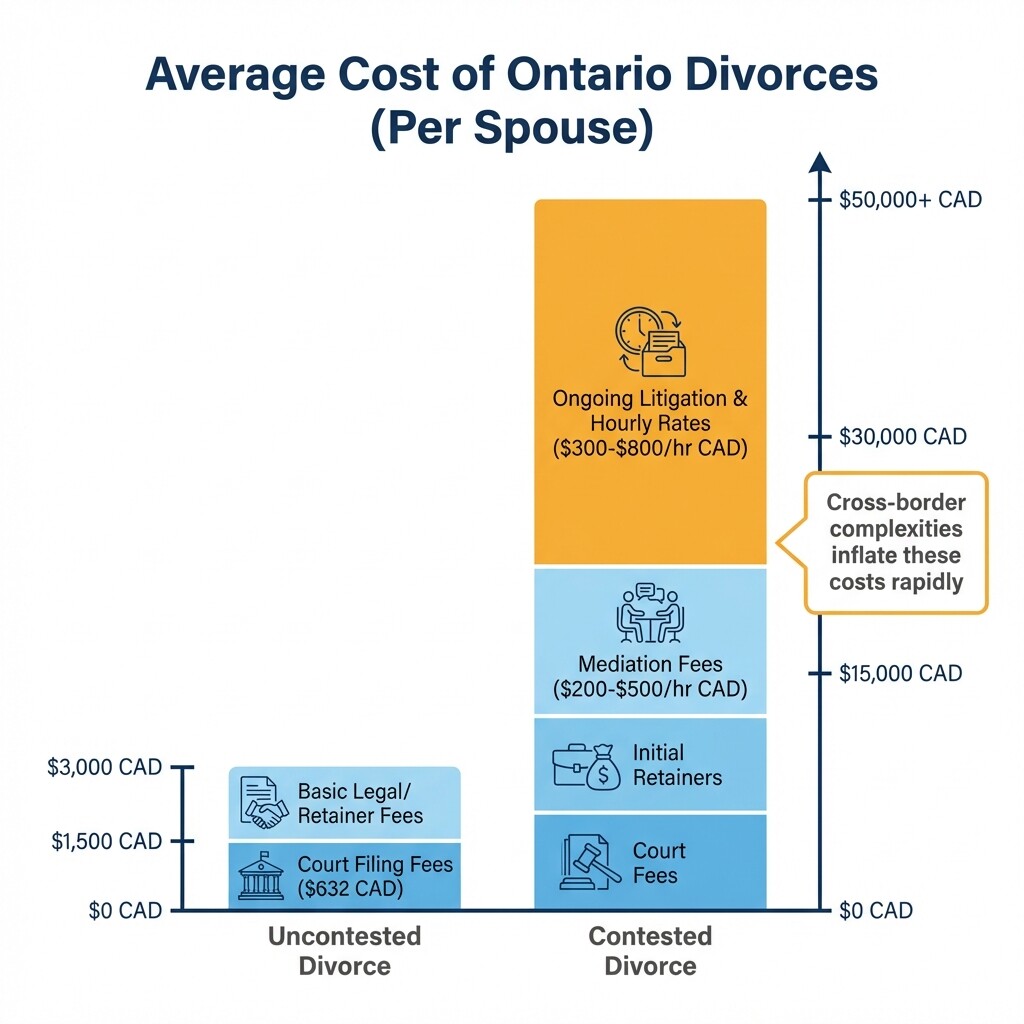
An uncontested divorce in Ontario typically costs between $1,500 and $3,000 CAD, while a contested divorce involving litigation easily exceeds $15,000 to $50,000 CAD per spouse. Your final bill depends heavily on lawyer retainers, mandatory mediation steps, and government filing fees.
Understanding the financial breakdown helps expats budget for the separation process in Canadian currency:
- Court Filing Fees: The Ontario government charges a standard set of fees to process a divorce. Currently, this totals $632 CAD ($212 to file the initial application and $420 before the divorce is granted).
- Lawyer Retainers: Family lawyers typically request an upfront retainer. For a simple uncontested divorce, this might be $2,000 CAD. For a contested divorce with cross-border complexities, expect a starting retainer of $5,000 to $10,000 CAD.
- Hourly Rates: Ontario family lawyers generally charge between $300 and $800 CAD per hour. Time spent arguing over foreign assets quickly inflates this cost.
- Mediation Fees: Before heading to trial, courts encourage alternative dispute resolution. Private mediators charge between $200 and $500 CAD per hour, usually split between the spouses.
Common Cross-Border Mistakes Expats Make
Expatriates frequently err by assuming foreign property is exempt from Canadian division rules or by failing to properly value overseas retirement accounts. Under Ontario law, all global assets accumulated during the marriage are subject to calculation and division, regardless of where they are physically located.
Navigating separation in a foreign country introduces unique pitfalls. Avoid these common misconceptions:
- Misconception 1: "My home country assets are protected." Ontario uses an "equalization of net family property" system. You must declare the value of all global assets, including overseas real estate, business interests, and bank accounts. While an Ontario court cannot directly transfer the title of a foreign property, they will offset its value against Canadian assets.
- Misconception 2: "Foreign pensions don't count." Overseas retirement accounts, such as a US 401(k) or a UK SIPP, must be valued and factored into the property division. Because tax rules and withdrawal penalties vary by country, expats must hire specialized actuaries to determine the true present value of these accounts.
- Misconception 3: "My foreign prenuptial agreement is ironclad." A marriage contract signed in another country is not automatically enforceable in Ontario, especially if it violates Canadian laws regarding child support or the matrimonial home.
Timelines for Separation Agreements and Divorce Decrees
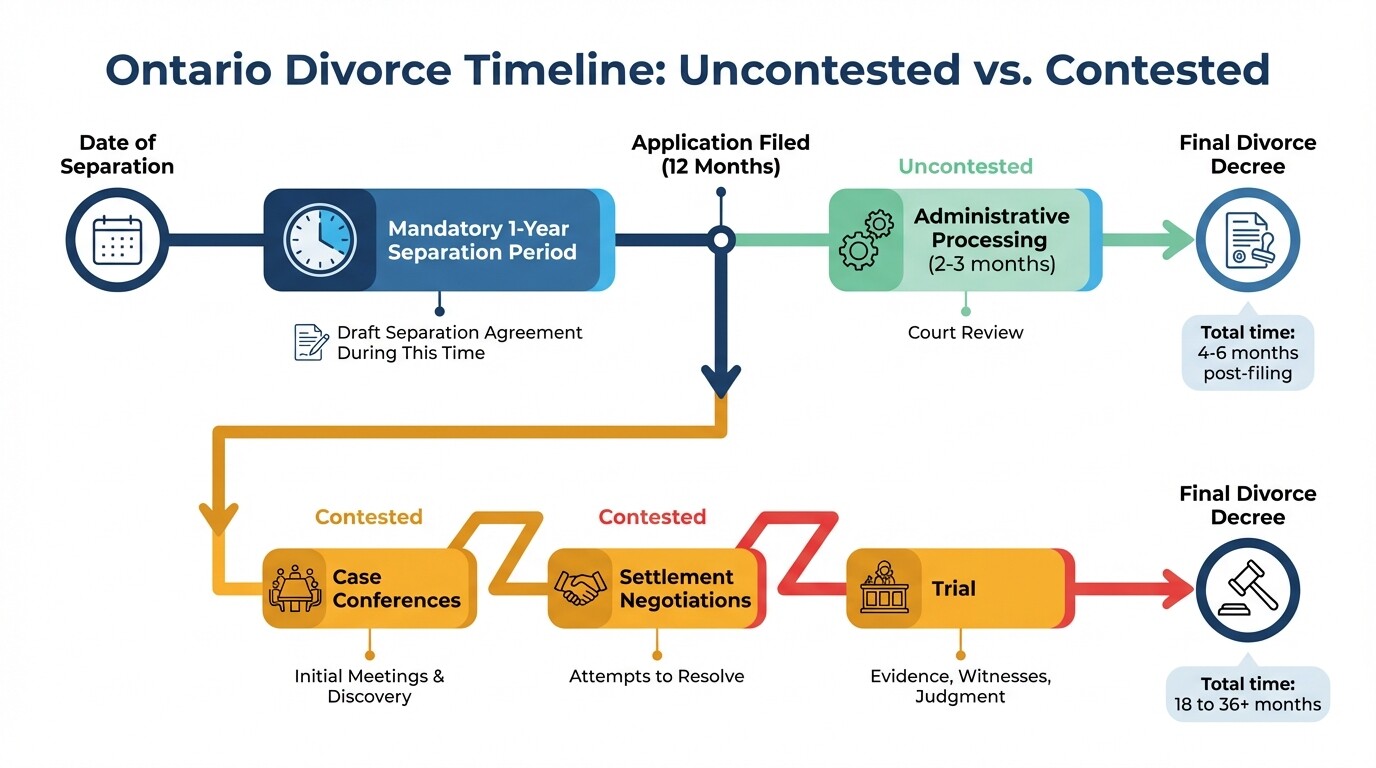
Reaching a separation agreement and securing a final divorce decree in Ontario typically takes 4 to 6 months for uncontested cases, whereas contested litigation often drags on for 18 to 36 months. Resolving disputes out of court is the most efficient path, especially when factoring in court backlogs expected through 2026.
In Canada, the legal ground for divorce is a breakdown of the marriage, most commonly established by living separate and apart for one full year.
- The Separation Period: You can file your application for divorce before the year is up, but the court will not grant the final decree until the full 12 months have passed.
- Drafting the Agreement: Spouses can negotiate a separation agreement immediately after parting ways. This contract governs asset division and support during the waiting period.
- Court Processing: Once the one-year mark passes and paperwork is submitted, an uncontested divorce requires 2 to 3 months of administrative processing by the court to issue the final Divorce Order and Certificate. Contested divorces require scheduling case conferences, settlement conferences, and potentially a trial, extending the timeline by years.
Managing Cross-Border Child Custody and International Travel
Moving children across international borders after a separation requires either the explicit written consent of the other parent or a formal court order. Attempting to relocate a child to your home country without these permissions is considered international child abduction under Canadian law and the Hague Convention.
For expats, child custody (now legally referred to as "decision-making responsibility" and "parenting time" in Canada) is the most sensitive area of a divorce.
- Mobility Rights: If you wish to return to your home country with your children, you must prove to the Ontario court that the relocation is in the child's best interest. The court will heavily scrutinize how the move impacts the child's relationship with the parent left behind.
- Travel Consent Letters: Even for short vacations to visit family overseas, you must carry a notarized travel consent letter signed by the other parent. Without this, border officials may deny your departure.
- Detailed Parenting Plans: Expat separation agreements must include highly specific clauses detailing international travel rules, passport holding responsibilities, and how long-distance parenting time (e.g., summer holidays abroad) will be managed.
FAQs
Can I get divorced in Ontario if I was married in another country?
Yes. Ontario courts have jurisdiction to grant a divorce regardless of where the marriage took place, provided that at least one spouse has been habitually resident in Ontario for at least one year immediately before filing the application.
Do I have to go to court for an uncontested divorce?
No. Uncontested divorces in Ontario are generally processed as a "joint" or "simple" application. A judge reviews your paperwork, separation agreement, and financial disclosures in their chambers and signs the divorce order without requiring you to step foot in a courtroom.
How does an Ontario divorce affect my immigration status?
If your permanent residency is dependent on spousal sponsorship, a divorce may impact your status. Conditional permanent residence rules have changed, but it is critical to consult an immigration lawyer alongside your family lawyer to understand how separation affects your right to remain in Canada.
Will my Ontario divorce be recognized in my home country?
In most cases, a legal divorce granted in Canada is recognized internationally. However, some countries require you to register the Canadian divorce certificate with their local authorities or embassies.
When to Hire a Lawyer and Next Steps
You should consult an Ontario family lawyer immediately if your spouse contests the separation, you share international assets, or there are disagreements regarding child mobility. Early legal intervention prevents costly jurisdictional mistakes and protects your financial future.
For expats, the stakes are exceptionally high due to the intersection of international property, immigration concerns, and cross-border custody. Start by gathering all financial documents, including recent valuations of overseas accounts and properties. Document your exact dates of residency in Ontario to confirm jurisdictional eligibility. If you are ready to seek guidance, you can find legal representation in Canada to ensure your separation agreement holds up across borders.