


- Singapore manages corporate restructuring under the Insolvency, Restructuring and Dissolution Act (IRDA), prioritizing rehabilitation over immediate liquidation.
- Foreign parent companies are generally protected from a Singapore subsidiary's debts unless they signed corporate guarantees or commingled funds.
- A Scheme of Arrangement lets a company control its operations while restructuring debt and includes an automatic moratorium on creditor lawsuits.
- Restructuring legal and advisory costs range from SGD 30,000 to over SGD 500,000 based on the selected procedure and creditor disputes.
- Parent companies must formalize intercompany loans with official documentation to vote as valid creditors during insolvency proceedings.
How Singapore Handles Insolvency for Foreign-Owned Subsidiaries
Singapore governs corporate insolvency under the Insolvency, Restructuring and Dissolution Act 2018 (IRDA). Foreign-owned subsidiaries incorporated in Singapore follow these laws. The Singapore Courts manage their financial rehabilitation or liquidation, regardless of the parent company's headquarters.
Singapore has adopted the UNCITRAL Model Law on Cross-Border Insolvency. This framework allows foreign insolvency representatives to apply to the Singapore High Court for recognition of foreign bankruptcy proceedings to coordinate asset recovery across borders.
The IRDA focuses on business rescue. It adapts elements from the US Chapter 11 bankruptcy model, including super-priority rescue financing and automatic moratoriums. Foreign parent companies can use these legal mechanisms to save a struggling Singapore entity before writing off the investment entirely. If rehabilitation fails, the law details a structured winding-up process to distribute assets to creditors.
Corporate Restructuring Checklist for Foreign Parents
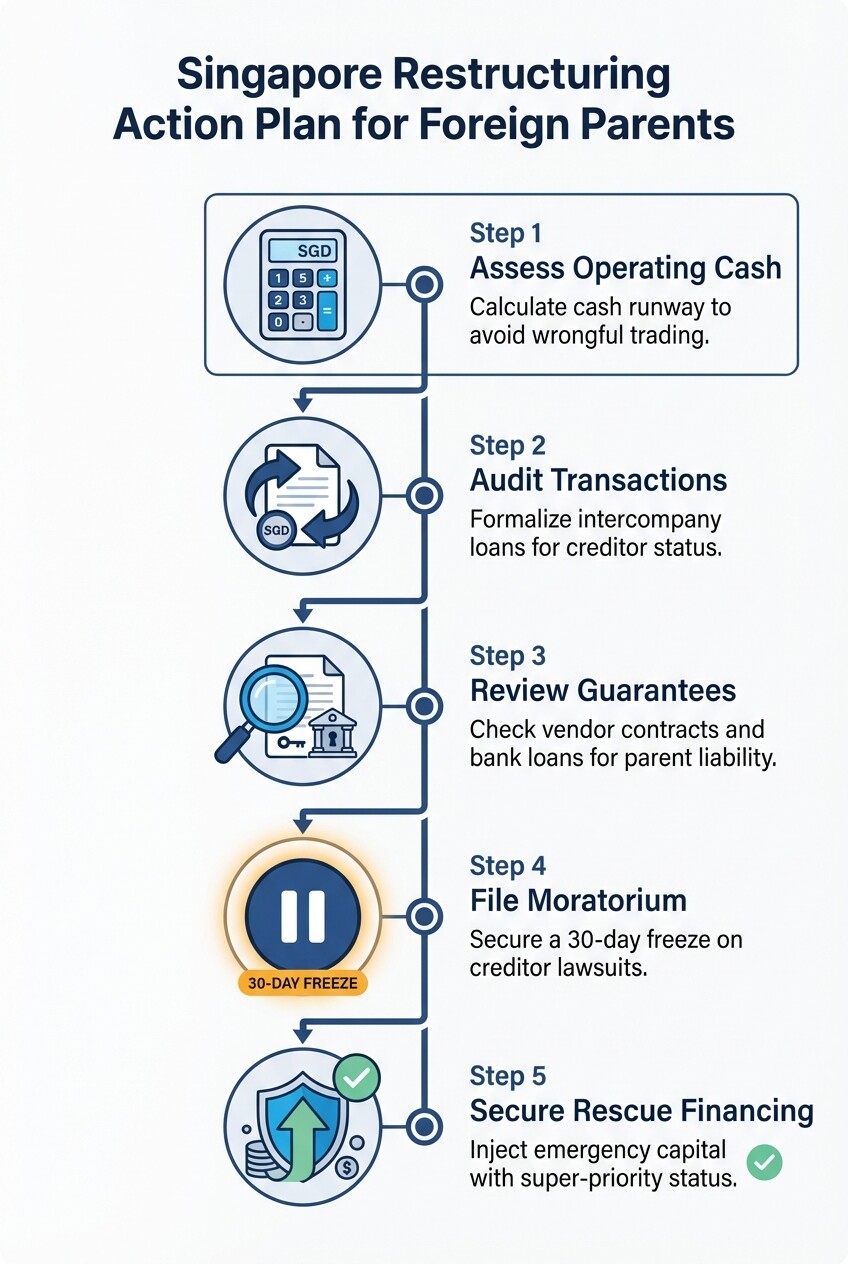
Restructuring requires an immediate assessment of the subsidiary's cash flow, debt, and intercompany agreements. Foreign parent companies must secure local counsel and evaluate their legal exposure before local creditors initiate recovery actions.
Follow this action plan when a Singapore subsidiary faces insolvency:
- Assess operating cash: Calculate exactly how many days of operating cash the subsidiary has left. Singapore penalizes wrongful trading, which occurs when directors incur debts knowing the company cannot pay them.
- Audit intercompany transactions: Identify all financial transfers between the foreign parent and the Singapore subsidiary. Formalize intercompany loans so the parent company can claim creditor status and vote in insolvency proceedings.
- Review corporate guarantees: Check vendor contracts, commercial leases, and bank loans to see if the parent company provided a binding guarantee.
- File for an automatic moratorium: If creditor lawsuits are imminent, instruct local counsel to apply to the Singapore High Court for a debt moratorium under Section 64 of the IRDA. This freezes legal actions against the subsidiary for up to 30 days.
- Secure rescue financing: Determine if the parent company or a third-party lender will inject emergency capital. This new financing can receive super-priority status, paying it back before existing debts.
Restructuring Options: Scheme of Arrangement and Judicial Management
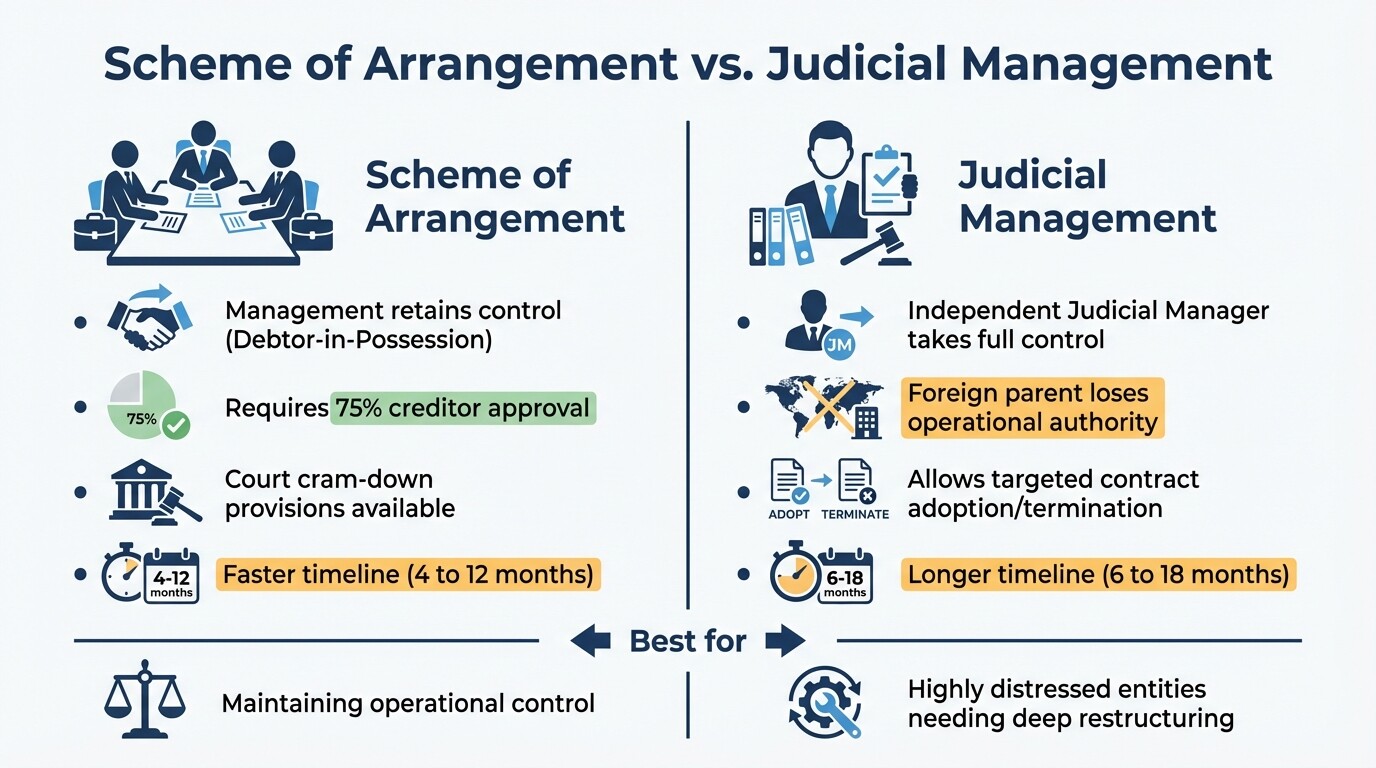
Financially distressed subsidiaries can use a Scheme of Arrangement or Judicial Management to rehabilitate the business. These tools restructure debt, stop creditor lawsuits, and preserve operations.
Scheme of Arrangement
This is a court-approved agreement between a company and its creditors. The management team retains control as a debtor-in-possession. The scheme requires approval from a majority of creditors representing at least 75 percent of the total debt value. The IRDA includes cram-down provisions, allowing the court to approve the restructuring plan even if some creditor classes vote against it.
A traditional scheme takes four to twelve months from the initial court application to final approval. Singapore also allows pre-packaged schemes, which can gain approval in two months if the company negotiates agreements with major creditors before filing.
Judicial Management
If the company is highly distressed, the court can appoint an independent Judicial Manager. This licensed practitioner takes complete control of the subsidiary to restore its financial health. This process shields the company from creditors but removes the foreign parent's operational control.
When a Judicial Manager is appointed, the subsidiary's employment contracts do not automatically terminate. The Judicial Manager has a specific window of time to adopt the existing contracts or lay off staff to reduce the company's financial burden.
Protecting Foreign Parent Assets
A Singapore subsidiary is a distinct legal entity. A foreign parent company's assets are shielded from the subsidiary's debts. However, courts can pierce the corporate veil and hold the parent liable if the subsidiary committed fraud or if the entities failed to maintain separation.
To keep multinational assets protected, maintain corporate formalities. Do not commingle the parent company's bank accounts with the subsidiary's accounts. Ensure transactions between the two entities are at arm's length and reflect fair market value. Review your financial exposure closely. Parent companies expose themselves to liability by co-signing commercial leases or acting as guarantors for the subsidiary's credit facilities. If a guarantee exists, the creditor can bypass the bankrupt subsidiary and sue the parent company directly.
Estimated Costs and Timelines
Legal and advisory costs for restructuring in Singapore range from SGD 30,000 for simple liquidations to over SGD 500,000 for complex Schemes of Arrangement. Expenses depend on the duration of the proceedings, total debt volume, and whether creditors aggressively contest the restructuring plan.
| Restructuring Mechanism | Estimated Cost Range (SGD) | Typical Timeline |
|---|---|---|
| Creditors' Voluntary Winding Up | $30,000 to $80,000 | 6 to 12 months |
| Pre-packaged Scheme of Arrangement | $80,000 to $200,000 | 2 to 4 months |
| Judicial Management | $100,000 to $300,000+ | 6 to 18 months |
| Scheme of Arrangement | $150,000 to $500,000+ | 4 to 12 months |
Common Misconceptions About Singapore Insolvency
Foreign executives often assume their home country's bankruptcy laws will govern their Singapore entities. Understanding Singapore's jurisdiction prevents strategic errors during a corporate financial crisis.
- Intercompany debt is automatically ignored: Parent companies assume the money they lent their subsidiary cannot be claimed. In Singapore, properly documented intercompany loans allow the parent to vote as an unsecured creditor and recover a portion of the assets. Informal cash transfers without loan agreements are often reclassified as equity injections by the liquidator, stripping the parent of its voting rights.
- Insolvency means immediate business closure: Many view insolvency as the end of a business. Singapore's framework focuses on rescue. Filing for restructuring protections early can save the business and preserve jobs.
- Foreign courts can easily freeze Singapore assets: Creditors attempt to use foreign court orders to seize a Singapore subsidiary's assets. Singapore courts require formal recognition proceedings before foreign judgments can be enforced locally, providing a layer of procedural protection.
When to Hire a Lawyer
Hire a local insolvency lawyer when your Singapore subsidiary projects an inability to pay its debts within the next 30 to 60 days. Early legal intervention is necessary to secure court-ordered moratoriums that freeze aggressive creditor actions and prevent statutory demands.
Directors of a distressed subsidiary face personal liability under Singapore law if they trade while insolvent. Engaging restructuring and insolvency lawyers in Singapore ensures the board of directors complies with its fiduciary duties. A lawyer will assess your legal exposure, advise on restructuring options, and draft court applications to protect both the subsidiary and the foreign parent.
Next Steps
Initiate a comprehensive financial audit of the Singapore subsidiary to determine its exact liabilities. Gather all balance sheets, creditor communications, and intercompany agreements to establish a clear picture of the financial distress.
Present this data to your legal team. They will map out a timeline and help you decide whether injecting rescue capital, restructuring the debt, or winding up the entity is the most financially viable path forward. Prepare to suspend non-essential payments to external creditors while your advisors finalize the strategy.