- Act Immediately on Service: Foreign suppliers have strict deadlines, often as short as 10 to 21 court days, to file a Notice of Intention to Defend before facing default judgment.
- Authenticate Your Evidence: Affidavits and corporate resolutions signed outside South Africa require formal authentication (usually via Apostille) to be admissible in a South African High Court.
- Enforce Arbitration Early: If the commercial contract contains a foreign arbitration clause, file a special plea to stay South African court proceedings before engaging with the merits of the claim.
- Demand Security for Costs: Multinational defendants can use court rules to force underfunded local plaintiffs to provide upfront financial security for legal fees.
- Implement a Litigation Hold: South African discovery rules compel the disclosure of relevant cross-border communications and electronic records, requiring immediate data preservation.
Timelines for Filing a Notice of Intention to Defend
Foreign defendants have 10 to 21 court days to file a Notice of Intention to Defend after receiving a summons in South Africa. Missing this deadline allows the local plaintiff to apply for default judgment. Once granted, the plaintiff wins unopposed and can seize local assets or apply for foreign enforcement.
The exact timeline depends on how the summons is served:
| Service Method | Response Deadline | Conditions |
|---|---|---|
| Local Branch or Chosen Address | 10 court days | Applies if your company operates a registered local branch or selected a South African address for legal notices. |
| Foreign Headquarters (Edictal Citation) | 21+ court days | Applies when the plaintiff obtains court permission to serve the summons abroad. The resulting court order states the specific deadline. |
Court days in South Africa exclude weekends and public holidays. Filing the Notice of Intention to Defend prevents an automatic default judgment and gives your legal team time to assess jurisdictional defenses.
Documentation Checklist: Proving Standing and Defenses
Challenging a South African High Court's jurisdiction requires specific, formally authenticated corporate records. Without strict compliance with South African evidentiary rules, the court will dismiss your jurisdictional defense.
Paperwork executed outside South Africa must comply with Rule 63 of the Uniform Rules of Court on foreign authentication. Foreign entities must prepare:
- Board Resolution: A formal resolution from the board of directors authorizing the defense and appointing an individual to depose affidavits.
- Rule 63 Authentication: If your country signed the Hague Convention, affidavits and resolutions need an Apostille certificate. Otherwise, a South African diplomatic or consular agent must authenticate them.
- Corporate Documents: Certified copies of the certificate of incorporation and foreign business registration to prove legal standing and corporate domicile.
- Special Plea Affidavit: A sworn statement explaining why the South African court lacks jurisdiction (for example, no local assets or an exclusive foreign jurisdiction clause).
- Contractual Evidence: The original supply agreement or terms of trade.
Navigating Discovery and Cross-Border Evidence
Discovery in South African High Courts requires parties to disclose documents relevant to the dispute. This includes emails, messaging app logs, and digital records stored on foreign servers. South African civil procedure does not use pretrial oral depositions. Evidence relies entirely on written pleadings, formal document discovery, and requests for trial particulars.
Multinational suppliers must immediately implement a litigation hold across all operational jurisdictions to preserve cross-border electronic evidence under Rule 35 of the Uniform Rules of Court. South Africa integrates electronic records into standard discovery processes, so foreign defendants must actively search for relevant digital communications.
Transferring supply chain data or internal communications hosted in Europe or North America requires navigating cross-border data privacy laws, like the GDPR, alongside South Africa's Protection of Personal Information Act (POPIA). Failing to preserve evidence or withholding internal communications will result in adverse inferences by the judge or the court striking out your defense.
Requesting Security for Costs Against Domestic Plaintiffs
Foreign defendants can file a Rule 47 notice demanding a local South African plaintiff provide financial security for the defendant's legal costs before trial. This maneuver protects multinational suppliers from defending frivolous lawsuits filed by undercapitalized local plaintiffs or shell companies.
South African courts do not automatically force local plaintiffs to provide security to foreign defendants. However, you can demand security if the domestic plaintiff is an insolvent corporate entity, a company in business rescue, or pursuing vexatious litigation.
The process involves:
- Filing a Rule 47 Notice requesting security and stipulating the grounds.
- Estimating the anticipated legal costs in South African Rand (ZAR). Defending a standard commercial High Court matter through trial routinely costs ZAR 500,000 to ZAR 1,000,000.
- Negotiating the security amount or having the court's Taxing Master determine a fair figure.
- Halting the plaintiff's litigation progress until the required funds are paid into a trust account or secured via a bank guarantee.
Enforcing Foreign Arbitration Clauses During Litigation
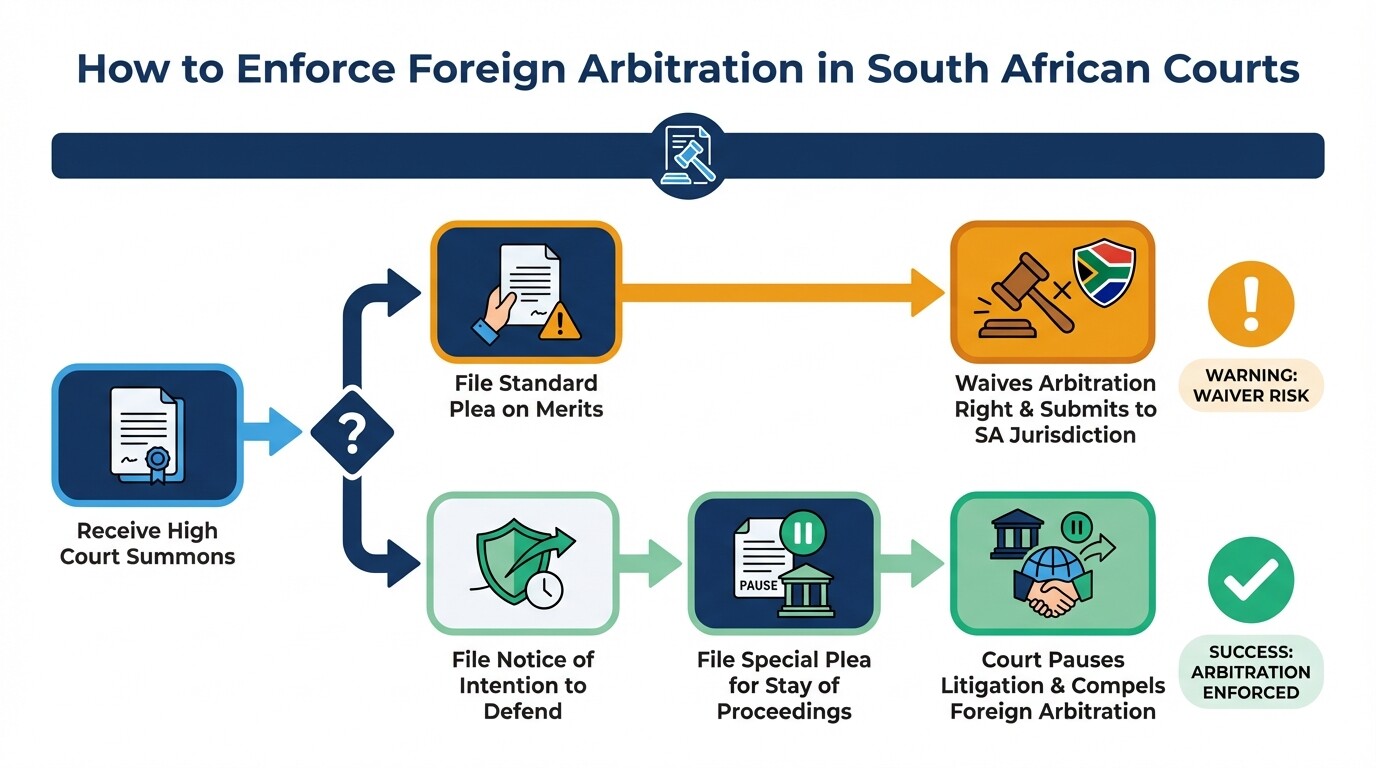
If the supply agreement mandates foreign arbitration, file a special plea to stay the South African court proceedings before defending the actual merits of the lawsuit. South African courts enforce international arbitration agreements under the International Arbitration Act 15 of 2017.
When a domestic buyer ignores an arbitration clause and issues a High Court summons, the foreign supplier must file a Notice of Intention to Defend, followed immediately by a special plea requesting a stay of proceedings. Do not file a standard plea addressing the breach of contract or liability claims. Engaging with the merits of the case legally signals submission to the South African court's jurisdiction and waives your right to foreign arbitration.
Once the special plea is filed, the court reviews the arbitration clause. If the clause is valid and covers the dispute, the judge will pause local litigation and compel the plaintiff to initiate proceedings in the contracted foreign arbitration forum.
Common Misconceptions About South African Litigation
Many foreign entities misunderstand South African court jurisdiction and digital evidence rules. Correcting these assumptions early prevents unnecessary legal exposure.
Misconception 1: South African courts cannot touch us if we have no local assets. Many suppliers assume they can safely ignore a South African summons if they hold no local bank accounts or property. If the plaintiff secures a default judgment in South Africa, they can apply to have that judgment recognized and enforced by courts in your home country. This puts domestic assets at risk.
Misconception 2: Standard terms automatically prevent local lawsuits. Foreign suppliers assume invoice terms dictating foreign jurisdiction are fully protective. Under South African law, if the contract was concluded in South Africa or the breach occurred there, local courts establish jurisdiction unless the foreign jurisdiction clause was explicitly negotiated, signed, and brought to the court's attention via a special plea.
Misconception 3: Foreign executives can testify virtually. Pre-trial case management meetings are often held virtually, but South African High Courts generally require witnesses to appear in person for civil trials. Exceptions for virtual testimony are rarely granted and require a formal, substantiated application to the presiding judge.
When to Hire a Commercial Litigation Lawyer
Engage a commercial litigation lawyer in South Africa the moment your company receives a formal letter of demand or a High Court summons. Early intervention is necessary. The 10-to-21-day window closes quickly, and local counsel needs time to assess jurisdictional vulnerabilities.
Do not attempt to negotiate directly with the plaintiff's local attorneys once formal litigation commences. Unintentional statements or procedural missteps by foreign in-house counsel easily establish South African jurisdiction or waive your rights to international arbitration.
Next Steps for Foreign Suppliers
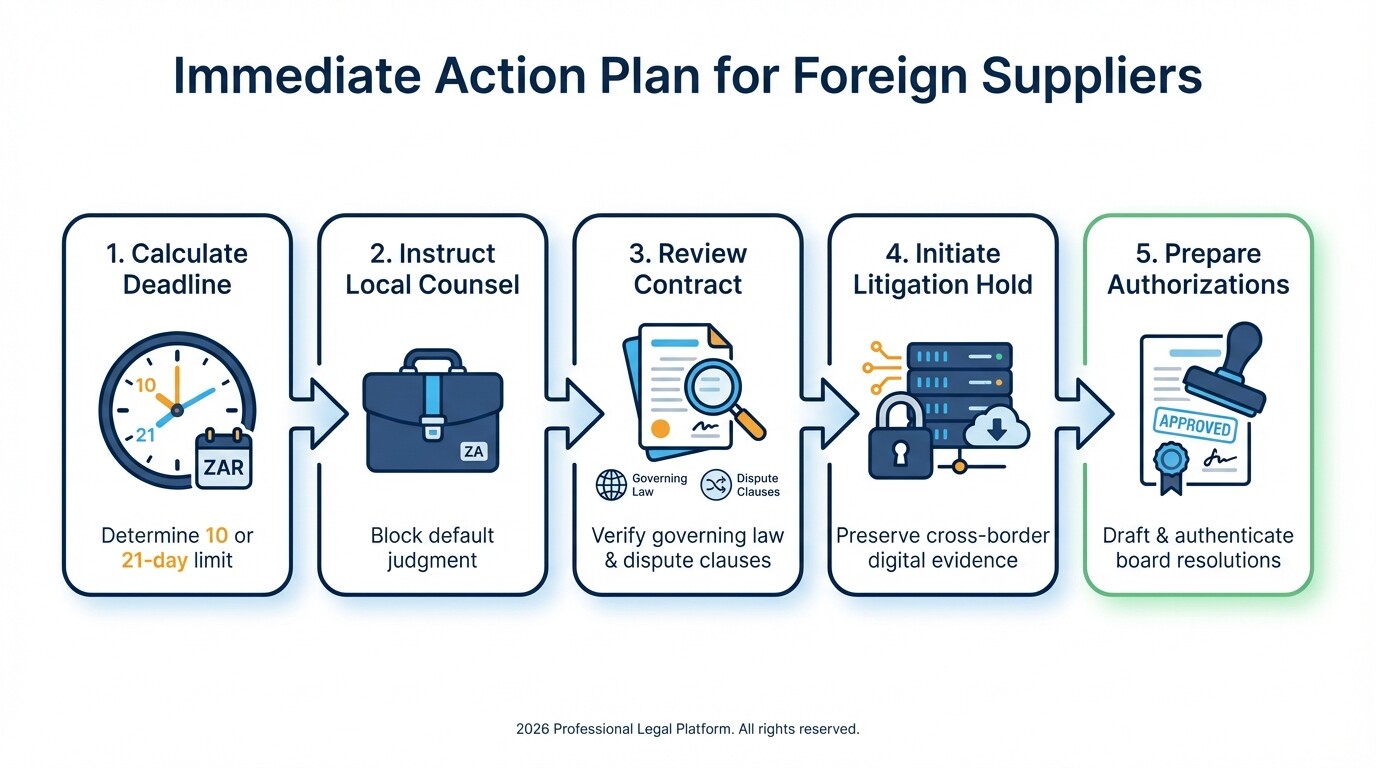
- Calculate the Deadline: Identify the exact date the summons was served and determine the deadline to file a Notice of Intention to Defend.
- Instruct Local Counsel: Appoint an experienced South African commercial litigator to formally go on record and block default judgment attempts.
- Review the Underlying Contract: Locate the signed master supply agreement to check governing law and dispute resolution clauses.
- Initiate a Litigation Hold: Instruct the IT department to preserve all emails, server data, and correspondence relating to the South African plaintiff.
- Prepare Corporate Authorizations: Draft and authenticate the board resolutions and affidavits required to formally empower the South African legal team.