How to Structure Renewable Energy Joint Ventures in South Africa
Key Takeaways
Structuring a renewable energy joint venture in South Africa requires aligning foreign capital with local laws, notably the Companies Act and economic empowerment mandates. A properly structured project mitigates financial risk and ensures grid compliance.
- Corporate vehicles: A Special Purpose Vehicle (SPV) registered as a private company (Pty Ltd) is the preferred structure for isolating project risks and managing cross-border capital.
- B-BBEE compliance: Achieving specific Broad-Based Black Economic Empowerment (B-BBEE) ownership thresholds is mandatory for securing government tenders and grid connections.
- Regulatory registration: While private generation caps have been lifted, National Energy Regulator of South Africa (NERSA) registration still requires strict legal and environmental compliance.
- Bankability: Power Purchase Agreements (PPAs) must feature take-or-pay mechanisms and address local grid instability to satisfy international project financiers.
Corporate Structures for Cross-Border Partnerships
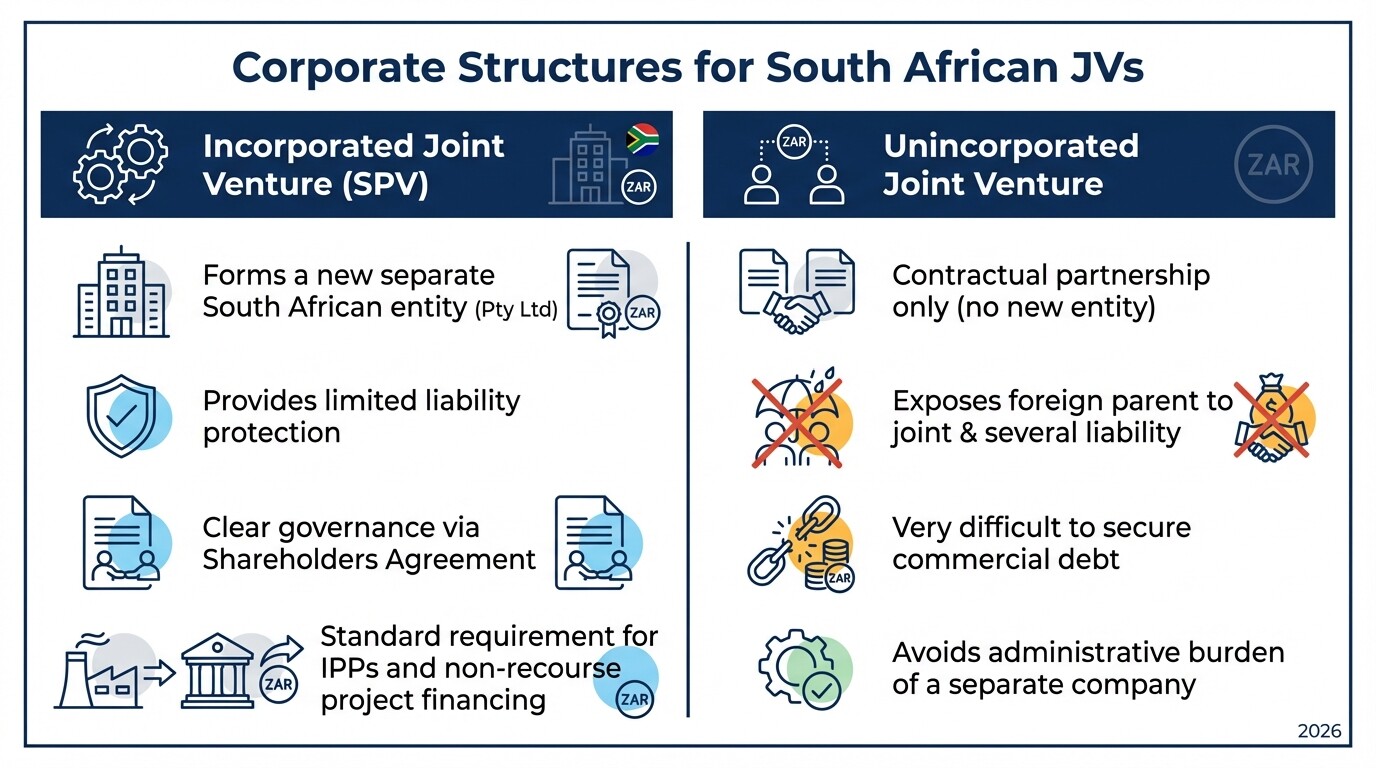
A Special Purpose Vehicle (SPV) registered as a private liability company (Pty Ltd) is the most effective corporate structure for cross-border renewable energy joint ventures in South Africa. It isolates project risks, simplifies equity distribution, and eases compliance with the South African Companies Act.
Foreign investors generally choose between two primary partnership models:
- Incorporated joint venture (SPV): The foreign developer and local partner incorporate a new, distinct South African company. This structure offers limited liability and clear governance through a Shareholders' Agreement. It makes securing non-recourse project financing much easier and is the standard model for independent power producer (IPP) projects.
- Unincorporated joint venture: A contractual partnership where companies collaborate without forming a new legal entity. This avoids the administrative burden of running a separate company. However, it exposes the foreign parent company to joint and several liability. Securing commercial debt under this model is very difficult.
South African Renewable Energy Joint Venture Checklist
Setting up a compliant energy partnership requires systematic planning across corporate, regulatory, and financial domains. Use this checklist to track the joint venture's path to grid connection and commercial operation.
Corporate Governance & Setup
- Register the SPV with the Companies and Intellectual Property Commission (CIPC).
- Draft and execute a localized Shareholders' Agreement outlining voting rights, deadlock resolution, and capital calls.
- Open a local bank account in South African Rand (ZAR) subject to South African Reserve Bank (SARB) exchange control approvals.
Regulatory & Permitting
- Obtain Environmental Authorization (EA) through a basic assessment or full Environmental Impact Assessment (EIA).
- Secure Water Use Licenses (WULAs) if the project affects local water resources.
- Complete land rezoning applications for agricultural or municipal land use.
Commercial & Financial
- Execute a Power Purchase Agreement (PPA) with a private off-taker or the government.
- Finalize the Engineering, Procurement, and Construction (EPC) contract.
- Negotiate the Operations and Maintenance (O&M) agreement.
B-BBEE Compliance for Infrastructure Investors
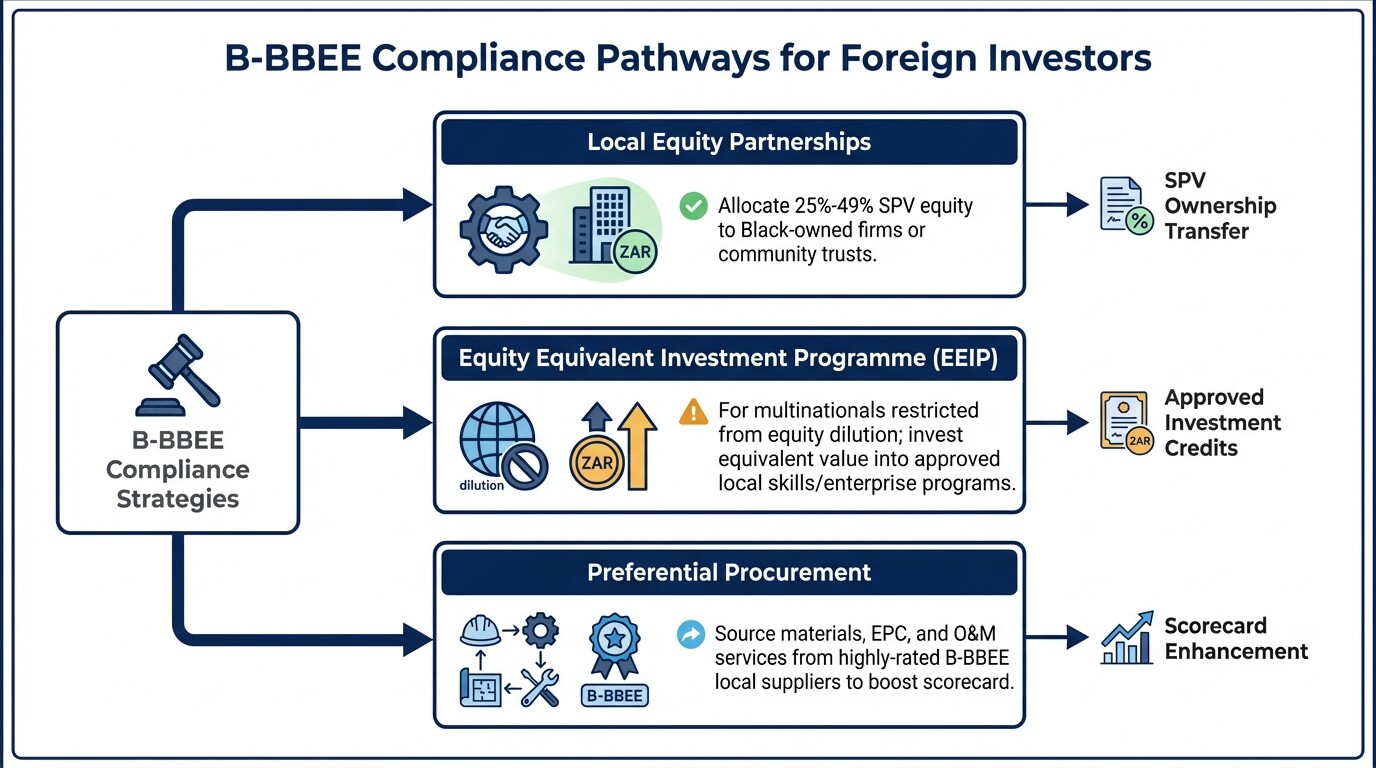
Broad-Based Black Economic Empowerment (B-BBEE) compliance dictates that foreign investors must structure their local operating entity with mandated black ownership and economic participation. Failing to meet these thresholds disqualifies the project from national grid connections, the Renewable Energy Independent Power Producer Procurement Programme (REIPPPP), and private corporate off-taker agreements.
Under the Broad-Based Black Economic Empowerment Act, energy sector projects face strict scrutiny. International investors achieve compliance through specific pathways:
- Local equity partnerships: The most direct route is allocating a percentage of SPV equity to local Black-owned investment firms or community trusts. This historically ranges from 25% to 49%, depending on the tender or corporate PPA requirement.
- Equity Equivalent Investment Programme (EEIP): Multinational corporations globally restricted from diluting ownership can apply for an EEIP. The foreign entity invests an equivalent value into approved local skills or enterprise development programs.
- Preferential procurement: Project developers must source construction materials, EPC services, and maintenance from highly-rated B-BBEE local suppliers to maintain the project's overall compliance scorecard.
Legal and Regulatory Costs for NERSA Registration
Legal and regulatory costs for a National Energy Regulator of South Africa (NERSA) generation registration typically range from ZAR 250,000 to ZAR 600,000. These costs cover statutory filing fees, environmental authorizations, and legal counsel.
The South African government removed the licensing threshold for private embedded generation projects, but developers must still formally register their facilities with NERSA. Project budgets should account for:
- Legal structuring: ZAR 150,000 to ZAR 300,000. Specialized energy counsel ensures all grid connection agreements and PPAs meet statutory definitions under the Electricity Regulation Act.
- Environmental Impact Assessments (EIA): ZAR 300,000 to ZAR 1,500,000+. This is payable to environmental consultants. Costs depend on whether the site falls within a Renewable Energy Development Zone (REDZ), which allows for expedited basic assessments.
- Statutory fees and deposits: NERSA's direct administrative fees are minimal. However, grid capacity connection quotes from Eskom (the national utility) require heavy upfront engineering deposits.
Bankable Power Purchase Agreements (PPAs)
Bankable PPAs in South Africa allocate risk between the independent power producer and the off-taker while guaranteeing predictable cash flows. International lenders require strict take-or-pay mechanisms. They also demand force majeure clauses that account for local grid instability and social disruptions.
Because the national utility network experiences capacity constraints, PPAs must state exactly what happens if the grid cannot accept the generated power.
Sample Deemed Generation Clause for South African PPAs:
"In the event of a Grid Curtailment Period or System Event where the Facility is capable of delivering Net Energy to the Delivery Point but the Grid Operator prevents such delivery, the Buyer shall pay the Seller for all Deemed Energy at the Contract Price. Deemed Energy shall be calculated based on the facility's available capacity and available meteorological data (irradiance/wind speed) during the curtailment period, less any standard line losses."
Managing Risks in EPC Contracts
Preventing disputes in Engineering, Procurement, and Construction (EPC) contracts requires clear allocation of site risk and localized dispute adjudication boards. Standard international forms like the FIDIC Silver Book, amended for South African local content and labor requirements, provide a reliable baseline.
Foreign developers face construction risks regarding labor unrest and community interference. Strategies to minimize these disruptions include:
- Community Liaison Officers (CLOs): Mandate a CLO in the EPC contract to manage local stakeholder expectations and prevent site disruptions by business forums.
- Standing dispute boards: For projects exceeding ZAR 500 million, establish a standing Dispute Adjudication Board (DAB) at the project's outset. This resolves technical and delay claims within 28 days to prevent project paralysis.
- Clear force majeure definitions: Explicitly carve out foreseeable local labor strikes from force majeure protections. This ensures the EPC contractor bears the risk of managing their workforce.
Common Misconceptions About South African Energy Projects
Foreign developers often underestimate the timeline for local compliance and the rigidity of South African labor laws. Understanding these operational hurdles prevents costly project delays.
| Misconception | Reality |
|---|---|
| B-BBEE requirements can be bypassed by exclusively serving private commercial off-takers. | Private corporate buyers require your project to have a strong B-BBEE rating to claim preferential procurement points on their own scorecards. |
| NERSA registration is instantaneous for projects that no longer require a generation license. | Registration requires a fully signed PPA, grid connection approvals, and environmental sign-offs. It routinely takes 6 to 12 months to compile. |
Foreign Ownership and Setup Timelines
Legally, a foreign entity can own 100% of the project company. However, doing so results in a non-compliant B-BBEE scorecard. This limits the project's ability to secure domestic financing, grid access, or lucrative corporate purchase agreements.
End-to-end setup typically takes 12 to 24 months before reaching financial close. This timeline includes corporate incorporation, joint venture agreement negotiations, environmental permits, and NERSA registration.
Foreign capital entering South Africa as equity or debt must be approved and recorded by an authorized dealer on behalf of the South African Reserve Bank (SARB). This approval is also necessary for future repatriation of dividends or loan repayments to foreign shareholders.
When to Engage Legal Counsel
Engage local legal counsel immediately upon signing a Memorandum of Understanding (MOU) or Term Sheet with a South African partner. Specialized energy lawyers design tax-efficient corporate structures, navigate the B-BBEE Act, and ensure power purchase agreements meet the bankability standards of South African commercial banks. To secure the project's legal foundation, connect with contract lawyers in South Africa experienced in cross-border energy transactions.
Next Steps
The immediate next step is conducting due diligence on the proposed local joint venture partner and the targeted project site. Following this, draft a binding term sheet that addresses corporate governance, equity splits, and the specific pathways to achieve regulatory compliance and grid connection.