- Contractors in Thailand are legally liable for defects for one year after delivery, extending to five years for structural failures under the Civil and Commercial Code.
- Owners must provide a formal written notice of defects and a reasonable deadline for repairs before pursuing legal action or hiring a third party.
- Evidence is the cornerstone of a successful claim; professional engineer reports and dated photographs are mandatory for court or arbitration.
- Residential owners can file complaints through the Office of the Consumer Protection Board (OCPB) for a faster, lower-cost mediation process.
- The statute of limitations for filing a construction defect lawsuit is generally one year from the date the defect appeared.
What are the legal warranty obligations for construction in Thailand?
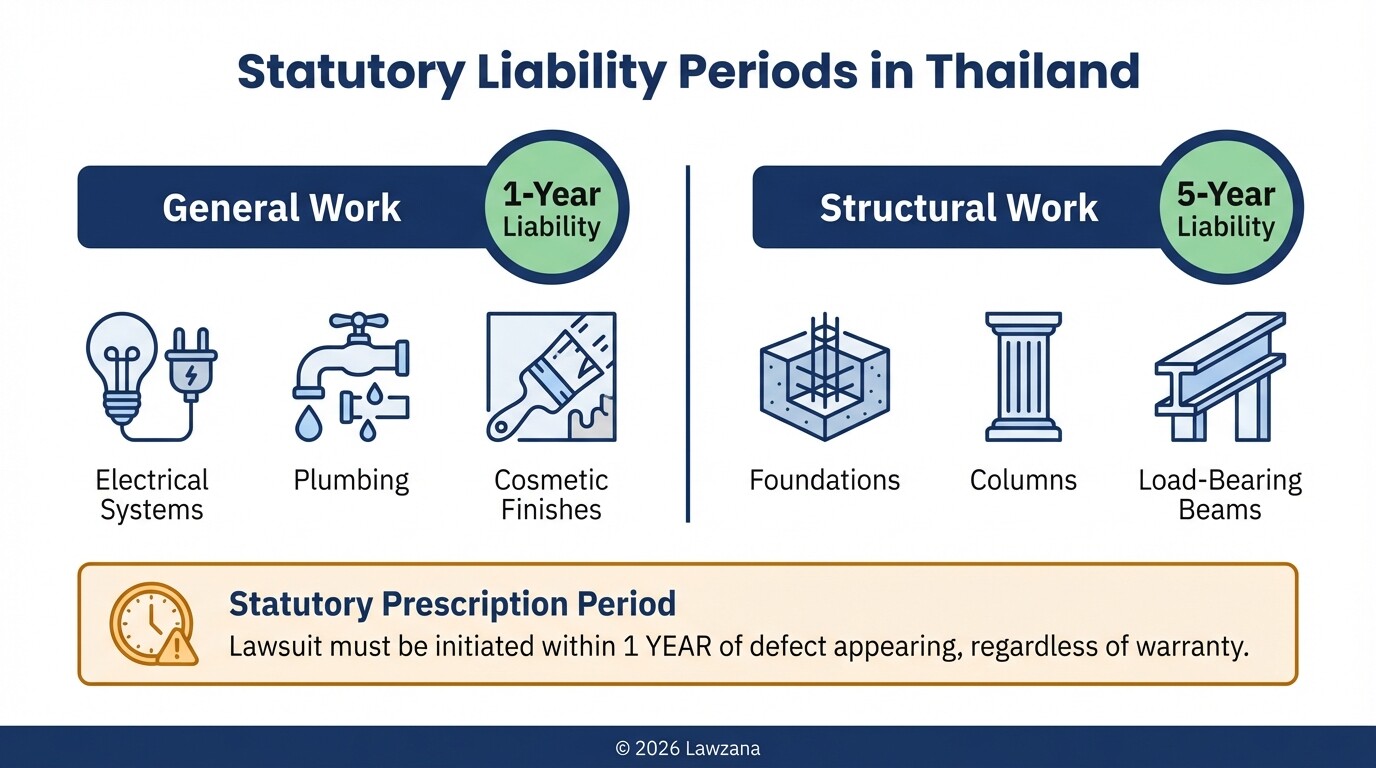
Under the Thailand Civil and Commercial Code (CCC), specifically Section 600, contractors are liable for defects that appear within one year of the work's delivery. However, if the construction involves a building or a "landed structure," this liability period extends to five years. These statutory protections apply automatically unless your contract explicitly states different terms, though the law prevents contractors from waiving liability for defects they intentionally concealed.
The "Hire of Work" provisions in the CCC distinguish between general defects and structural ones. To trigger a claim, the defect must render the work unfit for its intended purpose or decrease its value significantly.
The "Secret Weapon": Consumer Case Procedure Act (CCPA)
For residential owners suing a developer or construction firm, the Consumer Case Procedure Act B.E. 2551 (2008) provides a massive legal advantage. Unlike standard civil cases, filing a "Consumer Case":
-
Waives Court Fees: You do not have to pay the standard 2% filing fee (unless damages are enormous).
-
Shifts Burden of Proof: You only need to prove the damage exists. The contractor must then prove they were not negligent—a difficult hurdle for them.
-
Fast-Tracks the Case: These cases move through the "Green Court" system faster than typical business disputes.
Note: This applies only to B2C (Business-to-Consumer) contracts. If you hired a contractor under your own company name, you must file a standard civil suit.
Common Defect Claim Triggers
- Structural Failures: Foundation cracks, leaning walls, or compromised load-bearing beams (5-year liability).
- Water Ingress: Leaking roofs, windows, or subterranean seepage due to poor waterproofing.
- Material Non-Compliance: Use of "Grade B" materials when the contract specified "Grade A" or specific brands.
- Systems Failure: Faulty electrical wiring, plumbing leaks, or HVAC malfunctions (1-year liability).
- Cosmetic Issues: Peeling paint, uneven flooring, or poor finishing (1-year liability).
⚠️ CRITICAL WARNING: The "1-Year Rule" for Filing Do not confuse the Liability Period (Warranty) with the Prescription Period (Deadline to Sue).
-
Liability Period: You are covered for 5 years for structural defects.
-
Prescription Period: Once you discover a defect, you must file a lawsuit within 1 year of that discovery date.
Example: If a structural crack appears in Year 4, you are covered. However, if you wait more than 12 months after seeing it to file a claim, your case will be dismissed for expiring the statute of limitations. Clock starts ticking the day you find the defect.
How do you gather evidence and issue a formal repair notice?
To initiate a construction defect claim in Thailand, you must first document the damage thoroughly and issue a formal "Notice to Repair" via registered mail. This notice serves as a legal prerequisite, giving the contractor a reasonable timeframe-typically 15 to 30 days-to rectify the issues. If the contractor fails to respond or perform, this document proves their breach of contract in future litigation.
Steps for Building a Solid Case
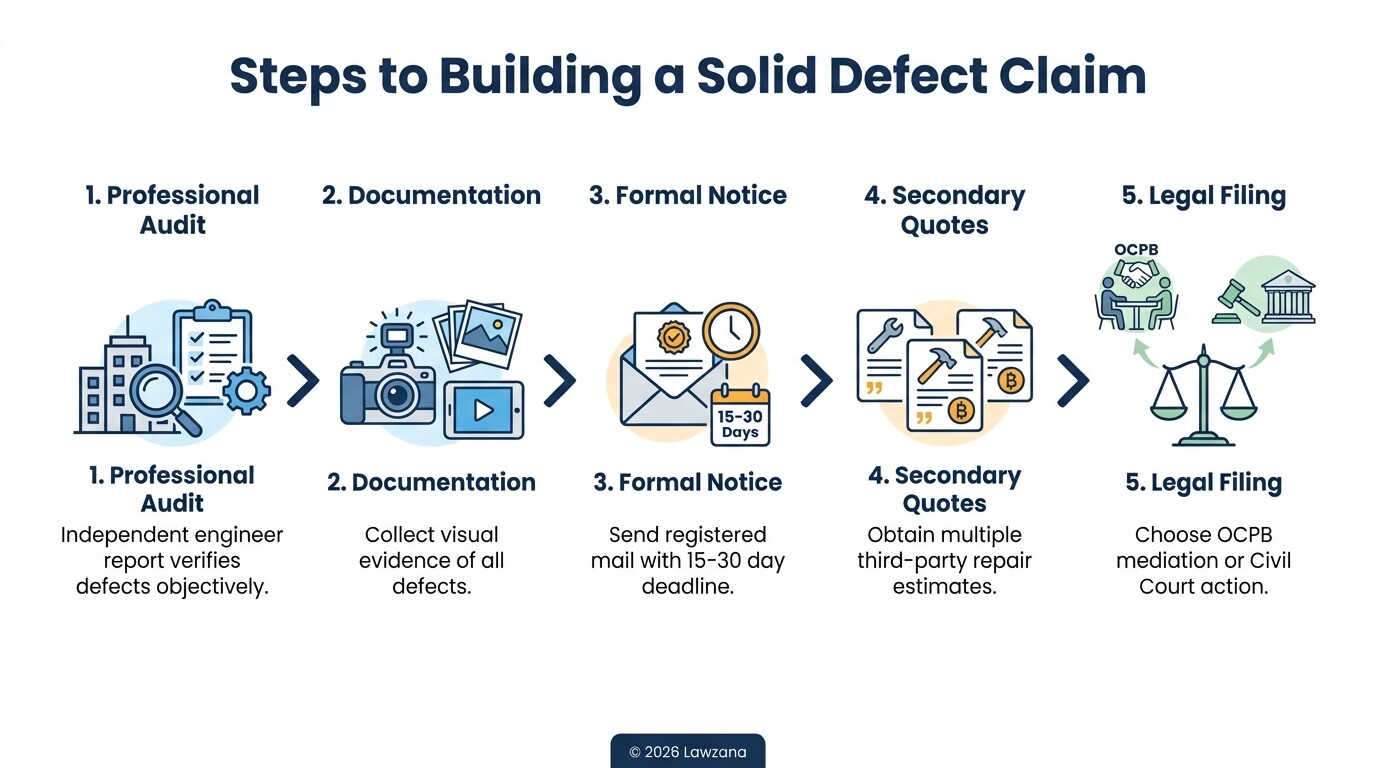
- Professional Inspection: Hire an independent, licensed civil engineer to conduct a "Defect Audit." Their signed report carries significant weight in Thai courts.
- Photographic Documentation: Take high-resolution photos and videos of the defects, ensuring you have "before and after" context if possible.
- The Formal Notice: Draft a letter (preferably in Thai and English) detailing the defects, referencing the contract clauses, and setting a firm deadline for repairs.
- Third-Party Quotes: If the contractor refuses to repair, obtain at least two quotes from other firms to establish the cost of rectification. This amount becomes your primary claim for damages.
What are the legal pathways for resolving construction disputes?
Dispute resolution in Thailand follows a hierarchy beginning with negotiation and ending with either litigation in the Civil Court or private arbitration. For residential owners, the Office of the Consumer Protection Board (OCPB) provides a mediation service that can resolve disputes without the need for a full trial. For high-value commercial projects, arbitration is the standard due to its confidentiality and the expertise of the presiding arbitrators.
Comparison of Dispute Resolution Methods
| Method | Best For | Timeline | Cost |
|---|---|---|---|
| Negotiation | Minor defects, ongoing relationships | 1-4 weeks | Minimal |
| OCPB Mediation | Homeowners, individuals | 3-6 months | Very Low |
| Civil Court | Uncooperative contractors, high damages | 1-2 years | 2% Court Fee (capped) |
| Arbitration | Large B2B projects, technical disputes | 1 year | High (Private fees) |
How are damages calculated and enforced in Thailand?
Damages in Thai construction cases are primarily compensatory, meaning the court aims to put the owner in the position they would have been in had the contract been performed correctly. This usually includes the actual cost of repairs (based on third-party quotes), loss of use or rental income during the repair period, and interest on the claim amount-currently set at 5% per annum under recent CCC amendments.
In rare cases involving "consumer contracts," the court may award punitive damages if the contractor acted with gross negligence or intent. However, "specific performance"-forcing the original contractor to return and fix the work-is rarely granted if the relationship has broken down. Instead, the court usually awards a monetary sum allowing the owner to hire someone else.
Punitive Damages: Under the Consumer Case Procedure Act, if the court finds the contractor acted with gross negligence (e.g., using clearly substandard steel that endangered safety) or intent to deceive, they can award Punitive Damages up to 2x the actual damage amount.
Elements of a Damage Claim
- Rectification Costs: The direct expense to fix the defect.
- Consultancy Fees: Costs paid to engineers or surveyors to identify the defect.
- Liquidated Damages: Daily penalties for delays caused by the defects, if stipulated in the contract.
- Interest: 5% annual interest calculated from the date the contractor was put in default.
What are the common misconceptions about Thai construction law?
Many owners and contractors operate under false assumptions that can lead to missed deadlines or lost cases. One frequent myth is that "signing the handover form waives all rights to future claims." In reality, Thai law protects owners against "latent defects"-those that could not have been discovered by a reasonable inspection at the time of delivery-regardless of a signed acceptance form.
Another misconception is that the "1-year warranty" found in many contracts is the absolute limit. As mentioned, structural defects are covered for 5 years by law. If a contract tries to shorten these statutory minimums, a Thai court may rule those clauses void, especially in consumer-facing contracts where the owner is at a disadvantage.
Frequently Asked Questions
Can I stop payments to the contractor if I find a defect?
You may withhold the final payment or "retention sum" if the contract allows it or if the defect is substantial enough to constitute a fundamental breach. However, withholding more than the estimated cost of repair can lead to a counter-suit for breach of payment.
How much are court fees for a construction lawsuit in Thailand?
The court fee is generally 2% of the total claim amount for claims up to 50 million THB, with a maximum cap of 200,000 THB. For claims exceeding 50 million THB, an additional fee of 0.1% is applied to the excess.
Is an oral agreement for repairs binding in Thailand?
While oral agreements are technically recognized, they are nearly impossible to prove in a construction dispute. The Court of Justice of Thailand heavily prioritizes written evidence and signed documents.
How long do I have to file a lawsuit after finding a defect?
Under Section 601 of the CCC, you must bring an action against the contractor within one year after the defect appeared. Delaying past this "prescription period" can result in your case being dismissed regardless of the defect's severity.
When to Hire a Lawyer
You should consult a construction litigator as soon as a contractor ignores a formal repair notice or disputes the existence of a defect. Legal counsel is particularly critical when:
- The defect involves structural integrity or safety hazards.
- The cost of repair exceeds 500,000 THB.
- The contract contains a mandatory arbitration clause (requiring specialized TABC or THAC procedures).
- You are a foreign property owner unfamiliar with the Thai Civil Court's language and filing requirements.
Next Steps
- Review Your Contract: Locate clauses related to "Defects Liability Period" (DLP) and "Retention."
- Commission an Audit: Hire a licensed Thai engineer to document all issues in a formal report.
- Issue a Formal Notice: Send a registered letter to the contractor demanding repairs within a specific timeframe.
- Consult Counsel: If the deadline passes without action, speak with a lawyer to evaluate whether OCPB mediation or a Civil Court filing is the most cost-effective path forward.