

- The Istanbul Arbitration Centre (ISTAC) provides a specialized, neutral, and efficient alternative to the heavily backlogged Turkish local courts.
- Commercial arbitration in Turkey generally concludes within 6 to 12 months, whereas local litigation can take three to five years.
- ISTAC administrative fees operate on a regressive scale, making arbitration significantly cheaper than Turkish court litigation for high-value disputes, which require high proportional filing fees.
- Turkey is a signatory to the 1958 New York Convention, meaning foreign arbitration awards are readily recognized and enforced by Turkish courts with minimal grounds for refusal.
- Drafting a clear arbitration clause that specifies the rules, seat, and language is the most effective way for foreign investors to mitigate jurisdictional risks.
Sample Arbitration Clause for Cross-Border Contracts
An effective arbitration clause dictates the rules, seat, and language of your dispute resolution before conflicts arise. Using a standard institutional clause prevents costly jurisdictional battles in Turkish courts and ensures a smooth transition to arbitration if a dispute occurs.
When drafting a contract with a Turkish entity, foreign investors should incorporate a clear, unambiguous dispute resolution provision. Below is the standard recommended clause for utilizing the Istanbul Arbitration Centre (ISTAC):
Standard ISTAC Arbitration Clause "Any dispute or claim arising out of or relating to this contract, or the breach, termination, or invalidity thereof, shall be finally settled by arbitration in accordance with the Rules of Arbitration of the Istanbul Arbitration Centre (ISTAC). The arbitral tribunal shall be composed of [insert one or three] arbitrator(s). The seat of arbitration shall be [insert city and country, e.g., Istanbul, Turkey]. The language to be used in the arbitral proceedings shall be [insert language, e.g., English]. The governing law of the contract shall be the substantive law of [insert jurisdiction]."
By explicitly stating the seat and language, foreign investors maintain control over the procedural framework and avoid defaulting to Turkish as the arbitration language.
Advantages of ISTAC Rules Over Local Litigation
The Istanbul Arbitration Centre (ISTAC) offers foreign investors a specialized, confidential, and faster alternative to the standard Turkish judicial system. As Turkey continues to position itself as a regional commercial hub in 2026, ISTAC provides a modern dispute resolution framework aligned with international standards.
Litigating a commercial dispute in local Turkish courts often exposes foreign investors to lengthy delays, mandatory Turkish language requirements, and judges who may lack specialized knowledge in complex international trade. Choosing ISTAC arbitration mitigates these risks through several structural advantages:
- Procedural Flexibility: Parties can agree to conduct the arbitration in English or any other language, eliminating the heavy costs and delays of officially translating every evidentiary document into Turkish.
- Industry Expertise: Investors can select arbitrators with specific commercial, financial, or technical expertise relevant to their sector, rather than relying on randomly assigned local judges.
- Fast Track Arbitration: For disputes under a specific monetary threshold (or by mutual agreement), ISTAC offers Fast Track Arbitration Rules that mandate an award within three months.
- Emergency Arbitrator Mechanism: Investors can obtain urgent interim relief through an emergency arbitrator before the full tribunal is even constituted, protecting assets from immediate dissipation. You can review the complete procedural framework on the official ISTAC Arbitration Rules page.
Average Timeline for Dispute Resolution in Turkey
Commercial arbitration in Turkey typically concludes within 6 to 12 months from the date the sole arbitrator or tribunal is appointed. This is a dramatic acceleration compared to local court litigation, which often drags on for three to five years through initial hearings and mandatory appeals.
The speed of your arbitration largely depends on the complexity of the case, the responsiveness of the parties, and the specific rules selected in your contract. ISTAC procedures are designed with strict deadlines to prevent stalling tactics.
- Standard Arbitration: Under standard ISTAC rules, the tribunal must render its final award within six months from the date the Terms of Reference are signed or approved. While tribunals can request extensions for highly complex cases, resolution generally occurs within a year.
- Fast Track Arbitration: Designed for lower-value or urgent claims, this procedure requires the sole arbitrator to issue an award within three months of receiving the file.
- Emergency Arbitrator: If immediate interim measures are required, an emergency arbitrator is appointed within two days of the application and must issue an order within seven days.
Fee Structures: Arbitration Costs vs. Court Fees
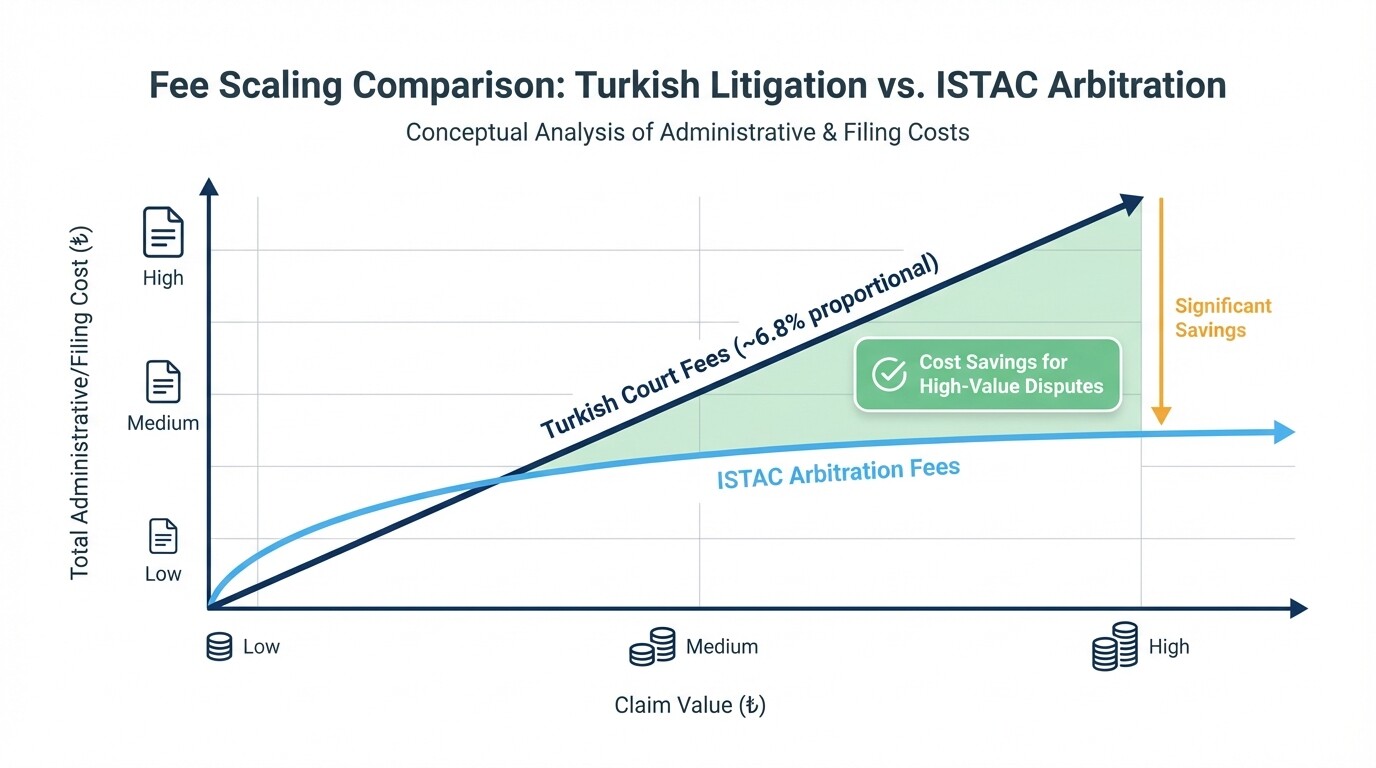
Arbitration through ISTAC is generally more cost-effective than Turkish court litigation for high-value commercial disputes. While arbitration requires upfront administrative and arbitrator fees, it avoids the proportional court filing fees that scale infinitely with the dispute amount.
In the Turkish judicial system, court fees are calculated as a percentage of the disputed amount, making large commercial claims prohibitively expensive to litigate. Arbitration fees, conversely, operate on a regressive scale where the percentage drops as the claim value increases.
Enforceability of Foreign Arbitration Awards in Turkish Courts
Foreign arbitration awards are highly enforceable in Turkey under the New York Convention of 1958. Turkish courts will recognize and enforce these awards with limited grounds for refusal, primarily focusing on procedural fairness and public policy rather than the merits of the dispute.
Because Turkey has ratified the New York Convention, an award rendered in any other signatory state (such as the UK, US, or Switzerland) is treated with high legal deference. The enforcement process falls under the Turkish International Private and Civil Procedure Law. To successfully enforce an award, foreign investors must provide the original arbitration agreement and the duly authenticated original award, both with certified Turkish translations.
Turkish courts are strictly prohibited from reviewing the merits of the arbitral award (no révision au fond). Enforcement can only be denied on narrow grounds, such as lack of proper notice, invalidity of the arbitration agreement, or if enforcing the award would clearly violate Turkish public policy.
Common Misconceptions About Turkish Arbitration
Many foreign investors misunderstand the legal landscape of arbitration in Turkey, assuming it mirrors the unpredictability of local courts. Clarifying these myths ensures better contract drafting and risk management.
- Misconception: Turkish courts will inevitably interfere with the arbitration. Courts in Turkey respect the competence-competence principle. If a contract contains a valid arbitration clause, Turkish courts will dismiss any lawsuit filed in breach of that agreement, provided the defendant raises an arbitration objection at the very beginning of the proceedings.
- Misconception: You must apply Turkish law if the arbitration takes place in Turkey. The seat of arbitration does not dictate the governing law of the contract. Parties are entirely free to choose a foreign substantive law (e.g., English law or Swiss law) to govern their commercial contract, even if the arbitration is seated in Istanbul and administered by ISTAC.
- Misconception: Arbitration awards can be appealed like court judgments. An arbitral award is final and binding. In Turkey, you cannot appeal an award based on an error of law or fact made by the tribunal. You can only file an action to set aside the award on very narrow procedural grounds.
Frequently Asked Questions
Can I choose a foreign governing law for a contract with a Turkish company?
Yes. Under Turkish law, parties to an international commercial contract have the freedom to choose the substantive law that will govern their agreement. The arbitral tribunal will apply the chosen foreign law to resolve the dispute.
Does ISTAC require the arbitration to be conducted in Turkish?
No. ISTAC rules allow the parties to freely determine the language of the arbitration. If no language is specified in the contract, the arbitral tribunal will determine the language based on the circumstances of the case, which is frequently English in international disputes.
Can a Turkish court grant interim injunctions during an arbitration?
Yes. Requesting an interim injunction or attachment from a Turkish court before or during arbitral proceedings is not considered a waiver of the arbitration agreement. Parties can seek urgent court protection for assets located in Turkey while the arbitration continues.
When to Hire an Arbitration Lawyer
Engaging legal counsel early in the contract negotiation phase prevents costly jurisdictional disputes later. A specialized arbitration lawyer is essential when drafting the arbitration clause, responding to a notice of arbitration, or enforcing a final award in Turkey.
Attempting to navigate international arbitration without local expertise can lead to drafting defective clauses (pathological clauses) that Turkish courts may refuse to recognize. If a dispute arises, retaining counsel who understands both the procedural rules of the chosen arbitral institution and the mandatory provisions of Turkish execution law is vital. To find vetted legal representation for your commercial needs, explore ADR, Mediation & Arbitration lawyers in Turkey.
Next Steps
Securing your commercial interests in Turkey requires proactive contract structuring. Reviewing existing agreements and updating dispute resolution clauses is the first step toward risk mitigation.
- Audit Existing Contracts: Review your current commercial agreements with Turkish partners to identify how disputes are currently handled. Look for vague or conflicting jurisdiction clauses.
- Standardize Arbitration Clauses: Update future contract templates to include standard institutional arbitration clauses, explicitly defining the seat, language, and governing law.
- Consult Legal Counsel: Before a conflict escalates, speak with a legal professional to evaluate whether utilizing fast-track arbitration or standard ISTAC rules is the best strategic fit for your specific commercial operations.