Corporate Governance for Family Offices in the DIFC and ADGM
- The Dubai International Financial Centre (DIFC) and Abu Dhabi Global Market (ADGM) offer specialized legal frameworks for high-net-worth families to structure their wealth, blending common law principles with local UAE benefits.
- Foundations provide a unique alternative to traditional trusts and limited companies, offering orphan-structure asset protection that is highly effective for generational succession planning.
- A family constitution sets the emotional and strategic vision, but it must be paired with a legally binding shareholder agreement to enforce operational rules.
- Single Family Offices (SFOs) enjoy lighter regulatory burdens than Multi-Family Offices (MFOs) but are strictly subject to Anti-Money Laundering (AML) and Ultimate Beneficial Ownership (UBO) reporting.
- Embedding binding arbitration clauses in family governance documents is critical to keeping sensitive wealth disputes out of public courts.
Structuring Succession: Foundation vs. Limited Company
Choosing between a Foundation and a Limited Company dictates how your family wealth is managed, protected, and transferred across generations. Foundations act as independent legal entities without shareholders, offering robust asset protection, while Limited Companies provide traditional corporate structures ideal for active business operations.
For many high-net-worth individuals in the UAE, the choice comes down to the primary purpose of the entity. If the goal is to consolidate assets, protect them from fragmentation during probate, and dictate how future generations benefit, a Foundation in the DIFC or ADGM is the premier vehicle. If the family office intends to actively trade, acquire operating businesses, or require equity-based compensation for non-family executives, a Private Company Limited by Shares (LTD) is usually more appropriate.
Comparison Table: Foundation vs. Limited Company
| Feature | DIFC/ADGM Foundation | Limited Company (LTD) |
|---|---|---|
| Ownership Structure | Orphan entity (no shareholders). Controlled by a council. | Owned by shareholders. Controlled by a board of directors. |
| Primary Use Case | Asset protection, legacy planning, probate avoidance. | Active trading, holding company for operating businesses. |
| Beneficiaries | Designated beneficiaries who hold no legal ownership. | Shareholders who hold direct equity and voting rights. |
| Public Disclosure | High privacy. Beneficiaries are not on public record. | Shareholder registers are typically subject to more disclosure. |
| Setup Costs (Approx) | $200 to $500 USD (734 to 1,835 AED) plus advisory fees. | $1,500 to $3,000 USD (5,505 to 11,010 AED) plus advisory fees. |
You can review the official legal frameworks governing these structures directly through the DIFC Legal Database.
Drafting Family Constitutions and Shareholder Agreements
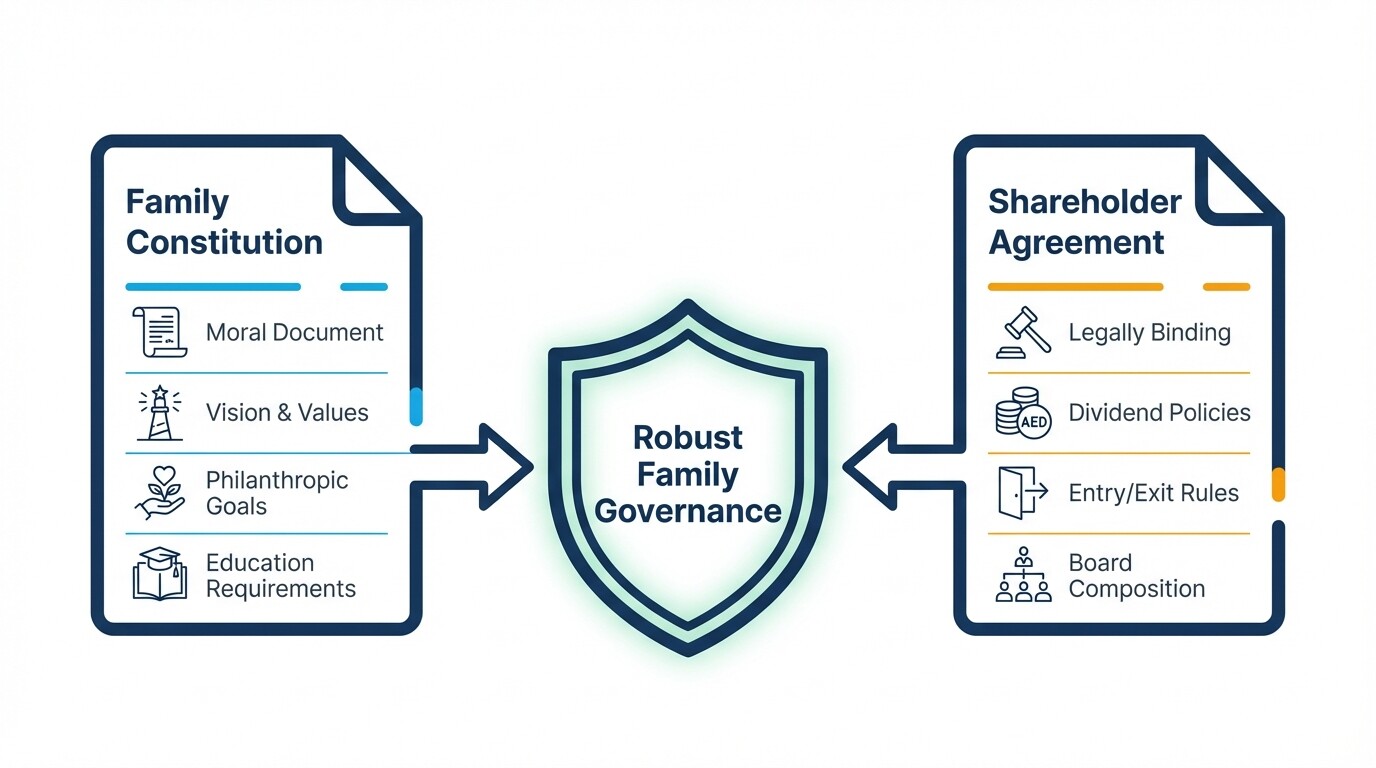
A family constitution defines the vision, values, and long-term goals of the family, while the shareholder agreement legally binds the family members to specific operational rules. Together, these documents prevent internal conflicts by setting clear expectations for succession, dividend distributions, and leadership roles.
The most successful family offices in the UAE treat the family constitution as the strategic blueprint. It outlines qualitative matters, such as philanthropic goals, the criteria for family members to join the family business, and educational requirements for the next generation. However, a constitution is generally a moral document rather than a strictly legal one.
To give these rules legal teeth, the provisions must be translated into a Shareholder Agreement or Foundation Charter. This binding document should explicitly cover:
- Dividend Policies: Clear formulas for how and when profits are distributed to family members versus reinvested.
- Entry and Exit Rules: Mechanisms for family members to sell their shares, usually restricted by pre-emption rights that force them to offer shares to family members first.
- Incapacity and Succession: Automatic trigger events that transfer voting rights if a key principal becomes incapacitated or passes away.
- Board Composition: The exact ratio of family members to independent, non-family directors.
Navigating AML and Ultimate Beneficial Ownership (UBO) Rules
Both the DIFC and ADGM enforce strict Anti-Money Laundering (AML) and UBO regulations to prevent financial crimes, requiring family offices to identify and report individuals who ultimately own or control the entity. Compliance is not optional, and failure to maintain accurate UBO registers can result in severe financial penalties or license revocation.
Under UAE free zone regulations, an Ultimate Beneficial Owner is generally defined as any natural person who owns or controls 25 percent or more of the company's shares or voting rights, or who exercises ultimate control over the management. Family offices must maintain an internal UBO register and submit this data to the respective free zone registrar.
Key compliance steps for family offices include:
- Identifying all natural persons crossing the 25 percent ownership or control threshold.
- Appointing a dedicated Money Laundering Reporting Officer (MLRO) if the office engages in regulated financial activities.
- Conducting Know Your Customer (KYC) checks on all external co-investors or joint venture partners.
- Updating the registrar within 15 to 30 days of any change in beneficial ownership.
For precise definitions and reporting obligations in Abu Dhabi, consult the official ADGM Beneficial Ownership and Control guidelines.
Regulatory Reporting Requirements for Private Offices
Family offices must file annual returns, maintain audited financial statements, and comply with data protection regulations depending on their specific regulatory status. While Single Family Offices (SFOs) enjoy lighter regulatory burdens compared to Multi-Family Offices (MFOs), foundational compliance remains mandatory across both the DIFC and ADGM.
SFOs are generally exempt from financial services regulation by the Dubai Financial Services Authority (DFSA) or the Financial Services Regulatory Authority (FSRA) because they only manage the wealth of a single family and do not offer services to the public. However, they are still corporate entities subject to the Registrar of Companies.
Private offices must adhere to the following ongoing requirements:
- Annual Returns: Filing corporate updates confirming the current directors, registered address, and shareholder structure.
- Economic Substance Regulations (ESR): Demonstrating that the entity conducts core income-generating activities within the UAE, requiring adequate local staff, physical premises, and local expenditure.
- Audited Accounts: Preparing annual financial statements in accordance with International Financial Reporting Standards (IFRS), even if they are not publicly published.
- Data Protection: Complying with DIFC Law No. 5 of 2020 or ADGM Data Protection Regulations 2021 regarding the secure handling of employee and family data.
Dispute Resolution Mechanisms Within Family Governance
Keeping family disputes out of public courts requires drafting binding arbitration or mediation clauses directly into your governance documents. The Dubai International Arbitration Centre (DIAC) and the ADGM Arbitration Centre provide confidential, globally recognized venues for resolving internal family office conflicts quietly and efficiently.
Public litigation in local courts can severely damage a family's reputation and expose sensitive financial data to the public record. By mandating alternative dispute resolution (ADR), families ensure that disagreements over asset management, succession, or dividend payouts are handled behind closed doors by specialized arbitrators who understand complex wealth structures.
Sample Dispute Resolution Clause
Below is a standard framework for an arbitration clause that can be adapted for a DIFC or ADGM Shareholder Agreement:
"Any dispute, controversy, or claim arising out of or relating to this Agreement, including its breach, termination, or invalidity, shall be settled by confidential and binding arbitration in accordance with the Arbitration Rules of the ADGM Arbitration Centre. The number of arbitrators shall be one (or three). The seat, or legal place, of arbitration shall be the Abu Dhabi Global Market. The language to be used in the arbitral proceedings shall be English. The parties expressly agree that all proceedings, documentary evidence, and the arbitral award shall remain strictly confidential."
Common Misconceptions About Family Offices in the UAE
Several myths surround the establishment and governance of family offices in the UAE financial free zones, leading to structural mistakes and compliance risks.
- "Family constitutions are legally binding on their own." Many families spend months drafting a constitution detailing succession rules, assuming it is enforceable. Without transferring those rules into a legally binding shareholder agreement or foundation charter, a constitution is merely a statement of intent that courts cannot enforce.
- "Single Family Offices are entirely exempt from compliance." While SFOs are exempt from stringent financial services licensing, they are not exempt from corporate laws. They must fully comply with ESR, UBO reporting, AML laws, and annual corporate filings.
- "Offshore setups offer the exact same benefits." Standard offshore jurisdictions do not offer the robust common law environment, regional double taxation treaty access, or immediate physical ecosystem of top-tier legal and banking professionals found in the DIFC and ADGM.
Frequently Asked Questions
Can a DIFC Foundation own Dubai mainland real estate?
Yes. The DIFC has signed a Memorandum of Understanding with the Dubai Land Department (DLD), allowing DIFC Foundations to directly purchase and hold registered properties in mainland Dubai.
What is the minimum capital requirement for a family office?
For an unregulated Single Family Office setting up as a standard private company in the DIFC or ADGM, there is typically no statutory minimum share capital, or it is set at a nominal amount like $1 USD. Regulated Multi-Family Offices have much higher, strict capital adequacy requirements.
How long does it take to establish a family office structure?
Assuming all KYC documents for family members are prepared, a standard family office structure or Foundation can typically be registered within 4 to 8 weeks. Opening the associated corporate bank accounts usually takes an additional 4 to 12 weeks.
When to Hire a Corporate Governance Lawyer
Navigating the intersection of family dynamics, wealth preservation, and UAE free zone regulations is highly complex. You should engage a corporate governance attorney when you are deciding between a Foundation and a Corporate structure, or when drafting the intricate mechanics of your shareholder agreements. Off-the-shelf templates rarely account for the specific tax, succession, and operational realities of ultra-high-net-worth families. To ensure your legacy is protected, connect with experienced corporate governance lawyers in the United Arab Emirates who specialize in DIFC and ADGM frameworks.
Next Steps for Establishing Your Family Office
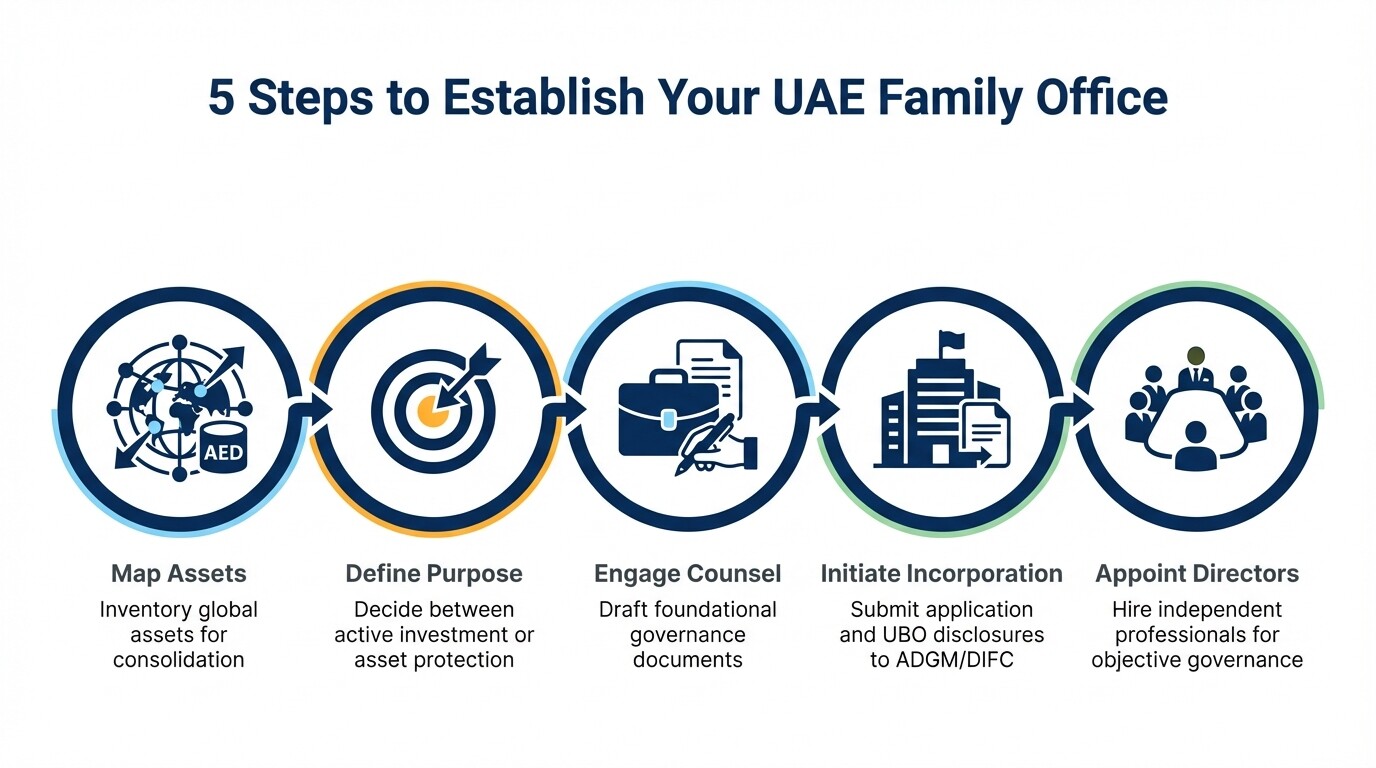
- Map the Family Assets: Create a comprehensive inventory of global assets, identifying which will be consolidated under the new UAE structure.
- Define the Purpose: Clarify whether the primary goal is active investment, philanthropic distribution, or passive asset protection to determine the correct legal entity type.
- Engage Legal Counsel: Work with a specialized UAE lawyer to draft the foundational documents, including the family constitution and binding shareholder agreements.
- Initiate Incorporation: Submit your application, business plan, and UBO disclosures to the DIFC or ADGM registrar.
- Appoint Independent Directors: Consider hiring independent, non-family professionals to sit on your council or board to ensure objective governance and regulatory compliance.