- Supplier Registration is Mandatory: All prospective bidders must register on the UAE Ministry of Finance's Federal Supplier Register before participating in federal tenders.
- ICV Certificates Drive Decisions: The National In-Country Value (ICV) score directly influences your bid's competitiveness by measuring your economic contribution to the UAE.
- Strict Bank Guarantees: UAE procurement laws require unconditional, on-demand bank guarantees issued by local banks, posing significant financial risk if a project derails.
- Short Appeal Windows: Grievances regarding tender awards or disqualifications must be filed within strict statutory timeframes, usually within five working days of notification.
- Zero Tolerance for Corruption: The UAE Penal Code strictly prohibits bribery of public officials, requiring foreign bidders to implement rigorous internal compliance programs.
Registering on the Federal Supplier Register
Foreign and local companies must register through the UAE Ministry of Finance's Federal Supplier Register to bid on government contracts. This digital portal centralizes all federal procurement activities, vendor approvals, and tender announcements.
To access federal government tenders, entities must complete the supplier registration process on the Ministry's digital procurement platform. The platform is designed to increase transparency and streamline the bidding process across all federal ministries and agencies.
When applying, companies must submit standard corporate documentation:
- A valid UAE Trade License (or foreign equivalent if bidding from abroad, though many tenders require a local presence)
- Memorandum of Association (MOA)
- A certified letter from a UAE-operating bank confirming the company's account details
- Tax Registration Number (TRN) issued by the Federal Tax Authority
- Audited financial statements for the past two years
Registration approval generally takes a few working days. Once approved, the company receives a vendor code and can purchase tender documents directly through the UAE Ministry of Finance portal.
UAE Public Procurement Bidding Checklist
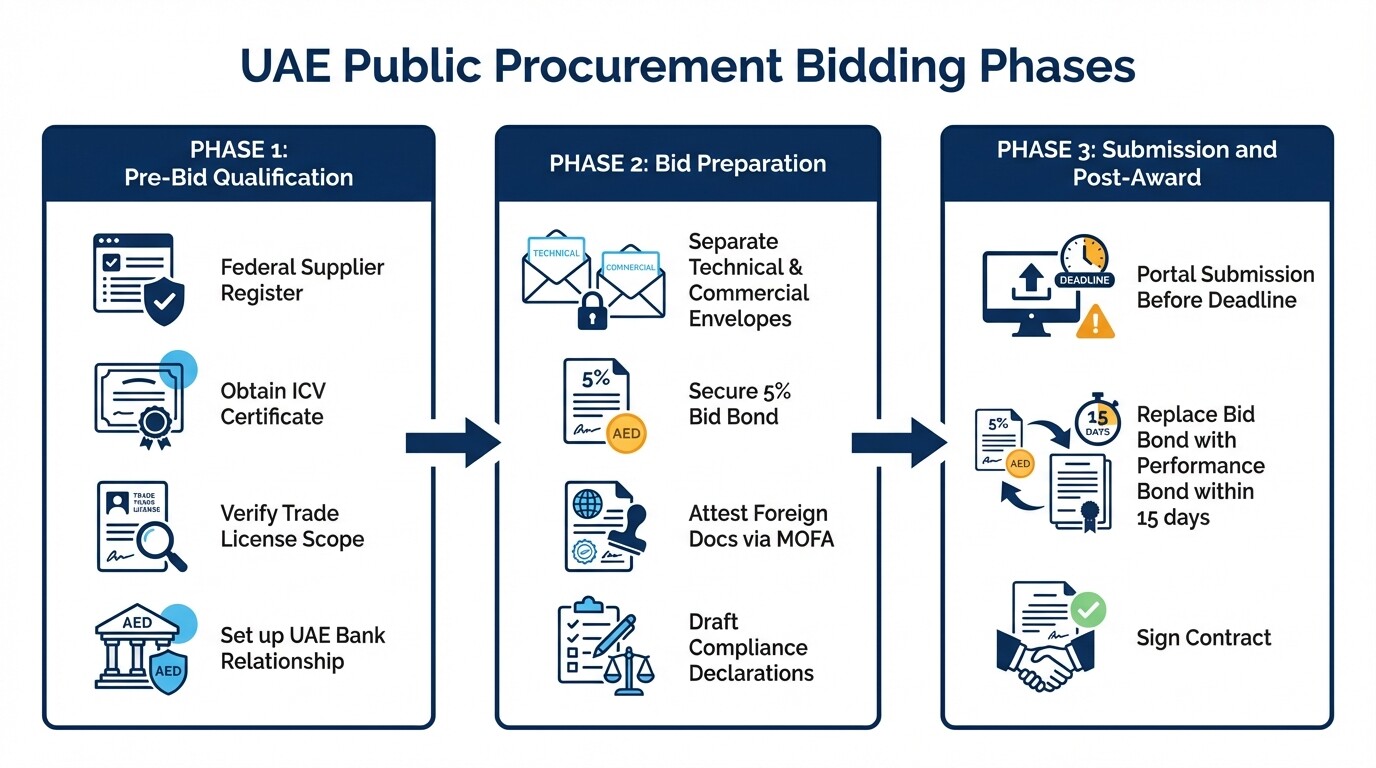
Successfully securing a UAE government contract requires strict adherence to procedural deadlines and documentation requirements. Use this checklist to ensure your bid package meets standard federal requirements.
Phase 1: Pre-Bid Qualification
- Complete registration on the Federal Supplier Register.
- Obtain a National In-Country Value (ICV) certificate from an approved certifying body.
- Review the specific tender classification to ensure your trade license activities match the project scope.
- Establish a relationship with a UAE-registered bank to handle mandatory guarantees.
Phase 2: Bid Preparation
- Segregate the bid into separate "Technical" and "Commercial" envelopes, as required by UAE procurement law.
- Secure an Initial Bank Guarantee (Bid Bond) for the exact amount or percentage specified (typically 5%).
- Ensure all foreign corporate documents are notarized, legalized by the UAE Embassy in the country of origin, and attested by the UAE Ministry of Foreign Affairs (MOFA).
- Draft all required declarations regarding anti-bribery and conflict of interest policies.
Phase 3: Submission and Post-Award
- Submit the complete package via the digital procurement portal before the exact cutoff time (late bids are automatically rejected).
- If awarded, secure the Final Bank Guarantee (Performance Bond) within the stipulated timeframe (usually 15 days) to replace the Bid Bond.
- Sign the formal government contract and register it with the relevant authorities.
Understanding the National In-Country Value (ICV) Program
The ICV certificate quantifies a company's economic contribution to the UAE and is a heavily weighted factor in tender evaluations. Bidders with higher ICV scores receive a distinct commercial advantage during the contract award process.
Managed by the Ministry of Industry and Advanced Technology (MoIAT), the National ICV program aims to boost the local economy, create jobs for Emiratis, and localize supply chains. When evaluating commercial bids, UAE government entities apply a weightage formula that favors companies with high ICV scores. Even if a foreign bidder submits a lower-priced bid, a competitor with a higher ICV score may win the contract.
ICV scores are calculated based on several factors:
- Goods and services procured from local UAE suppliers
- Investment in local assets and infrastructure
- Emiratization (hiring and training UAE nationals)
- Expatriate contribution (investing in the expatriate workforce living in the UAE)
- Export revenue generated from the UAE
Foreign companies bidding on UAE tenders should apply for an ICV certificate through MoIAT-approved auditing firms. Companies without an ICV certificate can still bid, but their ICV score will be calculated as zero, severely reducing their competitiveness.
Performance Bonds and Bank Guarantees
UAE public tenders require bidders to submit unconditional bank guarantees to secure their bids and ensure contract performance. These guarantees must be issued by a UAE-registered bank and are payable on demand without the need for court orders.
Financial guarantees are the bedrock of UAE public procurement risk management. Because these instruments are "unconditional," the government entity can liquidate them simply by making a written demand to the bank, without having to prove a breach of contract in court.
There are two primary types of guarantees required:
- Initial Guarantee (Bid Bond): Typically 5% of the total bid value. This ensures the bidder does not withdraw their offer before the tender validity period expires and that they will sign the contract if awarded.
- Final Guarantee (Performance Bond): Typically 10% of the total contract value. The winning bidder must provide this upon award to guarantee the proper execution of the project. It remains valid until the project is completed and finally handed over.
Foreign bidders cannot typically use guarantees issued directly by their home country banks. They must arrange for a correspondent UAE bank to issue the local guarantee, which requires careful financial planning and credit facility structuring.
Legal Grounds for Challenging a Tender Award
Bidders can formally challenge a tender disqualification or award decision if they suspect procedural violations or bias. Appeals must follow strict statutory timelines outlined in the UAE Federal Procurement Law.
Under Federal Decree-Law No. 11 of 2023 on Federal Government Procurement, transparency and fairness are legally mandated. If a bidder believes they were unfairly disqualified or that the award violated procurement procedures, they have the right to file a grievance.
Common legal grounds for challenging an award include:
- Failure of the procurement committee to follow published evaluation criteria
- Mathematical errors in the commercial evaluation
- Acceptance of a competitor's bid that failed to meet mandatory technical specifications
- Conflicts of interest among the evaluation committee members
Grievances must typically be submitted to the government entity's dedicated Grievance Committee within five working days from the date the bidder is notified of the decision. The committee will review the petition and issue a binding decision. If the grievance is rejected, further escalation to the UAE courts is difficult and highly specialized.
Complying with UAE Anti-Bribery and Corruption Laws
The UAE enforces strict anti-bribery measures under the Federal Penal Code, carrying severe penalties for offering anything of value to public officials. Companies participating in public procurement must maintain robust internal compliance and zero-tolerance policies.
Federal Decree-Law No. 31 of 2021 (the UAE Penal Code) criminalizes both the offering and accepting of bribes. When dealing with government tenders, the definition of a "public official" is broad, encompassing employees of federal ministries, local municipalities, and state-owned enterprises.
To mitigate legal risks, foreign bidders must implement:
- Clear Gift Policies: The UAE strictly prohibits giving gifts, hospitality, or travel expenses to public officials to influence tender outcomes.
- Intermediary Due Diligence: If using local agents or sponsors to assist with bidding, foreign companies must ensure these third parties comply with anti-corruption laws. The actions of an agent can create liability for the foreign principal.
- Corporate Liability: Under UAE law, corporate entities can be held criminally liable for bribery committed by their representatives. Penalties include massive financial fines, confiscation of illicit gains, and permanent blacklisting from future government contracts.
Common Misconceptions About UAE Public Tenders
Navigating UAE public procurement often leads foreign bidders to make costly assumptions about the process. Understanding the reality of these common myths prevents disqualifications and legal exposure.
- Misconception 1: The lowest price always wins. While price is vital, UAE public procurement relies heavily on technical compliance and the ICV score. A higher-priced bid with an excellent ICV score and superior technical merit frequently beats the lowest commercial offer.
- Misconception 2: Bank guarantees are negotiable. Foreign legal teams often attempt to mark up or negotiate the terms of standard UAE performance bonds. Government entities reject altered guarantee templates; they must be unconditional and strictly follow the prescribed government format.
- Misconception 3: Foreign entities do not need local presence. While some federal tenders allow direct international bidding, executing the contract, hiring staff, and importing materials almost always requires establishing a legal entity or branch in the UAE.
FAQ
How much does it cost to register on the Federal Supplier Register?
Registration on the UAE Ministry of Finance Federal Supplier Register is generally free of charge, though purchasing specific tender documents usually requires paying non-refundable fees ranging from AED 500 to AED 10,000, depending on the project's scale.
Is an ICV certificate mandatory to bid on UAE government contracts?
No, it is not legally mandatory to hold an ICV certificate to submit a bid. However, bidding without one means your ICV score is zero, which puts your company at a significant commercial disadvantage during the evaluation phase.
Can a foreign bank issue the required bid bond?
No. UAE government entities require bid bonds and performance guarantees to be issued by a bank licensed and operating within the UAE. Foreign companies must use their international bank to issue a counter-guarantee to a UAE correspondent bank, which will then issue the local bond.
Are digital signatures accepted for UAE public tenders?
Yes. The UAE has digitized its procurement process. Documents submitted through the federal digital procurement portal are generally accepted with approved electronic signatures, though certain foundational corporate documents may still require physical attestation.
When to Hire a Government Relations Lawyer
Foreign companies should engage legal counsel before participating in their first UAE public tender. A lawyer is critical when structuring your local legal presence, reviewing the mandatory conditions of contract (which are generally non-negotiable), and ensuring your internal policies comply with UAE anti-corruption laws. You should immediately seek legal assistance if you are unfairly disqualified from a tender and need to file an urgent grievance within the five-day statutory window, or if a government entity threatens to liquidate your performance bond.
Next Steps for Foreign Bidders
If your company plans to pursue UAE government contracts, start by auditing your corporate documents to ensure they are ready for MOFA attestation. Next, assess your supply chain to determine how you can maximize your ICV score, and consult with an approved auditing firm to begin the certification process. Finally, establish contact with government relations and lobbying lawyers in the UAE to review standard federal procurement contract terms and prepare your compliance strategy.