


- Financial Thresholds: Foreign acquisitions of New Zealand business assets generally require Overseas Investment Office (OIO) consent if the transaction exceeds NZD $100 million, though Free Trade Agreements often increase this limit.
- The Investor Test: Corporate officers and significant shareholders must pass rigorous character, immigration, and business acumen checks.
- Substantial Benefit: Investments involving sensitive land or national interest must include a detailed business plan proving economic, environmental, or social gains for New Zealand.
- Transaction Timing: OIO assessments typically take 50 to 130 working days, making early application and properly drafted conditions precedent essential for global M&A deals.
- Post-Acquisition Compliance: Investors face ongoing reporting obligations, with strict penalties including forced divestment for failing to meet promised business outcomes.
OIO Compliance Checklist for Foreign Investors
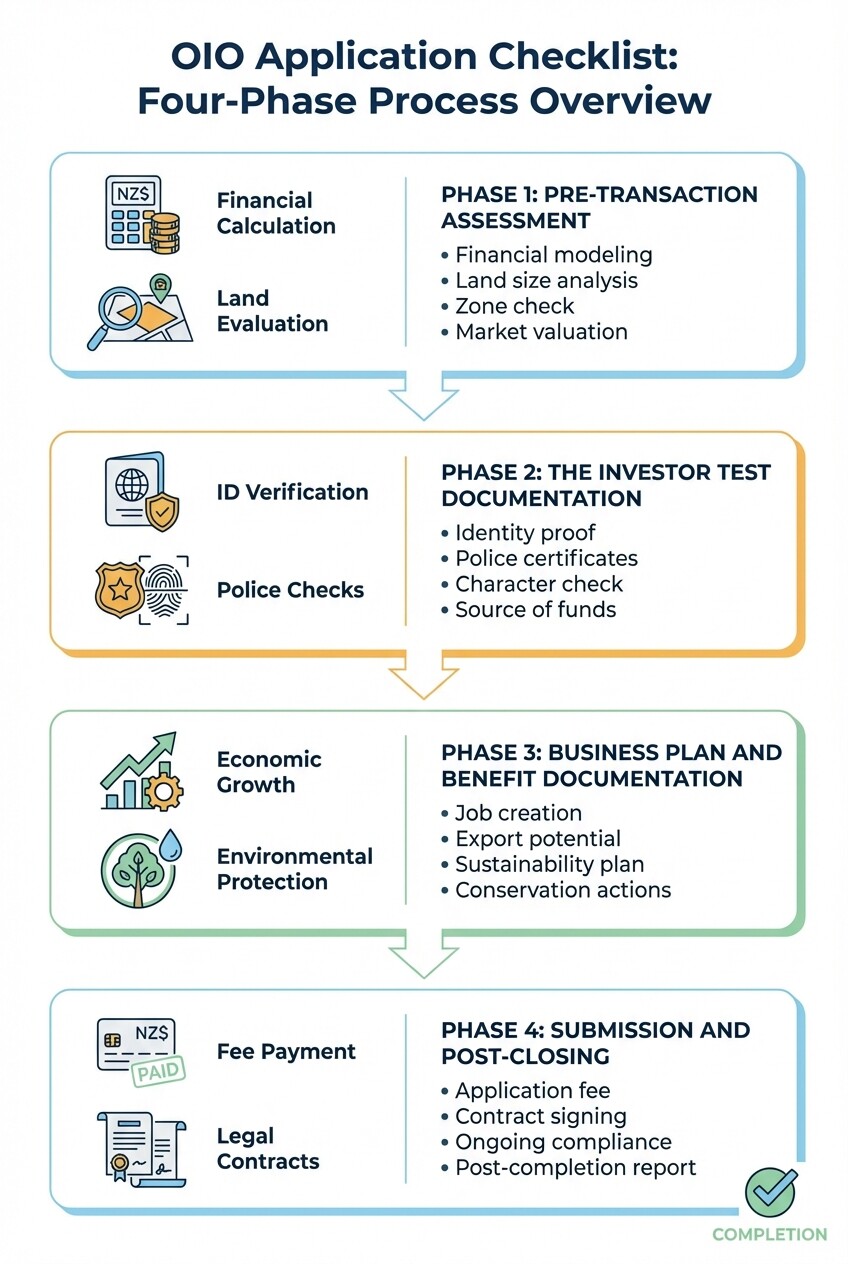
Preparing for an OIO application requires systemic coordination between your deal team and regulatory counsel. This checklist outlines the critical phases for securing consent for significant business assets in New Zealand.
Phase 1: Pre-Transaction Assessment
- Calculate the total transaction value in New Zealand Dollars (NZD) to determine if it breaches the base $100 million threshold or your applicable Free Trade Agreement threshold.
- Confirm whether the target business owns or leases "sensitive land" (e.g., non-urban land over 5 hectares, coastal land, or specific residential land).
- Determine if the target operates in a sector triggering a National Security and Public Order (NSPO) notification, such as critical infrastructure or media.
Phase 2: The Investor Test Documentation
- Identify all Individuals with Control (IWCs) within your corporate structure, including directors and shareholders with more than a 25% stake.
- Collect certified copies of passports for all IWCs.
- Procure national police clearance certificates for all IWCs from every country they have resided in for more than 12 months over the past 10 years.
- Prepare statutory declarations confirming no past corporate fraud, insolvency events, or immigration breaches.
Phase 3: Business Plan and Benefit Documentation
- Draft a comprehensive business plan detailing operations for the next three to five years.
- Quantify the economic benefits to New Zealand, such as capital expenditure, job creation, or increased export revenue.
- Outline specific environmental or social initiatives, particularly if sensitive land is involved.
Phase 4: Submission and Post-Closing
- Pay the mandatory application fee (ranging from NZD $35,000 to over $100,000 depending on the application pathway).
- Finalize the Sale and Purchase Agreement (SPA) with a strict "subject to OIO consent" condition precedent.
- Calendar the annual reporting dates for ongoing compliance once the transaction closes.
Determining Financial Thresholds for Mandatory OIO Consent
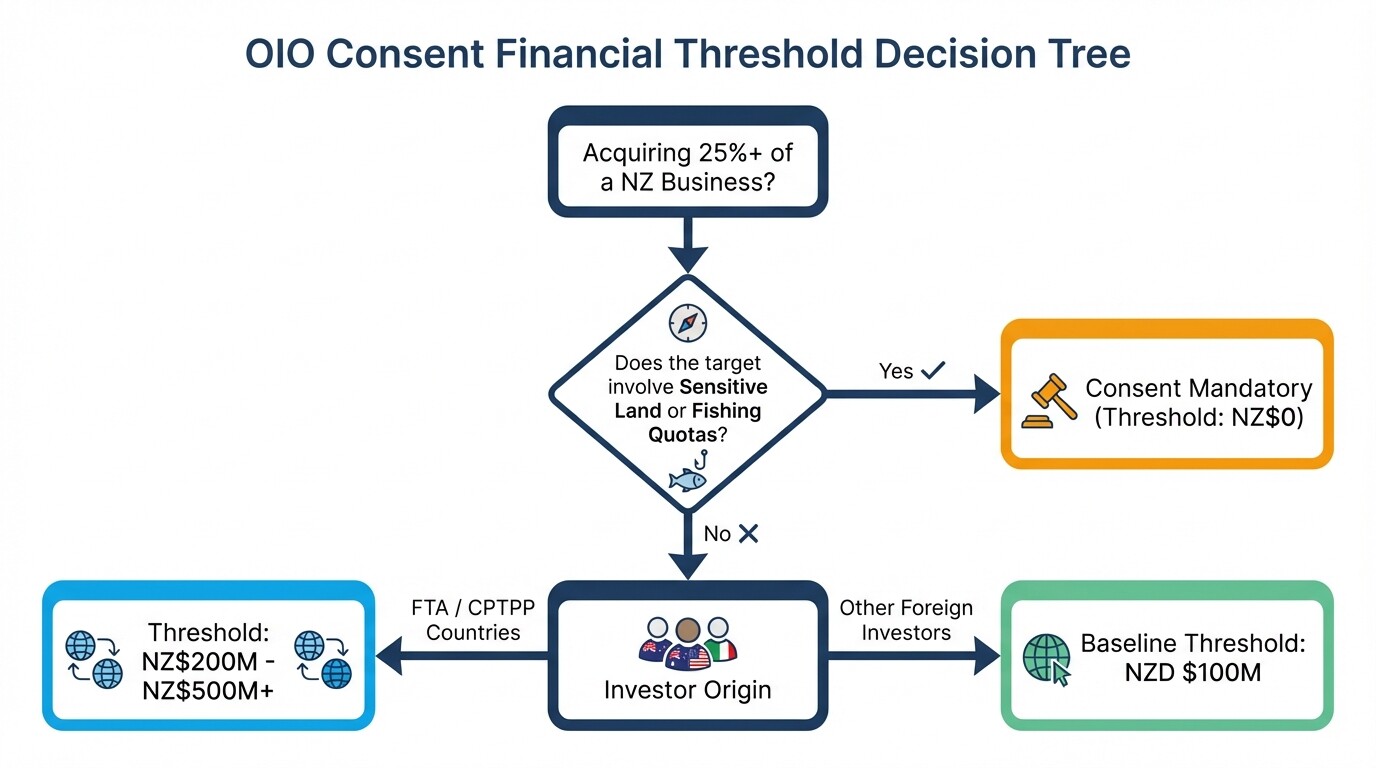
OIO consent is legally required when an overseas person acquires 25% or more ownership or control in a New Zealand business, and the investment exceeds specific monetary limits. Assessing this threshold early prevents regulatory blind spots during the valuation phase of a cross-border acquisition.
The baseline threshold for significant business assets is NZD $100 million. However, New Zealand's international trade obligations significantly alter this figure depending on the investor's origin. Investors from Australia, as well as countries within the Comprehensive and Progressive Agreement for Trans-Pacific Partnership (CPTPP) or specific other Free Trade Agreements, often benefit from a higher threshold, sometimes exceeding NZD $200 million or $500 million. It is important to note that if the acquisition involves sensitive land or fishing quotas, the financial threshold is generally reduced to zero, making consent mandatory regardless of the deal size.
Passing the 'Investor Test' for Corporate Character
The investor test evaluates the individuals who control the acquiring foreign entity to ensure they possess business acumen, good character, and no prohibitive criminal or immigration history. The OIO applies this test rigidly under the Overseas Investment Act 2005 to protect New Zealand's market integrity.
To pass this test, your corporation must map out its ownership structure to identify the key individuals exercising control over the investment. The OIO requires extensive background checks on these executives and major shareholders. You must provide comprehensive resumes proving relevant industry experience, alongside international police clearances. Any history of corporate insolvency, tax evasion, civil penalties, or visa rejections in any global jurisdiction will heavily prejudice the application and must be disclosed upfront with mitigating context.
Proving Substantial Benefit to New Zealand
If your commercial acquisition includes sensitive land or falls under specific national interest categories, you must submit a business plan demonstrating that the investment brings measurable, substantial benefits to the country. The OIO does not accept vague promises; they require highly specific, quantifiable commitments.
Your business plan should contrast the likely future under your ownership against the likely future if the current New Zealand owner retained the asset. The OIO evaluates "benefit" across several statutory factors:
- Economic gains: Creating or retaining jobs, introducing new technology, increasing capital investment, or boosting export receipts.
- Environmental protection: Advancing ecological initiatives, reducing carbon footprints, or funding local conservation projects.
- Public access: Creating walking tracks or allowing public access to natural features on the acquired land.
- Oversight participation: Offering New Zealanders meaningful participation in the management or ownership of the corporate entity.
Avoiding Application Timing Mistakes in Global M&A Transactions
Failing to align OIO processing timelines with global deal milestones can trigger costly delays, breach transaction deadlines, or completely derail a merger. The OIO process is highly thorough, and statutory processing timeframes only begin once the regulatory body considers the application complete.
Standard significant business asset applications typically take 50 working days, while complex transactions involving sensitive land or national interest tests can extend well beyond 130 working days. A common strategic error is submitting an incomplete application to save time, which results in the OIO pausing the statutory clock and issuing extensive requests for further information. To protect the deal, corporate counsel must draft Sale and Purchase Agreements with realistic "drop-dead" dates that accommodate these extended regulatory windows and ensure OIO consent is a strict condition precedent to closing.
Ongoing Reporting Obligations and Penalties for Breach
OIO approval is not the final step of the regulatory process; foreign investors face strict annual reporting requirements to prove they are meeting the business conditions set during approval. The New Zealand government actively monitors these commitments and takes aggressive enforcement action against non-compliance.
When the OIO grants consent, it attaches legally binding conditions based on the promises made in your business plan. You will be required to submit annual compliance reports detailing your progress on job creation, capital expenditure, and operational milestones. Failing to meet these conditions, or failing to file reports, can result in severe consequences. The OIO has the authority to seek injunctions, issue civil penalties of up to NZD $300,000 for corporate entities, or, in extreme cases of continuous breach, apply to the High Court to force the divestment of the New Zealand assets.
Common Misconceptions About the OIO Process
- Misconception: OIO approval is only required for real estate. Many foreign corporations believe they are exempt if they are just buying shares in a tech or manufacturing company. If the significant business asset threshold is met, or if the target company leases sensitive land (like a rural factory site), consent is mandatory.
- Misconception: Approvals are quick formalities. Treating the OIO like a rubber-stamp authority leads to deal failure. It is a rigorous, evidence-based regulatory body that routinely rejects applications lacking substantial proof of benefit or corporate character.
- Misconception: Post-deal changes are easily forgiven. Investors sometimes assume they can pivot their business strategy after closing without notifying the government. Materially altering the business plan without seeking a formal variation of your OIO conditions constitutes a regulatory breach.
Frequently Asked Questions
How much does an OIO application cost?
Application fees are set by statute and vary significantly based on the transaction type. A standard significant business assets application costs around NZD $35,000, whereas complex applications involving sensitive land or national security assessments can exceed NZD $100,000. These fees are non-refundable, even if the application is declined.
Does an Australian or US company need OIO approval?
Yes, entities from Australia, the United States, and other friendly nations are still considered "overseas persons" under New Zealand law. While they may benefit from higher financial thresholds due to Free Trade Agreements, they must still undergo the full OIO assessment if their investment triggers those thresholds or involves sensitive land.
What happens if we close the transaction before receiving OIO consent?
Closing an acquisition that requires OIO consent without obtaining it is a breach of the Overseas Investment Act. The transaction may be deemed void, and the acquiring entity can face substantial financial penalties and be forced to divest the assets at a loss.
Can the OIO block an investment on national security grounds?
Yes. The National Security and Public Order (NSPO) regime allows the government to review and potentially block investments in critical sectors like telecommunications, media, and defense tech, even if the financial value of the deal falls below standard OIO thresholds.
When to Hire a Lawyer and Next Steps
Foreign direct investment in New Zealand requires precise navigation of local statutes and an understanding of the OIO's current policy priorities. You should engage legal counsel the moment your corporate strategy identifies a New Zealand target for acquisition. Attempting to structure a cross-border deal or draft an SPA without input from local regulatory experts often results in invalid contract conditions or massive application delays.
Your first step should be consulting with specialized government relations lawyers in New Zealand to conduct a preliminary threshold and sensitive land assessment. They will help you compile the investor test documentation, structure the transaction to optimize regulatory timeframes, and draft a business plan that directly addresses the specific statutory benefits required by the Overseas Investment Office.