Navigating UK NSI Act Clearances in Cross-Border Tech M&A Transactions
- The UK National Security and Investment (NSI) Act 2021 mandates government clearance for foreign and domestic acquisitions in 17 sensitive sectors, heavily targeting technology assets.
- Acquiring 25% or more of shares or voting rights in a qualifying UK tech company automatically triggers a mandatory filing requirement.
- Completing a notifiable transaction without clearance is a civil and criminal offense, resulting in the transaction being legally void.
- Filing an initial notification is free, but M&A regulatory counsel fees typically range from £15,000 to £30,000, escalating significantly if the government initiates an in-depth review.
- Buyers must draft specific Condition Precedent (CP) clauses to allocate the risk of regulatory delays or blocked transactions.
What Triggers a Mandatory NSI Notification in Tech M&A?
Mandatory notification under the NSI Act is triggered when an acquirer purchases specific thresholds of equity or voting control in a target entity performing activities within 17 designated sensitive sectors. Technology transactions are heavily impacted because sectors like artificial intelligence, computing hardware, advanced robotics, cryptographic authentication, and quantum technologies are strictly regulated.
The government strictly enforces mandatory notification when an investor crosses specific ownership thresholds: 25%, 50%, or 75% of shares or voting rights. A filing is also required if the acquisition grants voting rights that enable or prevent the passage of any class of resolution governing the target's affairs. Even minority investments require clearance if they cross the 25% threshold or grant the buyer "material influence" over the tech company's strategic direction. If a transaction falls within these parameters, you must secure clearance from the Investment Security Unit (ISU) before closing the deal.
To determine if your target falls into a mandatory sector, review the official UK National Security and Investment Act guidance provided by the government.
Sample NSI Condition Precedent Clause
To protect the buyer from legally void transactions and regulatory penalties, cross-border M&A contracts must include a customized Condition Precedent (CP) clause tying the deal's closing to NSI Act clearance. Below is sample clause language designed to protect a foreign acquirer during the regulatory review period.
Condition Precedent: NSI Act Clearance
- Completion of the Transaction is conditional upon the occurrence of one of the following events regarding the UK National Security and Investment Act 2021 (the "NSI Act"):
- (a) The Secretary of State notifying the Purchaser pursuant to section 14(8)(b)(ii) of the NSI Act that no further action will be taken in relation to the Transaction; or
- (b) The Secretary of State making a final order pursuant to section 26(1)(b) of the NSI Act allowing the Transaction to proceed, provided that such final order is not subject to conditions that materially and adversely affect the Purchaser's intended commercial use of the Target Company; or
- (c) The statutory time limits for the Secretary of State to call in the Transaction under the NSI Act having expired without a call-in notice being issued.
- The Purchaser and Seller agree to cooperate in good faith to prepare and submit the mandatory notification to the Investment Security Unit within five (5) business days of the signing of this Agreement.
Step-by-Step ISU Filing Documentation Checklist
Submitting a mandatory notification to the ISU requires comprehensive disclosures about the buyer's corporate structure, the target's operations, and the strategic intent behind the acquisition. Missing documents or vague descriptions will result in the ISU rejecting the filing, resetting the statutory clock.
Use the following checklist to gather the necessary documentation before accessing the online NSI portal:
- Acquirer Corporate Structure: Complete organizational charts showing the acquirer's ultimate beneficial owners, board of directors, and any affiliations with foreign governments or state-backed entities.
- Target Company Details: Legal entity information, UK company registration numbers, and detailed mapping of the target's corporate structure prior to the acquisition.
- Sector Classification Justification: A precise technical breakdown explaining how the target's activities fall within one of the 17 sensitive areas, including product lines, R&D projects, and government contracts.
- Transaction Framework: Copies of the Term Sheet, Share Purchase Agreement (SPA), or Heads of Terms detailing the equity percentage, voting rights, and structural mechanics of the deal.
- National Security Matrix: Documentation detailing any dual-use technologies, defense contracts, or sensitive data access the target possesses, and the acquirer's security protocols for managing them.
Timeline Comparison: Initial Review vs. In-Depth Assessment
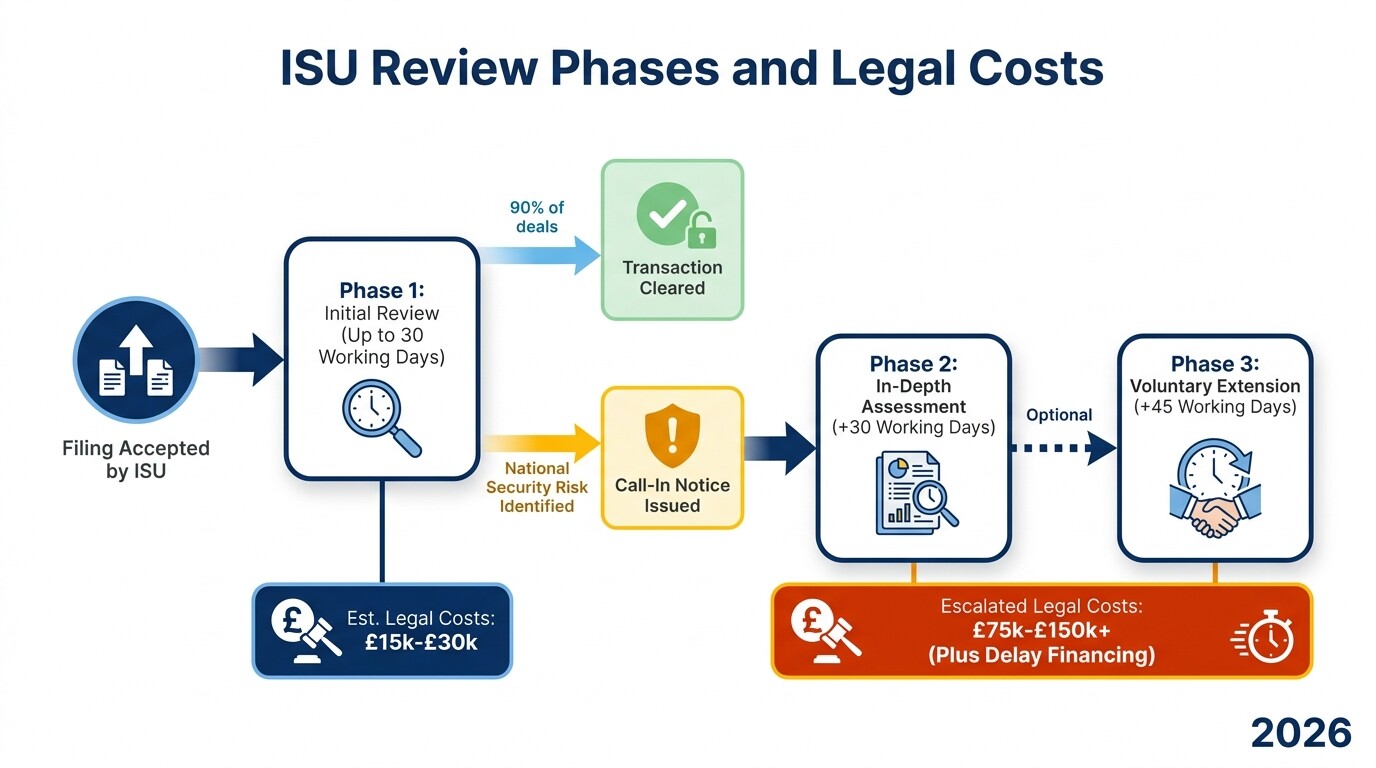
The NSI Act review process operates on strict statutory timelines measured in working days, creating two distinct phases: an initial screening and a potential in-depth national security assessment. Knowing these timelines is essential for setting accurate long-stop dates in your M&A contracts.
| Review Phase | Duration | Trigger / Characteristics |
|---|---|---|
| Initial Review | Up to 30 working days | Begins once the ISU formally accepts the complete notification. Roughly 90% of tech deals are cleared at this stage without further action. |
| In-Depth Assessment (Call-In) | Additional 30 working days | Triggered if the ISU issues a "call-in notice" due to identified national security risks. The ISU conducts deep due diligence on the buyer and the technology. |
| Voluntary Extension | Additional 45 working days | The government can unilaterally extend the call-in period by 45 working days. Further extensions require the acquirer's written consent. |
Cost Estimates for Regulatory Counsel and Delays
While the UK government does not charge a filing fee for NSI notifications, navigating the clearance process requires specialized legal expertise and contingency planning for deal delays. Foreign tech buyers should budget for both direct legal costs and the indirect financial impact of an extended closing timeline.
For a straightforward tech transaction cleared during the initial 30-day review, expect M&A regulatory counsel fees to range from £15,000 to £30,000. If the transaction receives a call-in notice and proceeds to an in-depth assessment, legal costs for negotiating mitigation agreements (such as ring-fencing technology or establishing UK-approved boards) easily escalate to £75,000-£150,000+. Furthermore, indirect delay costs-such as extended bridge financing, prolonged legal due diligence updates, and management distraction-can add thousands of pounds per day to the transaction's overall expense.
Common Misconceptions About UK NSI Clearance
Misunderstanding the scope of the NSI Act leads foreign buyers to structure deals improperly, risking severe legal consequences. Dealmakers routinely underestimate the broad application of the law beyond traditional defense contractors.
- Misconception: It only applies to military and defense companies. In reality, the NSI Act heavily scrutinizes commercial technology. Startups developing AI algorithms for retail, quantum encryption for finance, or advanced materials for consumer electronics are frequently caught under the mandatory notification rules.
- Misconception: Asset purchases are exempt. While the mandatory notification regime applies to share and voting right acquisitions, the government has the power to "call in" asset purchases (like buying intellectual property, source code, or machinery) if they pose a national security risk.
- Misconception: Foreign buyers face stricter legal thresholds than UK buyers. The NSI Act is technically country-agnostic. Domestic UK buyers acquiring UK tech companies are subject to the exact same mandatory notification triggers and ownership thresholds as foreign entities.
Frequently Asked Questions
What happens if we close a mandatory tech deal without NSI clearance?
Closing a notifiable transaction without clearance renders the acquisition legally void. The government can impose civil penalties up to 5% of the acquirer's global turnover or £10 million (whichever is higher), and executives may face up to five years in prison.
Can we engage the ISU for informal advice before filing?
The ISU does not offer an informal pre-clearance process or binding early guidance. Acquirers must submit a formal notification to receive a binding decision on whether the transaction poses a national security risk.
Does the NSI Act apply to offshore tech companies?
Yes. The regime captures offshore companies if they carry out activities in the UK or supply goods and services to people in the UK. A foreign acquirer buying an American tech company that sells advanced software into the UK market may still trigger an NSI filing.
How does the ISU handle confidential M&A deal information?
The ISU is bound by strict confidentiality protocols under the Act. Information submitted in the NSI portal is securely siloed within the government and is not shared publicly, ensuring that sensitive IP and trade secrets remain protected during the review.
When to Hire an M&A Regulatory Lawyer
You should engage an M&A regulatory lawyer the moment you identify a potential UK technology target, long before signing a letter of intent. Early legal involvement is critical to assess whether the target's products fall into one of the 17 sensitive sectors, allowing you to accurately structure your transaction timelines and draft protective condition precedent clauses. Attempting to draft an ISU filing without specialized counsel often leads to rejected notifications, resetting the 30-day statutory clock and endangering transaction financing. Retaining merger and acquisition lawyers in the United Kingdom ensures your filing is strategically positioned to minimize the risk of a government call-in.
Next Steps for Foreign Acquirers
- Conduct a Sector Audit: Review the target company's product lines, source code, and R&D pipeline against the UK government's definitions for the 17 sensitive areas.
- Draft Protective Contracts: Work with your legal team to insert precise NSI Act condition precedent clauses and long-stop dates into your Share Purchase Agreement.
- Gather Corporate Intelligence: Assemble complete structural and beneficial ownership charts for your own acquisition vehicle to prepare for the rigorous ISU disclosure requirements.
- Submit the Filing Promptly: Lodge the notification through the ISU portal immediately after signing the transaction documents to initiate the 30-working-day review period as early as possible.