


How to Register a Foreign Financial Services Firm With the FCA in the UK
- Foreign financial firms seeking UK clients must establish local substance and apply for direct authorization from the Financial Conduct Authority (FCA).
- The application process generally takes 6 to 12 months, requiring a detailed regulatory business plan and rigorous executive vetting.
- Firms must hold adequate regulatory capital specifically allocated to the UK entity, independent of the parent company's resources.
- Legal and compliance consulting costs for full FCA registration assistance typically range from £20,000 to £50,000.
- Post-Brexit regulations heavily restrict cross-border financial promotions, making a formal UK branch or subsidiary mandatory for most retail and wholesale operations.
Navigating the UK's Post-Brexit Regulatory Landscape in 2026
Operating a financial services firm in the UK requires direct authorization from the Financial Conduct Authority (FCA), as passporting rights from the European Economic Area (EEA) have permanently ended. For 2026 and beyond, the regulatory framework prioritizes domestic accountability, consumer protection, and localized risk management over simple cross-border market access.
Foreign institutions can no longer rely on their home-state regulator to satisfy UK compliance requirements. If your firm plans to conduct regulated activities-such as dealing in investments, managing alternative investment funds, or providing payment services-you must establish a genuine physical presence in the UK. The FCA strictly enforces a "substance over form" approach, meaning your UK branch or subsidiary must have local senior management capable of independent decision-making.
Additionally, international firms must adhere to the FCA's Consumer Duty regulations, which demand that firms actively deliver good outcomes for retail customers. Relying on the Overseas Persons Exclusion (OPE) is now highly restricted and generally only applies to specific, limited wholesale interactions that do not involve active marketing to UK clients.
Step-by-Step Process for FCA Authorization
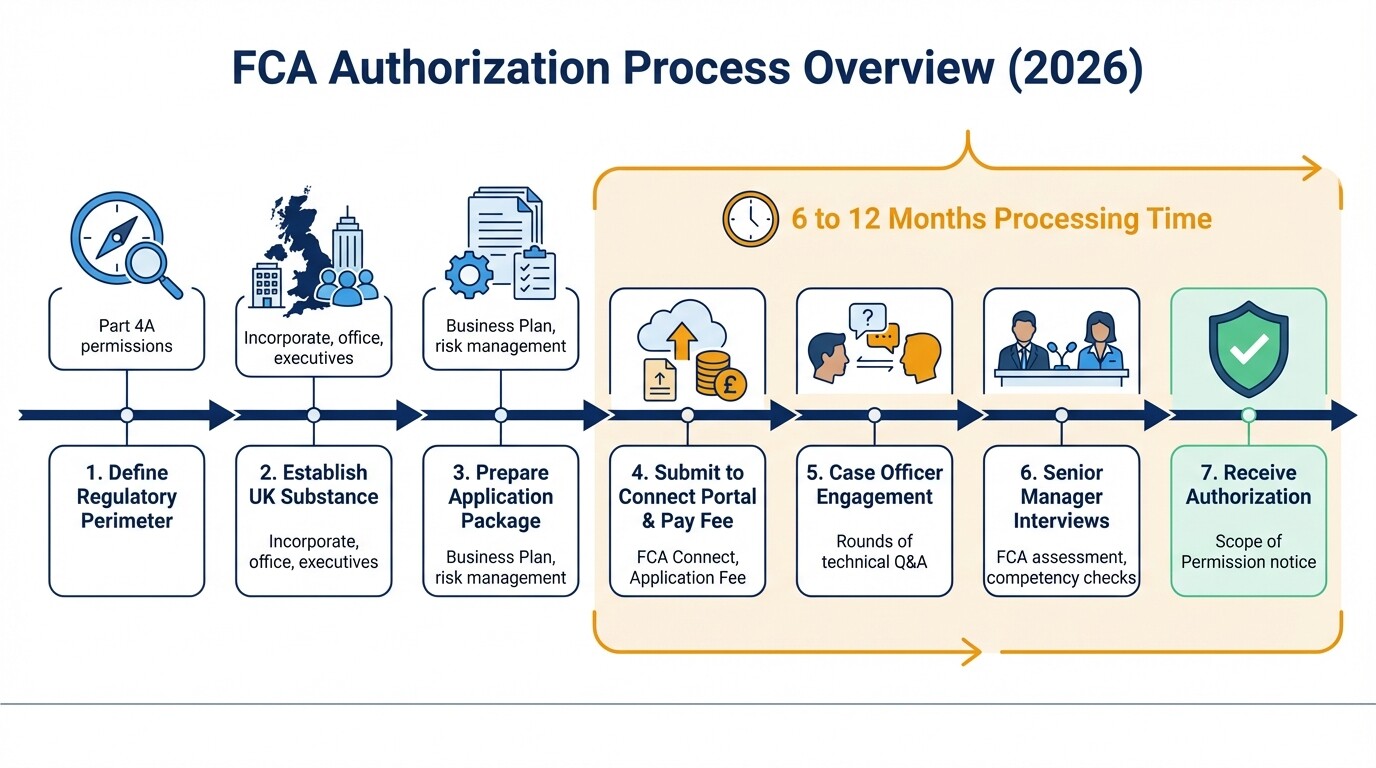
The FCA authorization process is a rigorous, multi-stage procedure that takes between six and twelve months to complete. Success requires meticulous planning before any formal application is submitted through the FCA's online Connect portal.
- Define Your Regulatory Perimeter: Identify the exact regulated activities your firm intends to perform under the Financial Services and Markets Act 2000. This determines the specific "Part 4A permissions" you must request.
- Establish UK Substance: Incorporate your UK entity (branch or subsidiary), secure physical office space, and identify the local executives who will hold Senior Management Functions (SMF).
- Prepare the Application Package: Draft your comprehensive core documents, focusing heavily on operational resilience, risk management, and the customer journey.
- Submit and Pay the Fee: Upload your application via the FCA Connect system and pay the non-refundable statutory application fee.
- Engage with the Case Officer: The FCA will assign a case officer who will thoroughly review your submission. Expect multiple rounds of detailed, technical questions regarding your business model, capital liquidity, and compliance framework.
- Undergo Senior Manager Interviews: Proposed executives may be called for competency interviews with the FCA to prove they understand UK regulations.
- Receive Authorization: If successful, the FCA will issue a formal Scope of Permission notice, allowing you to commence regulated activities.
Required Documentation for FCA Registration
Foreign financial institutions must submit a comprehensive suite of documents demonstrating their operational resilience, compliance framework, and financial stability. The FCA assesses these documents to ensure the firm poses no outsized risk to UK markets or consumers.
Your application package must include:
- Regulatory Business Plan (RBP): A highly detailed document outlining your target market, revenue projections, competitive landscape, and step-by-step customer journey.
- Compliance and AML Manuals: Tailored policies demonstrating exactly how the UK entity will comply with local anti-money laundering regulations, financial crime prevention, and the Consumer Duty.
- Proof of Financial Resources: Detailed financial models, including a 12-month cash flow forecast, stress testing scenarios, and an Internal Capital Adequacy and Risk Assessment (ICARA) if applicable.
- Senior Managers and Certification Regime (SM&CR) Forms: Detailed employment histories, background checks, and statements of responsibility for all individuals nominated for executive leadership.
Managing Regulatory Capital Requirements for Cross-Border Operations
The FCA requires all authorized firms to hold sufficient regulatory capital to absorb potential losses and ensure an orderly wind-down if the business fails. This capital must be held by the UK entity itself; parent company guarantees or capital held in foreign jurisdictions will not satisfy the FCA's threshold conditions.
The exact amount of initial and ongoing regulatory capital depends entirely on your firm's prudential classification. For example, a firm holding client money or executing complex trades will face significantly higher capital requirements than a simple advisory firm. You must continuously monitor this capital against your operational expenses. The FCA expects foreign-owned subsidiaries to maintain a distinct capital buffer that is highly liquid and immediately accessible in the UK banking system to protect domestic market integrity.
Estimated Legal Costs for FCA Registration
Legal and consulting fees for full FCA registration assistance typically range from £20,000 to £50,000, depending on the complexity of your financial services. Engaging specialized counsel is highly recommended to prevent application rejections, which forfeit your regulatory fees and delay market entry.
When budgeting for UK market entry, foreign firms should account for three distinct cost categories:
| Cost Category | Estimated Range | Description |
|---|---|---|
| Legal & Compliance Fees | £20,000 - £50,000 | Costs for drafting the Regulatory Business Plan, compliance manuals, and managing FCA correspondence. |
| FCA Application Fee | £1,500 - £25,000 | A non-refundable statutory fee paid directly to the regulator, scaled by your firm's revenue and complexity. |
| Regulatory Capital | £50,000 - £730,000+ | Liquid funds that must be locked in the UK corporate bank account prior to authorization. |
To navigate these expenses efficiently, it is advisable to consult with specialized business registration lawyers in the United Kingdom who routinely handle cross-border financial regulation.
Common Misconceptions About FCA Registration
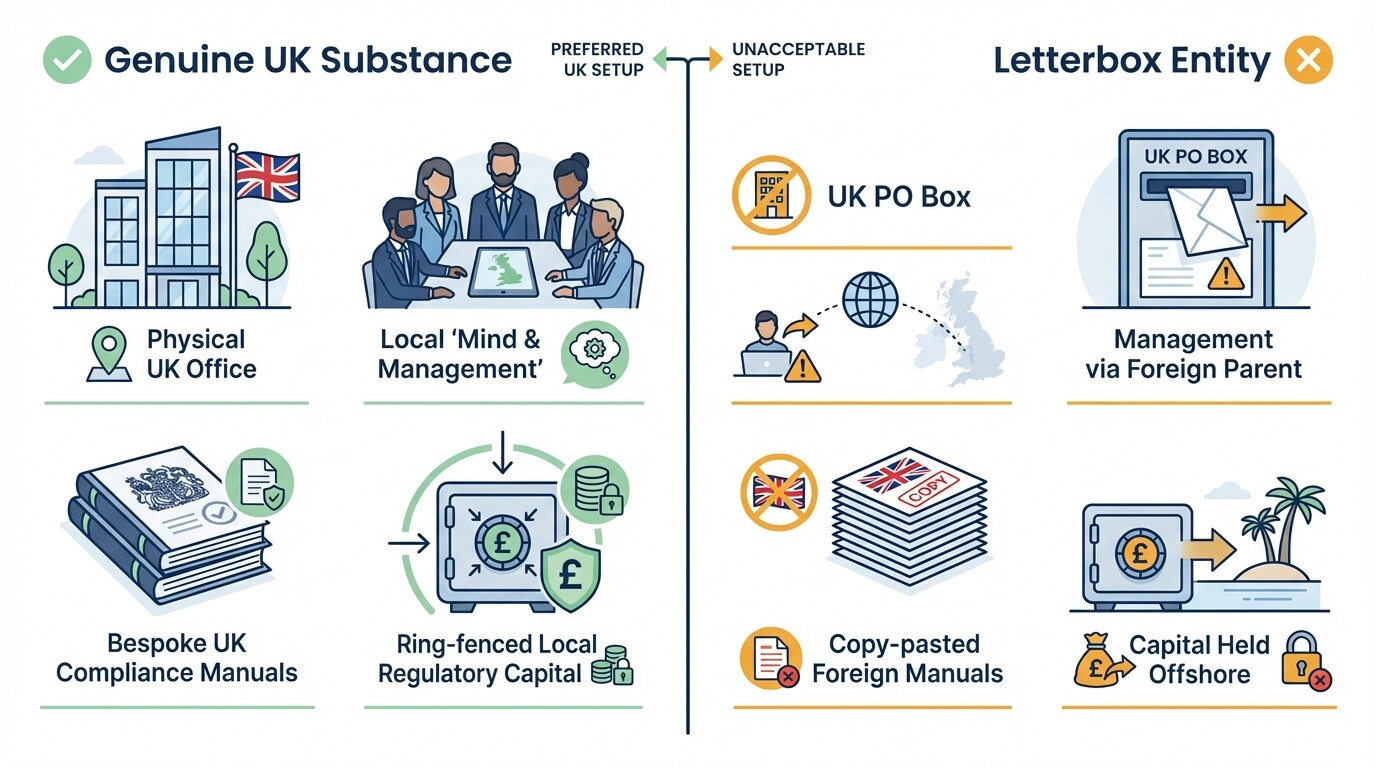
Many foreign firms underestimate the FCA's strict operational requirements, leading to delayed or rejected applications. Assuming that success in a foreign jurisdiction guarantees UK approval is a costly error.
- Relying on a foreign compliance manual: Simply translating or rebranding a US, Asian, or EU compliance manual will result in an immediate rejection. The FCA requires bespoke policies that specifically reference UK legislation, such as the Proceeds of Crime Act 2002 and the FCA Handbook.
- Operating entirely from abroad: The FCA rarely authorizes "letterbox" entities. You cannot register a UK firm while keeping all management, compliance, and operational staff in your home country. "Mind and management" must reside in the UK.
- Viewing registration as a checklist: FCA authorization is a qualitative assessment, not a box-ticking exercise. Case officers will actively challenge your assumptions, stress-test your financial models, and scrutinize your leadership's competence.
Frequently Asked Questions
How long does FCA authorization take for a foreign firm?
The FCA has a statutory obligation to process a complete application within six months, or an incomplete application within twelve months. In practice, due to the complexity of foreign ownership structures, most international firms should expect the process to take closer to nine to twelve months.
Can a foreign firm offer financial services in the UK without FCA registration?
Generally, no. Unless you fall under very strict, limited exemptions-such as interacting exclusively with certain institutional investors under the Overseas Persons Exclusion-active solicitation of UK clients requires direct FCA authorization.
What is the Senior Managers and Certification Regime (SM&CR)?
The SM&CR is the FCA's accountability framework. It requires the firm to assign specific regulatory responsibilities to approved senior executives, making them personally accountable for compliance failures within their designated areas of the business.
When to Hire a Financial Regulatory Lawyer
You should engage a financial regulatory lawyer before you finalize your UK business model or draft any regulatory documents. Early legal intervention ensures your proposed operations do not inadvertently trigger heavier regulatory burdens or higher capital requirements than necessary. A specialized lawyer will help you structure your UK subsidiary, assess your key personnel against FCA fitness standards, and translate your global business goals into an FCA-compliant regulatory plan.
Next Steps
Moving forward requires mapping your intended UK activities against the regulated activities framework to pinpoint the exact permissions you need. Start by drafting a high-level summary of your target client base, the flow of funds, and your proposed UK staffing structure. Once this framework is established, secure your local legal counsel to begin assembling the formal application and locking in your UK corporate banking arrangements for capital capitalization.