


- English law requires explicit force majeure clauses. It does not imply them automatically.
- UK commercial litigation uses a "loser pays" rule. This shifts legal fees to the unsuccessful party.
- Parties must follow strict pre-action protocols before filing a lawsuit to avoid court sanctions.
- Enforcing foreign judgments in English courts depends on international treaties and bilateral agreements.
- Jurisdiction clauses determine whether English courts or foreign tribunals hear cross-border disputes.
Supply Chain Dispute Resolution Checklist
Act quickly to preserve your rights under English law when a supply chain contract breaks down. Follow these initial steps before starting formal litigation.
- Preserve evidence: Suspend automated document deletion policies. Securely archive emails, shipping manifests, and digital communications.
- Check jurisdiction: Locate the contract provisions dictating which country's laws apply and where disputes are resolved.
- Verify notice requirements: Check mandatory timeframes and methods for issuing formal breach or force majeure notices.
- Calculate damages: Quantify direct losses in GBP (£). Include replacement goods, expedited shipping, and lost profits.
- Consider arbitration: Check for an arbitration clause. A valid clause forces parties into binding commercial arbitration and bypasses English courts.
- Draft a pre-action letter: Work with legal counsel to prepare a formal Letter of Claim complying with UK procedural rules.
Complying with Pre-Action Protocol Requirements
Before issuing a claim in the UK, parties must comply with procedural rules. Failing to follow these steps can result in severe financial penalties.
The UK Civil Procedure Rules mandate that litigants follow the Practice Direction on Pre-Action Conduct and Protocols. For commercial disputes, the claimant sends a detailed Letter of Claim outlining the facts, the basis of the claim, and the exact remedy sought. The defendant is then given reasonable time, usually 14 to 30 days, to investigate and provide a full Letter of Response.
Courts penalize companies that rush to litigate without attempting mediation. If a judge determines that a party unreasonably refused to engage in the pre-action process, they can order that party to pay a larger share of the legal costs or reduce the interest awarded on their damages.
Invoking Force Majeure and Frustration
English law does not automatically excuse contract performance when supply chains become expensive or difficult. You must rely on explicit contract terms or the narrow doctrine of frustration.
English common law does not have a general concept of force majeure. Your contract must contain a specific force majeure clause detailing the exact triggering events (such as pandemics, strikes, or acts of war). If the specific event is not listed, the clause will not protect you.
If your contract lacks a force majeure clause, you must rely on the doctrine of frustration. Frustration applies only if an unforeseen event makes the contract physically or legally impossible to perform. If you successfully prove frustration, the Law Reform (Frustrated Contracts) Act 1943 dictates how advance payments and incurred expenses are apportioned. A supply chain issue that merely reduces profit margins or causes shipping delays rarely qualifies.
Navigating Jurisdictional Challenges
Cross-border supply chain disputes often face immediate battles over which country's courts have the authority to hear the case.
When international businesses draft supply chain agreements, they typically include an exclusive jurisdiction clause naming a specific court. If an English court is named, it generally upholds the clause and accepts jurisdiction even if neither party is based in the UK.
If the contract is silent on jurisdiction, the claimant must rely on common law rules or international conventions. English courts may permit serving a lawsuit out of the jurisdiction if the claimant proves a strong connection to the UK. Defendants frequently counter this by arguing that a different country's court is a more appropriate venue for the trial.
Procedures for Enforcing Foreign Judgments
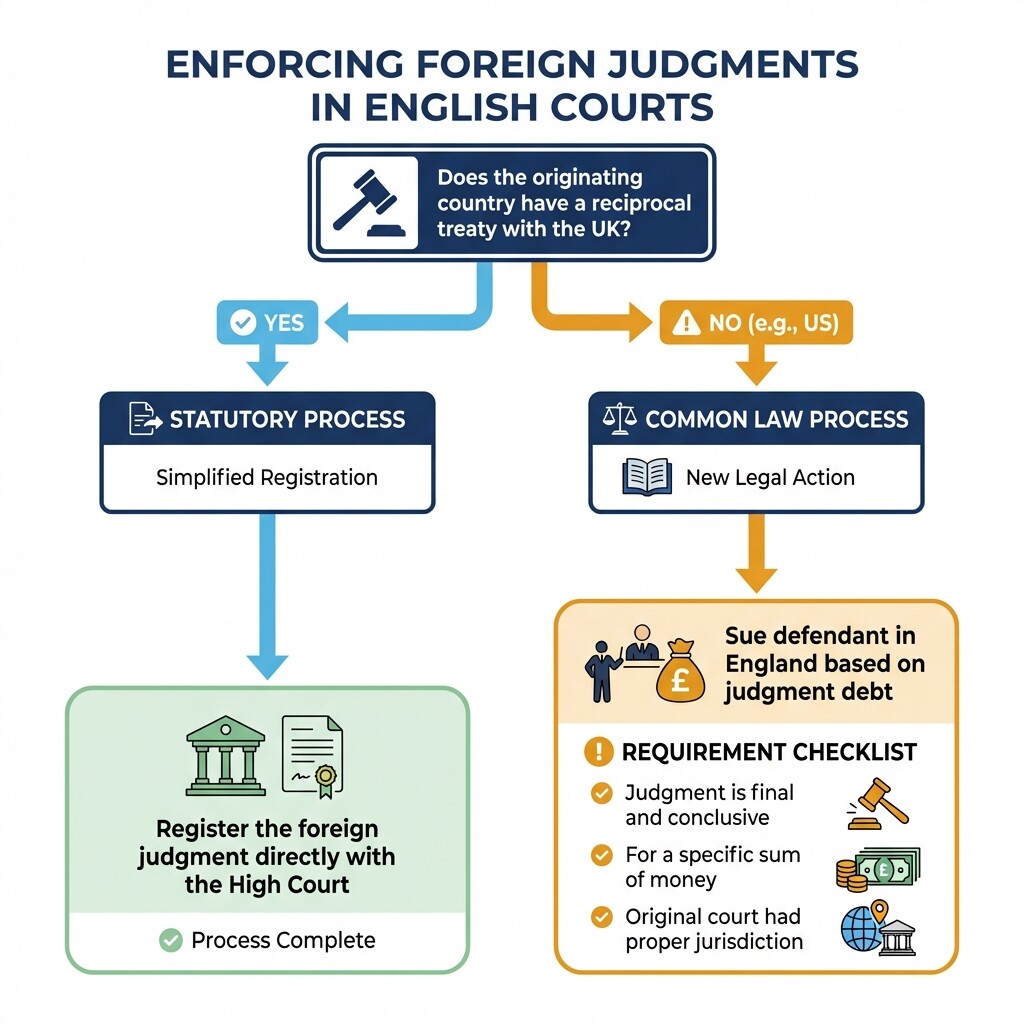
International companies can enforce foreign judgments in English courts to seize UK-based assets of non-compliant supply chain partners. The process depends on whether the originating country has a reciprocal enforcement treaty with the UK.
If the judgment originates from a country with a bilateral treaty or convention with the UK, the process is statutory. The claimant registers the foreign judgment with the High Court. It is then treated as an English judgment.
If no treaty exists (such as between the UK and the US), the claimant must sue the defendant in England based on the foreign judgment debt. To succeed, the foreign judgment must be final, conclusive, and for a specific sum of money. The English court must also be satisfied that the foreign court had proper jurisdiction over the defendant.
Litigation Timelines and Available Remedies
The standard limitation period for bringing a breach of contract claim is six years from the date the breach occurred. If the contract was executed as a deed, the period extends to twelve years.
A standard commercial breach of contract claim usually takes between 12 to 18 months from the issuance of the claim form to a final trial. Complex cross-border supply chain disputes with heavy evidentiary requirements can exceed two years.
The primary remedy is financial damages designed to put the injured party in the position they would have been in had the contract been performed. Courts may also grant specific performance or injunctions, though these are rare in supply chain cases.
Cost Implications and Fee-Shifting Rules
The UK operates under a "loser pays" principle. The unsuccessful party is generally ordered to pay the successful party's legal costs. This deters frivolous lawsuits but increases the financial risk of pursuing a weak claim.
English courts calculate cost awards based on the conduct of the parties:
| Cost Basis | Typical Recovery | Trigger |
|---|---|---|
| Standard | 60% to 70% | Default award for successful claims |
| Indemnity | Up to 90% | Bad behavior, hiding evidence, ignoring protocols |
For international plaintiffs suing a UK company, the defendant may apply for Security for Costs. This requires the foreign claimant to deposit funds into the court in advance to cover the defendant's legal fees in case the claim fails. This ensures UK companies are not left with unrecoverable legal bills.
Common Misconceptions About English Litigation
- Automatic force majeure: International businesses often assume force majeure is a general legal protection. Under English law, it only exists if explicitly written into the contract.
- Immediate lawsuits: Litigants often think they can go straight to court. Failing to exchange pre-action correspondence and attempt settlement first leads to severe cost penalties.
- Zero legal fees for winners: Because of the loser-pays rule, plaintiffs assume a victory means full reimbursement. Courts only order reimbursement of reasonable costs, usually leaving the winner to cover 30% to 40% of their own legal bills.
When to Retain Legal Counsel
Consult a solicitor the moment a supply chain failure becomes apparent. Do this before issuing a formal notice of breach. Early legal intervention ensures your immediate communications do not accidentally waive your rights or constitute an unlawful termination of the contract. Secure legal representation immediately if you receive a formal Letter of Claim or if jurisdictional challenges require urgent court applications to freeze assets.
Next Steps
If you face a supply chain dispute involving English law or UK-based entities, prioritize preserving evidence and reviewing your contract's dispute resolution clauses. Compile a timeline of the breach, calculate your direct financial damages, and gather all relevant correspondence. Contact specialized commercial litigation lawyers in the United Kingdom to draft a compliant pre-action letter and evaluate your claim.