


How to Handle International Child Custody Disputes in Texas
Key Takeaways
International child custody cases require immediate action. Success depends heavily on establishing your child's legal home state under Texas law before that status shifts to a foreign country.
- Texas courts use the Uniform Child Custody Jurisdiction and Enforcement Act to determine if they have the legal authority to hear a case.
- The Hague Convention allows for the swift return of abducted children between participating countries.
- Serving legal documents overseas requires strict adherence to international service treaties for Texas courts to recognize the case.
- Foreign custody orders must be registered and translated in Texas before a local judge can enforce or modify them.
Applying the Hague Convention
The Hague Convention is an international treaty that secures the prompt return of children wrongfully removed to or kept in a foreign country. In Texas, parents invoke this treaty through state or federal courts to return the child to their original country of residence rather than to decide underlying custody rights.
To petition for a child's return under this treaty, you must prove specific facts:
- The child is under the age of 16.
- The child was a habitual resident of one country before the wrongful removal or retention.
- You had valid custody rights under the law of the child's home country and were actively exercising them.
Texas courts typically expedite these proceedings, aiming to resolve return petitions within six weeks of filing. However, the treaty only applies if both the United States and the foreign country are signatories. You can verify country partnerships through the official U.S. Department of State directory. If the child is taken to a non-member country, Texas courts must rely on diplomatic channels or you must file a lawsuit under that country's domestic laws.
Common Mistakes with Texas Jurisdiction
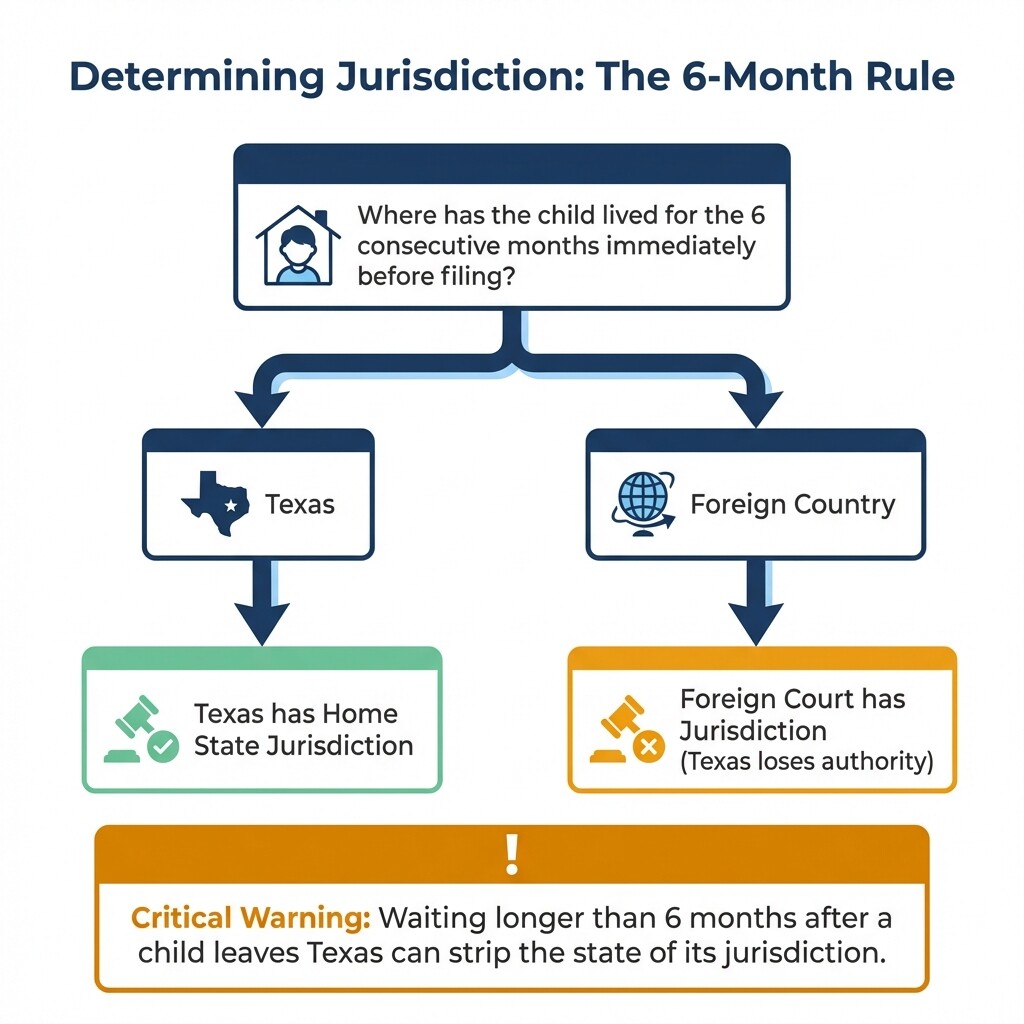
Jurisdiction in Texas is governed by the Uniform Child Custody Jurisdiction and Enforcement Act. This act dictates which state or country has the authority to make custody decisions. A frequent mistake is assuming Texas has jurisdiction simply because one parent lives in the state or holds United States citizenship. Citizenship does not affect custody jurisdiction under Texas law.
The primary factor for jurisdiction is the child's home state. This is the state or country where the child lived with a parent for at least six consecutive months immediately prior to the filing of a custody lawsuit.
Common jurisdictional mistakes include:
- Waiting too long: If a child stays in a foreign country for six months, that country may become the new home state and strip Texas of its jurisdiction.
- Simultaneous proceedings: Filing in Texas while a foreign court is already hearing the case often leads to dismissed petitions.
- Emergency jurisdiction limits: Texas courts can take temporary emergency jurisdiction if a child is present in the state and faces immediate danger, but this does not grant the court long-term authority over permanent custody.
Serving Foreign Spouses Under Texas Law
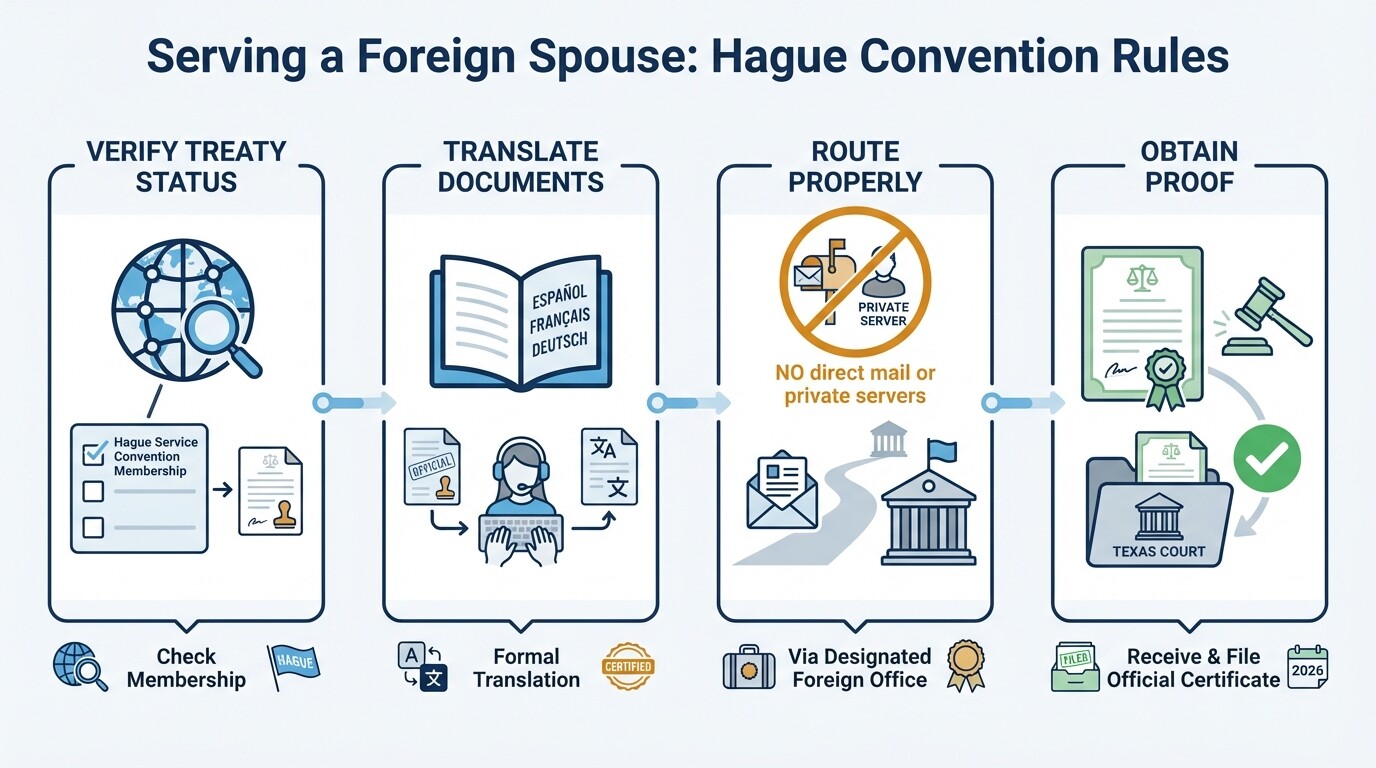
Serving legal papers to a spouse in a foreign country requires compliance with Texas long-arm statutes and international treaties like the Hague Service Convention. Failing to follow these procedures results in the court dismissing your case for lack of personal jurisdiction.
To bring an international spouse under the authority of a Texas court, you must demonstrate they have sufficient ties to the state. According to the Texas Constitution and Statutes, specifically within the Family Code, this could mean the spouse previously resided in Texas with the child or provided prenatal expenses within the state.
Service of process must follow international rules:
- Verify treaty status: Check if the spouse's country is part of the Hague Service Convention.
- Translate documents: Most foreign central authorities require the petition and summons to be formally translated into their official language.
- Route properly: You cannot mail the documents directly or hire a private process server. The paperwork must go through the foreign nation's designated government office.
- Obtain proof: The foreign government issues a certificate of service for you to file with the Texas court.
Modifying Foreign Custody Orders
Texas courts generally enforce a foreign custody order if the foreign court exercised jurisdiction in substantial conformity with Texas legal standards. To modify the order, you must formally register it in Texas and prove that the foreign court no longer has jurisdiction or has declined to exercise it.
Registering a foreign order requires certified copies of the original judgment and a certified translation if the document is not in English. You must also submit a sworn affidavit stating that the order has not been modified by another court.
Once registered, the foreign spouse has 20 days to contest the registration. If unchallenged, the order becomes enforceable as a Texas order. To change the custody terms, you must show a material and substantial change in circumstances since the foreign order was issued and prove the modification is in the child's best interest.
International Family Law Mediation
International mediation allows parents to negotiate custody, visitation, and travel arrangements outside of court with a neutral third party. This approach gives families direct control over highly specific cross-border parenting plans and avoids the heavy expense of litigation.
Parents can draft agreements that include:
- Virtual visitation: Factoring in multiple time zones for regular calls.
- Travel protocols: Designating who holds the child's passport, allocating flight costs, and requiring advance travel itineraries.
- Financial safeguards: Establishing travel bonds or escrow accounts that forfeit funds if a parent refuses to return the child.
Once signed, these mediated agreements can be filed with the court as a binding order.
Key Facts for Texas Cross-Border Custody
Many parents facing cross-border disputes operate on false assumptions. Understanding Texas family law prevents costly strategic errors.
- Passport control: Withholding a child's passport without a specific court order authorizing you to do so can escalate the conflict and damage your position with the judge.
- Gender neutrality: Texas law explicitly prohibits judges from considering the gender of the parent when determining custody and visitation rights.
- Supervised visits: If a Texas court determines there is a credible risk of international abduction, a judge can mandate that all visits take place in Texas under the supervision of an approved third party.
International Custody Dispute Checklist
Preparing for an international custody dispute requires careful organization before you file a legal petition. Use this checklist to stabilize your legal position.
- Secure the child's current passport and birth certificate in a safe location.
- Gather utility bills, school records, and medical records proving the child's habitual residence in Texas over the last six months.
- Collect written communications discussing the child's living arrangements with the other parent.
- Request certified copies of any existing marriage certificates or foreign custody orders.
- Hire an authorized service to translate foreign legal documents into English.
- Register with the State Department's Children's Passport Issuance Alert Program to receive alerts if the other parent attempts to apply for a new U.S. passport for the child.
Next Steps
Your priority is to establish the legal facts of your child's residency before the six-month jurisdictional window closes. Gather all documents proving where your child attends school and receives medical care. Then, seek out qualified lawyers for lawsuits and disputes who are licensed in Texas and have specific experience handling Hague Convention petitions. International custody requires an advocate who understands both Texas family law and international treaty application. Acting decisively is the most effective way to protect your parental rights.