- Businesses must implement mandatory opt-out mechanisms for automated decision-making and artificial intelligence profiling by 2026.
- Data minimization standards now strictly regulate cross-border transfers, requiring companies to prove international data sharing is absolutely necessary.
- Employee and business-to-business (B2B) data are fully classified as consumer data, meaning human resources files and vendor contacts require the exact same privacy protections as customer information.
- California remains the only US state with a dedicated privacy enforcement agency and explicitly denies a mandatory right to cure violations.
- International tech firms must complete comprehensive internal data audits and update all vendor agreements by Q4 2025 to avoid substantial non-compliance penalties in 2026.
What are the New 2026 Thresholds for Automated Decision-Making Opt-Outs?
California privacy laws now require businesses to give consumers the explicit right to opt out of automated decision-making technologies. This means if your company uses artificial intelligence or algorithms to profile users, you must provide a clear mechanism for users to reject this processing.
Automated decision-making refers to any system that processes personal information to evaluate consumer behavior, economic situation, health, personal preferences, or location without meaningful human involvement. Under the 2026 updates, international tech firms operating in California must implement highly visible opt-out links specifically addressing these technologies. If a consumer exercises this right, the business must immediately cease using their data for predictive profiling.
To comply, businesses must update their privacy interfaces. You will need a frictionless process for users to submit opt-out requests. Furthermore, companies are required to conduct pre-deployment risk assessments for any new algorithm that significantly impacts consumer rights, ensuring that AI tools do not inadvertently violate privacy standards before they even launch.
Mandatory Data Minimization Requirements for Cross-Border Transfers
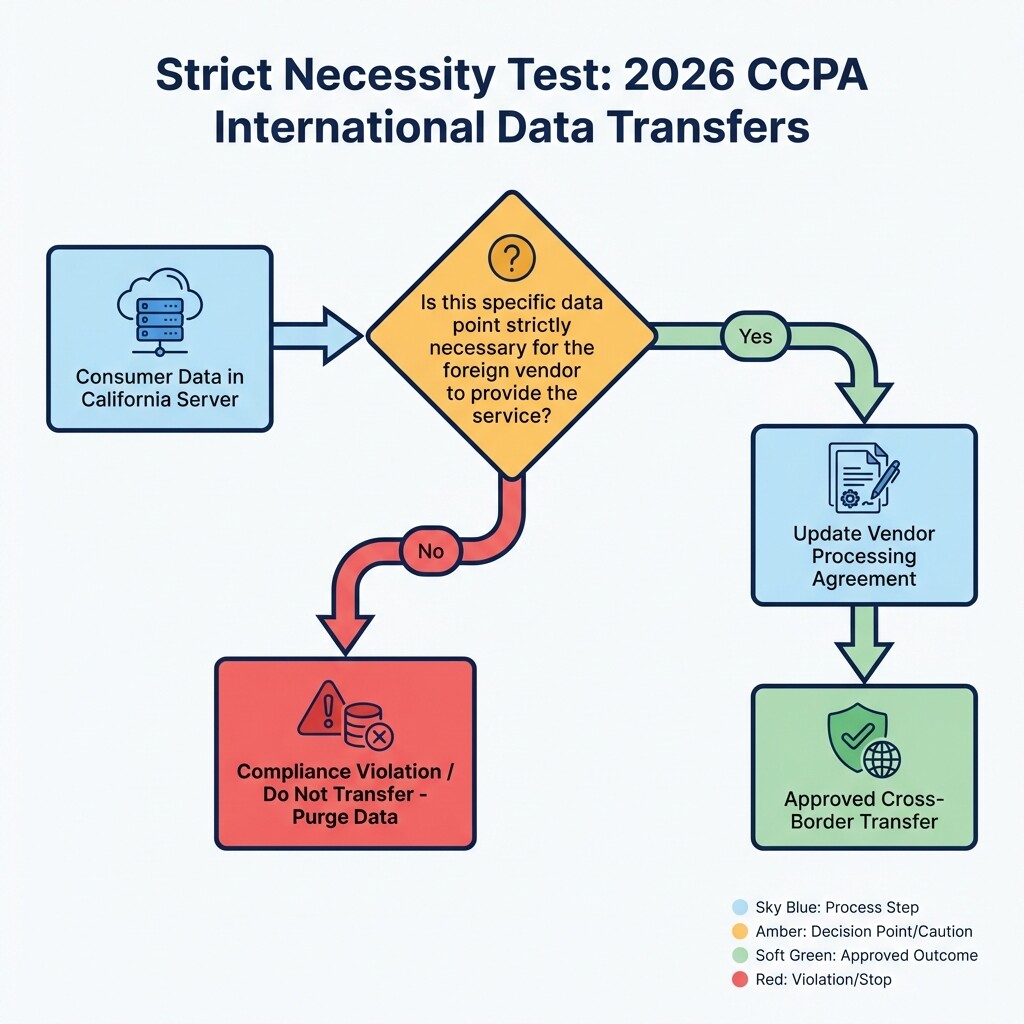
The 2026 updates strictly enforce data minimization for any personal information transferred across international borders. Companies are legally prohibited from collecting, storing, or transferring more data than is strictly necessary to provide the requested good or service.
For international tech firms, this significantly impacts how data moves from servers in California to overseas development teams or third-party vendors. You must implement aggressive data mapping to identify exactly what data leaves the United States. Before transferring data abroad, businesses must apply strict necessity tests. If a consumer's physical address is not required for a foreign vendor to perform a digital service, transferring that specific data point is a compliance violation.
Additionally, standard contractual clauses and vendor agreements must reflect these minimization standards. International data processing agreements now require explicit language stating that foreign subsidiaries or vendors will independently adhere to California data minimization rules and will immediately purge unnecessary data once a specific task is complete.
Common Mistakes in Processing Employee and B2B Data
A major compliance failure occurs when companies assume their own employees and business partners are exempt from consumer privacy laws. In California, all exemptions for human resources data and business-to-business contacts have expired, meaning these individuals hold the exact same privacy rights as retail consumers.
Many businesses mistakenly route employee data requests through standard HR channels instead of their formal privacy compliance teams. If an employee requests to know what personal data the company holds, or asks for its deletion, the company must respond within the strict statutory deadlines set for consumer requests. Failing to track employee surveillance data, such as badge swipes or software monitoring metrics, is a common trap that leads to hefty regulatory fines.
Another frequent error involves B2B vendor contacts. Tech firms often share vendor contact lists with third-party marketing partners without securing proper consent or providing an opt-out mechanism. Businesses must audit their internal directories, applicant tracking systems, and vendor management portals to ensure every individual represented in those databases is provided a compliant privacy notice.
California Enforcement vs. Other US State Privacy Laws
California enforces its privacy laws far more aggressively than other jurisdictions, primarily because it funds an independent regulatory body dedicated solely to privacy enforcement. While other states offer businesses a safety net to fix mistakes, California expects absolute compliance upon the effective date of new regulations.
| Feature | California (CCPA/CPRA) | Virginia (VCDPA) | Colorado (CPA) |
|---|---|---|---|
| Enforcement Body | Independent California Privacy Protection Agency (CPPA) | State Attorney General | State Attorney General & District Attorneys |
| Right to Cure | None (Immediate penalties apply) | 30 days | 60 days |
| B2B & Employee Data | Fully protected | Exempt | Exempt |
| Automated Profiling | Strict opt-out & mandatory risk assessments | Opt-out required | Opt-out & impact assessments required |
| Global Privacy Control | Mandatory compliance | Discretionary | Mandatory compliance |
Because California has eliminated the mandatory 30-day cure period, companies can be fined up to $7,500 per intentional violation the moment an audit uncovers non-compliance. This is uniquely challenging for international tech firms accustomed to the European GDPR model, making rigorous proactive compliance essential. You can review official enforcement guidelines directly through the California Privacy Protection Agency.
2026 CCPA Internal Audit Checklist and Timeline
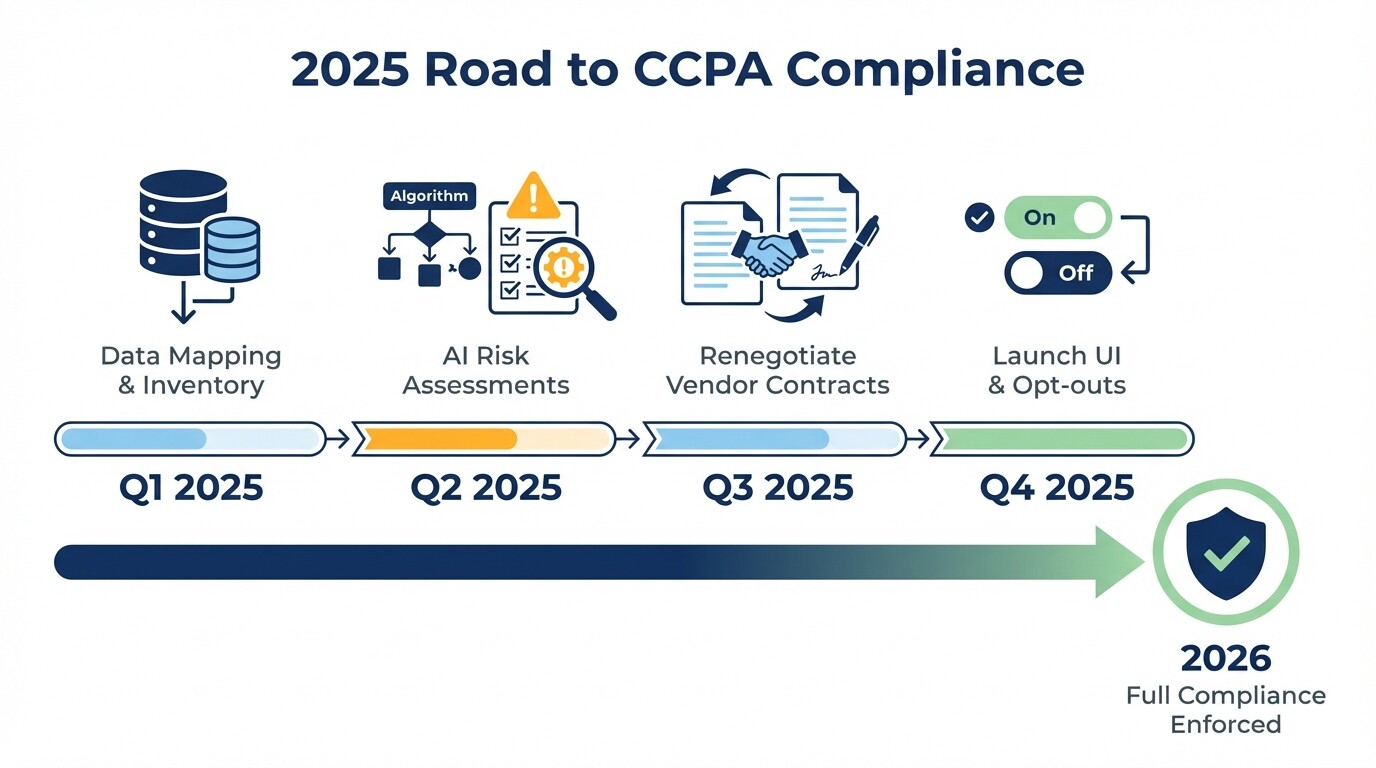
To achieve compliance by 2026, organizations must adopt a phased approach to auditing their data systems. Preparation must begin well in advance to ensure technical teams have time to build necessary opt-out mechanisms and legal teams can renegotiate vendor contracts.
Compliance Timeline:
- Q1 2025: Conduct complete data mapping and inventory of all cross-border data flows.
- Q2 2025: Execute risk assessments for all AI and automated decision-making tools.
- Q3 2025: Renegotiate contracts with third-party vendors and foreign subsidiaries.
- Q4 2025: Launch and test new user interfaces for AI opt-outs and data deletion requests.
Internal Audit Checklist:
- Map all personal information collected from California residents, including employees and B2B contacts.
- Verify that a "Do Not Sell or Share My Personal Information" link is prominently displayed.
- Build a dedicated "Limit the Use of My Sensitive Personal Information" mechanism.
- Audit algorithms to ensure an opt-out path exists for automated decision-making.
- Review cross-border data transfer logs and delete any data failing the strict necessity test.
- Update internal human resources manuals to include privacy request protocols for employees.
- Confirm your website automatically detects and respects Global Privacy Control (GPC) browser signals.
Common Misconceptions About CCPA Compliance
A prevalent myth is that a company must have physical offices in California to be subject to the law. In reality, the law applies to any for-profit entity doing business in California that meets specific revenue or data-volume thresholds, regardless of where the company is headquartered globally.
Another frequent misconception is that anonymized data is entirely free from regulation. While truly aggregated data is exempt, many companies mistakenly believe simply removing a name constitutes anonymization. If data can be reasonably linked back to a consumer or household through IP addresses, device IDs, or behavioral patterns, California still regulates it as personal information.
Finally, many executives believe that standard data processing agreements cover all privacy liabilities. However, California law requires specific, prescriptive language in vendor contracts. If your contract lacks mandatory clauses prohibiting the vendor from combining your data with other datasets, your business remains fully liable for that vendor's privacy breaches.
Frequently Asked Questions (FAQs)
Who must comply with the 2026 California privacy updates?
Any for-profit business that targets California residents and either has a gross annual revenue over $25 million, buys or sells the personal information of 100,000 or more consumers, or derives 50% or more of its revenue from selling or sharing personal data.
What are the fines for violating California privacy regulations?
The regulatory agency can issue administrative fines of $2,500 per standard violation and up to $7,500 for intentional violations or violations involving the personal data of minors. These fines are calculated per consumer, meaning a single data misuse affecting thousands of users can result in massive penalties.
Does our company need a dedicated Data Protection Officer (DPO)?
While the European GDPR mandates a DPO in many cases, California law does not explicitly require a specific DPO title. However, businesses must designate individuals responsible for privacy compliance and provide their contact information in public privacy notices.
How long do we have to respond to a consumer privacy request?
Businesses must respond to verifiable consumer requests to know, delete, or correct personal information within 45 days of receipt. An extension of an additional 45 days is permitted if the business notifies the consumer within the initial timeframe.
When to Hire a Lawyer
Navigating technical privacy thresholds requires specialized legal guidance, particularly when cross-border data transfers and artificial intelligence are involved. You should hire legal counsel immediately if your business is launching new automated profiling tools, transferring consumer data to foreign servers, or renegotiating software-as-a-service vendor agreements.
A legal professional will conduct a privileged gap analysis of your current data practices, ensuring your audit findings do not inadvertently expose you to liability. If your company receives an inquiry from the California Privacy Protection Agency or a demand letter from an employee regarding their data rights, retaining experienced corporate governance counsel is critical to executing a defensible response strategy.
Next Steps
Your immediate priority is to mobilize a cross-functional compliance team involving your IT, legal, and human resources departments. Begin by executing a comprehensive data mapping exercise to understand exactly where your employee, B2B, and consumer data resides. Once your data inventory is clear, review your automated decision-making technologies and plan the technical infrastructure needed for consumer opt-outs.
For international businesses, securing compliant vendor contracts is highly complex. To protect your operations from severe regulatory penalties, consider consulting with corporate governance lawyers in the United States who specialize in California privacy law and cross-border tech compliance. Addressing these structural changes now guarantees your firm will be fully prepared for the strict enforcement landscape of 2026.