


- New York law limits security deposits to a maximum of one month's rent, regardless of a tenant's citizenship or credit history.
- Landlords are prohibited from discriminating against tenants based on their immigration status or national origin under the NYC Human Rights Law.
- Security deposits must be returned within 14 days of the tenant vacating the unit, along with an itemized statement of any deductions.
- International guarantors are often rejected by NYC landlords, but legal alternatives like institutional guarantors provide a path to securing a lease.
- Legal representation in NYC Housing Court typically ranges from $2,500 to $7,000, depending on the complexity of the dispute.
New York Lease Review Checklist for Foreign Nationals
Foreign nationals often face unique hurdles when signing a New York City lease, such as lack of a US credit history or Social Security Number. Before signing any rental agreement, use this checklist to ensure the terms comply with the Housing Stability and Tenant Protection Act of 2019 and protect your rights as an international resident.
- Deposit Limit: Confirm the security deposit is exactly one month's rent. It is illegal for a landlord to ask for "prepaid rent" or a double deposit because you lack a US credit score.
- International Guarantor Clause: If using a third-party service like Insurent or TheGuarantors, ensure the lease explicitly recognizes them as the guarantor.
- Utility Responsibilities: Clarify which utilities (heat, water, electricity) are included. In NYC, landlords are generally required to provide heat and hot water.
- Subletting Provisions: Verify that the lease does not waive your statutory right to sublet or have a roommate, as these rights are protected by New York State law.
- Notice Periods: Check the required notice period for non-renewal. For tenancies between one and two years, the landlord must give 60 days' notice of rent increases over 5% or non-renewal.
- Condition Disclosure: Ensure there is a move-in inspection report attached to prevent the landlord from claiming your security deposit for pre-existing damage.
Common Mistakes with International Guarantors
New York landlords frequently refuse to accept guarantors who live outside the United States because it is difficult to enforce a judgment in foreign courts. This often leads to foreign nationals being asked for illegal "extra" security deposits or upfront rent payments to mitigate the landlord's perceived risk.
While a landlord is not legally required to accept an international guarantor, they are legally prohibited from demanding more than one month's rent as a security deposit. To navigate this, many expats use the following strategies:
- Institutional Guarantors: Companies that act as a co-signer for a fee (usually 70-85% of one month's rent).
- Proof of Liquid Assets: Providing bank statements showing 40-80 times the monthly rent in a US or international account.
- Employer Verification: A formal letter from a US-based employer stating your salary and employment duration can sometimes bypass the need for a guarantor.
How to Reclaim a Security Deposit as a Non-Resident
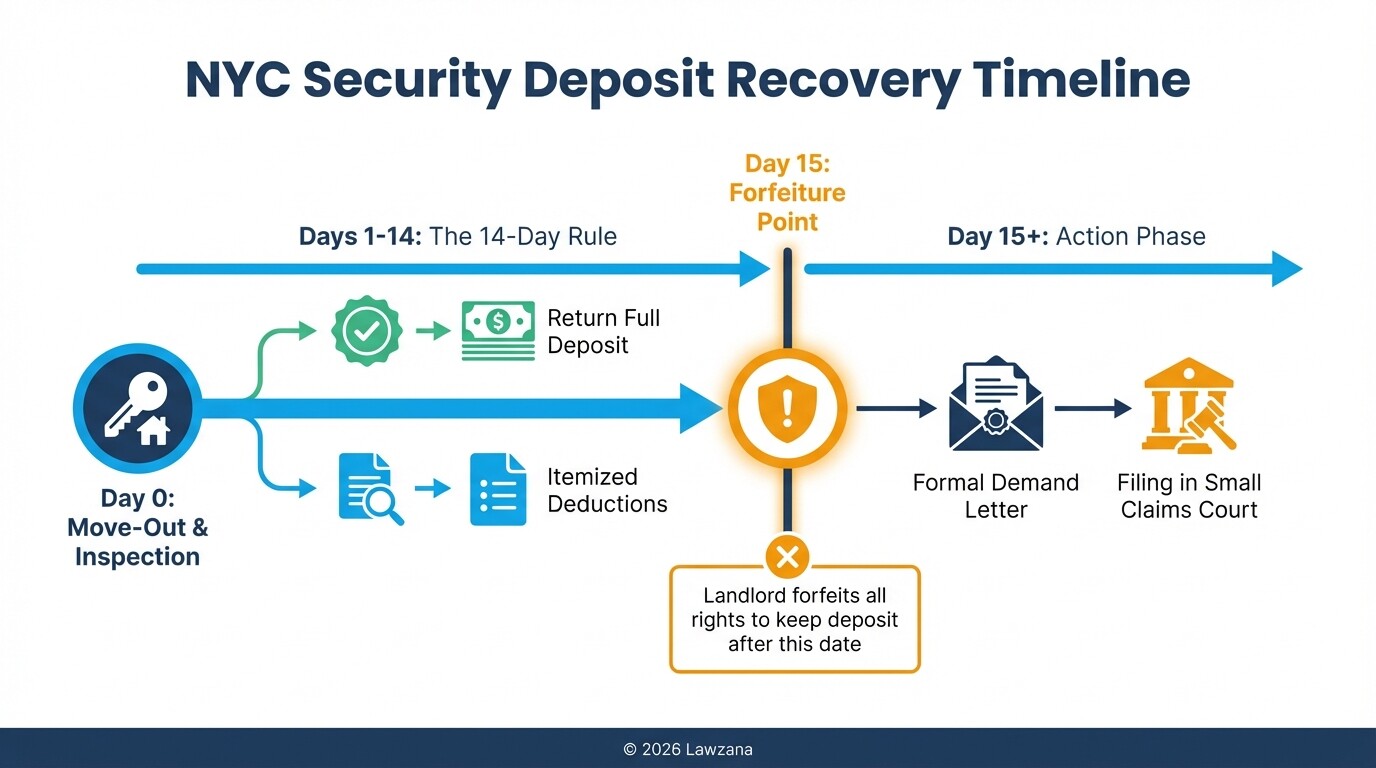
New York law requires landlords to return a security deposit within 14 days of the tenant vacating the apartment. If any portion is withheld, the landlord must provide an itemized statement explaining the costs of repairs, or they forfeit the right to keep any part of the deposit.
For foreign nationals who have already left the country, the process of reclaiming a deposit requires proactive documentation. Follow these steps to ensure your funds are returned:
- Request a Walk-Through: Notify your landlord in writing that you want a move-out inspection. You have a right to be present to contest any claimed damages on the spot.
- Document Everything: Take high-resolution photos and videos of the empty apartment, focusing on floors, walls, and appliances.
- Provide a Forwarding Address: Give the landlord a mailing address (or a trusted friend's US address) where the check can be sent.
- The Demand Letter: If 14 days pass without a refund or itemization, send a formal "Demand for Return of Security Deposit."
Sample Security Deposit Demand Letter
[Your Name] [Current Address/Email] [Date]
[Landlord/Management Company Name] [Address]
Re: Return of Security Deposit - [Apartment Address]
Dear [Landlord Name],
I am writing to formally demand the return of my security deposit in the amount of $[Amount] for the apartment located at [Address]. I vacated the premises on [Date] and provided my forwarding address at that time.
Under New York State General Obligations Law § 7-108, landlords must provide an itemized statement and the remaining balance of the security deposit within 14 days of the tenant vacating the unit. As of today, [Number] days have passed, and I have not received the deposit or an itemized list of deductions.
Please be advised that under New York law, the failure to provide this itemization within 14 days results in the forfeiture of your right to retain any portion of the deposit. If the full amount is not received by [Date], I will be forced to pursue legal action in Small Claims Court, where I may be entitled to up to double the amount of the deposit in punitive damages.
Please send the funds via [Check/Wire/Zelle] to the following: [Payment Details]
Sincerely, [Your Name]
Understanding Roommate Laws and Subletting Restrictions
The New York "Roommate Law" (Real Property Law § 235-f) grants most residential tenants the right to share their apartment with one additional occupant and that person's dependent children. This right exists regardless of what your lease says, as long as you (the primary tenant) continue to live in the apartment as your primary residence.
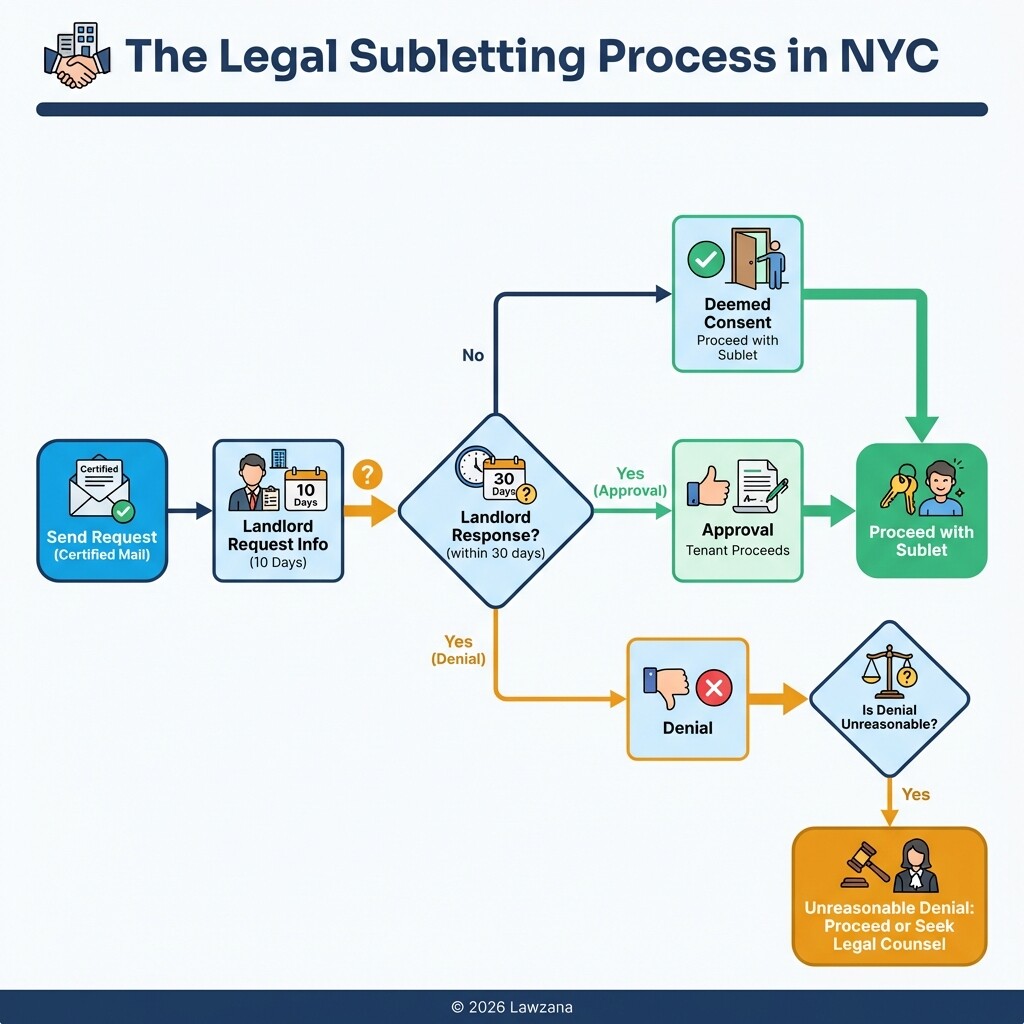
For foreign nationals, subletting is often necessary during extended trips home or academic breaks. In New York, a tenant in a building with four or more units has a statutory right to sublet with the landlord's consent, which cannot be "unreasonably withheld."
- Procedure: You must send a request via certified mail, return receipt requested, including the subtenant's information and the reason for subletting.
- Landlord Response: The landlord has 30 days to ask for more information or 30 days to approve/deny. If they do not respond, it is deemed as consent.
- Visa Considerations: Ensure your subtenant understands that your lease is tied to your legal residency status; however, the landlord cannot deny a sublet based solely on the subtenant's nationality.
Cost Estimates for Housing Court Representation
Legal fees for residential lease disputes in New York City typically range from $2,500 to $7,000 for a standard case. These costs vary based on whether the attorney charges a flat fee for specific actions or an hourly rate, which often ranges from $300 to $600 per hour for experienced tenant attorneys.
| Service Type | Estimated Cost (USD) | What it Covers |
|---|---|---|
| Demand Letter/Consultation | $350 - $750 | Reviewing the lease and sending an official legal warning to the landlord. |
| Small Claims (Security Deposit) | $1,000 - $2,500 | Preparing the filing and representing the tenant in Small Claims Court. |
| Housing Court Defense | $3,000 - $7,000 | Full representation for non-payment or holdover proceedings, including hearings. |
| Lease Negotiation | $500 - $1,500 | Reviewing and amending lease terms before signing for international clients. |
Protections Against Discrimination Based on Citizenship
The New York City Human Rights Law strictly prohibits landlords, brokers, and property managers from discriminating against tenants based on their actual or perceived immigration status or citizenship. This means a landlord cannot refuse to rent to you simply because you are on an F-1, J-1, or H-1B visa.
Specific protections for foreign nationals include:
- No Extra Documentation: While landlords can ask for proof of identity and ability to pay rent, they cannot use your immigration status to harass you or demand "extra" documentation that they do not require from US citizens.
- Prohibited Threats: It is illegal for a landlord to threaten to call Immigration and Customs Enforcement (ICE) to coerce a tenant into leaving or paying more rent.
- Language Access: Harassment based on a tenant's limited English proficiency is also a violation of the NYC Human Rights Law.
If you believe you have faced discrimination, you can file a complaint with the NYC Commission on Human Rights.
Common Misconceptions About NYC Lease Disputes
"I cannot sue my landlord if I am not a US citizen." This is false. Access to the New York City Housing Court and Small Claims Court is open to anyone regardless of their immigration status. Your status in the country does not invalidate your rights under a residential lease.
"The landlord can keep my deposit if I move back to my home country." A landlord cannot keep your deposit just because you are leaving the US. The same 14-day rule applies. If you move abroad, you can still sue in Small Claims Court, and many proceedings are now handled virtually, allowing you to participate from your home country.
"My landlord can enter my apartment anytime if they suspect I've left the country." In NYC, landlords must provide at least 24 hours' notice to enter for repairs and 24 hours' notice for inspections. They cannot enter your home without notice just because you are a foreign national, unless there is a genuine emergency (e.g., a burst pipe).
FAQ
Can a NYC landlord ask for my passport?
Yes, a landlord can ask for a passport or visa as a form of government-issued photo identification to verify your identity. However, they cannot use this information to discriminate against you or demand higher fees than those charged to US citizens.
What happens if I have to break my lease to return to my home country?
New York law requires landlords to "mitigate damages," meaning they must make a reasonable effort to re-rent the apartment if you leave early. You are responsible for the rent until a new tenant is found, but the landlord cannot simply let the apartment sit empty and charge you for the remainder of the lease.
How do I get my deposit back if I don't have a US bank account anymore?
You can request that the landlord return the deposit via a wire transfer or an international bank draft. You may have to cover the transaction fees, but the landlord must make a reasonable effort to return the funds to you.
When to Hire a Lawyer
You should consult a New York tenant attorney if your landlord has served you with a "Notice to Quit" or an "Eviction Petition," or if they are withholding a security deposit exceeding $5,000 (the Small Claims limit). Legal counsel is also highly recommended if you face harassment or threats regarding your immigration status, as you may be entitled to significant damages under NYC Human Rights laws. For foreign nationals, having an attorney ensures that your rights are protected even if you are unfamiliar with the local court system or have language barriers.
Next Steps
- Gather Documentation: Collect your lease agreement, all proof of rent payments, and any correspondence with your landlord (emails and texts).
- Send a Formal Notice: If you have a dispute, send a clear, written explanation of the issue to the landlord via certified mail.
- Contact the Tenant Helpline: For free advice on your rights, you can call the NYC Tenant Helpline by dialing 311.
- Consult an Attorney: If the landlord remains unresponsive, schedule a consultation with a lawyer specializing in NYC residential real estate to evaluate your case for Housing Court.