- California law strictly prohibits non-compete agreements, making them unenforceable even if your contract was signed in another country or state.
- To qualify as an "exempt" executive and avoid overtime requirements, you must earn a minimum salary that is at least twice the California state minimum wage.
- Intellectual property (IP) protections in California favor the employee for inventions created on personal time without using company resources.
- Relocating as a foreign executive typically requires an L-1 or E-2 visa, with legal fees ranging from $3,000 to $10,000 depending on complexity.
- Misclassifying an executive as an independent contractor is legally risky due to California's stringent "ABC test" for employment status.
Foreign Executive Relocation and Contract Checklist
International transfers involve complex legal overlaps between federal immigration law and California state employment law. Use this checklist to ensure your contract and relocation plan meet local standards before you start your role in 2026.
- Visa Status Verification: Confirm that your underlying visa (e.g., L-1A for managers or E-2 for treaty investors) allows for the specific duties outlined in your job description.
- Non-Compete Audit: Review existing and new contracts to identify "Restraint of Trade" clauses. Ensure the employer has provided written notice that any prior non-compete clauses are void, as required by California law.
- Salary Threshold Check: Verify that your base salary meets the California "Executive Exemption" threshold (calculated as 2x the state minimum wage for 2,080 hours per year).
- Labor Code 2870 Notice: Ensure your contract includes the mandatory disclosure that IP assignments do not apply to inventions created on your own time using your own equipment.
- Relocation and Tax Equalization: Confirm if the contract includes a "gross-up" for taxes on relocation benefits, as California taxes worldwide income for residents.
- Arbitration and Choice of Law: Check if the contract mandates arbitration. Under California Labor Code Section 925, you cannot be forced to litigate or arbitrate a California-based dispute outside of California or under another state's laws.
California Absolute Ban on Non-Compete Agreements
California Business and Professions Code Section 16600 voids almost every contract that restrains an individual from engaging in a lawful profession, trade, or business. This ban is a matter of fundamental public policy, meaning it applies to all employees working in California, regardless of where the employer is headquartered or where the contract was originally signed.
In 2024, California strengthened these protections with Senate Bill 699 and Assembly Bill 1076. These laws make it a civil violation for an employer to even attempt to enforce a non-compete clause or to include one in a new contract. If you are moving from a jurisdiction where non-competes are standard (like the UK, Singapore, or New York), your previous restrictive covenants generally become unenforceable the moment you begin working in California. Employers are also required to provide individualized written notice to current and former employees that any previously signed non-compete clauses are void.
Wage and Hour Compliance for Salaried Foreign Executives
Foreign executives in California are entitled to overtime pay unless they meet the specific criteria for the "Executive Exemption." To be exempt, you must be primarily engaged in management duties, regularly exercise discretion and independent judgment, and earn a fixed salary of at least twice the California state minimum wage.
The salary threshold for exempt status increases annually based on inflation and minimum wage adjustments. As of 2024, the minimum salary for an exempt employee is $66,560 per year, but this is expected to be higher by 2026. If your duties are primarily functional rather than managerial-or if your salary falls below the threshold-California law requires you to be paid "time-and-a-half" for any work exceeding eight hours in a day or 40 hours in a week. Foreign executives often work long hours across multiple time zones; without a valid exemption, this can lead to significant "wage theft" claims against the employer.
Protecting Intellectual Property in California Contracts
California Labor Code Section 2870 prevents employers from claiming ownership of inventions that an employee develops entirely on their own time without using the employer's equipment, supplies, or trade secret information. Any provision in an employment agreement that requires an employee to assign such inventions to the employer is unenforceable under California law.
While California is an "IP-friendly" state for employers regarding work done within the scope of employment, the law protects your personal innovation. When reviewing your contract, look for a "Schedule of Prior Inventions" where you can list IP you already own.
Sample Intellectual Property Disclosure Clause
"In accordance with California Labor Code Section 2870, Employee is hereby notified that this Agreement does not apply to an invention that the Employee developed entirely on his or her own time without using the Employer's equipment, supplies, facilities, or trade secret information except for those inventions that either: (1) Relate at the time of conception or reduction to practice of the invention to the Employer's business, or actual or demonstrably anticipated research or development of the Employer; or (2) Result from any work performed by the Employee for the Employer."
Estimated Costs for Legal Support and Visa Processing
Relocating an executive to California involves both immigration filing fees and legal fees for contract negotiation. While the employer usually covers these costs, executives should understand the breakdown to ensure their relocation package is sufficient.
| Service Type | Estimated Cost (USD) | Timeline |
|---|---|---|
| L-1A Visa (Intracompany Transferee) | $5,000 - $10,000 | 3-6 months (or 15 days with Premium) |
| E-2 Visa (Treaty Investor) | $6,000 - $12,000 | 2-5 months |
| Executive Contract Review | $2,500 - $7,500 | 1-2 weeks |
| Tax Equalization Advice | $1,500 - $4,000 | 1 week |
Filing fees paid to U.S. Citizenship and Immigration Services (USCIS) are separate from legal fees and can vary based on company size and the need for "Premium Processing," which currently costs an additional $2,805 to expedite the decision.
Independent Contractor vs. Employee Status for Executives
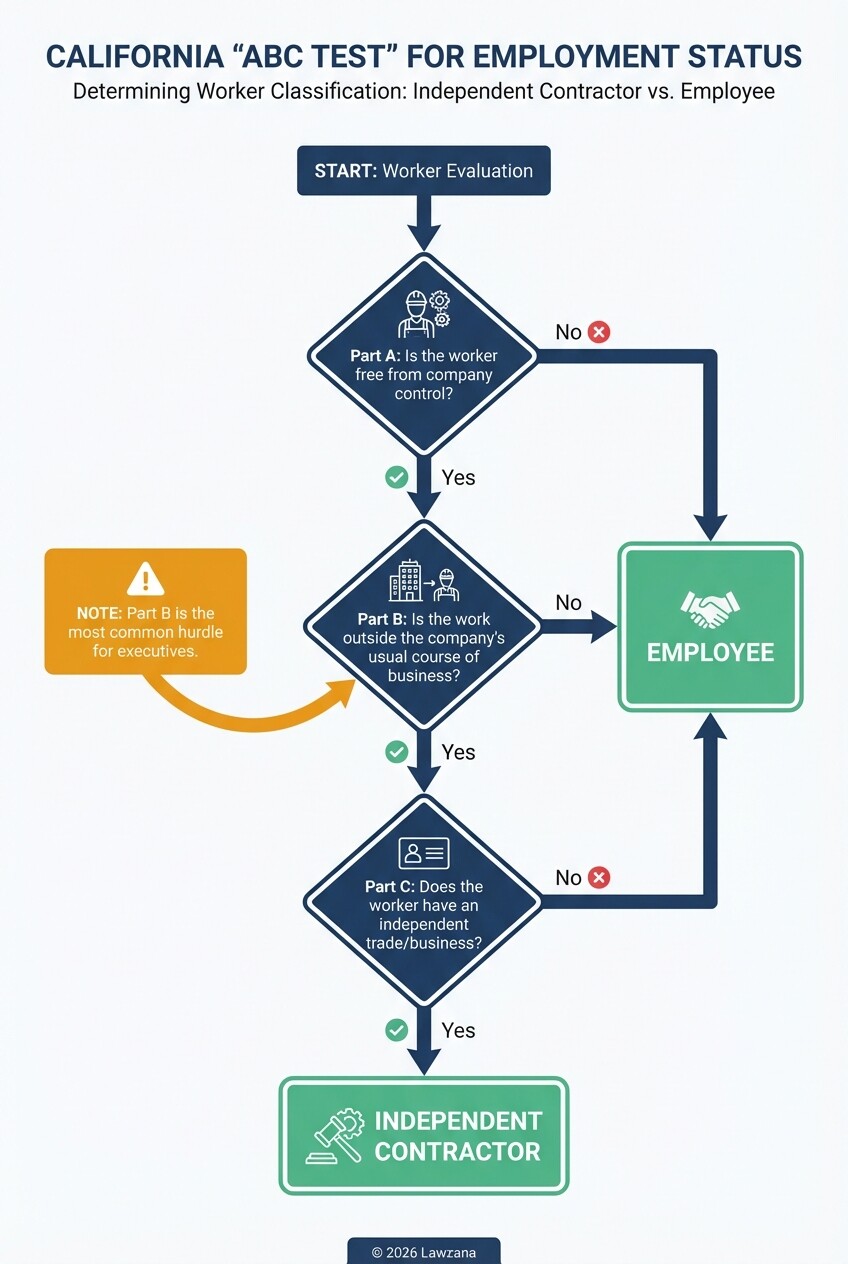
California uses the "ABC test" to determine if a worker is an employee or an independent contractor, as codified in Assembly Bill 5 (AB5). It is exceptionally difficult for a foreign executive to qualify as an independent contractor if they are performing core business functions for a California-based company.
To be legally classified as an independent contractor, the hiring entity must prove:
- The person is free from the control and direction of the hiring entity in connection with the performance of the work.
- The person performs work that is outside the usual course of the hiring entity's business.
- The person is customarily engaged in an independently established trade, occupation, or business of the same nature as that involved in the work performed.
For most foreign executives transferring into a leadership role, "Part B" of this test is the primary hurdle. If you are the CEO or a VP, your work is intrinsically part of the company's "usual course of business." Misclassification can lead to the loss of workers' compensation, unemployment insurance, and disability protections, and it may also jeopardize the validity of your work visa.
Common Misconceptions About California Employment Law
"My foreign employment contract is still valid in California."
Many executives believe that if they have a contract governed by the laws of London, Paris, or Tokyo, those laws will protect the employer in a California court. However, California Labor Code Section 925 prevents employers from requiring employees who reside and work in California to agree to a provision that would require them to adjudicate a dispute outside of California or deprive them of the substantive protection of California law.
"I don't need to worry about overtime because I have a high salary."
A high salary alone does not make an executive exempt from overtime. You must also meet the "duties test," which requires that you spend more than 50% of your time on truly managerial tasks. In California, if you spend most of your day performing the same production work as your subordinates, you may be entitled to overtime regardless of your $200,000+ salary.
"At-will employment means I can be fired for any reason."
While California is an "at-will" state, this does not allow for termination based on discrimination, retaliation, or violations of public policy. Furthermore, many executive contracts include "For Cause" provisions that override the default at-will status, providing a layer of job security that requires the employer to prove specific misconduct before termination.
FAQ
Can my employer fire me if I refuse to sign a non-compete?
No. In California, it is illegal for an employer to terminate an employee or refuse to hire a candidate for refusing to sign a non-compete agreement. Such an action would likely constitute wrongful termination in violation of public policy.
What happens to my stock options if I am terminated?
Stock option vesting is typically governed by a separate Equity Incentive Plan. However, California law requires that all earned and unpaid wages (which can include certain types of bonuses) be paid immediately upon termination. Review your specific Grant Agreement to see if it includes "Double-Trigger" acceleration in the event of a change in control.
Am I entitled to meal and rest breaks as an executive?
If you are properly classified as an "exempt" executive, you are not entitled to the mandatory 30-minute meal breaks and 10-minute rest periods required for non-exempt workers. If you are "non-exempt," your employer must provide these breaks or pay a penalty.
Is my employer required to pay for my relocation to California?
There is no statutory requirement in California for an employer to pay relocation costs. However, these are standard components of executive "move packages." Ensure these benefits are explicitly detailed in your offer letter, including any "repayment" or "clawback" clauses if you leave the company within a certain timeframe.
When to Hire a Lawyer
You should consult a California employment attorney if your employer asks you to sign an agreement containing restrictive covenants, such as non-competes or broad non-solicitation clauses. Legal counsel is also essential if there is a discrepancy between your visa job description and your actual daily duties, as this can lead to both immigration and wage-hour complications. If you are negotiating a "C-suite" level package with significant equity or "golden parachute" provisions, a localized review ensures these clauses are enforceable under the California Department of Industrial Relations guidelines.
Next Steps
- Review Your Current Contract: Check for any "Choice of Law" or "Choice of Forum" clauses that attempt to move disputes out of California.
- Request a Written Job Description: Ensure your duties align with the "Executive Exemption" to avoid future wage disputes.
- Audit Your IP: Prepare a list of all patents or proprietary processes you owned prior to your California start date.
- Negotiate Relocation Terms: Confirm that your package covers tax preparation services, as California's tax system is notably complex for high-earners.
- Secure Local Counsel: Have a California-based attorney review your final offer letter and any ancillary non-disclosure agreements (NDAs).