Drafting Enforceable Joint Venture Contracts with Local Partners in Kenya
- Structuring a joint venture in Kenya requires choosing between a registered equity company and a purely contractual partnership, each carrying different tax and liability implications.
- Foreign investors must explicitly protect intellectual property through localized licensing clauses that prevent local partners from claiming ownership of imported brands or technology.
- Profit-sharing models must account for the Kenya Revenue Authority withholding tax rates on dividend repatriation and cross-border service fees.
- All joint ventures must be evaluated against the Competition Authority of Kenya merger guidelines to ensure compliance with current and upcoming antitrust regulations.
- Dispute resolution clauses should prioritize arbitration seated in Kenya, utilizing the Nairobi Centre for International Arbitration to bypass lengthy court delays.
Equity vs Contractual Joint Venture Structures
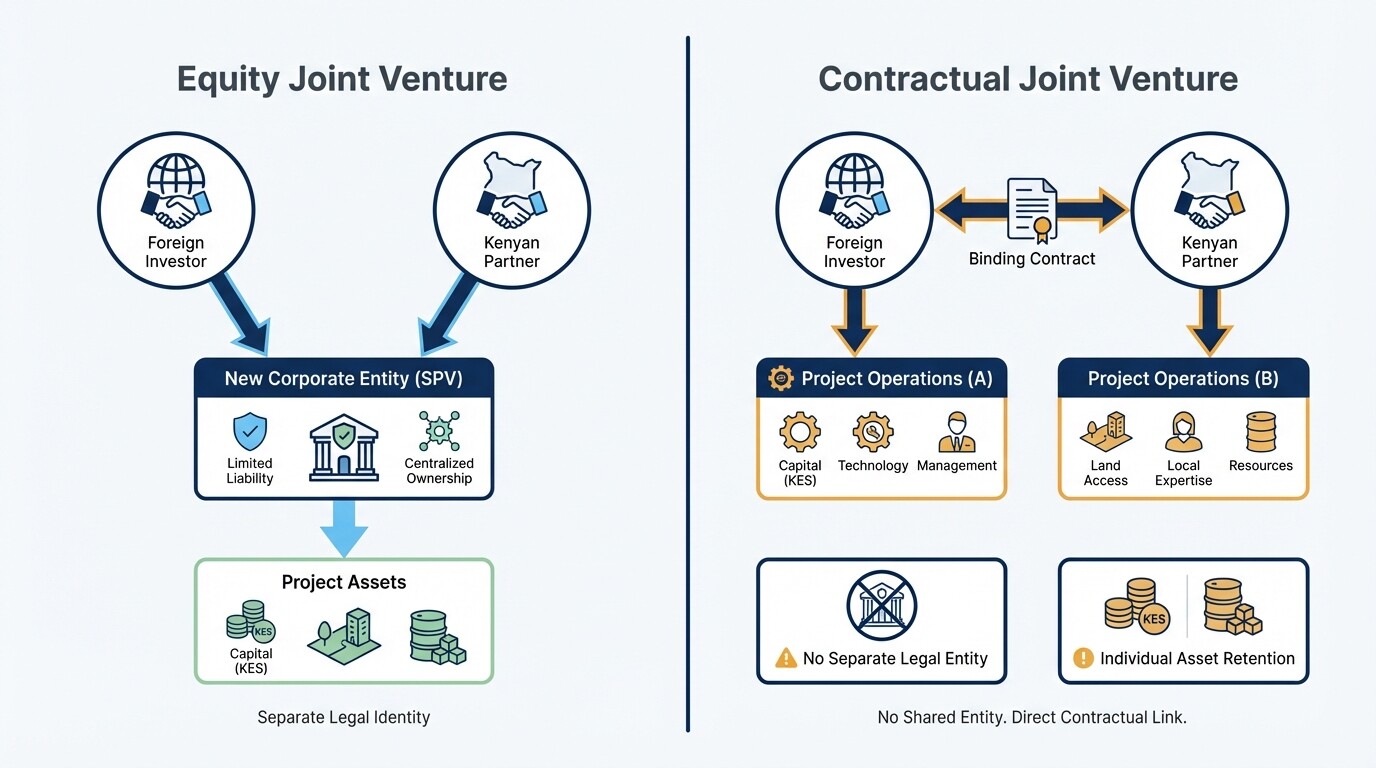
Foreign investors and Kenyan partners must select a structure based on the project lifespan, risk tolerance, and tax strategy. You can either form a new corporate entity together (Equity Joint Venture) or collaborate through a binding agreement without forming a new company (Contractual Joint Venture).
An Equity Joint Venture involves incorporating a Special Purpose Vehicle under the Companies Act of 2015. A Contractual Joint Venture is an unincorporated partnership governed entirely by the terms of your contract.
| Feature | Equity Joint Venture (New SPV) | Contractual Joint Venture |
|---|---|---|
| Legal Status | Separate legal entity from its founders. | No separate legal entity. |
| Liability | Limited to the partners' share capital contributions. | Joint and several liability based on contract terms. |
| Setup Cost | Higher (incorporation fees, KRA PIN registration). | Lower (primarily contract drafting fees). |
| Asset Ownership | The new company owns the project assets. | Partners retain individual ownership of their assets. |
| Best For | Long-term projects, manufacturing, real estate development. | Short-term projects, government procurement bids, service delivery. |
Joint Venture Agreement Drafting Checklist
A robust joint venture agreement provides a clear roadmap for daily operations, financial contributions, and eventual separation. This checklist ensures your contract covers all essential operational and legal requirements under Kenyan law.
- Define the exact scope and objective of the joint venture.
- Specify the management structure, including board representation and voting rights.
- Detail the timeline and currency for initial capital contributions.
- Outline the valuation method for non-cash contributions like land or technology.
- Establish clear procedures for resolving deadlocks among the board of directors.
- Define the conditions under which either party can exit the partnership.
- Include non-compete and non-solicitation clauses applicable during and after the venture.
- Mandate regular financial reporting and independent audit schedules.
Essential Contractual Clauses for Protecting Foreign Intellectual Property
Protecting your intellectual property in Kenya requires precise contractual boundaries that separate background intellectual property from newly created intellectual property. Foreign investors must explicitly license their trademarks, patents, or software to the joint venture rather than transferring ownership.
Background IP refers to the assets you bring into the partnership. Foreground IP refers to new intellectual property created jointly during the venture. Your contract must specify that all background IP remains the exclusive property of the foreign investor, and it must dictate who owns foreground IP upon termination of the partnership.
Sample Intellectual Property Retention Clause
"The Parties agree that all intellectual property rights owned by the Foreign Investor prior to the Effective Date (Background IP) shall remain the sole and exclusive property of the Foreign Investor. The Foreign Investor hereby grants the Joint Venture a non-exclusive, non-transferable, revocable license to use the Background IP solely for the purpose of executing the Joint Venture objectives within the Republic of Kenya. Upon termination of this Agreement, the Joint Venture shall immediately cease all use of the Background IP."
Documenting Capital Contributions and International Profit-Sharing Models
Clear documentation of capital contributions and profit distribution prevents financial disputes and ensures compliance with the Central Bank of Kenya regulations. Your contract must detail whether contributions are made in Kenyan Shillings (KES) or foreign currency and how currency fluctuation risks are shared.
When drafting profit-sharing models, you must account for local tax obligations. Foreign partners repatriating profits will face withholding taxes, generally set at 15 percent for dividends paid to non-residents unless a Double Taxation Agreement lowers the rate. The contract should clearly state whether profit shares are calculated before or after tax liabilities are settled.
- Quantify Contributions: State the exact monetary value of all cash investments, equipment, and intellectual property provided by both partners.
- Set Contribution Timelines: Establish firm deadlines for capital injections and outline penalties for delayed funding.
- Define the Distribution Waterfall: Create a prioritized list detailing how generated cash flow will be used to pay off venture debts, fund reserves, and distribute remaining profits to partners.
- Address Currency Risk: Specify the exchange rate benchmark (such as the Central Bank of Kenya daily rate) for converting KES profits into the foreign partner's local currency.
Compliance with Kenyan Antitrust and Foreign Ownership Laws
Foreign investors must structure their joint ventures to comply with local ownership caps and rigorous antitrust scrutiny. Heading into 2026, the Competition Authority of Kenya (CAK) actively treats many equity joint ventures as mergers, requiring formal regulatory approval before operations can begin.
Foreign ownership is broadly permitted in Kenya, but specific sectors mandate local participation. For example, telecommunications and private security companies require minimum percentages of Kenyan ownership. Furthermore, if the combined turnover or assets of the joint venture partners meet specific financial thresholds, you must submit a formal filing to the Competition Authority of Kenya to ensure the partnership does not restrict market competition.
Pre-Litigation Dispute Resolution and Sample Arbitration Clause
Litigating commercial disputes in Kenyan courts can be a lengthy process, making alternative dispute resolution mechanisms vital for foreign investors. A well-drafted contract mandates a tiered approach: good faith executive negotiation, followed by formal mediation, and concluding with binding arbitration.
Arbitration allows parties to keep disputes confidential and select arbitrators with specific industry expertise. The Nairobi Centre for International Arbitration (NCIA) is the preferred institution for seating commercial arbitrations in Kenya due to its modern rules and alignment with international standards.
Sample NCIA Arbitration Clause
"Any dispute, controversy, or claim arising out of or relating to this Agreement, or the breach, termination, or invalidity thereof, shall be resolved by arbitration in accordance with the Nairobi Centre for International Arbitration Rules. The arbitral tribunal shall be composed of one arbitrator mutually agreed upon by the Parties. The seat of the arbitration shall be Nairobi, Kenya. The language of the arbitration shall be English."
Common Misconceptions About Joint Ventures in Kenya
- Misconception: Foreigners must always give a Kenyan partner a 51 percent majority stake. Reality: Outside of specific regulated sectors like aviation, mining, and telecommunications, foreign investors can legally own 100 percent of a Kenyan company. Local partnerships are often chosen for market expertise rather than legal obligation.
- Misconception: Standard international contract templates work perfectly in Kenya. Reality: Generic templates often fail to account for Kenyan employment laws, local tax reporting requirements, and the specific enforcement mechanisms recognized by Kenyan courts.
- Misconception: A Memorandum of Understanding is a legally binding joint venture. Reality: A Memorandum of Understanding is typically a preliminary statement of intent. Unless explicitly drafted with binding provisions, it cannot be enforced as a joint venture agreement in Kenya.
Frequently Asked Questions
How much does it cost to set up an equity joint venture in Kenya?
Incorporating a standard Special Purpose Vehicle generally costs between KES 10,000 and KES 30,000 in government registry fees. However, legal fees for drafting the joint venture agreement, tax structuring, and securing CAK regulatory approvals can range from KES 200,000 to over KES 1,000,000 depending on the project's complexity.
Can foreign investors freely repatriate their share of the profits?
Yes. Under the Foreign Investments Protection Act, foreign investors have the right to repatriate profits, capital, and loan repayments in convertible currency, provided they have cleared all tax obligations with the Kenya Revenue Authority.
Do we need government approval to dissolve a joint venture?
If you are dissolving a Contractual Joint Venture, you simply follow the termination clauses in your agreement. If you are dissolving an Equity Joint Venture, you must undergo a formal winding-up process under the Companies Act and obtain tax clearance certificates from the KRA.
Can a joint venture agreement be governed by foreign law?
Yes. Parties can choose a foreign governing law (such as English law) for their contract. However, mandatory Kenyan laws regarding taxes, employment, property ownership, and antitrust will still apply to the venture's local operations regardless of the contract's governing law.
When to Hire a Lawyer for Kenyan Joint Ventures
Engaging local legal counsel is vital before sharing sensitive business information or signing any preliminary letters of intent. A qualified lawyer will conduct due diligence on your prospective Kenyan partner to verify their corporate standing and financial health. Furthermore, legal expertise is necessary to navigate the complex tax implications of cross-border profit sharing and to ensure your joint venture does not violate the Competition Authority of Kenya thresholds. If you are preparing to negotiate a partnership, you can find experienced contract lawyers in Kenya through Lawzana to protect your investment.
Next Steps for Foreign Investors
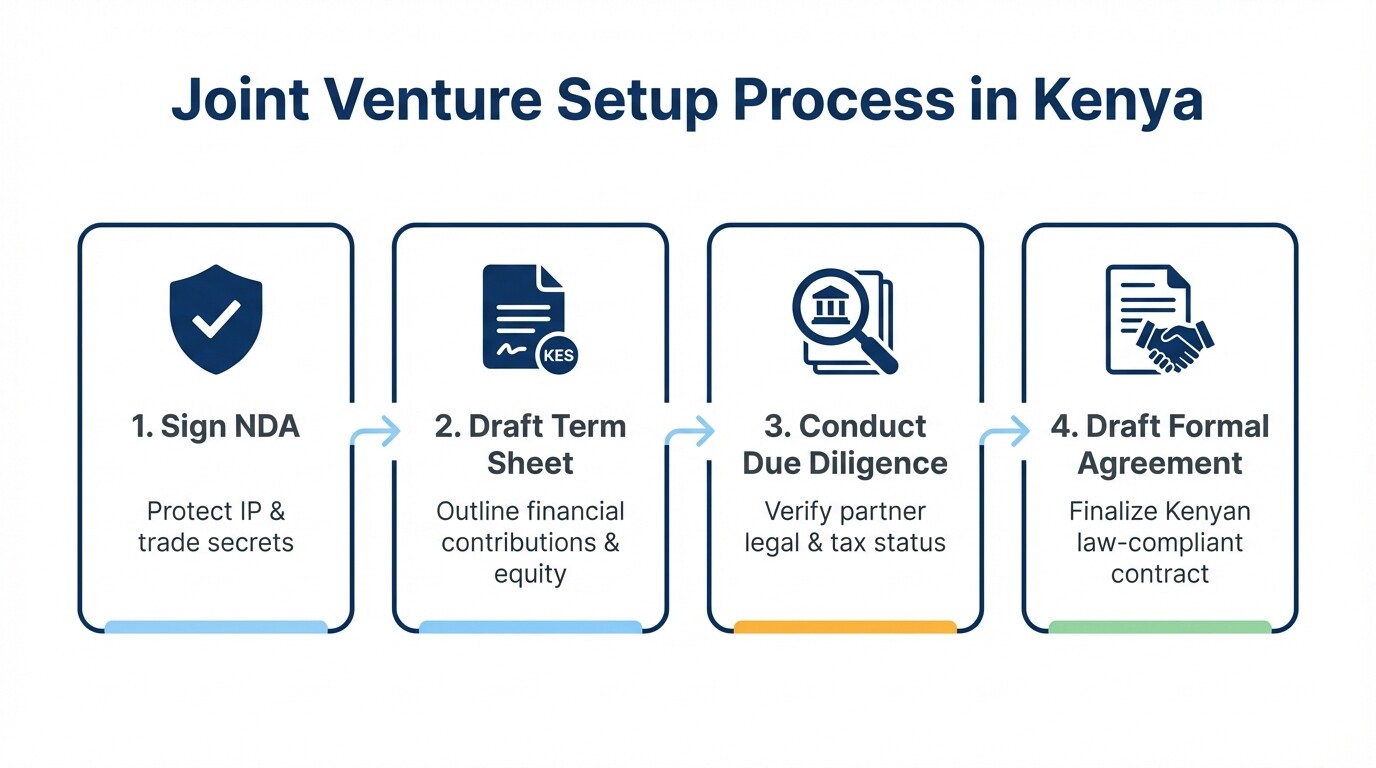
- Sign a Non-Disclosure Agreement: Protect your intellectual property and trade secrets before discussing operational details with a potential local partner.
- Draft a Term Sheet: Outline the core financial contributions, equity split, and management roles in a preliminary document to ensure both parties are aligned.
- Conduct Due Diligence: Verify the local partner's legal standing, tax compliance status, and history of litigation in Kenya.
- Draft the Formal Agreement: Work with legal counsel to draft a comprehensive joint venture agreement tailored to Kenyan corporate and regulatory frameworks.