


Negotiating Expat Employment Contracts in New Zealand
- Ensure your contract explicitly meets the mandatory minimum hours and wage thresholds required for the Accredited Employer Work Visa (AEWV).
- Negotiate clear relocation, housing allowance, and repatriation clauses to protect against unexpected out-of-pocket expenses.
- Remember that New Zealand law guarantees minimum statutory rights, including four weeks of annual leave and ten sick days, which no contract can waive.
- Carefully review non-compete and restraint of trade clauses to ensure they do not unfairly restrict your future global career mobility.
- Check that your agreement outlines a clear, local dispute resolution process for handling personal grievances under New Zealand jurisdiction.
Meeting Accredited Employer Work Visa (AEWV) Requirements
To secure an Accredited Employer Work Visa (AEWV) in New Zealand, your employment contract must meet specific immigration requirements, including guaranteed minimum hours and compliance with the median wage threshold. Immigration New Zealand will reject visa applications if the employment agreement falls short of these legal standards.
When negotiating your contract, ensure the following immigration compliance factors are clearly established:
- Guaranteed Hours: The contract must guarantee a minimum of 30 hours of work per week. "Zero-hour" contracts are not acceptable for an AEWV.
- Wage Thresholds: Your pay rate must meet or exceed the current median wage set by Immigration New Zealand, unless your role falls under a specific sector exemption.
- Accreditation Status: Verify that your prospective employer holds valid accreditation. Your contract is only valid for visa purposes if the employer is authorized to hire migrant workers.
- Payment Method: The contract must state that wages will be paid in New Zealand Dollars (NZD) directly into a local bank account.
Sample Expat Relocation and Repatriation Clauses
A comprehensive expat employment contract must explicitly detail who covers the costs of moving to New Zealand and what happens if the employment ends. Without explicit language, you may be left paying thousands of dollars out of pocket for flights, housing, and shipping.
When reviewing your contract, look for or request language similar to these standard expat provisions:
Sample Relocation Allowance Clause: "The Employer agrees to provide a one-time Relocation Allowance of $15,000 NZD to cover expenses related to the Employee's relocation to New Zealand, including but not limited to airfare, excess baggage, shipment of household goods, and temporary accommodation. This allowance will be paid upon the presentation of valid receipts. If the Employee voluntarily terminates employment within 12 months of the commencement date, the Employee agrees to repay a prorated portion of this allowance."
Sample Repatriation Clause: "Upon the termination of employment by the Employer for reasons other than serious misconduct, the Employer agrees to cover reasonable repatriation costs for the Employee and their immediate dependents to their home country. This includes economy-class return airfares and the shipment of personal effects up to standard shipping container limits, provided the relocation occurs within 60 days of the termination date."
Understanding Your Statutory Rights in New Zealand
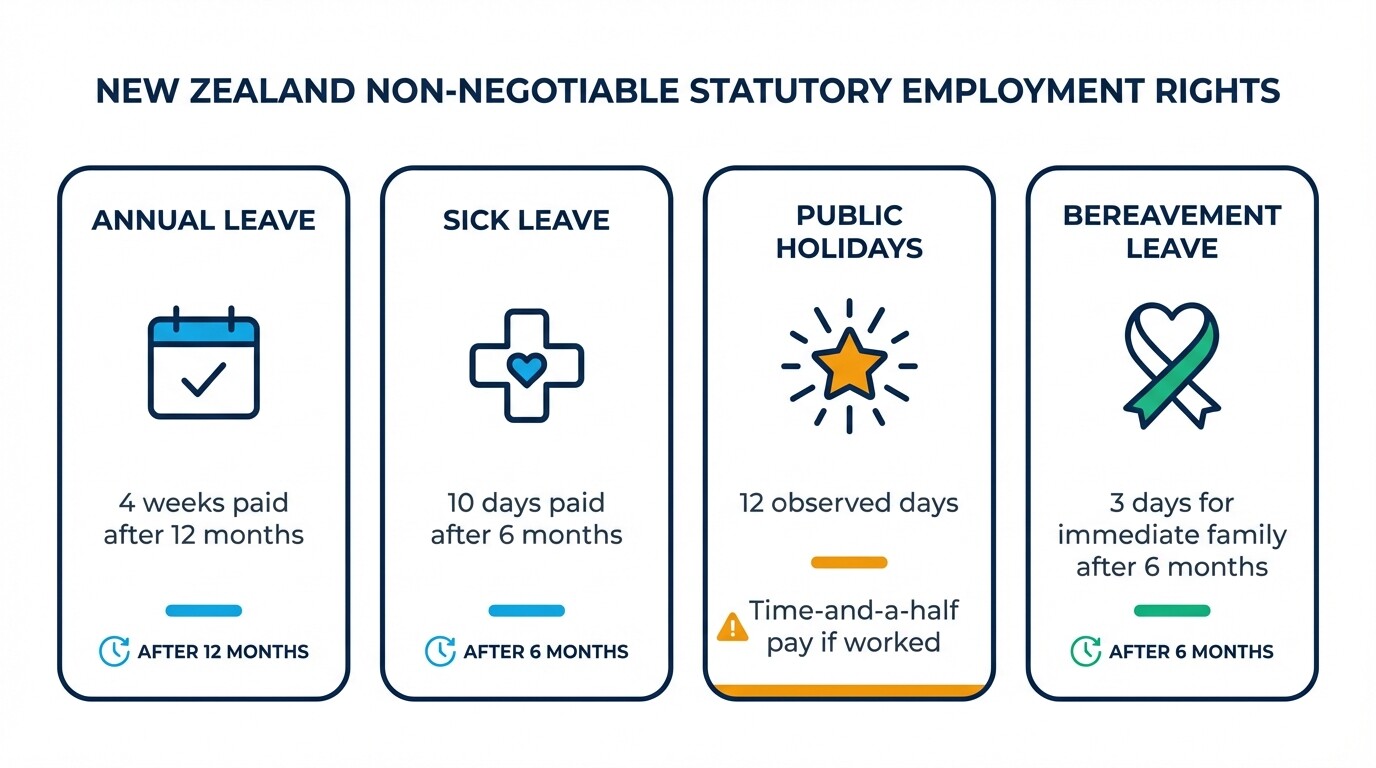
New Zealand employment law provides robust statutory protections that cannot be contracted out of, regardless of what your agreement says. As an expat, you are entitled to the exact same minimum leave, holiday, and sick pay rights as local workers.
Your contract should acknowledge these statutory minimums outlined by Employment New Zealand, which include:
- Annual Leave: All employees are entitled to a minimum of four weeks of paid annual leave after 12 months of continuous employment.
- Sick Leave: You receive 10 days of paid sick leave per year after working for six continuous months.
- Public Holidays: New Zealand observes 12 public holidays. If you are required to work on a public holiday that would otherwise be a normal working day, you must be paid time and a half and given an alternative paid day off.
- Bereavement Leave: You are entitled to up to three days of paid bereavement leave for immediate family members, available after six months of employment.
Restraint of Trade and Non-Compete Agreements
Restraint of trade and non-compete clauses in New Zealand are only enforceable if they protect a legitimate business interest and are reasonable in scope, geography, and duration. For expats, overly broad clauses can severely restrict your global mobility and ability to find future work back home or in other countries.
To protect your career mobility, carefully negotiate these aspects of a restraint clause:
- Geographical Scope: Ensure the non-compete is limited to New Zealand or the specific region where the employer operates, rather than applying globally.
- Duration: Restraints longer than three to six months are heavily scrutinized by New Zealand courts. Push for the shortest duration possible.
- Consideration: In New Zealand, a restraint of trade usually requires specific financial compensation (consideration) to be enforceable. Ensure your contract explicitly states what portion of your salary compensates you for this restriction.
- Non-Solicitation vs. Non-Compete: If possible, negotiate to replace a strict non-compete (which stops you from working for rivals) with a non-solicitation clause (which only stops you from poaching clients or staff).
Dispute Resolution and Grievance Handling
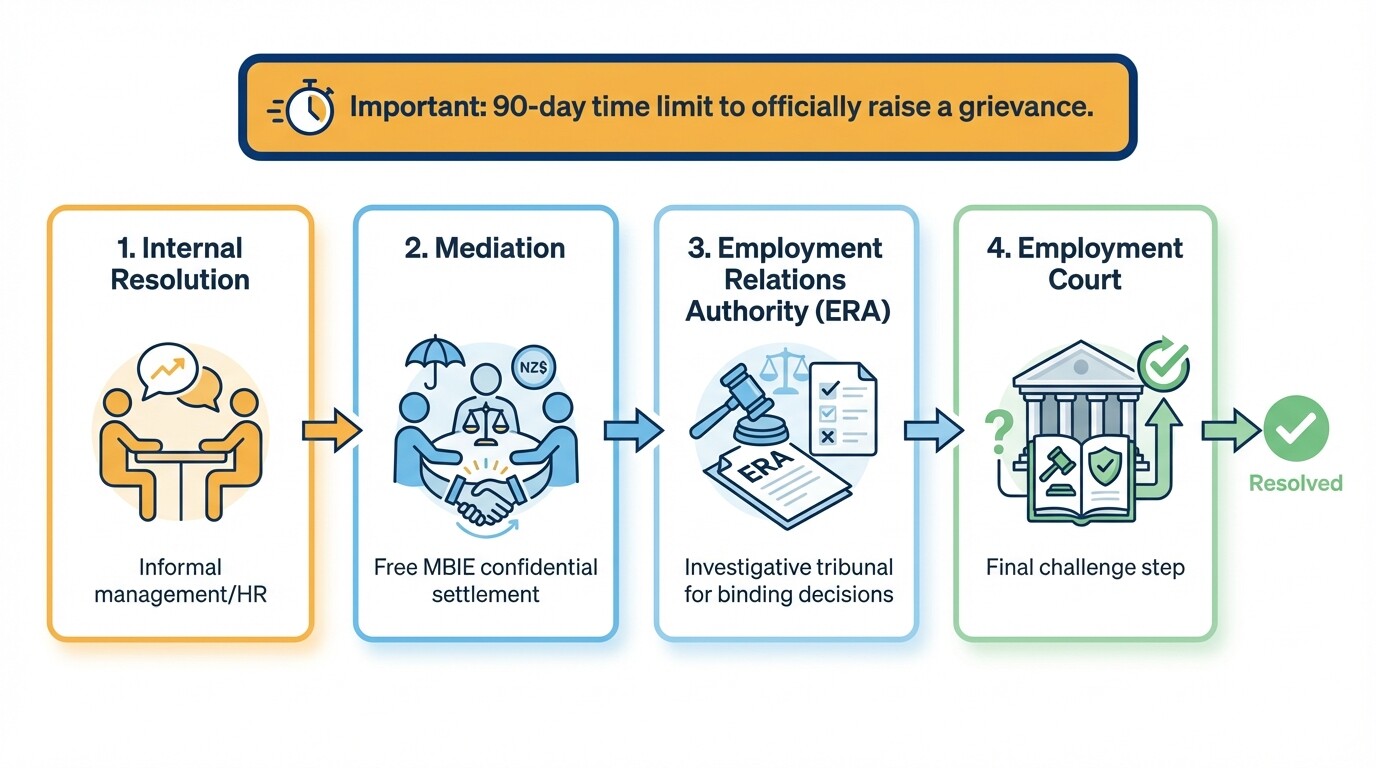
Every New Zealand employment agreement must legally include a clear process for resolving employment relationship problems, including personal grievances. You have 90 days from the date a grievance occurs to raise it officially with your employer.
A standard New Zealand employment contract will outline a dispute resolution process that involves:
- Internal Resolution: Raising the issue informally with management or human resources.
- Mediation: Using the free mediation services provided by the Ministry of Business, Innovation and Employment (MBIE) to reach a confidential settlement.
- Employment Relations Authority (ERA): If mediation fails, the ERA acts as an investigative tribunal to make binding legal decisions on the dispute.
- Employment Court: As a final step, ERA decisions can be challenged in the Employment Court.
Common Misconceptions About NZ Employment Contracts
Expats often assume their home country's labor laws still apply or misunderstand the protections offered under New Zealand law. Clearing up these myths ensures you negotiate from a position of factual strength.
- Misconception: Employers can fire you "at will." Unlike in the United States, "at-will" employment does not exist in New Zealand. Employers must have a legally justified reason (such as redundancy or serious misconduct) and follow a strict, fair process before terminating employment.
- Misconception: A 90-day trial period applies to everyone. A 90-day trial period, where you can be dismissed without grounds for a personal grievance, is only valid if explicitly agreed to in writing before you start work. Depending on current legislation, it may also be restricted to businesses with fewer than 20 employees.
- Misconception: Visa cancellation means immediate deportation. If your employment ends, your AEWV does not mean you must leave the country the next day. You typically have a grace period to find a new accredited employer and apply for a visa transfer or a new visa.
Frequently Asked Questions
Can my employer make me pay for my own visa costs?
Yes, employers can require you to cover the cost of your specific visa application. However, they cannot legally charge you for the costs associated with their employer accreditation or the Job Check process.
What happens to my relocation allowance if I get fired?
If you are dismissed by your employer (other than for serious misconduct), you generally do not have to repay your relocation allowance. However, repayment terms for voluntary resignation or termination for cause should be explicitly detailed in your contract.
Can an employer pay me in my home currency?
No. To meet AEWV requirements and comply with New Zealand tax laws, your salary must be paid in New Zealand Dollars (NZD) into a New Zealand bank account.
Do I get paid out for unused annual leave if I leave New Zealand?
Yes. Under New Zealand law, any accrued but unused annual leave must be paid out in full in your final paycheck when your employment ends.
When to Hire an Employment Lawyer
Engaging an employment lawyer is crucial before signing any cross-border employment agreement, especially when your visa status is tied directly to your job. Legal counsel ensures your contract protects both your career and your immigration status.
You should consult a legal professional if your contract contains restrictive global non-compete clauses, lacks clear repatriation terms, or includes complex bonus and equity structures that cross tax jurisdictions. Finding experienced contract lawyers in New Zealand can help you align the agreement with both local labor standards and your international career goals.
Next Steps
- Request a draft of your employment agreement and read it alongside the current AEWV requirements to ensure the salary and hours comply.
- Identify missing expat provisions, particularly regarding relocation allowances, temporary housing, and repatriation flights.
- Draft a list of counter-proposals focusing on minimizing the geographical scope of restraint of trade clauses.
- Have a New Zealand-based employment lawyer review the contract to confirm it meets all statutory minimums before you sign and finalize your visa application.